“Party in the U.S.A.” Lyrics Meaning: Miley Cyrus’ Song About Anxiety, Music and Finding Confidence in a New Place
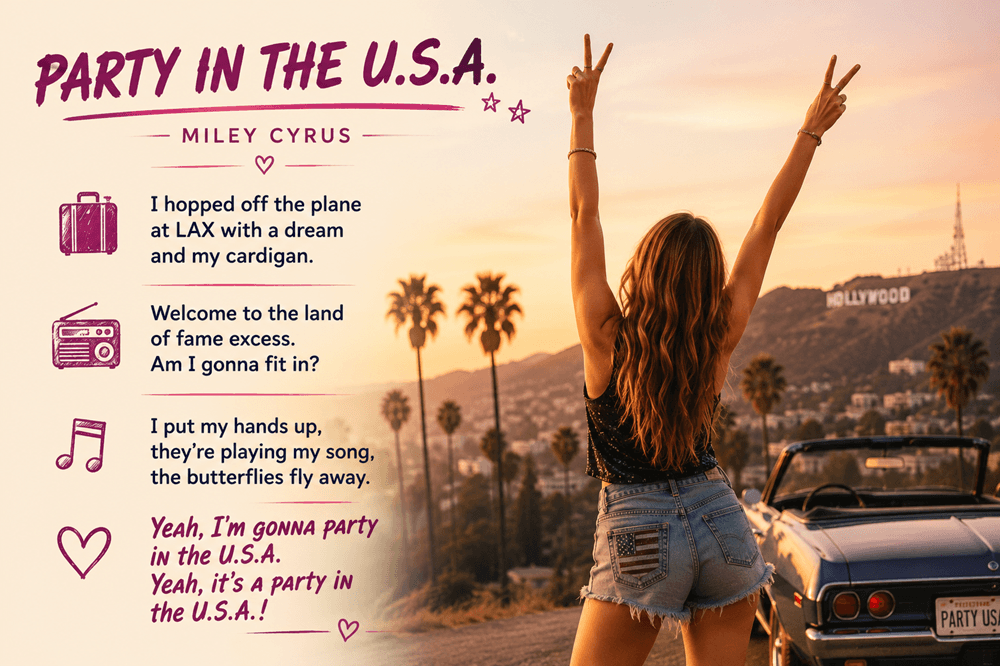
Miley Cyrus’ “Party in the U.S.A.” is about arriving in Los Angeles, feeling overwhelmed and gradually finding the confidence to enjoy an unfamiliar environment.
The narrator enters a city associated with fame, glamour and entertainment, but she does not initially feel as though she belongs there. She is homesick, nervous and surrounded by people who appear more confident than she feels.
A familiar song changes her mood.
Music gives her something recognizable inside a strange environment. Her anxiety decreases, her body relaxes and the intimidating city begins to feel more welcoming.
The song’s central meaning is:
A familiar piece of music can transform anxiety into confidence and make an unfamiliar place feel temporarily like home.
Despite its title, “Party in the U.S.A.” is not mainly a political or patriotic song. It is a coming-of-age story about culture shock, self-consciousness and using music to overcome the fear of not fitting in.
Listeners can hear the complete recording through Miley Cyrus’ official music video. The video was directed by Chris Applebaum and released in September 2009.
What is “Party in the U.S.A.” about?
“Party in the U.S.A.” follows a young woman traveling from Nashville to Los Angeles.
She expects Los Angeles to be exciting, but her first emotional response is discomfort. The city feels larger, more glamorous and more socially demanding than the place she left.
She notices celebrities, fashionable people and the pressure of being in an entertainment capital. Instead of feeling thrilled, she becomes tense and homesick.
The story changes when music begins playing during her journey.
The song on the radio reminds her of something familiar. It gives her a rhythm to follow and creates a private emotional space inside the overwhelming city.
By the chorus, she is no longer focused entirely on whether strangers approve of her. She begins participating in the moment.
The song therefore moves through three emotional stages:
- Arrival: She enters a new environment.
- Anxiety: She worries that she does not belong.
- Release: Familiar music helps her regain confidence.
The “party” is not only an event happening around her. It is the emotional shift that occurs inside her.
What does the title “Party in the U.S.A.” mean?
The title describes a feeling of collective celebration.
The narrator begins as an outsider observing Los Angeles. By the chorus, she feels connected to the people and music around her.
The phrase “in the U.S.A.” gives the moment a broad, national scale. Instead of describing one private car ride or one Los Angeles party, the title turns the experience into something that can be shared by listeners across the country.
However, the song is not presenting a detailed statement about American history, government or national identity.
“U.S.A.” functions more as a pop-cultural setting.
The country represents:
- A place of possibility
- Celebrity culture
- Popular music
- Reinvention
- Youthful ambition
- Large-scale entertainment
- The freedom to become someone new
The narrator is nervous because she has entered a world where transformation seems possible. The same possibility that excites her also makes her feel exposed.
Is “Party in the U.S.A.” a patriotic song?
It has become a patriotic celebration song, but that was not its original narrative purpose.
The lyrics focus on a nervous traveler arriving in Los Angeles. There are no references to government, military history, national policy or traditional patriotic symbols.
The song became associated with national celebrations because of its title, energetic chorus and repeated references to the United States.
It is now commonly played during:
- Independence Day celebrations
- Sporting events
- Election-night gatherings
- School dances
- National-team victories
- Holiday weekends
- Public festivals
- American-themed parties
The song works in those settings because the chorus is simple, communal and easy for a crowd to sing.
Its cultural use eventually became larger than the personal story in the verses.
Why does the narrator feel nervous in Los Angeles?
Los Angeles represents ambition and comparison.
The narrator has arrived in a city filled with people who appear to understand its unwritten social rules. They know how to dress, behave and move through celebrity culture.
She feels visibly inexperienced.
Her anxiety comes from several pressures:
- She is far from home.
- She is entering a highly competitive city.
- She believes other people look more fashionable.
- She is uncertain whether she belongs in the entertainment world.
- She feels watched and judged.
- She has not yet developed a stable identity in this environment.
This type of anxiety is common when someone moves to a new city, begins college, enters a new workplace or attends an unfamiliar social event.
Other people may appear naturally confident because the newcomer cannot see their private uncertainty.
The narrator assumes everyone else fits in.
The song gradually shows that fitting in may begin when she stops studying the crowd and allows herself to respond naturally to the music.
What does the trip from Nashville to Los Angeles symbolize?
The journey represents movement from familiarity into ambition.
Nashville is associated with the narrator’s home, existing identity and country-music background. Los Angeles represents film, pop music, celebrity and a larger entertainment industry.
Traveling between the cities therefore suggests more than a physical flight.
The narrator is crossing from one version of herself into another.
She is leaving behind:
- Familiar routines
- Family and friends
- A regional identity
- A less intimidating social environment
- The comfort of knowing how she is perceived
She is moving toward:
- Greater independence
- Career opportunity
- Public attention
- Reinvention
- Uncertainty
- Pressure to perform
This makes “Party in the U.S.A.” a coming-of-age song.
The narrator wants the opportunities associated with Los Angeles, but she has not yet become comfortable with the person those opportunities may require her to be.
Why does she feel homesick?
Homesickness often appears when excitement and uncertainty arrive together.
A person may choose to leave home and still miss it immediately. Wanting a new life does not erase attachment to the old one.
The narrator’s homesickness suggests that Los Angeles is not automatically glamorous from the perspective of someone experiencing it alone.
She may miss:
- People who already understand her
- Familiar accents and behavior
- Places where she does not need to impress anyone
- A quieter pace
- Her established reputation
- The ability to feel ordinary
In Los Angeles, she is surrounded by possibility but has not yet created belonging.
The song does not treat homesickness as weakness.
It presents it as a natural response to entering a place where the narrator’s old identity offers less protection.
What does the Hollywood sign represent?
The Hollywood sign represents the dream of fame.
For visitors, it can symbolize movies, celebrity, wealth and the possibility of being discovered. For someone trying to build a career, however, it can also represent competition and impossible expectations.
The narrator sees the sign while feeling anxious, so it does not appear only as an inspiring landmark.
It reminds her that she has entered a city where people arrive with enormous ambitions.
The sign can represent questions such as:
- Am I talented enough?
- Do I look as though I belong here?
- Will anyone take me seriously?
- Can I compete with everyone else?
- What happens if I fail?
- Will success change me?
The landmark is visually impressive, but the narrator’s emotional reaction reveals the pressure beneath the fantasy.
Why does music calm her down?
Music gives the narrator familiarity, rhythm and temporary control.
She cannot control the city, the people around her or how they judge her. She can control how she responds to a song she recognizes.
Hearing familiar music helps because it:
- Connects her with earlier memories
- Gives her body something predictable to follow
- Distracts her from self-conscious thoughts
- Creates a sense of belonging
- Reminds her that she has an identity beyond the current situation
- Turns passive anxiety into physical movement
The city initially feels like a test.
Music transforms it into an experience.
Instead of asking whether she looks correct or belongs socially, she begins moving with the song. That physical response interrupts the cycle of nervous thoughts.
The moment reflects why music is often used during travel, exercise, celebrations and stressful situations. A familiar recording can make an unfamiliar environment feel emotionally manageable.
What do the Jay-Z and Britney Spears references mean?
The two artists represent widely recognizable American pop culture.
Jay-Z symbolizes confidence, status and hip-hop culture. Britney Spears represents mainstream pop, celebrity and the kind of instantly familiar music capable of filling a public space.
The narrator’s mood improves when she hears music associated with major American stars. Their songs become cultural landmarks, much like the Hollywood sign.
The references also support the song’s larger contrast.
The narrator feels small and uncertain, while the artists on the radio sound established and confident.
By moving along with their music, she temporarily borrows some of that confidence.
Interestingly, Cyrus later said she had not written “Party in the U.S.A.” and did not know which Jay-Z recording the songwriters had imagined. She explained that the track was not originally representative of her own musical taste, although she was grateful for its success.
Did Miley Cyrus write “Party in the U.S.A.”?
No.
The song was written by Jessie J, Claude Kelly and producer Dr. Luke.
Jessie J was still developing her own recording career at the time and had already begun writing songs for other performers. “Party in the U.S.A.” became one of her most commercially successful songwriting credits.
Cyrus’ lack of a writing credit is relevant because the song’s narrator is often assumed to be a direct representation of her personal thoughts.
The performance fits parts of Cyrus’ public story—a Tennessee teenager entering the larger entertainment industry—but the original concept did not begin with her.
The songwriters reshaped an earlier idea to suit her image and background.
Was the song originally written for Jessie J?
Yes.
Claude Kelly explained that the original version was written from the perspective of a British woman moving from London to Los Angeles.
That early version focused more directly on cultural differences between Britain and the United States. The traveler noticed unfamiliar driving customs, American stores and other details that would surprise someone arriving from London.
After the song was not used for Jessie J, its writers changed the narrator’s journey.
London became Nashville, and the culture-shock story was adapted for Cyrus.
Kelly said the revised song was then connected to Cyrus’ work with Walmart during her Hannah Montana era. He initially viewed it as a relatively small promotional release rather than an obvious global hit.
This history explains why some details do not perfectly match Cyrus’ personal musical preferences.
The song was shaped through several creative stages before becoming associated with her.
Why was Nashville chosen?
Nashville connected the rewritten story to Cyrus’ Tennessee background.
Cyrus was born in Franklin, Tennessee, near Nashville, and was strongly associated with country music through her family and her father, Billy Ray Cyrus.
Changing the starting point from London to Nashville made the narrator feel more connected to Cyrus’ public identity.
The new journey also created a useful contrast.
Nashville and Los Angeles are both entertainment centers, but they represent different musical and cultural traditions.
Nashville suggests:
- Country music
- Southern identity
- Family roots
- Songwriting traditions
- A more familiar home environment
Los Angeles suggests:
- Film and television
- Mainstream pop
- Celebrity culture
- Reinvention
- National and international visibility
The narrator is not leaving music behind. She is entering a different version of the entertainment industry.
Did Miley Cyrus like the song?
Cyrus initially had a complicated relationship with it.
In a 2009 interview, she said the recording was not closely aligned with the music she personally listened to and that she had not expected it to become so successful.
She also explained that she needed material connected to a clothing-line promotion and selected the song for that project.
Her early distance from the track is understandable.
She was a young performer attempting to establish an identity beyond Hannah Montana. A highly polished pop song written by other people could feel less personal than music she had helped create.
Over time, however, “Party in the U.S.A.” became inseparable from her career.
Cyrus has continued performing it and has acknowledged the energy it creates for audiences. In 2025, she recalled recording it while filming The Last Song during the week Michael Jackson died, describing the emotional atmosphere around the upbeat session as unusually strange.
Why is the song connected to Miley Cyrus’ transition from Disney?
“Party in the U.S.A.” arrived while Cyrus was becoming known as a performer separate from Hannah Montana.
The Disney series had made her famous, but the character created a complicated public identity. Many younger fans knew Cyrus primarily through a fictional pop star with a blonde wig.
Her solo career needed to establish that she could succeed under her own name.
The song helped because it presented Cyrus as:
- A teenager leaving home
- A performer entering adult spaces
- Someone confronting public pressure
- A young woman building confidence
- A recognizable pop artist outside the television character
The track appeared on her 2009 EP The Time of Our Lives. The Recording Academy identifies it as a major part of her early solo career and notes that it reached No. 2 on the Billboard Hot 100.
The song remained family-friendly, but it also suggested movement toward greater independence.
What does the chorus mean?
The chorus captures the moment when anxiety becomes release.
Before the music begins, the narrator is highly conscious of how she appears. She compares herself with strangers and worries that she has entered a world designed for someone else.
Once the song affects her, those thoughts temporarily lose their power.
Her physical movements signal emotional change:
- Her posture relaxes.
- She begins following the rhythm.
- She stops observing herself from the outside.
- She feels connected to the people around her.
- The city becomes less threatening.
The chorus does not prove that every insecurity has permanently disappeared.
It shows that confidence can begin through participation.
She does not wait until she feels completely comfortable before joining the moment. Joining the moment helps create comfort.
What does raising her hands symbolize?
The gesture represents surrendering to the music and allowing herself to become visible.
Earlier, the narrator wants to disappear because she feels socially out of place. Raising her hands is the opposite response.
She occupies space.
The movement suggests:
- Confidence
- Celebration
- Emotional release
- Participation
- Connection with a crowd
- Freedom from self-consciousness
It is also a common concert gesture.
Audience members raise their hands when they feel united by a performance. The act turns individual listening into collective experience.
In the song, this physical openness marks the moment when the narrator stops behaving like an outsider.
Why does nodding along matter?
The narrator’s small physical response shows that confidence develops gradually.
She does not instantly become the loudest person in the city. She begins with a familiar movement.
That matters because overcoming anxiety rarely requires one dramatic transformation.
A person may begin by:
- Smiling
- Moving with the music
- Speaking to one stranger
- Entering a room
- Accepting an invitation
- Staying rather than leaving early
The narrator’s movement is simple, but it breaks her emotional isolation.
She has begun responding to the environment rather than only fearing it.
Is the narrator actually at a party?
Not necessarily during the entire song.
Much of the story appears to occur while she is traveling through Los Angeles. The “party” may describe her changing emotional state rather than one specific event.
Later references suggest she enters a club or social environment, but the title’s meaning is broader.
The narrator creates a party by allowing music to change the experience.
This interpretation helps explain the song’s wide usefulness.
Listeners do not need to be at a literal party. They can play it:
- In a car
- At home
- During a workout
- At a stadium
- During a holiday
- While preparing to go out
- After receiving good news
The song converts an ordinary setting into a shared celebration.
Why does she still feel nervous at the club?
The narrator’s confidence is not permanent.
Even after feeling better in the car, she becomes anxious again when entering a more demanding social environment.
This is realistic.
Confidence does not usually develop in a straight line. Someone may feel comfortable for several minutes and then become self-conscious again when the situation changes.
A club creates new pressures:
- People are watching one another.
- Clothing becomes part of social comparison.
- The narrator may not know anyone.
- She feels physically far from home.
- The environment is louder and less predictable.
Once again, music helps her regulate the anxiety.
The repeated pattern suggests that songs can become emotional anchors. Each time uncertainty returns, familiar music gives her a way back into the moment.
Does “Party in the U.S.A.” promote celebrity culture?
The song is fascinated by celebrity culture, but it also shows how intimidating that culture can be.
The narrator notices famous people and fashionable surroundings because she believes they establish the standard she must meet.
Los Angeles appears exciting, yet its glamour creates pressure.
The song therefore communicates two attitudes at once:
Attraction
The narrator wants to experience the city, music and opportunities.
Intimidation
She worries that she lacks the appearance or confidence required to belong.
This tension is common in stories about fame.
Public success appears desirable from a distance, but entering that world can create intense comparison and insecurity.
What does the music video mean?
The official video places Cyrus in a dusty drive-in setting filled with American imagery, cars, flags and dancing.
Rather than recreating the nervous arrival in Los Angeles literally, it emphasizes the celebratory side of the song.
Cyrus performs with confidence while surrounded by a crowd, transforming the uncertain narrator into the leader of the gathering.
The drive-in atmosphere evokes an idealized version of American youth culture:
- Classic vehicles
- Open space
- Outdoor dancing
- Casual clothing
- Large groups of friends
- Summer-night freedom
The video was directed by Chris Applebaum and produced by John Hardin.
Its visual confidence helped turn the track from a story about anxiety into a full pop anthem.
Why does the video use a drive-in setting?
The drive-in combines nostalgia with youth culture.
Drive-in theaters are associated with an earlier period of American entertainment, particularly teenage freedom, cars and outdoor social life.
Using this setting gives the video a broader national identity.
The song could have been filmed in a modern Los Angeles nightclub, but that would have connected it too closely with one city and one social scene.
The drive-in makes the celebration feel more accessible.
It is not a private celebrity party.
It is a large outdoor gathering where the song itself creates the event.
How successful was “Party in the U.S.A.”?
The song became one of Cyrus’ biggest early hits.
It debuted and peaked at No. 2 on the Billboard Hot 100, establishing Cyrus as a major pop artist outside her television work. The Recording Academy includes the track among the defining releases of her early career.
In the United Kingdom, it reached No. 11 on the Official Singles Chart and remained in the Top 40 for 15 weeks during its original run. Its complete British chart history is available through the Official Charts archive.
The song was later certified Diamond in the United States, representing at least 10 million certified units.
Its long-term success exceeded the expectations of both Cyrus and its writers.
Why did the song become an unofficial American anthem?
The title gave audiences an obvious phrase for public celebration.
However, the song’s emotional structure also contributed to its anthem-like reputation.
It begins with uncertainty and ends in confidence.
That movement can be applied to many shared moments:
- A team overcoming pressure
- A crowd celebrating a result
- People gathering for a national holiday
- A newcomer feeling accepted
- A public event becoming joyful
- A difficult period giving way to relief
Claude Kelly described the track’s growth as largely driven by listeners. He recalled seeing people discuss it online before “viral” success had become a standard industry expectation and credited the public with turning it into something resembling a national anthem.
Why is it played on the Fourth of July?
The title makes the song an easy choice for Independence Day playlists.
Its bright production, familiar chorus and references to American pop culture suit fireworks, outdoor gatherings and summer parties.
The lyrical story does not concern the founding of the country, but listeners often respond more strongly to the celebratory phrase in the title than to the narrative details.
A song can acquire cultural meanings its writers did not originally intend.
“Party in the U.S.A.” now functions as:
- A travel song
- A party song
- A patriotic pop song
- A confidence anthem
- A nostalgic 2000s hit
- A communal singalong
Its flexibility has allowed it to remain useful in different settings.
Why does the song return during major public events?
The chorus can express large-scale excitement without requiring a detailed political message.
After Joe Biden was projected to win the 2020 U.S. presidential election, videos circulated of people using the song during public celebrations. Cyrus responded enthusiastically to its renewed cultural role.
The song has also been adapted during live performances to comment on current events. Cyrus has occasionally changed small portions to support causes or reflect the moment, including public support for Britney Spears during the conservatorship debate.
These uses demonstrate that audiences now treat the track as a flexible public anthem rather than only a 2009 teen-pop single.
Why does the production feel so uplifting?
The production creates immediate forward motion.
A bright guitar figure, steady beat and highly repetitive chorus make the song easy to recognize and sing.
The arrangement mirrors the narrator’s emotional change.
The verses leave space for nervous observations. The chorus becomes wider and more confident, making the listener experience the release rather than merely hearing about it.
Several production choices contribute to the uplifting effect:
Repetition
The central musical ideas return frequently, making the song feel familiar even during a first listen.
A steady rhythm
The beat gives the listener a predictable physical pattern.
A rising chorus
The vocal and instrumental energy expands when the narrator becomes more confident.
Simple imagery
The song avoids complicated explanations, allowing audiences to understand the emotional journey immediately.
A communal hook
The chorus sounds designed for a group rather than one private singer.
The production turns personal anxiety into something a crowd can celebrate together.
Why do people feel nostalgic when hearing it?
“Party in the U.S.A.” is closely associated with late-2000s pop culture.
For many listeners, it recalls:
- Disney Channel stars
- Early social media
- School dances
- Childhood road trips
- Radio countdowns
- Teen magazines
- The beginning of Cyrus’ adult career
- A period when pop music felt especially bright and direct
Nostalgia does not depend entirely on the song’s meaning.
A recording becomes connected to where people heard it, who they were with and what stage of life they were experiencing.
Because the song remained popular for years, different generations may attach it to different memories.
One listener may remember hearing it as a child in 2009.
Another may associate it with a sporting event, political celebration or viral video much later.
Is the song about overcoming social anxiety?
It can be interpreted that way.
The narrator experiences many recognizable signs of social anxiety:
- Physical nervousness
- Fear of not fitting in
- Comparison with strangers
- Concern about clothing
- Homesickness
- A desire to escape
- Increased anxiety in a crowded social setting
Music does not permanently cure those feelings, but it provides a coping mechanism.
The narrator redirects attention from imagined judgment toward rhythm and movement.
This does not mean everyone experiencing serious anxiety can solve it by playing a song.
The track offers a smaller and more relatable idea: familiar music can help someone remain present during an uncomfortable transition.
Is the song really about belonging?
Yes.
The narrator’s deepest concern is not whether the city is objectively exciting. She wants to know whether there is a place for her inside it.
At first, belonging appears to require looking and behaving like everyone else.
By the end, she discovers a different route.
Music allows her to belong through shared feeling.
She does not need to know every person in the room. She only needs one recognizable song connecting her movement with theirs.
The song suggests that belonging can begin before complete familiarity.
A person may still be new, nervous and uncertain while taking the first step toward feeling at home.
What can listeners learn from the song?
“Party in the U.S.A.” offers a simple but useful perspective on entering unfamiliar situations.
Its story suggests:
- Feeling nervous does not mean you made the wrong decision.
- Other people may be less confident than they appear.
- Familiar routines can provide stability during change.
- Participation can create confidence.
- Homesickness and excitement can coexist.
- You do not need to understand an entire environment immediately.
- One small source of comfort can make a new place manageable.
The narrator does not conquer Los Angeles through status or perfect clothing.
She begins feeling comfortable through an ordinary human response to music.
Is “Party in the U.S.A.” still relevant?
The song remains relevant because people continue moving into unfamiliar environments.
The details may involve Los Angeles and celebrity culture, but the emotional experience applies to:
- Beginning college
- Moving abroad
- Attending a new school
- Starting a job
- Traveling alone
- Entering a crowded event
- Pursuing a creative career
- Leaving a hometown
In each case, the person may wonder whether they belong.
The song’s answer is not that confidence must exist before the journey begins.
Confidence can emerge during the experience.
Final meaning
“Party in the U.S.A.” is about a young woman arriving in Los Angeles and feeling overwhelmed by the city’s glamour, social pressure and unfamiliarity.
She misses home and worries that everyone around her appears more comfortable than she is.
A familiar song changes the experience.
Music interrupts her anxious thoughts, reconnects her with a recognizable part of herself and gives her the confidence to participate rather than withdraw.
The Nashville-to-Los Angeles journey represents a larger transition from familiarity into ambition. The Hollywood imagery represents both opportunity and pressure. The references to famous musicians show how shared pop culture can create an immediate sense of connection.
Although the title caused the song to become an unofficial patriotic anthem, its emotional story is more personal.
It is about entering a place where you feel like an outsider and discovering one thing that helps you remain.
The city does not suddenly become less intimidating.
The narrator simply stops allowing intimidation to control the entire experience.
That is the meaning of “Party in the U.S.A.”:
Sometimes belonging begins with nothing more complicated than recognizing the music, moving with it and deciding not to leave.