“We Are Charlie Kirk” Lyrics Meaning: How Spalexma’s AI Tribute Became a Viral Internet Meme
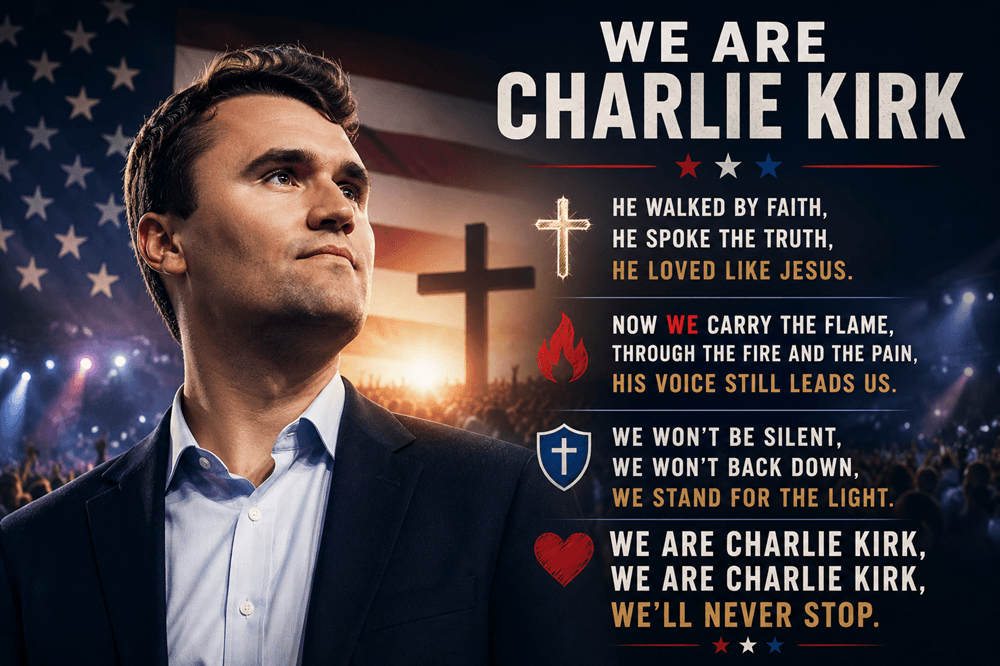
Spalexma’s “We Are Charlie Kirk” is a tribute song that presents conservative activist Charlie Kirk as a courageous Christian leader whose followers must continue his religious and political mission after his death.
The narrator does not speak as one individual. Instead, the chorus uses the word “we,” transforming Kirk’s name into a collective identity. Supporters are encouraged to see themselves as inheritors of his faith, convictions and willingness to speak publicly.
The song’s central message is:
Charlie Kirk may be gone, but his supporters believe his ideas can remain alive through the people who continue defending them.
The track was released on September 16, 2025, six days after Kirk was assassinated during an event at Utah Valley University. It is credited to Spalexma, with Sargis Poghosyan listed as songwriter, composer and producer on the official YouTube release.
However, the song did not remain only a sincere memorial.
Its dramatic production, repetitive chorus and widely reported use of artificial intelligence made it a target of online parody. Supporters used it in emotional tribute videos, while critics and meme creators attached it to absurd face swaps, unrelated film scenes and deliberately ironic posts.
That double life made “We Are Charlie Kirk” much more culturally visible than an ordinary political tribute song.
Listeners can hear the original recording through Spalexma’s official YouTube upload or its Deezer release page.
What is “We Are Charlie Kirk” about?
“We Are Charlie Kirk” is about continuing a public figure’s mission after his death.
The song portrays Kirk as someone who remained firm during hostility, spoke openly despite personal risk and built his life around Christianity. It then shifts responsibility from Kirk to the people listening.
His followers are asked to:
- Continue speaking about their faith
- Defend the values they associate with him
- Remain united during opposition
- Treat his death as motivation rather than defeat
- Carry his message into the future
- Present Christianity publicly and confidently
The song does not spend much time describing grief in a private or reflective way. It quickly converts grief into action.
Kirk is remembered not only as a person but as the beginning of a larger movement. The listeners are told that his courage now belongs to them.
What does the title “We Are Charlie Kirk” mean?
The title is not meant literally.
The people singing are not claiming to become Charlie Kirk as individuals. They are declaring that his identity has become symbolic.
In this context, “We are Charlie Kirk” means:
- We share his beliefs.
- We intend to continue his work.
- Silencing one person will not silence the larger movement.
- His public identity now belongs to the community he inspired.
- His death has strengthened rather than ended the cause.
This type of language often appears after the death or persecution of a public figure. A person’s name becomes shorthand for a principle, movement or collective grievance.
The title therefore turns an individual into a group identity.
That transformation is emotionally powerful for supporters because it removes the finality of death. Kirk’s physical voice may be absent, but thousands of people can claim to speak in his place.
It can also be politically powerful. Identifying with a fallen leader creates loyalty and encourages followers to treat criticism of the figure as criticism of themselves.
What does “carry the flame” symbolize?
The flame represents a belief or mission that can be transferred from one person to another.
Kirk is presented as someone who carried that flame during his lifetime. After his death, the song asks supporters to prevent it from going out.
The image can symbolize:
- Christian faith
- Conservative political activism
- Public courage
- Opposition to cultural change
- Loyalty to Kirk’s organization and supporters
- A willingness to continue speaking despite criticism
Fire can provide light, warmth and direction, but it can also suggest conflict and intensity.
That dual meaning fits the song. The flame is both comforting and militant. It represents spiritual guidance while also preparing listeners for an ongoing battle.
The metaphor allows the tribute to move beyond memory. Remembering Kirk is not enough. The listener must actively protect and spread what the song says he represented.
Why does the song focus so strongly on Christianity?
The lyrics present Christianity as the foundation of Kirk’s identity and legacy.
Rather than portraying him mainly as a political organizer, media personality or founder of Turning Point USA, the song emphasizes his relationship with Jesus, Scripture, the Gospel and the Cross.
This framing serves several purposes.
It gives his life a spiritual meaning
His activism is presented as more than political work. It becomes part of a religious mission.
It interprets opposition as persecution
Criticism of Kirk can be understood not merely as political disagreement but as hostility toward Christian truth.
It offers reassurance after death
The religious language suggests that death is not a final defeat and that Kirk’s life continues within a larger divine story.
It creates a duty for supporters
Followers are not simply asked to preserve a political organization. They are encouraged to continue what the song describes as Christian witness.
The result is closer to a worship-influenced memorial anthem than a conventional political campaign song.
Does the song portray Charlie Kirk as a martyr?
Yes, although it does not always use that exact word.
The lyrics repeatedly connect courage, faith, danger and death. Kirk is presented as a person who knew that speaking publicly carried a cost but refused to become silent.
That structure closely resembles martyr narratives.
A martyr is remembered not only because they died, but because their death is interpreted as proof of commitment to a belief.
The song suggests:
- Kirk possessed an important truth.
- Powerful or hostile forces opposed him.
- He continued speaking despite the danger.
- His death demonstrated the sincerity of his convictions.
- Followers must now continue the struggle.
This interpretation is meaningful to supporters who viewed Kirk primarily through his Christian faith and conservative activism.
However, it is important to recognize that this is the song’s perspective, not a neutral biography.
Kirk was a deeply polarizing political figure. Admirers saw him as a fearless defender of faith and free speech, while critics strongly opposed many of his statements and political campaigns. The song removes that complexity and presents an entirely reverential image.
What does the song say about truth?
“Truth” is treated as something fixed, eternal and closely connected to Christianity.
The song does not portray truth as something people reach through debate, evidence or compromise. It presents truth as already known and under attack.
That creates a clear moral structure:
- Kirk and his followers stand with truth.
- Their opponents represent darkness or attempted silencing.
- Continuing the mission is morally necessary.
- Compromise may appear equivalent to surrender.
This structure is common in movement anthems because it creates certainty.
Political life is normally complicated. People disagree about facts, values, policies and consequences. A song must compress that complexity into an emotional message that can be remembered and repeated.
“We Are Charlie Kirk” achieves that by dividing the world into truth and darkness.
For supporters, this can feel inspiring.
For critics, it may sound self-righteous because it assumes one political and religious community has exclusive possession of truth.
What does the spiritual battle represent?
The song describes an ongoing battle between light and darkness.
This battle can be interpreted in several ways:
- Christianity against secular culture
- Conservatives against political opponents
- Free expression against censorship
- Traditional values against social change
- Courage against fear
- Good against evil
The language deliberately allows these ideas to overlap.
Political disagreements become part of a spiritual struggle. This raises the emotional stakes because ordinary compromise can begin to seem morally dangerous.
If an opponent is merely mistaken, discussion may be possible.
If an opponent represents darkness, resistance becomes a religious duty.
The song’s dramatic language therefore does more than honor Kirk. It gives his followers a framework for interpreting future conflict.
Why does the song mention Kirk as a husband and father?
The family references make Kirk appear more personal and morally complete.
Public figures can become abstract symbols. By mentioning his roles within his family, the song reminds listeners that his death affected people who knew him privately.
The image of a devoted husband and father also supports the song’s religious message.
Family becomes evidence of:
- Personal responsibility
- Christian commitment
- Traditional values
- Private character
- A life larger than politics
These references encourage listeners to grieve both the public activist and the family man.
They also strengthen the martyr-like presentation. The song emphasizes that he had meaningful personal relationships and much to lose, yet supposedly continued speaking without fear.
Is “We Are Charlie Kirk” an AI-generated song?
The track is widely reported as AI-generated, although the release itself does not provide a detailed public explanation of how it was made.
Spalexma has little visible public identity beyond music credited to SP Music Project. The YouTube and streaming credits name Sargis Poghosyan or SP Music Project as the creative source, but there is no conventional performer biography or documented recording process attached to the release.
Major coverage of the viral trend has described “We Are Charlie Kirk” as an AI-generated tribute. The New Yorker called it an AI gospel-style anthem, while The Guardian referred to it as an apparent AI-created song that later became a source of widespread parody.
The artificial quality is part of why the song attracted attention.
Listeners pointed to:
- An unusually polished but anonymous production
- Dramatic vocals without an identifiable singer
- Generic religious imagery
- Repetitive writing
- A vocal delivery some considered unnatural
- The speed with which similar tribute songs appeared online
The song belongs to a much larger wave of AI-generated political and memorial music. After Kirk’s death, numerous artificial tracks were falsely presented as tributes by famous artists, including Adele, Taylor Swift and Ed Sheeran. Those recordings were not genuine releases by the named celebrities.
Who is Spalexma?
Spalexma is the artist name credited on the release, but little verified personal information is publicly available about the project.
The official upload credits SP Music Project and Sargis Poghosyan, while streaming platforms list “We Are Charlie Kirk” alongside a large collection of Christian-themed recordings.
The album Charlie Kirk Forever Alive contains 11 tracks with titles centered on faith, battle, sacrifice and Kirk’s legacy.
This unusually rapid and thematically consistent output contributed to suspicions that generative tools were used in its creation.
Unlike a traditional band or singer, Spalexma does not appear to have built the song through public performances, interviews or an established fan community.
The song effectively became famous before the artist did.
In many ways, the lack of a recognizable artist made the track easier to transform into a meme. Listeners focused on the artificial-sounding voice, the intense chorus and the political message rather than on a performer’s intentions.
Why did “We Are Charlie Kirk” go viral?
The song went viral because it worked simultaneously as a sincere anthem and as unintentional comedy.
Supporters could hear it as a moving expression of unity and Christian faith.
Critics heard exaggerated vocals, predictable lyrics and artificial production that appeared ideal for parody.
The chorus was especially effective online because it was:
- Immediately understandable
- Emotionally excessive
- Easy to imitate
- Connected to a controversial public figure
- Suitable for short video clips
- Serious enough to become funny when placed beside unrelated footage
In November 2025, social-media users began reposting the song with captions criticizing its quality. Those negative posts exposed the track to millions of people who might never have encountered a sincere tribute video.
The criticism did not stop the song.
It promoted it.
This reflects an important feature of internet culture: mockery and support can produce the same algorithmic result. Both increase plays, searches, comments and reposts.
What is the “We Are Charlie Kirk” meme?
The meme involves placing the song over content that is absurd, unrelated or deliberately inappropriate for a solemn political tribute.
Examples have included:
- Dramatic scenes from films and television
- Celebrity face swaps
- Video-game footage
- Fake performances by politicians
- Images in which Kirk’s face is placed on unrelated figures
- Videos presenting the chorus as though it were a national anthem
- Reaction clips from people hearing the song for the first time
The humor usually comes from contrast.
The song sounds completely serious. The accompanying image or video is intentionally ridiculous.
The trend became connected to “Kirkification,” in which users digitally placed Kirk’s face onto celebrities, fictional characters and historical images. The New Yorker described the larger wave as “Kirkslop,” a mixture of AI imagery, political satire and absurdist internet humor.
The original tribute’s solemnity made it especially useful to meme creators. The more emotionally intense the song sounded, the more dramatic the contrast became.
Why did critics keep using a song they disliked?
Disliking a song does not prevent it from becoming entertaining.
Some listeners found the chorus memorable even while criticizing its lyrics and production. Others enjoyed participating in a shared joke or surprising friends with the recording.
The track began functioning like an internet prank.
A video could appear to concern a completely unrelated subject before suddenly introducing the recognizable chorus. The song became less important as a musical composition and more important as an online signal.
Hearing it told users:
- This post is part of the meme.
- The creator understands the joke.
- The serious image is about to become absurd.
- The audience is expected to react ironically.
This is similar to earlier internet practices in which a familiar song was repeatedly inserted into unrelated content.
The difference is that “We Are Charlie Kirk” carried real political grief, religious symbolism and controversy, making the humor much darker.
Did supporters also use the song sincerely?
Yes.
Not every use was ironic.
Some supporters placed the song beneath memorial photographs, religious messages and videos honoring Kirk’s public life. For these listeners, the production’s dramatic quality strengthened rather than weakened the tribute.
The song gave grieving supporters a simple collective statement.
Instead of explaining their feelings in detail, they could repeat the title and signal that they intended to continue his work.
This overlap between sincerity and irony made the trend difficult to interpret.
The same audio could accompany:
- A genuine prayer
- A political tribute
- An insulting parody
- A neutral reaction video
- A deliberately confusing meme
Meaning depended on context.
A person hearing only the song might assume the post was reverent, while the images made it obvious that the creator was mocking it.
Why is the chorus so memorable?
The chorus is built around repetition, collective identity and a large melodic rise.
The phrase “We are Charlie Kirk” is simple enough to understand immediately. It also contains a surprising idea that encourages listeners to pay attention.
The vocal delivery stretches Kirk’s name into a dramatic musical climax.
This creates several advantages:
It is easy to recognize
Only a few seconds are needed before listeners know which song is playing.
It is easy to parody
Exaggerated vocal moments can be imitated, remixed and placed into new contexts.
It feels larger than one person
The word “we” turns individual listening into group participation.
It works without the verses
Short-form videos can use the chorus without explaining the complete song.
It combines religion and politics
The listener hears a political name delivered with the emotional intensity of worship music.
That final combination is especially important.
The song sounds partly like a Christian power ballad and partly like a political movement anthem. The unusual mixture helped it stand out.
Is “We Are Charlie Kirk” a Christian song or a political song?
It is both.
Its vocabulary is strongly Christian, but the person being honored was known primarily through political activism.
The song does not separate these identities.
Instead, it presents Kirk’s politics as an expression of his faith and his faith as the moral justification for his politics.
This fusion allows the song to function in several settings:
- Christian tribute videos
- Conservative political gatherings
- Memorial posts
- Social-media debates
- Ironic meme culture
Traditional Christian music usually directs worship toward God.
“We Are Charlie Kirk” repeatedly centers a political figure while using language associated with faith, sacrifice and spiritual continuation.
Supporters may see that as honoring a Christian witness.
Critics may see it as turning a political personality into a sacred symbol.
Is the song political propaganda?
The word “propaganda” usually describes media designed to promote a political cause through simplified and emotionally persuasive messaging.
By that definition, “We Are Charlie Kirk” has propagandistic qualities.
It:
- Presents Kirk only positively
- Divides the conflict into truth and darkness
- Encourages collective loyalty
- Connects political action with religious duty
- Offers no criticism or complexity
- Asks listeners to continue a movement
- Uses grief to inspire commitment
However, calling it propaganda does not mean that everyone sharing it is being manipulated or that the emotions are insincere.
Most movement anthems simplify reality. Their purpose is not to provide balanced historical analysis. They create unity, motivation and emotional clarity.
“We Are Charlie Kirk” should therefore be understood as a tribute from a committed ideological perspective rather than a neutral account of Kirk’s life.
Why did the song become more famous than other tributes?
Many memorial songs appeared after Kirk’s death, but this one had the ideal characteristics for algorithmic growth.
It was:
- Released quickly
- Connected to a major news event
- Associated with AI
- Highly dramatic
- Politically divisive
- Easily shortened into a clip
- Memorable after one listen
- Useful to both supporters and critics
The song also arrived during a period when audiences were increasingly fascinated and disturbed by AI-generated media.
Listeners were not discussing only Kirk.
They were also asking:
- Who made this voice?
- Is the singer a real person?
- Can artificial music carry genuine grief?
- Does streaming success require a human performer?
- Who earns money from an AI-created tribute?
- Can parody accidentally turn an artificial song into a hit?
The technological mystery gave people another reason to share it.
Was the song commercially successful?
Its viral popularity moved beyond isolated social-media posts.
The song reached the top of Spotify’s global Viral 50 chart during its late-2025 surge and later appeared on Billboard’s Hot Christian Songs chart, according to reporting and chart summaries collected around the release.
Its official and lyric-video uploads also accumulated millions of combined views. One widely circulated lyric upload passed six million views, demonstrating that the audience extended far beyond people intentionally seeking political tribute music.
The numbers are difficult to interpret as straightforward support.
A play could represent:
- Genuine admiration
- Curiosity
- Mockery
- Repeated meme exposure
- Research into AI music
- Someone sharing it as a joke
Streaming statistics show attention, not agreement.
That distinction is essential when evaluating politically charged viral music.
Why did the song remain controversial?
The controversy came from several overlapping issues.
Charlie Kirk was politically divisive
People strongly disagreed about his activism, public statements and influence.
The song followed a real assassination
Some users believed parodying the tribute was cruel or disrespectful, regardless of their political views.
The tribute used sacred language
Critics objected to presenting a political activist through imagery associated with Christian martyrdom.
AI complicated the sincerity
An anonymous artificial production seemed strange to people who expected memorial art to come from personal human grief.
Algorithms rewarded both mourning and mockery
The same platforms distributed sincere memorials beside dehumanizing jokes.
The result was a piece of music that could not be separated from broader arguments about politics, death, religion, artificial intelligence and online behavior.
Does the meme erase the original meaning?
Not completely.
The song still carries its intended tribute message whenever supporters use it sincerely.
However, viral culture has changed how many listeners hear it.
Someone discovering the song through parody may find it impossible to experience the chorus solemnly. The meme becomes attached to the music and permanently alters its emotional effect.
This has happened to many songs.
A recording may begin as:
- A serious ballad
- A protest song
- A love song
- A religious piece
- A soundtrack moment
After repeated internet use, it becomes associated with a joke.
“We Are Charlie Kirk” demonstrates how quickly this transformation can happen when AI and politics are involved.
The creators may have intended a permanent monument.
The internet turned it into reusable material.
Why is “We Are Charlie Kirk” culturally significant?
The song is significant less because of its musical originality than because of what happened around it.
It illustrates a new type of cultural cycle:
- A major political event occurs.
- AI-generated content appears almost immediately.
- Supporters circulate it sincerely.
- Critics mock its artificial qualities.
- Algorithms combine sincere and ironic engagement.
- The song becomes a charting viral hit.
- Its original purpose becomes inseparable from the meme.
This cycle would once have required musicians, studios, labels and promotional campaigns.
Generative technology can now produce an apparently polished tribute within days or even hours.
That speed creates difficult questions about authorship and emotional authenticity.
A song can appear to represent collective grief without a visible singer, band or community participating in its creation.
Yet listeners may still experience real emotion while hearing it.
Artificial creation does not guarantee an artificial response.
Final meaning
“We Are Charlie Kirk” is a posthumous tribute that presents Charlie Kirk as a Christian leader whose faith, courage and activism must continue through his supporters.
The title transforms his name into a collective identity. Saying “we are” Kirk means accepting responsibility for carrying his message forward.
The flame symbolizes a mission passed from one person to many.
The references to the Gospel, Scripture, Heaven and the Cross frame Kirk’s political work as part of a spiritual battle. His death is presented not as the end of that struggle but as a reason for followers to become more committed.
However, the song’s cultural meaning changed after its release.
Its anonymous presentation, likely AI-generated production and intensely dramatic chorus attracted widespread mockery. Meme creators used it in face swaps, fake performances and absurd video edits, while supporters continued sharing it as a sincere memorial.
The song eventually became both tribute and joke.
That contradiction explains its extraordinary reach.
Supporters heard a declaration of faith and unity.
Critics heard an exaggerated piece of political AI music.
Internet culture heard something endlessly reusable.
At its deepest level, “We Are Charlie Kirk” is about turning one person’s death into a collective promise.
Its viral history shows that once a song enters the internet, its creators no longer control what that promise will mean.