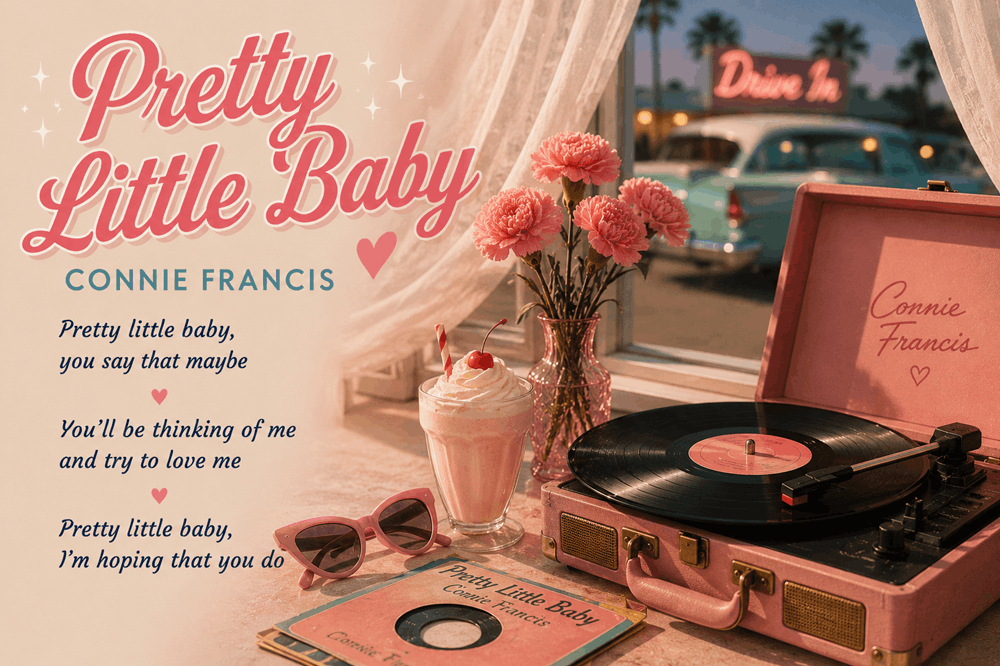
“Pretty Little Baby” Lyrics Meaning: Connie Francis’s Sweet Song About Young Love and Hopeful Devotion
Connie Francis’s “Pretty Little Baby” is about someone asking a romantic interest to turn a possible attraction into real love.
The narrator already feels deeply attached, but the other person has offered only uncertainty. Instead of demanding a commitment, she gently encourages them to think about her, spend time with her and give their young relationship a chance.
The song’s central meaning is:
Young love may be uncertain, but the narrator believes affection can grow if both people stop hesitating and enjoy the moment together.
Despite the title, “Pretty Little Baby” is not about an infant. “Baby” is an affectionate name for a romantic partner, as it commonly was in early pop music.
That distinction became especially interesting when the song found a new audience in 2025. Social media users frequently paired it with videos of babies, children and pets, giving the title a more literal meaning than the original romantic story intended.
Listeners can hear the complete recording through Connie Francis’s official “Pretty Little Baby” audio or find the original album version on Apple Music.
What is “Pretty Little Baby” about?
“Pretty Little Baby” is about the hopeful beginning of a romance.
The narrator is already in love, but the person she addresses has not made an equally clear commitment. They have apparently suggested that they might think about her and might eventually try to love her.
That uncertainty could make the song sad.
Instead, the narrator responds with optimism.
She believes the relationship deserves an opportunity because:
- They are both young.
- Attraction already appears to exist.
- Spending time together could strengthen their feelings.
- Love should be enjoyed rather than endlessly analyzed.
- Waiting too long may cause them to miss a happy experience.
The song does not describe an established couple overcoming a major conflict. It captures the smaller but emotionally intense moment before a relationship has fully begun.
One person is ready.
The other is still deciding.
What does “pretty little baby” mean?
“Pretty little baby” is a romantic nickname.
The narrator is not addressing a literal baby. She is speaking affectionately to someone she finds attractive and wants to date.
In songs from the 1950s and early 1960s, words such as “baby,” “darling” and “sweetheart” were frequently used for romantic partners. The language created intimacy while remaining suitable for mainstream radio.
The phrase also establishes the song’s gentle tone.
The narrator is not confronting the other person or accusing them of emotional dishonesty. She is trying to charm them.
Calling the person “pretty” communicates attraction. Calling them “baby” suggests that she already imagines a closeness that the relationship may not yet officially have.
That creates a small emotional imbalance.
Her language sounds like the language of a couple, but the other person has apparently promised only that love might develop.
Is the narrator already in love?
Yes.
The narrator’s feelings appear much more certain than those of the person she addresses.
She spends time thinking about the relationship and even imagines nature itself as a witness to her devotion. Her attention is not casual.
The other person, however, speaks in possibilities.
They may think about her.
They may try to love her.
The narrator hopes those possibilities will become reality.
This makes the song a gentle form of persuasion. She is not simply celebrating mutual love; she is asking someone to meet her emotionally.
Her optimism protects the recording from sounding desperate. She treats uncertainty as a temporary stage rather than evidence that the feelings will never be returned.
Still, the emotional risk is present.
She has already invested more than the other person has promised.
What does “puppy love” mean in the song?
“Puppy love” refers to youthful romantic affection that adults may consider innocent, temporary or less serious than mature love.
The expression can sound dismissive. It suggests that young people may experience intense feelings without fully understanding long-term relationships.
The song rejects the idea that young love should therefore be ignored.
The narrator’s position is simple: even if the relationship is youthful and may not last forever, it still deserves its moment.
This gives the song a surprisingly practical message.
Not every romance must become a lifelong partnership before it has value. A relationship can matter because it brings happiness, teaches emotional openness and becomes part of someone’s youth.
The narrator does not promise marriage or permanence.
She asks for an opportunity.
Her argument is that being young is not a reason to postpone love. It is a reason to experience it while the moment is available.
Is this a serious love song or an innocent crush?
It exists between the two.
The narrator’s emotions are serious to her, but the world surrounding those emotions is deliberately innocent.
There are no descriptions of adult domestic life, painful betrayal or long-term sacrifice. The imagined dates take place in familiar public locations associated with teenagers and young adults.
The romance consists of:
- Thinking about one another
- Meeting casually
- Spending time together
- Enjoying the moonlight
- Allowing affection to develop
- Being young without demanding certainty about the future
This simplicity is central to the song’s appeal.
“Pretty Little Baby” does not treat love as a problem that must be solved. It presents affection as something gentle that should be given room to grow.
The narrator wants an answer, but she does not make the relationship feel heavy.
What do the flowers and birds symbolize?
The narrator imagines telling flowers and birds about her love.
These images give private emotion a storybook quality.
Flowers traditionally symbolize romance, beauty and feelings beginning to bloom. Birds often symbolize courtship, song and communication. References to paired birds also suggest two creatures naturally drawn toward one another.
The narrator is so consumed by affection that she speaks to the world around her.
This can be interpreted in two ways.
Her happiness is overflowing
She is excited enough to share her feelings with anything that seems capable of listening.
She has nobody else to tell
Because the relationship remains uncertain, she may not yet be able to openly describe the person as her partner. Nature becomes a safe audience for feelings that have not been fully returned.
The images are intentionally sweet rather than realistic.
They create a world in which young love appears natural, harmless and supported by the arrival of spring.
Why does the song mention meeting in public places?
The narrator suggests ordinary places where the couple could meet, including locations associated with food, music and teenage social life.
These details place the romance firmly in the early 1960s.
A carhop was an employee who delivered food to customers in parked cars, often at a drive-in restaurant. Soda shops, diners and similar meeting places gave young people somewhere to socialize away from school and family homes.
The locations suggest dates that are:
- Casual
- Affordable
- Public
- Youthful
- Easy to arrange
- Free from heavy expectations
The narrator is not asking for an elaborate romantic gesture.
She simply wants the other person to show up.
She is also flexible about when they meet. Daylight or moonlight would both be acceptable because the location matters less than being together.
That willingness reinforces the song’s emotional directness.
She does not need perfection.
She needs participation.
Why does the recording sound so innocent?
The arrangement supports the narrator’s hopeful view of love.
Francis sings with warmth and control, while the light rhythm and delicate instrumental details prevent the song from becoming emotionally demanding.
The recording feels:
- Airy
- Playful
- Reassuring
- Romantic
- Slightly dreamy
- Easy to sing along with
The backing voices make the title sound almost like an affectionate chant. Their repetition surrounds the narrator’s request with encouragement.
Nothing in the music suggests that rejection would destroy her.
Instead, the arrangement creates the feeling that love is already beginning and only needs the other person’s agreement.
That confidence is part of the fantasy.
In real life, affection may not develop simply because one person waits patiently. In the song, the melody makes a happy answer feel inevitable.
Why does the song feel nostalgic?
Even before its social-media revival, “Pretty Little Baby” sounded connected to a specific image of the past.
Its language and setting evoke a world of:
- Drive-in restaurants
- Soda shops
- Moonlit dates
- Formal courtship
- Handwritten affection
- Youthful romance without digital communication
The production also belongs clearly to the era before rock music became heavier and pop lyrics became more explicit.
For modern listeners, this creates nostalgia even if they were born decades after the recording.
The nostalgia is not necessarily for the real early 1960s, which contained far more complexity than the song acknowledges. It is for an imagined period when attraction appeared easier to understand and romantic intentions were expressed through simple invitations.
The song offers a brief escape into that imagined simplicity.
Who wrote “Pretty Little Baby”?
“Pretty Little Baby” was written by Don Stirling and Bill Nauman.
Francis performed the lead vocal, while Jim Vienneau and Norro Wilson produced the recording. Apple Music dates the album release to April 10, 1962 and lists the track at two minutes and 22 seconds.
The song appears on Connie Francis Sings “Second Hand Love” & Other Hits.
Francis had already become one of the most successful female singers of her era through recordings including “Who’s Sorry Now?,” “Stupid Cupid,” “Where the Boys Are” and “Everybody’s Somebody’s Fool.”
“Pretty Little Baby,” however, was not treated as one of her defining releases at the time.
It remained a relatively obscure album track for more than six decades.
Was “Pretty Little Baby” originally a hit?
No.
The song was not promoted as a major American single during its original release.
It appeared on Francis’s 1962 album and was used as the B-side of “I’m Gonna Be Warm This Winter” in several international markets. It did not become one of the chart hits most closely associated with her career.
That makes its later success especially unusual.
Songs that return through social media are often former hits already supported by nostalgia, films or famous performances. “Pretty Little Baby” was closer to a forgotten catalog recording.
Even Francis reportedly had difficulty immediately remembering it when she learned that it had become popular again.
The revival did not simply remind listeners of an established classic.
It effectively transformed an overlooked song into a classic more than 60 years after it was recorded.
Why did “Pretty Little Baby” become popular in 2025?
The song began spreading rapidly through short-form videos in spring 2025.
Creators used it for content featuring:
- Babies and children
- Puppies and other animals
- Couples
- Vintage clothing
- Makeup and fashion
- Family memories
- Gentle everyday moments
- Lip-sync performances
The original romantic meaning was often secondary.
The title and Francis’s tender delivery made the recording suitable for almost anything viewers considered cute, cherished or beautiful.
According to TikTok, the song had appeared in more than 17 million videos generating over 27 billion views by June 9, 2025. The platform also reported enormous increases in streaming activity and said the recording reached the top of its U.S. Viral 50 and Top 50 charts.
Its revival eventually extended beyond social media. The song reached No. 20 on Billboard’s Digital Song Sales chart and appeared on both the Bubbling Under Hot 100 and Billboard Global 200.
In the United Kingdom, it reached No. 80 on the Official Singles Sales Chart and No. 76 on the Official Singles Downloads Chart. (View its complete UK chart history)
Why does the song work so well in short videos?
“Pretty Little Baby” communicates affection almost immediately.
A viewer does not need to understand a complicated story before the music supports the image on screen.
Several qualities make it especially adaptable.
The title can be interpreted literally
Although “baby” originally means a romantic partner, the phrase also fits videos of actual babies, children and pets.
The melody is recognizable quickly
The vocal entrance gives a video an immediate emotional identity.
The lyrics are uncomplicated
The song expresses love without introducing conflict, heartbreak or specific biographical details.
The recording feels vintage
Its age gives modern images a warm, nostalgic texture.
The emotion is flexible
The affection can be romantic, parental, playful or sentimental depending on the video.
This flexibility helped the song travel far beyond its original courtship story.
The meaning changed slightly with every new use, yet the central emotion—loving someone or something precious—remained intact.
How did Connie Francis react to the revival?
Francis was surprised and delighted.
She initially admitted that she did not understand what it meant to have a “viral” hit. She later joined TikTok and thanked the listeners who had introduced her recording to a new generation.
In her first post, she described herself as overwhelmed that a song recorded 63 years earlier was attracting young audiences.
The timing made the revival especially moving.
Francis died on July 16, 2025, at age 87, only a few months after the song’s sudden return. The Associated Press reported that more than 22.5 million TikTok videos had used the sound by the time of her death, producing more than 45.5 billion global views.
Her label also reissued international versions she had recorded in French, German, Italian, Japanese, Spanish and Swedish. (Explore the international release)
The revival became an unexpected final celebration of her career.
A recording that had once been overlooked allowed Francis to see a new generation discover her voice before her death.
What is the deeper meaning of “Pretty Little Baby”?
The deeper meaning concerns the courage to enjoy affection before certainty arrives.
The narrator cannot guarantee that the relationship will last. She cannot even guarantee that the other person will return her love.
What she can do is make the invitation clear.
She argues that youth should not be spent waiting for perfect emotional security. Love may begin awkwardly, with one person feeling more certain than the other.
That does not make the feeling meaningless.
The song also demonstrates how music can outlive its original context.
In 1962, it described a youthful courtship involving carhops, soda shops and moonlit meetings.
In 2025, it became a soundtrack for children, animals, fashion and family affection.
The specific images changed, but the emotional core survived.
Someone looks at another person or cherished creature and feels unable to contain their tenderness.
That feeling is simple enough to cross generations.
Final meaning
“Pretty Little Baby” is about someone who has fallen in love and hopes a hesitant romantic interest will give the relationship a genuine chance.
The narrator’s feelings are already clear. The other person offers only the possibility that love may develop.
Rather than demanding certainty, she invites them to meet, spend time together and experience young affection while the opportunity exists.
The flowers, birds, moonlight and casual meeting places create an innocent romantic world. Love does not require dramatic promises there. It begins with two people showing up and allowing themselves to enjoy one another.
The title originally uses “baby” as a romantic nickname, not a reference to a child. Decades later, social-media users gave the phrase a second life by pairing it with videos of actual babies, pets and other cherished subjects.
That reinterpretation did not erase the song’s meaning.
It widened it.
“Pretty Little Baby” began as a hopeful request for romantic love. More than 60 years later, it became a universal expression of tenderness—proof that a song does not have to be famous when it is released to eventually find the moment when the world is ready to love it.