
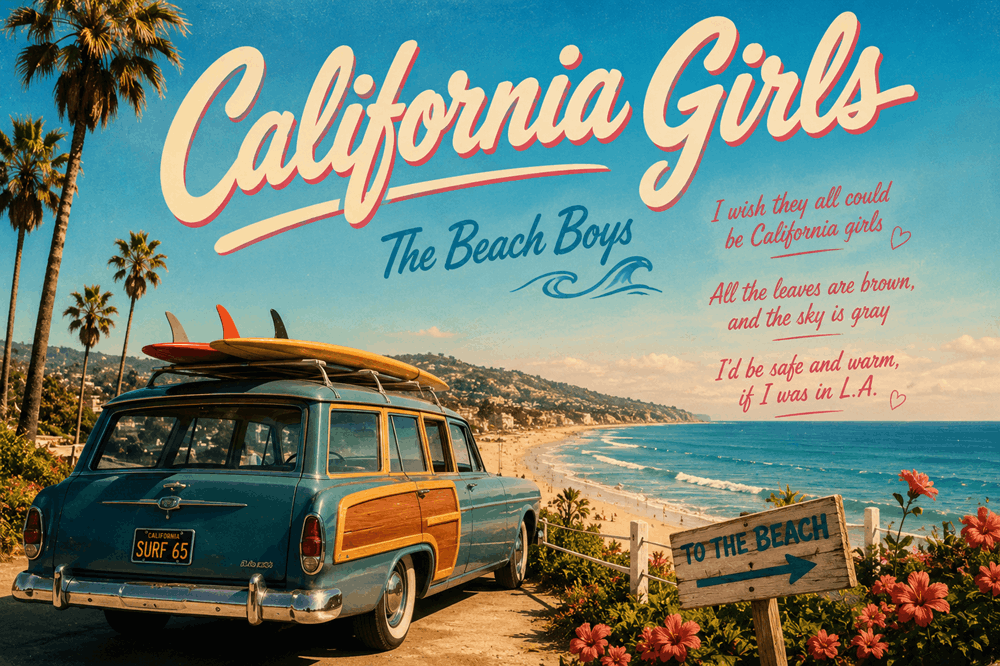
“California Girls” Lyrics Meaning: The Beach Boys’ Song About Attraction, Travel and the California Dream
The Beach Boys’ “California Girls” is about a young man who admires women from different parts of the United States but still sees California as his ideal.
He describes regional differences with playful exaggeration, turning the country into a collection of romantic possibilities. Yet every comparison leads him back to the West Coast, where sunshine, beaches and youthful freedom have become inseparable from his idea of attraction.
The song’s central meaning is:
The narrator appreciates beauty everywhere, but California represents the carefree world he wants every woman to share.
“California Girls” is not really a competition in which every woman outside California loses. The fantasy is broader than that. The narrator imagines bringing the styles, personalities and appeal he has encountered elsewhere into the sunny California environment he considers home.
The complete recording is available through The Beach Boys’ official “California Girls” audio.
What is “California Girls” about?
“California Girls” follows a narrator mentally traveling across the United States and describing the women associated with each region.
He notices:
- East Coast fashion
- Southern accents and personality
- Midwestern warmth
- Northern romance
- West Coast sunshine and beach culture
The descriptions are brief and highly simplified. They function more like colorful postcards than realistic portraits of individual people.
The narrator is not building serious relationships with these women. He is daydreaming about different types of beauty while measuring them against the California lifestyle he loves.
Brian Wilson later summarized the idea as a man imagining women from everywhere before realizing that the kind he truly wants is waiting at home.
Does the narrator believe California women are better?
At first, the song seems to rank California women above everyone else.
The narrator admires women from other regions but repeatedly returns to California as the standard. That can make the song sound like a straightforward declaration that women from his home state are more desirable.
Mike Love offered a slightly different explanation.
He said the concept developed after The Beach Boys had traveled and seen attractive women in many places. According to Love, the fantasy was not simply that California women were superior. It was that all the women they admired could somehow become “California girls” by joining the lifestyle associated with the state.
Under that interpretation, “California” describes more than someone’s birthplace.
It represents a mood:
- Sunny
- Relaxed
- Youthful
- Fashionable
- Physically active
- Close to the beach
- Free from ordinary responsibility
The narrator wants every attractive person he meets to enter that imagined world.
What does “California girl” represent?
The California girl is partly a real person and partly a cultural fantasy.
By 1965, The Beach Boys had already helped popularize an idealized version of Southern California built from beaches, cars, surfing, romance and endless summer.
The California girl belongs inside that mythology.
She represents:
- Warm weather
- Outdoor life
- Confidence
- Youth
- Physical beauty
- Casual romance
- Freedom from restraint
The song does not ask what her ambitions, fears or private life might be. She is seen from the narrator’s perspective as part of the landscape he desires.
The beach, sunshine, palm trees and women blend into one image of California abundance.
That is why the song feels less like a realistic description of dating and more like an advertisement for a dream.
Why does the song describe women from different regions?
The regional structure makes the narrator’s fantasy feel national rather than local.
He does not begin by praising California immediately. He mentally travels through other parts of the country, recognizing something appealing in each place.
Every region contributes a different quality:
- The East suggests style and sophistication.
- The South suggests charm and a distinctive voice.
- The Midwest suggests friendliness and wholesome warmth.
- The North suggests affection during cold weather.
- The West suggests sunshine, tans and beach life.
These are stereotypes rather than detailed observations. Their purpose is musical and imaginative.
The narrator creates a map of American attraction, then places California at its emotional center.
This structure also reflects The Beach Boys’ experience as a touring group. Their success had taken them beyond Southern California, allowing them to meet audiences and observe styles in other regions. Love later connected the song’s concept to that travel.
Is “California Girls” really about returning home?
Yes.
Beneath its flirtatious surface, the song follows a familiar emotional pattern: travel makes the narrator appreciate home more strongly.
He enjoys what he encounters elsewhere. He is not disappointed by the rest of the country. However, distance sharpens his attachment to California.
This gives the song a small element of homesickness.
The narrator can admire novelty without wanting to remain away. Other places are exciting, but California contains the combination of beauty, climate and identity that feels natural to him.
Brian Wilson described the central character in similar terms: someone who imagines many different women but ultimately wants the type associated with home.
The song therefore works as both a celebration of attraction and a homecoming fantasy.
Is California a real place or an imagined paradise?
It is both, but the imagined version is more important.
The Beach Boys were from the Los Angeles area, so California was not an abstract destination for them. The weather, beaches and youth culture belonged to their actual environment.
Yet the California presented in their music is carefully selected.
It rarely includes:
- Ordinary work
- Traffic
- Poverty
- Urban isolation
- Environmental problems
- Social conflict
- The emotional complications of real relationships
Instead, California becomes a permanent summer.
This selective image helped turn the state into an international symbol of freedom and pleasure. Listeners who had never visited could imagine it through harmonies, surf rhythms and descriptions of beach life.
In “California Girls,” the state is almost a condition of mind. To become a California girl is to join the narrator’s sunlit fantasy, regardless of where you were born.
Is the song sexist?
Parts of the song can sound objectifying to a modern listener.
The women are grouped by region and evaluated mainly through:
- Appearance
- Clothing
- Accents
- Kissing
- Tans
- Their effect on men
They are not presented as individual characters with their own voices. The narrator moves across the country categorizing them according to what he finds attractive.
That reflects a male-centered style common in much mid-1960s pop music.
The song can therefore be both culturally important and limited in its perspective.
Its appeal comes from melody, harmony, fantasy and youthful excitement—not from a complex understanding of women. The narrator’s gaze is intentionally simple and adolescent.
Mike Love acknowledged that some people interpreted the song as chauvinistic, while arguing that its intended idea was to imagine attractive women from everywhere joining the California lifestyle.
That explanation softens the competition between regions, but it does not completely remove the song’s objectifying language.
A balanced interpretation recognizes both elements:
- It is a joyful travel-and-homecoming fantasy.
- It views women primarily as symbols of male desire.
Why is the introduction so important?
The instrumental introduction is one of the song’s most admired features.
Before the vocals begin, the music feels unusually spacious and elegant. It does not immediately sound like a simple beach-party record.
The introduction creates anticipation.
It resembles the opening of a much larger journey, preparing the listener to travel across regions before reaching California.
Brian Wilson said he wanted an introduction different from the rest of the song but still capable of leading naturally into it. He remained especially proud of the passage and at times described it as one of his finest musical achievements.
Its grandeur also changes how the lyrics are received.
Without the introduction, the song could sound like a light list of attractive women. The opening makes the fantasy feel almost ceremonial, as though the narrator is unveiling an entire American landscape.
What inspired Brian Wilson’s music?
Wilson later recalled that the music began at the piano after an LSD experience.
He associated the original rhythm with old Western movies, particularly the image of a cowboy riding slowly into town. From that starting point, the larger melody began to take shape.
The Western influence fits the song even though it is not a cowboy story.
Both Western films and “California Girls” are concerned with geography, movement and idealized American spaces.
The rhythm suggests travel across a large landscape. The lyrics then fill that landscape with regional personalities before the narrator arrives emotionally on the West Coast.
Wilson also wanted the verse to have the bouncing quality of an older country-and-western piano pattern. The combination of that traditional motion with layered pop production helped make the song sound familiar and innovative at the same time.
Why does the music sound more sophisticated than the lyrics?
The lyrics are deliberately accessible.
They use recognizable regions, simple images and a chorus that listeners can understand immediately.
The arrangement is more complex.
It combines:
- Multiple keyboards
- Guitars
- Percussion
- Bass
- Carefully layered harmonies
- Shifts in texture between the introduction, verses and chorus
This contrast became an important feature of Brian Wilson’s work.
He could place youthful, commercial language inside arrangements that were increasingly ambitious. The music gave emotional scale to subjects that might otherwise seem lightweight.
The Beach Boys’ official retrospective describes Summer Days (And Summer Nights!!) as a turning point when Wilson was adding more musical ideas while keeping the results commercially inviting.
“California Girls” is one of the clearest examples.
The words describe a young man’s fantasy.
The production makes that fantasy sound enormous.
Why are the harmonies essential?
The harmonies create the sense that the fantasy is shared.
A single singer praising California might sound like one person’s opinion. A group of voices makes the idea feel communal, almost like an anthem.
The backing vocals also help the chorus expand.
The verses move from one region to another, but the harmonies bring everyone back to the same destination.
That repeated return gives California a gravitational pull.
Bruce Johnston participated in the group’s vocal recording for the first time on “California Girls.” He later remembered Wilson assigning him a distinct chorus part as the group’s arrangements were becoming increasingly sophisticated.
The blend makes individual voices difficult to separate.
That is musically appropriate: the song imagines separate regions and personalities merging into one California ideal.
Who wrote “California Girls”?
“California Girls” is credited to Brian Wilson and Mike Love.
Wilson composed and produced the music, while Love contributed to the lyrical concept and words.
The song initially appeared without Love receiving the co-writing credit he later claimed. His authorship was formally recognized after a 1990s legal case involving several Beach Boys songs.
For understanding the song, their different contributions fit naturally together.
Wilson supplied the expansive musical landscape.
Love helped turn that landscape into a humorous, regional survey of American women.
The Beach Boys’ official history now describes “California Girls” as one of Wilson and Love’s major collaborations.
Which album includes “California Girls”?
“California Girls” appears on Summer Days (And Summer Nights!!), released in July 1965.
The album arrived during an important transition for The Beach Boys.
Brian Wilson had stopped touring regularly and was concentrating more intensely on composition, arrangement and studio production. This allowed him to treat recording as a creative process rather than simply documenting the group’s live sound.
The Beach Boys’ official retrospective describes the album as their highest-charting original studio set in the United States at the time, peaking at No. 2. It also presents “California Girls” as one of the recordings that signaled Wilson’s growing orchestral ambition before Pet Sounds.
The song balances the two sides of that period:
- The familiar Beach Boys world of sun and romance
- Wilson’s increasingly sophisticated studio imagination
How successful was the song?
“California Girls” became one of The Beach Boys’ defining hits.
It reached No. 3 on the Billboard Hot 100 in 1965, behind major releases by The Beatles and Bob Dylan at its peak.
In the United Kingdom, it peaked at No. 26 and remained on the Official Singles Chart for eight weeks.
Its cultural importance eventually became greater than those original chart numbers suggest.
The song helped establish:
- The Beach Boys’ signature California mythology
- Brian Wilson’s reputation as an innovative producer
- The image of California as an international pop fantasy
- A template for later songs celebrating particular places and lifestyles
It also became a regular part of the group’s live identity. Al Jardine recalled that its grand arrangement and unmistakably Californian quality helped make it an opening number for much of the band’s career.
Why did David Lee Roth cover it?
David Lee Roth released his version of “California Girls” in 1985.
The cover updated the fantasy for the MTV era. Its exaggerated video, celebrity cameos and cartoonish beach imagery made the song even more knowingly theatrical.
Roth’s version worked because the original was already larger than a realistic dating story.
It was a cultural image that could be recreated:
- Sunshine
- Bodies
- Fashion
- Humor
- California excess
- An outsider’s desire to enter the party
Brian Wilson expressed affection for Roth’s version, which also included Carl Wilson on backing vocals. He noted that the cover repeated the original recording’s No. 3 peak in the United States.
The cover demonstrated that the California fantasy could survive beyond the 1960s, even as its style became more exaggerated.
What is the deeper meaning of “California Girls”?
The deeper meaning is about turning home into an ideal.
The narrator sees attractive qualities everywhere he travels, but he cannot appreciate them without imagining how they would fit into California.
That reveals both affection and limitation.
He loves his home so much that it becomes the standard through which he interprets the rest of the world.
Every regional difference is welcomed, but only after it is brought inside his preferred setting.
The song therefore celebrates diversity in a very particular way. It admires different styles while dreaming of combining them under one sunny identity.
California becomes a place where distance disappears:
- East meets West.
- Cold regions meet permanent summer.
- Different personalities enter one shared fantasy.
- Travel ends in homecoming.
The narrator does not want California to remain one region among many.
He wants it to become the emotional center of everything he has seen.
Final meaning
The Beach Boys’ “California Girls” is about a young man who admires women from across the United States but remains emotionally attached to the California lifestyle.
Each region offers something different—fashion, warmth, charm or romance. Yet the narrator keeps returning to the West Coast, where sunshine, beaches and youth represent his ideal world.
The song is not simply saying that women born in California are better.
Its larger fantasy is that every attractive quality found elsewhere could be brought into California and transformed by its carefree atmosphere.
That idea is playful, but it is also limited by the narrator’s perspective. The women are presented as regional types rather than full individuals, making the song both a classic celebration of youth and a product of the male-centered pop culture of its era.
Brian Wilson’s arrangement gives the simple concept unusual emotional scale. The grand introduction, bouncing rhythm and layered harmonies turn a flirtatious travelogue into an anthem.
“California Girls” lasts because it sells more than attraction.
It sells California itself—not exactly as it exists, but as listeners have imagined it for generations: sunny, youthful and always waiting at the end of the journey.