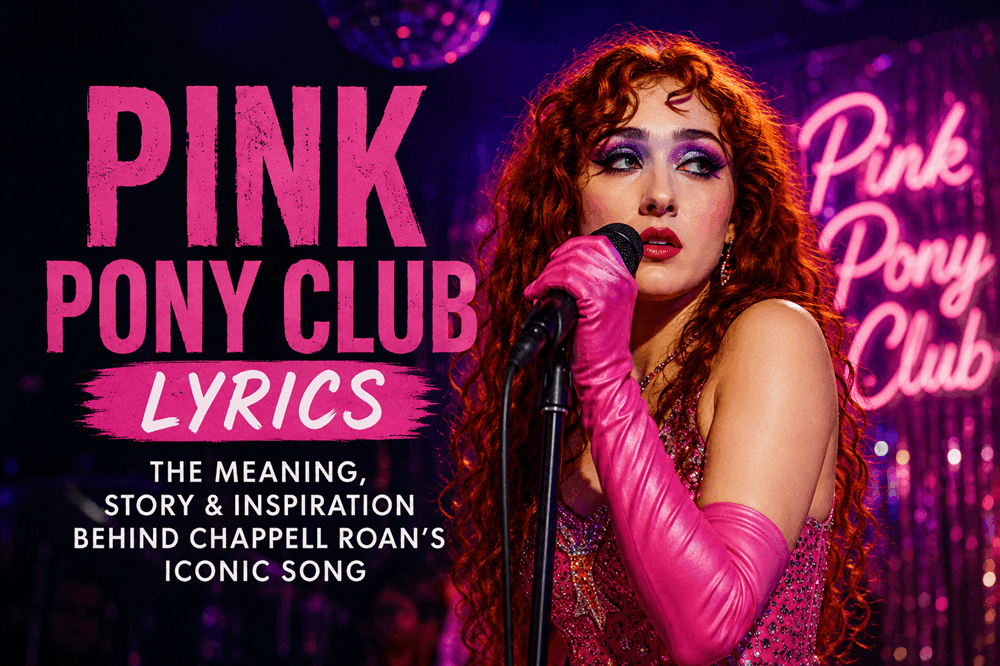
Pink Pony Club Lyrics Meaning & Story Explained
The story, meaning, symbolism, and real-life inspiration behind Chappell Roan’s song
Chappell Roan’s “Pink Pony Club” follows a young woman who leaves Tennessee for Southern California and begins performing at a club in West Hollywood. She expects her mother to disapprove, but the club gives her something she could not find at home: the freedom to be seen as she truly wants to be.
The song sounds euphoric, yet its lyrics are not simply about escaping a conservative hometown. They explore the harder choice between receiving approval and finding belonging.
Looking for the complete lyrics?
Read the full “Pink Pony Club” lyrics on Apple Music or watch Chappell Roan’s official music video.
Apple Music credits Chappell Roan, under her legal name Kayleigh Rose Amstutz, and Daniel Nigro as the songwriters. Nigro also produced the recording. The song was originally released on April 3, 2020.
What Do the “Pink Pony Club” Lyrics Mean?
“Pink Pony Club” is about choosing a life that feels authentic even when that decision disappoints people you love.
The narrator has heard about an exciting place in West Hollywood where people can dance, perform, dress boldly, and express themselves without shame. She leaves Tennessee and eventually becomes a dancer there.
Her mother’s imagined disapproval follows her to California, but the narrator no longer allows that voice to decide where she belongs.
The club can therefore be understood as both a real setting within the song’s story and a larger symbol of:
- Queer community
- Freedom from restrictive expectations
- Creative self-expression
- Chosen family
- The courage to reinvent yourself
The song’s emotional power comes from the fact that the narrator does not stop loving home. She simply realizes that love cannot require her to remain someone she no longer wants to be.
The Story Told Through the Lyrics
The song moves from fantasy to action and then to emotional acceptance.
The first verse: Imagining another life
At the beginning, California is still an idea.
The narrator has heard about a place where people can escape conventional roles and become more expressive versions of themselves. Los Angeles represents a world beyond the expectations she has grown up with.
She is not merely running away from Tennessee. She is moving toward a life that has only recently become imaginable.
That distinction is important. The song is less about rejecting a hometown than discovering that the hometown is not the whole world.
Somewhere else, qualities that once made the narrator feel unusual might be welcomed. The possibility of that community gives her the courage to leave.
Why “wicked dreams” matters
The phrase “wicked dreams” reveals that the narrator has partly internalized the judgment she expects from others.
One way to interpret the phrase is that her desires still feel forbidden. Moving away, entering queer nightlife, wearing heels, and performing publicly all challenge the values associated with home.
The narrator may know that these desires are not genuinely wrong, but the language of shame still shapes how she thinks about them.
People can leave a restrictive environment physically before they stop hearing its rules internally. The narrator’s journey is therefore psychological as well as geographic.
By pursuing the dreams anyway, she begins separating her own values from the beliefs she inherited.
The chorus: Disapproval versus belonging
The chorus brings the song’s central conflict into focus.
From the mother’s perspective, the daughter has made a shocking transformation. She has left home, entered an unfamiliar world, and adopted a public identity that does not fit the future once imagined for her.
From the narrator’s perspective, the same transformation feels like an arrival.
The stage is “where I belong.”
One person sees a fall from respectability; the other experiences the discovery of home.
The narrator does not win this conflict by persuading her mother to approve. She wins by deciding that approval is no longer the only measure of whether her life is worthwhile.
A label that might have been used to make her feel foolish becomes part of an identity she celebrates. Repetition turns embarrassment into confidence.
The second verse: Being seen is the point
The second verse shows the narrator living inside the world she previously imagined.
The club is bright, crowded, theatrical, and openly sensual. Its performers and guests do not try to disappear into the background.
That creates a strong contrast with the narrator’s earlier life.
At home, she worries about causing a scene. At the club, being seen is the point.
The stage also complicates the difference between performance and authenticity. Costumes, heels, lighting, and theatrical gestures might look artificial from the outside, but they allow the narrator to reveal qualities she previously had to suppress.
Performing does not conceal who she is. It gives her a language for expressing it.
The bridge: She still loves home
The bridge is the emotional center of the song.
The narrator has found freedom, but she has not forgotten Tennessee or stopped caring about her family. She can still imagine her mother’s voice, even from far away.
This prevents “Pink Pony Club” from becoming a simple story about escaping bad people and finding better ones.
Leaving can be necessary and still hurt.
Someone can feel happier in a new city while missing the place they came from. They can disagree with their family and still want their love. They can know they made the right choice without feeling completely free of guilt.
The narrator does not resolve those contradictions. She learns to live with them.
The final chorus: Choosing to continue
When the chorus returns, the situation has not fundamentally changed. The mother has not necessarily accepted the narrator’s life, and the narrator has not stopped caring what she thinks.
What changes is the authority that disapproval holds.
The promise to “keep on dancing” becomes a statement of persistence. Dancing is no longer just entertainment. It represents the decision to continue living openly, even when understanding or permission never arrives.
What Does the Pink Pony Club Symbolize?
The Pink Pony Club carries several related meanings, but the song does not require every listener to interpret it in exactly the same way.
A queer space where difference is celebrated
The most direct reading is that the club represents a welcoming queer space.
It is a place where clothing, sexuality, gender expression, performance, and desire do not need to be hidden. The narrator discovers a community in which the qualities that might have caused discomfort at home are ordinary or celebrated.
The club does not merely tolerate her. It gives her a stage.
A chosen community
The club also represents the experience of finding people who understand parts of you that your original community could not.
Chosen community does not always replace a person’s family. Instead, it can provide another kind of home—one based on recognition rather than obligation.
The narrator may still love Tennessee, but the club offers a form of belonging she could not create there.
Permission to reinvent yourself
Moving to California gives the narrator distance from the identity other people already assigned to her.
At home, everyone may have an established idea of who she is and how she should behave. At the club, she can experiment with her appearance, work, relationships, and public identity.
Reinvention is sometimes treated as a form of pretending. In “Pink Pony Club,” it brings the narrator closer to the truth.
She does not become less authentic when she steps onstage. She becomes less restricted.
A psychological destination
The Pink Pony Club does not have to be understood only as a physical venue.
It can represent the moment someone realizes that another way of living is possible.
For one listener, that place might be a queer bar. For another, it could be a theater company, a new city, an artistic community, or a group of friends who make self-expression feel safe.
The setting is specific, but the desire to find your people is universal.
The Real Story Behind “Pink Pony Club”
Chappell Roan has explained that the song was inspired by visiting The Abbey, a well-known gay bar in West Hollywood.
In an interview with Headliner, Roan described being fascinated by the dancers and by the freedom she felt in the venue. She had struggled with feeling judged for being different and creative in Missouri, while The Abbey offered an atmosphere in which she could express herself more openly.
That experience inspired Roan to imagine herself as a dancer in a fictional club.
The song is therefore personal without being entirely autobiographical. Roan is from Missouri, while the narrator comes from Tennessee. She transformed the emotional truth of her own experience into a separate character and story.
Roan has also called “Pink Pony Club” a love letter to Los Angeles, connecting the song not only to queer nightlife but also to the city where she discovered a new creative direction.
What Roan has confirmed
Roan’s visit to The Abbey influenced the song. The venue’s dancers, openness, and queer community showed her a form of freedom she had not previously experienced.
LineDay’s interpretation
The fictional Pink Pony Club expands that real experience into a broader symbol. It becomes any place where someone can stop treating their difference as a problem and begin seeing it as a source of identity, joy, and connection.
Is the Pink Pony Club a Real Place?
The club in the song is fictional, although it was strongly inspired by The Abbey in West Hollywood.
The fictional name helps the setting feel larger than one real venue. It sounds playful, colorful, theatrical, and slightly unreal—qualities that match Chappell Roan’s artistic world.
Because it is imaginary, every listener can also picture a different version of it.
The Pink Pony Club may be located in West Hollywood within the song, but symbolically, it can exist anywhere people feel free to become more fully themselves.
Why Does the Song Mention Tennessee?
Chappell Roan grew up in Missouri, not Tennessee.
The Tennessee setting is one of the clearest signs that the song uses a fictional narrator rather than recounting Roan’s life word for word.
Tennessee creates an immediate contrast with West Hollywood. It evokes distance from California geographically and culturally, helping the song establish the tension between a traditional home and a more openly expressive destination.
Using a character also gives Roan creative freedom. She can draw on her own emotions without being limited to literal biography.
Is “Pink Pony Club” a Coming-Out Song?
It can be interpreted as a coming-out song, but it is not built around one formal declaration.
The narrator comes into visibility through movement, performance, clothing, and community. She does not simply announce who she is. She enters an environment that allows her to discover and express that identity.
The song is therefore concerned with more than telling other people the truth. It is about finding a place where you can understand that truth for yourself.
The club does not only accept the narrator after she has changed. It helps make her transformation possible.
How the Music Changes the Meaning
The production turns a private conflict into a communal release.
The verses leave space for storytelling. As the song reaches the chorus, the arrangement expands and the narrator’s personal decision begins to sound like an anthem.
That musical lift matters because the lyrics themselves remain emotionally complicated. The narrator feels homesick, anticipates judgment, and still wants her mother’s love.
The production does not erase those feelings. It allows joy to rise above them.
The guitar solos also push the song beyond straightforward dance-pop and give it a theatrical, arena-sized quality. Producer and co-writer Dan Nigro later discussed how record executives wanted the guitar elements changed, but he resisted those notes. The solos became one of the recording’s most recognizable features.
The music therefore supports the narrator’s transformation. What begins as a private dream becomes too large and confident to remain hidden.
Who Wrote “Pink Pony Club”?
“Pink Pony Club” was written by Chappell Roan and Daniel Nigro.
Apple Music lists the following principal credits:
- Songwriters: Kayleigh Rose Amstutz and Daniel Nigro
- Producer: Daniel Nigro
- Guitar: Sam Stewart
- Piano: Ben Romans
- Background vocals: Kate Brady
- Programming: Ryan Linvill
The song was released on April 3, 2020, before later appearing on Roan’s debut album, The Rise and Fall of a Midwest Princess.
Its release also represented an important creative shift. The theatrical production, queer narrative, humor, and emotional directness pointed toward the larger artistic identity Roan would continue developing.
Why the Song Connects With So Many Listeners
“Pink Pony Club” is rooted in a specifically queer experience, but its central conflict is widely recognizable.
Many listeners know what it feels like to choose between the life expected of them and the life that feels honest.
That conflict can appear when someone:
- Comes out to their family
- Moves away from a restrictive hometown
- Chooses an unconventional career
- Changes how they dress or present themselves
- Enters a new creative or social community
- Stops organizing every decision around other people’s comfort
The narrator’s victory is not that everyone eventually understands her.
It is that misunderstanding no longer prevents her from living.
Roan has carried the song’s idea into her concerts, describing her performances as spaces built around queer joy, freedom, and community. Her shows turn the imagined club into something audiences can experience together.
The Meaning of “Pink Pony Club”
“Pink Pony Club” is about accepting that becoming yourself may disappoint people you love—and recognizing that their disappointment cannot determine where you belong.
The narrator does not forget Tennessee, stop loving her mother, or completely escape the guilt she learned at home.
Instead, she stops treating that guilt as evidence that she has chosen incorrectly.
The Pink Pony Club gives her more than a job or a stage. It gives her a glimpse of a life in which she no longer has to apologize for being visible.
That is why the song feels triumphant and bittersweet at the same time. Freedom does not arrive because every conflict has been resolved. It begins when the narrator decides that the place where she feels most alive is also the place she is allowed to call home.