
“Slipping Through My Fingers” Lyrics Meaning: ABBA’s Song About Watching a Child Grow Up
ABBA’s “Slipping Through My Fingers” is about a parent realizing that childhood is disappearing faster than expected.
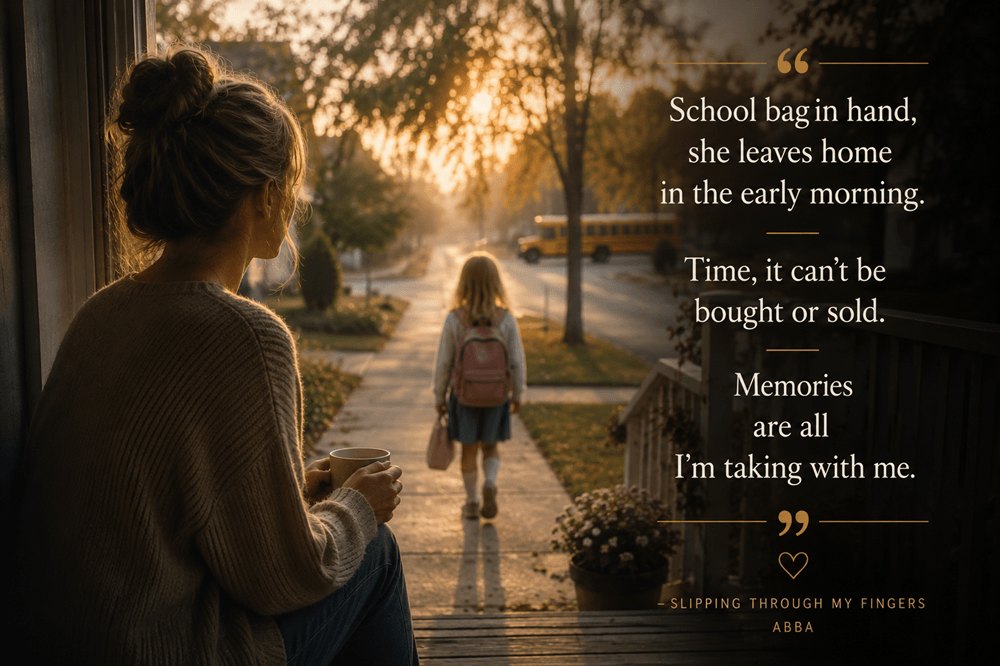
The song begins with an ordinary morning. A young girl prepares for school and leaves home while her parent watches. Nothing dramatic happens, yet the moment creates a sudden wave of sadness. The child is becoming more independent, and the parent understands that this process cannot be slowed or reversed.
The central meaning of the song is:
Parents may spend years planning to make the most of childhood, only to realize that many of its most precious moments passed while they were occupied with everyday life.
“Slipping Through My Fingers” is not about a parent literally losing a child. It is about the natural separation that begins as children develop their own thoughts, routines and identities.
The parent feels pride in that growth, but pride does not remove the grief.
The complete words and official songwriting credits are available through ABBA’s official song page.
What is “Slipping Through My Fingers” about?
“Slipping Through My Fingers” describes the emotional experience of watching a daughter grow up.
The narrator observes small signs of independence and recognizes that the child is gradually entering a world the parent cannot completely share.
She is still young enough to sit at the breakfast table and leave for school with a bag in her hand. At the same time, she already has private thoughts, feelings and experiences that belong only to her.
The parent wants to preserve every moment but cannot.
Time continues through:
- School mornings
- Sleepy breakfasts
- Missed conversations
- Family plans that never happened
- Ordinary routines that did not seem important at the time
- Small steps toward independence
- Changes the parent notices only afterward
The song captures a common contradiction of parenthood.
Parents want their children to grow into confident, independent people. When that growth actually happens, however, it can feel like a series of small goodbyes.
What does “slipping through my fingers” mean?
The title compares time with something a person tries to hold but cannot keep.
You may close your hand around water, sand or another fine material, yet some of it escapes between your fingers. Holding more tightly does not necessarily solve the problem.
The metaphor describes the parent’s relationship with childhood.
The narrator tries to pay attention, make plans and remain emotionally close. Nevertheless, the child continues growing.
Every stage is temporary:
- The first day of school
- The bedtime routine
- The questions asked from the back seat
- The toys left around the house
- The request to hold hands
- The excitement about a small discovery
- The need for help with ordinary tasks
Parents often recognize the importance of these moments only after they stop happening.
The child does not disappear all at once. Childhood slips away gradually, through tiny changes that seem unremarkable until they become memories.
Is the song about a mother and daughter?
The recording is sung by Agnetha Fältskog from a mother’s perspective, which is why listeners frequently understand it as a mother-daughter song.
However, the emotional experience is not limited to mothers.
The lyrics were written by Björn Ulvaeus and Benny Andersson, and Björn has explained that the song was inspired by his own feelings about his eldest daughter, Linda.
In a 2024 interview, Björn recalled watching Linda leave for school alone when she was around six or seven years old. She was proud of her growing independence and looked back to wave. He recognized that this small act represented a new stage in her life—and the beginning of his need to let her go. (Gold Radio’s interview with Björn Ulvaeus)
The song therefore combines two parental perspectives:
- Björn’s experience inspired the story.
- Agnetha’s voice gives that story the intimacy of a mother watching her daughter.
That combination helped make the song universal rather than strictly autobiographical.
Who was the song written about?
Björn Ulvaeus wrote the song with his and Agnetha Fältskog’s daughter Linda in mind.
Linda was born in 1973 and was still a young child when the song was written. The image that stayed with Björn was not a major family event but her ordinary walk to school.
She carried her schoolbag, enjoyed being trusted to go alone and waved back proudly.
For the child, the moment represented freedom.
For the parent, it represented separation.
This difference in perspective is central to the song.
A child may experience independence as excitement:
- Walking to school alone
- Choosing personal interests
- Spending more time with friends
- Developing opinions
- Keeping private thoughts
- Needing less assistance
A parent may celebrate those achievements while also feeling the loss of the earlier child who depended on them more completely.
Neither perspective is wrong.
The child is moving toward life.
The parent is learning how to remain connected without preventing that movement.
Why does the song begin with a school morning?
The school morning makes the story feel real.
ABBA could have written about a graduation, wedding or child leaving home—events that clearly announce the end of one stage. Instead, the song focuses on an ordinary weekday.
That choice communicates an important truth:
Parents do not always know when they are living through a moment they will later miss.
The last time a child asks for help getting dressed may not feel historic.
The final school drop-off may appear identical to hundreds that came before it.
A hurried breakfast can become precious only years later, when the kitchen is quiet.
The song’s opening suggests that childhood does not disappear through one dramatic event. It is carried away by ordinary mornings.
Why does the parent feel sad when the child goes to school?
School represents a world beyond the parent’s control.
Before a child begins developing an independent life, the parent may know nearly everything about their routine. School introduces teachers, classmates, friendships, conflicts and experiences the parent does not witness directly.
The child returns home changed in small ways.
She may have:
- Learned a new idea
- Developed a friendship
- Experienced embarrassment
- Discovered a talent
- Heard language the family does not use
- Formed an opinion without parental guidance
- Kept an experience private
These changes are healthy, but they remind the parent that the child’s inner life can no longer be fully observed.
The narrator wants to understand what her daughter thinks and feels. Each time she believes she is close, however, the child develops again.
The parent is always learning a version of the child who is already beginning to change.
What does the breakfast table represent?
The breakfast table represents family time that appears unlimited until it is gone.
The parent and child are tired and distracted. They are physically together, yet neither fully recognizes the emotional importance of the moment.
This is one of the song’s most relatable ideas.
Parents are often told to cherish every moment, but everyday family life does not always feel cherishable.
Mornings can involve:
- Alarms
- Missing shoes
- Unfinished homework
- Spilled drinks
- Arguments about clothing
- Work deadlines
- Traffic
- Exhaustion
- Repeated reminders to hurry
The narrator later feels guilty for allowing precious time to pass without fully appreciating it.
However, the song does not present that guilt as evidence of bad parenting.
It shows the impossible standard parents often place on themselves. No person can remain emotionally present during every breakfast, school run and bedtime.
Life feels ordinary while it is happening.
Its value becomes clearer in memory.
Why does the parent feel guilty?
The narrator remembers plans that were never completed.
She imagined taking her daughter on adventures, visiting places and creating meaningful experiences. Some plans happened, but many remained ideas.
The parent now wonders why there was never enough time.
Possible reasons are easy to imagine:
- Work became demanding.
- Money was limited.
- The family was tired.
- Other responsibilities intervened.
- The ideal time never appeared.
- The plans seemed postponable.
- Everyone assumed there would be another year.
The guilt comes from comparing real family life with an imagined perfect version.
In the imagined version, the parent is always patient, present and adventurous.
In reality, parents must balance love with work, money, health, household tasks and their own emotional needs.
The song recognizes that even loving parents can look backward and see opportunities they missed.
Is the narrator a neglectful parent?
No.
The narrator’s sadness and self-questioning show that she is deeply involved in her daughter’s life.
She notices the child’s expressions, enjoys her laughter and wants to understand her thoughts. Her guilt does not prove neglect. It reflects how much she cares.
A neglectful parent might feel little concern about missing childhood.
The narrator feels the opposite problem: she cares so much that no amount of shared time seems sufficient.
This is why the song can be emotionally difficult for parents.
It activates the fear that they are not doing enough, even when they are already giving their children attention and love.
The song should not be interpreted as a demand to create a perfect childhood.
Its message is gentler:
Notice ordinary moments when you can, because their importance may not be obvious until later.
What does the song say about parental regret?
The regret in “Slipping Through My Fingers” is not connected to one terrible decision.
It is made from accumulated small omissions.
The narrator thinks about conversations she might have extended, adventures she postponed and mornings she allowed to pass without appreciating them.
This type of regret is difficult because there is no single mistake to correct.
She cannot return to one day and make a different choice. Time has changed the child gradually.
Parental regret often involves questions without clear answers:
- Did I listen enough?
- Was I too distracted?
- Did I work too much?
- Did we create enough happy memories?
- Did I understand who my child really was?
- Was I too strict?
- Did I protect them without limiting them?
- Did I appreciate the stage before it ended?
There is no perfect answer because parenting is lived forward and evaluated backward.
The narrator is judging her past self with knowledge that her past self did not possess.
Why does the narrator want to freeze time?
The desire to freeze a picture represents the wish to preserve a moment before it changes.
Photographs seem to stop time, but they can preserve only appearance. They cannot preserve a child’s voice, habits, dependence or way of understanding the world.
A parent may look at an old photograph and remember:
- The sound of laughter
- The way the child mispronounced a word
- A favorite toy
- A particular school uniform
- The feeling of holding a smaller hand
- The questions the child used to ask
The picture remains unchanged while the people inside it continue aging.
The narrator wants more than a photograph. She wants to remain inside the experience.
That is impossible, which makes the wish so painful.
Is “Slipping Through My Fingers” a sad song?
The song is sad, but it is not tragic.
The daughter is not ill, missing or in danger. She is growing normally and becoming more independent.
The sadness comes from something positive.
This type of emotion is sometimes called bittersweet because happiness and grief are present together.
The parent feels:
- Pride that the child is developing
- Gratitude for their relationship
- Joy when they laugh together
- Sadness that childhood is temporary
- Anxiety about emotional distance
- Guilt about missed opportunities
- Love that cannot stop time
The song does not ask the child to stop growing.
It asks how a parent can celebrate growth without mourning what it replaces.
Is the daughter leaving forever?
Not literally.
At the beginning, she is simply going to school.
The parent’s fear of losing her forever refers to emotional development rather than permanent physical separation.
As children grow, parents lose access to earlier versions of them.
The toddler does not return after the child begins school.
The schoolchild changes again during adolescence.
Eventually, the adult child may leave home, build relationships and establish a family or career.
The parent may remain important throughout these stages, but the relationship changes.
The child’s independence requires the parent to release some control.
The word “forever” captures the permanence of development. Once a stage has passed, it cannot be experienced in exactly the same way again.
Does the parent understand her daughter?
The narrator is unsure.
She loves her daughter and pays attention to her, yet she recognizes that love does not provide complete access to another person’s mind.
Children are often treated as extensions of their parents, but they possess independent inner lives.
They may have fears they do not express, dreams their parents do not expect and opinions formed outside the family.
The narrator repeatedly comes close to believing she understands her daughter. Then the girl grows again, revealing new parts of herself.
This does not mean their relationship is weak.
It means that knowing another human being is never complete.
The parent must keep meeting the child as she changes rather than assuming the version she knew yesterday will remain permanent.
Why is the daughter’s independence painful?
Independence changes the parent’s role.
A baby depends on adults for nearly everything. Over time, the child learns to eat, dress, travel, decide and solve problems without the same level of help.
Each achievement is a success.
It is also a small reduction in the parent’s necessity.
Parents may struggle with this even when they understand that independence is the goal.
Being needed can provide:
- Purpose
- Routine
- Identity
- Emotional closeness
- A sense of importance
- Opportunities to show love
As the child becomes capable, the parent must discover new ways of expressing care.
The relationship moves from direct management toward guidance, trust and companionship.
The narrator is witnessing the beginning of that transition.
Is the song really about time rather than parenting?
Parenthood is the immediate subject, but time is the larger theme.
The song reflects how human beings experience change.
Most stages of life feel slow while they are happening. Looking backward, they appear to have passed almost instantly.
The same feeling can apply to:
- Children growing up
- Friendships changing
- Parents aging
- Relationships developing
- School years ending
- Families moving apart
- A familiar home being sold
- A person recognizing their own aging
The narrator’s daughter makes the passage of time visible.
The parent can compare the child she remembers with the person standing in front of her and see that years have passed.
That is why listeners without children can still find the song emotional. Everyone eventually discovers that a period they assumed would continue has already ended.
Why is Agnetha Fältskog’s vocal so effective?
Agnetha performs the song with restraint.
She does not sing as though the child has been taken from her in a dramatic tragedy. Her voice communicates quiet sadness, tenderness and private reflection.
That emotional control fits the story.
The narrator is not having a public breakdown. She is sitting alone after an ordinary goodbye, suddenly aware of time.
Agnetha was also Linda’s mother, giving the performance an unavoidable personal context.
The song was written by Linda’s father and sung by her mother. Even though listeners should not assume every emotion in the recording is a literal confession, that family connection deepens its emotional resonance.
The performance balances two qualities:
- The warmth of a parent describing a beloved child
- The ache of knowing that love cannot preserve childhood
Who wrote “Slipping Through My Fingers”?
The song was written by Benny Andersson and Björn Ulvaeus.
ABBA’s official song page lists both men as the writers, while the original recording was produced and arranged by them as part of the band’s established creative partnership. (ABBA’s official song page)
Björn contributed the personal inspiration involving Linda, while Benny’s music gives the song its gentle movement.
The composition does not attempt to overpower the story.
It creates enough space for the listener to focus on the parent’s observations, regrets and unanswered questions.
Which ABBA album includes the song?
“Slipping Through My Fingers” appears on ABBA’s 1981 album The Visitors.
It is placed near the end of the record, between “Two for the Price of One” and “Like an Angel Passing Through My Room.” ABBA’s official store lists it as the eighth track on the original nine-song album. (The Visitors official track listing)
The Visitors is often remembered as one of ABBA’s more mature and reflective albums.
Its songs explore subjects including separation, uncertainty, political fear and emotional distance. “Slipping Through My Fingers” fits that atmosphere, but its conflict is not romantic or political.
It focuses on a different form of separation: the natural distance developing between a parent and a growing child.
The original ABBA recording can be heard through the group’s official YouTube release.
Was “Slipping Through My Fingers” released as a major single?
The song did not become one of ABBA’s signature chart singles during the group’s original era.
Unlike “Dancing Queen,” “The Winner Takes It All” or “Take a Chance on Me,” it developed much of its reputation gradually through the album, live performances and later appearances in Mamma Mia!
Its status as an album track may have helped preserve its intimacy.
The song does not feel designed primarily for radio. It is quiet, specific and emotionally reflective.
Over time, those qualities allowed it to become one of ABBA’s most personally meaningful recordings for many listeners.
Its later revival is visible in British download and sales data. In January 2024, it appeared on the UK Official Singles Downloads and Singles Sales charts, decades after its original recording. (Official Charts history)
How is the song used in Mamma Mia!?
In Mamma Mia!, the song is placed within the relationship between Donna and her daughter Sophie.
Donna helps Sophie prepare for her wedding and becomes overwhelmed by how quickly her daughter has grown.
The story gives the song a clear dramatic setting.
Sophie is no longer the small child Donna raised. She is preparing to marry and begin a life that will not center on her mother in the same way.
Donna experiences several emotions:
- Pride in the woman Sophie has become
- Sadness that childhood has ended
- Anxiety about being less necessary
- Memories of raising Sophie alone
- Awareness that their relationship is changing
- Love that makes letting go difficult
ABBA’s official site describes the song as part of one of the musical’s more poignant moments. (ABBA’s feature on The Visitors)
What does the song mean in the Mamma Mia! movie?
The 2008 film places “Slipping Through My Fingers” shortly before Sophie’s planned wedding.
Donna, played by Meryl Streep, helps Sophie, played by Amanda Seyfried, get dressed. The preparation leads Donna to remember Sophie as a child and recognize how their daily closeness is about to change.
The scene is powerful because it combines celebration with grief.
A wedding is usually treated as a joyful beginning. From Donna’s perspective, it is also an ending.
The independent adult standing before her is the same person she once cared for as a little girl, but the relationship can never return to its earlier form.
The film’s official site describes Mamma Mia! as the screen adaptation of the stage musical and lists Meryl Streep and Amanda Seyfried among its principal cast. (Official Mamma Mia! movie page)
The movie helped introduce the song to listeners who had never explored The Visitors album.
Why does the Mamma Mia! scene make people cry?
The scene gives the audience two stages of Sophie’s life at the same time.
Viewers see the adult daughter preparing for marriage while Donna remembers the child she raised.
Parents often experience similar emotional doubling.
They may look at an adult child and simultaneously remember:
- The newborn they first held
- The toddler learning to walk
- The nervous child beginning school
- The teenager asking for independence
- The adult preparing to leave
Time does not erase the earlier images.
They remain present inside the parent’s memory, even when the child no longer resembles them.
The scene also allows Donna to express something many parents find difficult to say directly:
“I am happy for your future, but I am grieving the version of our relationship that is ending.”
Why has the song become popular with younger listeners?
The meaning of the song has expanded beyond its original parent-child perspective.
Young listeners often use it to reflect on their own childhoods. Instead of hearing the voice only as a parent watching a child, they imagine themselves as the child who has grown.
The song can therefore create nostalgia for:
- School mornings
- Family breakfasts
- Childhood bedrooms
- Parents who have aged
- Siblings who have moved away
- Homes that no longer exist
- Earlier versions of oneself
- A period that once felt permanent
Some listeners recognize their parents’ feelings only after reaching adulthood.
A school morning that seemed unimportant to the child may have been emotionally significant to the parent watching from the doorway.
The popularity of Mamma Mia! and the song’s renewed visibility on streaming and social platforms have helped it reach generations born long after ABBA recorded it.
Why do parents relate so strongly to the song?
The song acknowledges that loving a child does not give a parent control over time.
Parents may try to preserve childhood through:
- Photographs
- Videos
- Memory books
- Saved drawings
- Height marks on walls
- Birthday traditions
- Boxes of clothing and toys
These objects can trigger memories, but they cannot restore the relationship exactly as it was.
The child must grow.
That is both the parent’s success and the source of sadness.
The song also validates the guilt parents feel about not being fully present.
Most parents know they occasionally rushed, became distracted or postponed something important. “Slipping Through My Fingers” gives language to the fear that those ordinary compromises may have allowed something precious to pass unnoticed.
Can the song make parents feel unnecessarily guilty?
Yes, especially when its message is interpreted too literally.
Parents may hear the narrator’s regrets and conclude that they must appreciate every second of family life.
That expectation is impossible.
Parenting includes:
- Exhaustion
- Frustration
- Financial stress
- Repetitive tasks
- Conflicting responsibilities
- Personal needs
- Moments when closeness is difficult
Not every minute will feel meaningful.
A parent can love a child deeply while also wanting silence, privacy, work or time away.
The healthier message is not that parents must treasure every second.
It is that ordinary routines deserve occasional attention because they will eventually change.
Presence does not require perfection.
Does the song encourage parents to hold children back?
No.
The narrator feels sadness about her daughter’s independence, but she does not attempt to prevent it.
The parent watches the child leave.
That action matters.
She allows the daughter to enter the world, even though the separation hurts.
Healthy parenting requires this balance.
Parents provide safety and connection while gradually allowing children to make decisions, experience consequences and develop identities beyond the family.
Trying to freeze childhood literally would harm the child.
The narrator’s wish to freeze time is emotional rather than practical. She understands that growth must continue.
Why does the song feel more emotional as listeners age?
A younger listener may initially understand the song as a sad story about a parent.
Later, the meaning can become personal.
As people age, they may notice:
- Their parents becoming older
- Their children becoming independent
- Their childhood home changing
- Family traditions ending
- Memories becoming less detailed
- Years passing more quickly
- Their own identity shifting between generations
A listener may begin by identifying with the daughter and eventually identify with the parent.
Some people occupy both positions at once.
They watch their own children grow while recognizing that their parents once experienced the same sadness.
The song changes because the listener changes.
Is “Slipping Through My Fingers” only for parents?
No.
The song is specifically written around parenthood, but its larger subject is the inability to keep a meaningful period from ending.
It can connect with anyone who has watched time change a relationship.
A listener might associate it with:
- A younger sibling growing up
- A student leaving school
- A close friend moving away
- A parent becoming elderly
- A family separating
- A beloved home being sold
- A stage of life ending
- Childhood memories becoming distant
The emotional structure remains the same.
You know change is natural.
You may even know it is good.
You still wish you had paid more attention before the earlier life disappeared.
Is the song about loss or love?
It is about love expressed through the awareness of loss.
The narrator feels sadness because the relationship matters.
Without love, the child’s growth would not create this emotional response.
The song does not describe love as possession. The parent cannot keep the daughter small or require her to remain dependent.
Instead, love involves witnessing growth and accepting the pain that comes with it.
This makes “Slipping Through My Fingers” different from a conventional song about separation.
The daughter is not rejecting the parent.
The relationship is changing because change is built into childhood.
What can listeners learn from the song?
The song does not provide practical instructions, but it encourages attention.
Its message may inspire parents and families to:
- Put down a phone during an ordinary conversation
- Ask a child what they are thinking rather than assuming
- Complete one postponed family plan
- Record stories as well as taking photographs
- Accept that closeness changes with age
- Avoid treating independence as rejection
- Forgive themselves for imperfect parenting
- Recognize that everyday routines will not last forever
The purpose is not to become anxious about time.
Constantly worrying that a moment will end can prevent someone from enjoying it.
The deeper lesson is to be present often enough that memory contains more than regret.
Final meaning
“Slipping Through My Fingers” is about a parent watching a daughter take small but unmistakable steps toward independence.
A routine school morning creates the realization that childhood is disappearing. The parent wants to understand the child’s inner world, preserve every stage and complete all the plans once imagined for them.
Time makes those desires impossible.
The title describes the parent’s attempt to hold something that cannot remain still. Childhood continues slipping away regardless of how deeply it is loved.
The narrator feels guilt over distracted mornings and postponed adventures, but the song is not an accusation of parental failure.
It is a recognition that family life often becomes precious only in retrospect.
Björn Ulvaeus drew the story from watching his daughter Linda proudly walk to school. Agnetha Fältskog’s vocal transforms that memory into a tender parental confession.
The song became even more widely recognized through Mamma Mia!, where Donna sings it while helping Sophie prepare for marriage. That scene extends the original school-morning image to a later stage of separation.
In both versions, the parent faces the same truth:
A child’s growth is something to celebrate, but every new stage quietly replaces one that will never return.
Parents cannot stop that process.
They can only notice, love and learn to let go.