“Running Up That Hill” Lyrics Meaning: Kate Bush’s Song About Love, Misunderstanding and Swapping Places
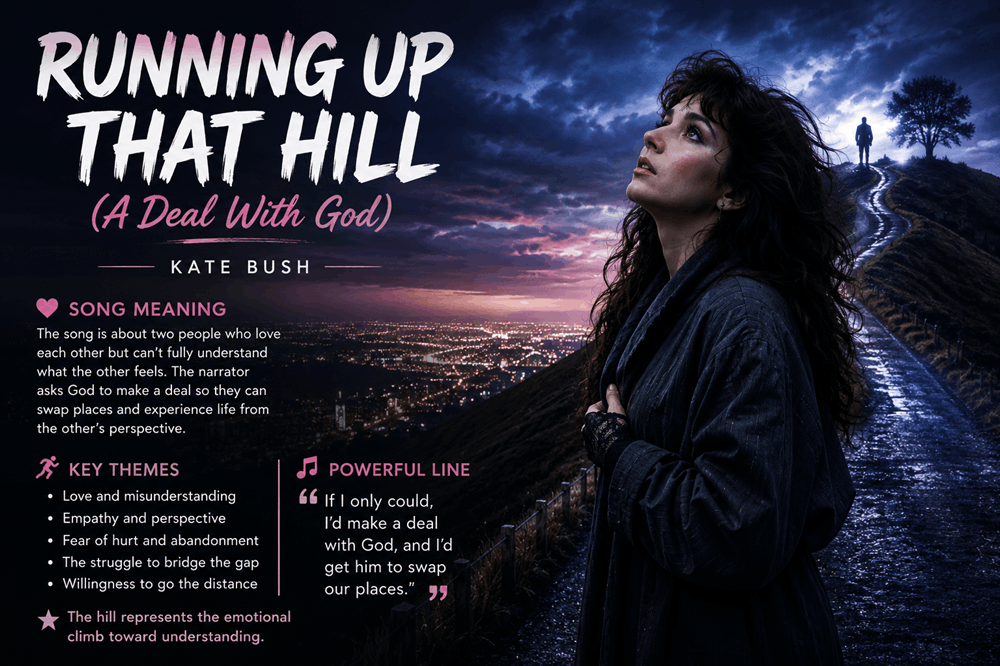
Kate Bush’s “Running Up That Hill” is about two people who love each other but cannot fully understand what the other person feels.
Their connection is powerful, yet that power creates fear. Each partner worries about being hurt, misunderstood or abandoned. The narrator imagines making a deal with God so they could exchange bodies and experience the relationship from the other person’s perspective.
The song’s central meaning is:
Many conflicts between people who love each other come from an inability to experience the same situation through the other person’s eyes.
The hill represents the exhausting work of overcoming that emotional distance. The narrator is willing to run uphill, along a road or even up a building if doing so could remove the misunderstandings between them.
Despite its later association with trauma, survival and supernatural danger through Stranger Things, the original song is not about escaping a monster. It is about wanting enough empathy to stop love from becoming destructive.
Listeners can hear the complete recording through Kate Bush’s official “Running Up That Hill” music video. Bush wrote and produced the song for her 1985 album Hounds of Love.
What is “Running Up That Hill” about?
“Running Up That Hill” describes a relationship in which both people care deeply but repeatedly fail to understand each other.
Neither person appears intentionally cruel.
The problem is that each experiences the relationship from a different emotional position. Something said without harmful intent may still cause pain. Attempts to protect oneself may look like rejection to the other person.
The narrator wants to eliminate that distance completely.
She imagines that if the two lovers could exchange places, they would finally understand:
- What the other person fears
- How deeply certain words hurt
- Why they react differently
- What each person needs from the relationship
- How much both of them still care
Bush explained in 1985 that the song concerns a man and woman who are deeply in love but frightened by the strength of their relationship. She imagined that exchanging places would allow them to understand each other’s feelings more truthfully and prevent accidental hurt.
The song is therefore not asking for the power to escape love.
It is asking for the power to understand it.
What does the deal with God mean?
The narrator wants God to perform something impossible: allowing two people to exchange their lived experiences.
This is not presented as a traditional religious prayer. The narrator approaches God almost as someone capable of arranging a supernatural agreement.
She wants a deal because ordinary communication has failed.
The couple may have already tried to explain themselves, but words are insufficient. Each person remains trapped inside their own body, memories and emotional habits.
The proposed exchange would go beyond listening.
The narrator wants to experience:
- The other person’s physical vulnerability
- Their emotional history
- The pressure they feel
- The meaning behind their behavior
- The pain she may have caused without realizing it
God represents the only force powerful enough to make perfect empathy possible.
The deal is also risky. Swapping places would mean surrendering control and allowing another person to feel everything one normally keeps private.
The narrator is willing to accept that risk because misunderstanding has become more frightening than exposure.
Why was the song not originally called “A Deal With God”?
Bush originally wanted the song to be titled “A Deal With God.”
Her record company worried that some radio stations or countries might avoid a song with “God” in the title. She reluctantly accepted “Running Up That Hill” as the main title, although “A Deal With God” remained in parentheses and she continued to regard it as the song’s true name.
The two titles emphasize different parts of the meaning.
“A Deal With God”
This focuses on the impossible exchange the narrator wishes to arrange.
“Running Up That Hill”
This focuses on the effort required to overcome emotional separation.
The released title is less controversial, but it also gives the song a more universal quality. A person does not need to interpret the words religiously to understand the feeling of struggling uphill against a difficult relationship or private crisis.
What does the hill symbolize?
The hill represents an emotional obstacle that requires continual effort.
Running uphill is exhausting because progress demands more energy than moving across flat ground. The higher a person climbs, the more difficult it can become to continue.
That physical struggle mirrors the relationship.
The two people are trying to reach understanding, but every insecurity, old wound and misinterpreted sentence makes the climb harder.
The hill may represent:
- Poor communication
- Gender differences
- Emotional defensiveness
- Fear of abandonment
- Unspoken resentment
- The limits of empathy
- The effort required to keep love alive
The narrator does not ask for the hill to disappear.
She imagines herself running up it.
That distinction matters. She is willing to make an effort, but she wants the supernatural exchange to ensure that the effort finally leads somewhere.
Why does she want to swap places?
The narrator believes perspective is the missing piece in the relationship.
People often assume that their own emotional response is obvious. They may think their partner should automatically understand why something hurts or why they need reassurance.
But two people can experience the same moment very differently.
One person may believe they are creating space.
The other may experience abandonment.
One may believe they are being honest.
The other may hear rejection.
One may remain quiet to avoid conflict.
The other may interpret silence as indifference.
Swapping places would remove the need to guess.
Each person would feel the consequences of their behavior from the other side. They might discover that both have been frightened rather than hateful.
Bush said the idea grew from the fundamental difficulty of a man and woman understanding each other completely. Although the song begins with gender, its message can apply to any two people separated by experience, personality or emotional history.
Is the relationship abusive?
The song uses images of deep pain, but it does not clearly describe physical abuse.
The narrator feels wounded, and both people appear capable of emotionally damaging each other. However, Bush’s explanation emphasizes misunderstanding, insecurity and the frightening intensity of love rather than deliberate violence.
The relationship may still be unhealthy.
Love alone does not guarantee that two people communicate safely. Strong attachment can increase jealousy, fear and emotional dependence.
The song asks a troubling question: why do people sometimes cause the deepest pain to those they most want to protect?
The answer suggested by “Running Up That Hill” is not that love secretly becomes hatred.
It is that closeness creates vulnerability.
A stranger has limited power to wound you. A loved person knows where the most sensitive emotional places are, even when they do not intend to strike them.
What does the hidden wound represent?
The song describes pain buried deeply enough that the other person may not recognize it.
This wound can symbolize:
- An old emotional injury
- A comment that caused more damage than expected
- Resentment that was never discussed
- Fear created by an earlier relationship
- Pain the narrator has tried to conceal
The other person may honestly believe that no harm was done.
The narrator knows otherwise.
This difference demonstrates why the imagined perspective swap feels necessary. Telling someone that they hurt you does not always make them understand the depth of the injury.
The narrator wants them to feel it directly.
At the same time, she acknowledges that she may also be tearing the other person apart without realizing it. Neither partner has complete access to the damage occurring inside the other.
Why is there so much tension between love and hate?
The song asks how such painful emotions can exist between people who love one another.
This does not necessarily mean that the couple literally hates each other.
It reflects the confusion created when affection and resentment occupy the same relationship.
A person may simultaneously:
- Love their partner
- Fear losing them
- Resent their behavior
- Need their reassurance
- Want distance
- Feel guilty for causing pain
These emotions do not remain neatly separated.
The closer the bond becomes, the more intense every conflict can feel. Anger may come from fear, and apparent coldness may be an attempt at self-protection.
The imagined deal with God would expose the emotions beneath the behavior.
The narrator hopes they would discover that the apparent hatred is actually fear on both sides.
Does the narrator want to leave the relationship?
No.
The song is driven by a desire to preserve the connection, not escape it.
The narrator believes that she and her partner both matter. She continues to imagine a version of the relationship in which they are no longer unhappy.
Her frustration comes from still caring.
If she had become indifferent, there would be no reason to bargain with God or attempt the exhausting climb.
The relationship may be close to breaking, but the narrator has not accepted that outcome.
She wants one moment of complete understanding before they lose each other.
That is what makes the song emotionally urgent. She is trying to repair a bond while recognizing that ordinary methods may no longer be enough.
What does “exchange the experience” mean?
The phrase summarizes the entire song.
The narrator does not merely want to exchange opinions. She wants both people to trade the full experience of being themselves.
That would include:
- The body
- Gender
- Memory
- Fear
- Desire
- Social expectations
- Emotional wounds
- The way each person receives love
The idea is impossible, but it reveals the limitation of ordinary empathy.
People can listen carefully and still never know exactly what another person feels.
The narrator imagines removing that limit.
The exchange would also require mutual vulnerability. She wants to enter the other person’s experience, but she must allow them to enter hers.
Understanding cannot flow in only one direction.
Why does the music feel like constant movement?
The recording is built around a steady, forceful rhythm that rarely allows the listener to relax.
Del Palmer programmed the rhythmic foundation, while Bush performed the Fairlight CMI parts and produced the track. The recording also features Stuart Elliott on drums, Alan Murphy on guitar, Paddy Bush on balalaika and Palmer on bass.
The pulse resembles:
- Running footsteps
- A racing heart
- Repeated effort
- A ritual
- A machine that cannot easily be stopped
This motion supports the image of climbing.
The narrator does not seem to reach the top of the hill. The rhythm continues because the emotional struggle continues.
Bush’s layered vocals add to that sensation. Her voice sometimes sounds intimate and vulnerable, then expands into something larger and more urgent.
The music transforms a relationship disagreement into an almost mythic physical task.
What does the music video mean?
The official video centers on Bush and dancer Michael Hervieu performing an interpretive routine.
Rather than showing a literal hill, road or conversation between a realistic couple, the video uses bodies to represent emotional exchange. The dancers repeat one another’s movements, reach toward each other and struggle to remain connected.
The choreography reflects the song’s central wish.
The two people attempt to mirror one another, but perfect synchronization is difficult. Their bodies can approach the same shape without becoming the same person.
At one point, the pair is separated by crowds wearing masks of Bush and Hervieu’s faces. The image suggests that outside identities, expectations and distorted versions of the self interfere with direct connection.
Bush wrote on her official album page that she hoped the video could function as a “filmic piece of dance.”
The video avoids conventional romantic storytelling because the song concerns something deeper than a particular argument.
It concerns the physical impossibility of fully becoming another person.
Which album includes “Running Up That Hill”?
“Running Up That Hill” opens Hounds of Love, Kate Bush’s fifth studio album.
The song was released in the United Kingdom on August 5, 1985, and originally reached No. 3 on the UK Singles Chart. It was also her strongest American chart success at the time.
Bush wrote, performed and produced much of Hounds of Love in a studio constructed near her family home. The album allowed her greater control over the recording process and became one of the defining works of her career. Her official site describes “Running Up That Hill” as one of the major visual and musical projects created for the album.
The song introduces several themes that continue across the record:
- Fear
- Pursuit
- Love
- Transformation
- The body under pressure
- The struggle to survive overwhelming emotion
Why did “Running Up That Hill” become popular again?
The song experienced an extraordinary revival after appearing prominently in the fourth season of Netflix’s Stranger Things in 2022.
It becomes the favorite song of Max Mayfield, a teenager struggling with grief, guilt and emotional isolation. Music offers her a connection to the outside world when the villain Vecna attempts to trap her inside traumatic memories.
In the episode “Dear Billy,” the song accompanies Max as she runs toward her friends and away from Vecna. Netflix music supervisor Nora Felder explained that the scene connects Max’s literal escape with a movement away from the absence of love and toward the care offered by her friends.
Bush praised the use of the song, calling it a talisman for Max and connecting the scene with fear, conflict and the power of love.
The placement introduced the recording to millions of younger listeners.
How does Stranger Things change the song’s meaning?
The series does not replace the original relationship meaning.
It expands it.
For Max, the hill becomes the work of surviving grief and returning to people who love her. The exchange of experience becomes connected to friends trying to understand pain she has kept hidden.
Vecna isolates his victims by trapping them inside their worst memories.
Music breaks through that isolation.
This makes the song especially appropriate because its original message concerns the desire to cross an emotional distance that ordinary words cannot overcome.
In both the song and the series, survival depends on connection.
The difference is scale:
- Bush’s original narrator wants to save a relationship.
- Max is trying to save her life.
- Both need another person to understand that they are hurting.
The scene turned “Running Up That Hill” into a modern anthem about trauma and resilience without erasing its earlier meaning.
How successful was the revival?
After originally peaking at No. 3 in 1985, “Running Up That Hill” reached No. 1 on the UK Singles Chart in June 2022 and remained there for three weeks.
Its success set several records, including the longest time a single had taken to reach No. 1 in the UK—37 years after its original release. The song became the sixth-biggest UK single of 2022.
Bush responded with surprise and gratitude, saying she was overwhelmed by the affection the song had received and thanking the creators of Stranger Things for bringing it into the emotional world of Max’s story.
The revival demonstrated that the song’s emotional language was not limited to the 1980s.
Its themes of alienation, misunderstanding and the need to be reached remained recognizable to a new generation.
Why does the song still resonate?
“Running Up That Hill” expresses a wish most people have experienced:
I wish you could feel this from my side.
That wish applies far beyond romantic relationships.
It can describe tension between:
- Parents and children
- Friends
- Different generations
- Men and women
- People with different identities
- Someone in pain and someone trying to help
- A person struggling privately and the world around them
The song recognizes that love does not automatically create understanding.
Sometimes caring makes misunderstanding more painful because both people believe the other should already know what they need.
Bush turns that frustration into a physical image.
Empathy is not a gentle step.
It is a hill that must be climbed.
Final meaning
“Running Up That Hill” is about two people who love each other but remain separated by the limits of their individual experience.
They do not deliberately want to cause harm. Yet fear, insecurity and misunderstanding create wounds that neither person can completely see.
The narrator imagines making a deal with God so she and her partner could swap places. By living briefly inside each other’s bodies and emotions, they might finally understand how their words and actions are received.
The hill represents the exhausting work required to reach that understanding.
Bush’s original meaning focused on a man and woman exchanging perspectives, but the song has grown beyond one type of relationship. It now speaks to anyone who has felt unseen, misjudged or unable to explain their pain.
Its use in Stranger Things gave that message another form. For Max, the song becomes a path out of isolation and back toward the people trying to save her.
In both versions, the emotional truth is the same:
The greatest obstacle is not the absence of love.
It is the distance between two people who love each other but cannot yet feel what the other feels.