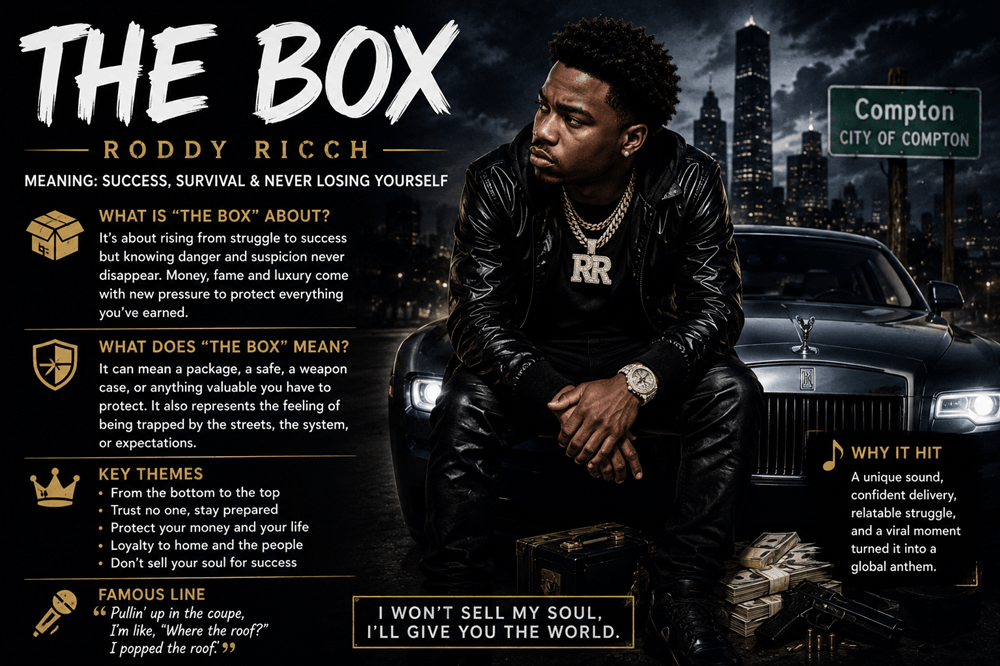
“The Box” Lyrics Meaning: Roddy Ricch’s Song About Success, Survival and Refusing to Be Controlled
Roddy Ricch’s “The Box” is about rising from street-level struggle into wealth and fame without believing that success has made him safe.
The narrator celebrates expensive cars, money and his growing influence, but nearly every boast is accompanied by suspicion. He travels in protected vehicles, keeps weapons nearby and assumes that other people may be watching his money or waiting for an opportunity to take it.
The song’s central meaning is:
Escaping poverty can change what a person owns without removing the survival instincts created by where they came from.
“The Box” is not one continuous story. It is a fast-moving collection of memories, warnings and victory statements. Roddy Ricch presents himself as someone who has escaped one kind of confinement but still lives inside another: the constant need to protect his wealth, reputation and life.
Listeners can hear the complete recording through Roddy Ricch’s official audio or watch the official “The Box” music video. The song appears on his 2019 debut album, Please Excuse Me for Being Antisocial.
What is “The Box” about?
“The Box” is about the complicated transition from street life to mainstream success.
Roddy Ricch describes someone who now possesses the visible rewards of fame:
- Luxury cars
- Expensive watches
- Designer clothing
- Private travel
- Large amounts of money
- Recognition in his hometown
Yet he does not describe success as peaceful.
The narrator continues to think about:
- Police attention
- Robbery
- Rivalries
- Weapons
- Hidden money or contraband
- Loyalty
- People who may betray him
- The pressure to remain authentic
This creates the song’s main tension.
He has reached a level of wealth that once seemed impossible, but he cannot behave like someone who has never experienced danger. His surroundings may have changed more quickly than his instincts.
The track therefore celebrates achievement while questioning whether achievement can ever create genuine security.
What does “the box” mean?
“The box” does not appear to have one fixed meaning throughout the song.
Roddy Ricch uses the phrase around several references to packages, valuables, weapons and illegal activity. In its most immediate sense, it can mean a container used to store or move something that must remain hidden.
Depending on the surrounding line, the box may suggest:
- A package containing drugs or money
- A case used to conceal a weapon
- A storage place for valuable or dangerous items
- A safe
- A vehicle or enclosed space
- Confinement, including the possibility of jail
The title’s ambiguity is important.
A box protects what is inside, but it also limits movement. That makes it a useful image for the narrator’s entire life.
Money may be placed inside a box for protection.
A weapon may be placed inside a box for concealment.
A person may also feel trapped inside expectations created by the streets, the police, the music industry or fame.
Roddy never pauses to define the title because its power comes from how many parts of his world can be contained by it.
Does the box symbolize being trapped?
It can.
The narrator has escaped financial hardship, but his success introduces new forms of confinement.
He must now protect:
- His income
- His public image
- His family
- His possessions
- His relationships
- His credibility
- His personal freedom
He may own more than he once did, yet those possessions give other people more reasons to target him.
In that sense, the box can represent a life organized around protection.
The narrator keeps valuable things enclosed because exposure creates danger. He may also keep his emotions enclosed for the same reason.
The title suggests that survival requires boundaries.
Anything valuable must be hidden, guarded or carefully controlled.
Why does the song combine wealth with danger?
The narrator does not treat wealth as the end of struggle.
Instead, money changes the nature of the struggle.
Before success, the main problem may have been acquiring resources. After success, the problem becomes keeping them and surviving the attention they attract.
The song repeatedly connects luxury with protection.
A costly vehicle is also armored.
A successful person is also being followed.
A large amount of money creates freedom, but it creates suspicion as well.
This tension reflects a common theme in Roddy Ricch’s music: achievement does not erase the environment that shaped the person achieving it.
The narrator may now travel farther and buy more expensive things, but he still sees the world through the perspective of someone who learned that safety can disappear quickly.
His wealth is real.
So is his fear.
What does “I won’t sell my soul” mean?
The narrator insists that he will not surrender his identity or values in exchange for success.
“Selling your soul” can mean abandoning your principles for money, fame or industry approval.
In “The Box,” the statement serves as a defense against several possible accusations:
- That fame has changed him
- That he has forgotten his community
- That the music industry controls him
- That his image is manufactured
- That he would betray people for greater success
The promise also reflects distrust of the entertainment industry.
A successful artist may receive money and visibility while losing privacy, creative control or relationships. The narrator wants the rewards without becoming owned by the system providing them.
This is another version of the box metaphor.
The music business can elevate an artist while placing them inside a commercial identity they must continue performing.
Roddy presents himself as determined to remain larger than the role created for him.
Is the narrator confident or paranoid?
He is both.
The song’s energy comes from the way confidence and fear repeatedly overlap.
The narrator believes he is:
- More successful than his rivals
- Musically gifted
- Financially powerful
- Respected in Compton
- Capable of protecting himself
At the same time, he behaves as though danger could appear at any moment.
He assumes that others may want his money. He travels defensively and keeps protection nearby. He thinks constantly about betrayal and police attention.
This does not necessarily mean his fears are imaginary.
The song presents a world where visibility creates risk. The more successful he becomes, the easier he is to locate and the more valuable he appears.
His confidence is partly what allows him to function inside that risk.
He cannot afford to sound frightened, so fear is transformed into preparation.
Why does he emphasize Compton?
Compton gives the narrator’s success a specific starting point.
Roddy Ricch was raised in Compton, California, a city with an enormous place in hip-hop history. Associating himself with it connects his music to earlier West Coast artists while grounding his wealth in a recognizable community.
His hometown represents:
- The environment that shaped his survival instincts
- The place where his reputation matters most
- A history of influential rap music
- The people who knew him before fame
- The contrast between earlier hardship and current success
The narrator does not want to become famous by separating himself from where he came from.
He imagines receiving recognition from the city itself.
That desire reveals that national success is not enough. Approval from home carries a different emotional value because it confirms that his rise has not erased his origins.
Roddy later told GQ that he wanted his career to remain connected to Compton and that he was more interested in lasting community impact than conventional celebrity culture.
Why are there so many basketball references?
Basketball provides a language for achievement, competition and physical dominance.
The narrator compares his actions to famous players because sports references communicate status immediately. A successful basketball player performs under pressure, defeats opponents and makes extraordinary actions look natural.
These comparisons help Roddy present rap as a competitive sport.
He is not merely participating in music.
He is scoring, winning and outperforming others.
The basketball imagery also connects street culture, popular entertainment and aspiration. For many young people, professional sports and music represent two highly visible paths from limited circumstances into wealth.
Roddy’s comparisons place him inside that tradition of exceptional escape.
Why is the “eee-err” sound so important?
The unusual squeaking sound at the beginning became the track’s most recognizable feature.
Many listeners compared it to:
- A windshield wiper
- A squeaking door
- A bird
- A mechanical hinge
- Something sliding across glass
The sound is actually Roddy Ricch’s voice.
Producer 30 Roc explained that it was not originally part of the instrumental. Roddy added it after the main recording had already been completed. Roddy later described it as a spontaneous sound created from imagination rather than something engineered specifically for social media.
Its effectiveness comes from being difficult to identify.
The listener immediately wonders what produced it.
That small mystery makes the song recognizable before the first full verse begins.
The sound also resembles something opening or moving, which unintentionally fits the title. It can be heard as the box being opened, although Roddy has not presented that as an official explanation.
Was the sound designed to become a meme?
No.
Roddy said he did not create the noise with TikTok or viral marketing in mind. He described it as one of the random sounds he naturally adds while making music.
That spontaneity became central to the song’s success.
Short-form video creators used the sound for:
- Window-cleaning jokes
- Door-opening edits
- Dance videos
- Visual transformations
- Sudden reveals
- Comedic timing
By early 2020, it had already appeared in more than a million TikTok videos. Roddy said the reaction surprised him because he was not heavily involved with the platform himself.
The viral moment worked because the sound was distinctive without having one obvious visual meaning. Creators could adapt it to almost anything.
Why does Roddy Ricch keep changing his voice?
Roddy moves between rapping, melody, ad-libs and different vocal pitches throughout the track.
His delivery can sound:
- Calm
- Threatening
- Playful
- Mocking
- Celebratory
- Suspicious
These changes prevent the repetitive chorus and minimal beat from becoming static.
Pitchfork identified the track as one of the clearest demonstrations of Roddy’s versatility, noting how frequently he changes pitch and delivery.
The vocal variety also reflects the narrator’s unstable environment.
He must shift roles quickly:
- Successful artist
- Street survivor
- Family protector
- Public celebrity
- Suspicious target
- Entertainer
There is no single voice capable of expressing all those identities, so the performance keeps changing.
How was “The Box” created?
“The Box” was the final song Roddy Ricch made for Please Excuse Me for Being Antisocial.
He told GQ that he recorded it at approximately seven in the morning in New York after working throughout the night. It was not originally selected as one of the album’s major singles. Roddy preferred to release collaborations first and let listeners determine which solo track should become the breakout.
Producer 30 Roc said the core recording came together extremely quickly—roughly 15 minutes—before Roddy later added the famous vocal sound. The instrumental was intentionally kept simple, using an orchestral-style texture, bells, percussion and heavy low-end production.
That quick creation makes the song’s enormous success even more unusual.
It was not designed through a long campaign to become a global hit.
Its audience selected it.
Who wrote and produced “The Box”?
Apple Music credits Rodrick Moore, Roddy Ricch’s legal name, alongside Adarius Moragne, Aqeel Qadir Tate, Samuel Gloade, Khirye Anthony Tyler and Larrance Dopson as songwriters.
The production credits include 30 Roc, Datboisqueeze, Zentachi, Khirye Tyler and Dopson. Apple Music lists Roddy as the vocalist and dates the track’s album release to December 6, 2019.
The recording lasts three minutes and 16 seconds.
It appears as the second track on Please Excuse Me for Being Antisocial, immediately after the album’s introduction. That placement gives it the feeling of the record’s true opening statement.
What does the music video mean?
The official video turns Roddy’s boasts into exaggerated visual fantasies.
He is shown:
- Racing expensive cars
- Performing an impossible basketball dunk
- Surrounded by sharks
- Carrying out a bank robbery
- Acting like a presidential candidate
- Escaping explosive danger
The scenes do not form one realistic storyline. They show success becoming increasingly surreal.
Roddy co-directed the video with Christian Breslauer. The visual repeatedly presents him as someone who cannot be contained by ordinary rules.
At the end, however, Roddy appears inside a glass display box.
That final image changes the meaning of everything before it.
He has achieved enough to become an exhibit—someone preserved, watched and turned into an object for public consumption.
The ending suggests that fame may be another form of confinement.
He escapes poverty, rivals and physical danger only to become trapped inside the image of Roddy Ricch.
How successful was “The Box”?
“The Box” became one of the defining songs of 2020.
It spent 11 weeks at No. 1 on the Billboard Hot 100 and became Roddy Ricch’s first chart-topper as a lead artist. The album also reached No. 1 on the Billboard 200.
The song received three Grammy nominations:
- Song of the Year
- Best Rap Song
- Best Melodic Rap Performance
The Recording Academy’s official profile lists all three nominations.
Its success was especially notable because the track had not initially been pushed as the album’s main single.
Streaming, social media and listener enthusiasm turned an album track into a cultural event.
Why did the song become so popular?
The viral sound helped, but it does not fully explain the song’s success.
Several elements worked together.
The opening is instantly recognizable
The unusual vocal sound identifies the track within seconds.
The beat is simple but dramatic
Its orchestral texture and heavy rhythm create space for the vocal performance.
Roddy changes delivery constantly
The song feels more varied than its repetitive structure suggests.
The chorus is memorable
Its rhythm is easy to recognize even when listeners do not know every word.
The lyrics combine fantasy and realism
Luxury, crime, police, hometown pride and anxiety exist in the same world.
The song was discovered organically
Listeners felt they had selected the hit rather than being told which song to support.
TIME argued that the viral sound provided an important boost while Roddy’s flexible delivery and songwriting helped the track survive beyond a short meme cycle.
Is “The Box” only a bragging song?
Bragging is a major part of it, but the song contains more anxiety than a simple victory anthem.
The narrator celebrates money because he remembers not having it.
He celebrates protection because he remembers danger.
He celebrates independence because he distrusts institutions and people who might control him.
Nearly every success statement has a shadow.
The expensive car needs armor.
The money needs hiding.
The career requires a promise not to sell out.
The hometown recognition comes with pressure to remain loyal.
The song’s deeper emotional structure is not “I have everything.”
It is:
I finally have something, and now I must make sure nobody takes it from me.
Final meaning
Roddy Ricch’s “The Box” is about success shaped by survival.
The narrator has escaped financial struggle and entered a life of cars, jewelry, private travel and national recognition. Yet he remains suspicious, defensive and prepared for danger.
The box can refer to several literal containers—a package, safe or weapon case—but it also works as a broader symbol of confinement.
The narrator stores valuable things inside boxes because they must be protected. At the same time, he risks becoming trapped inside street expectations, industry pressure and the public image created by fame.
His refusal to sell his soul expresses the song’s central conflict.
He wants success without surrendering ownership of himself.
The famous squeaking ad-lib makes the song playful and immediately recognizable, but the world beneath it is tense. Wealth has increased the narrator’s freedom while giving him more to lose.
That contradiction is what gives “The Box” lasting meaning.
Roddy Ricch sounds as though he has broken out.
He also sounds as though he is still checking every wall around him.