“Unwritten” Lyrics Meaning: Natasha Bedingfield’s Song About Freedom, Possibility and Writing Your Own Future
Natasha Bedingfield’s “Unwritten” is about refusing to let fear, perfectionism or other people’s expectations decide the direction of your life.
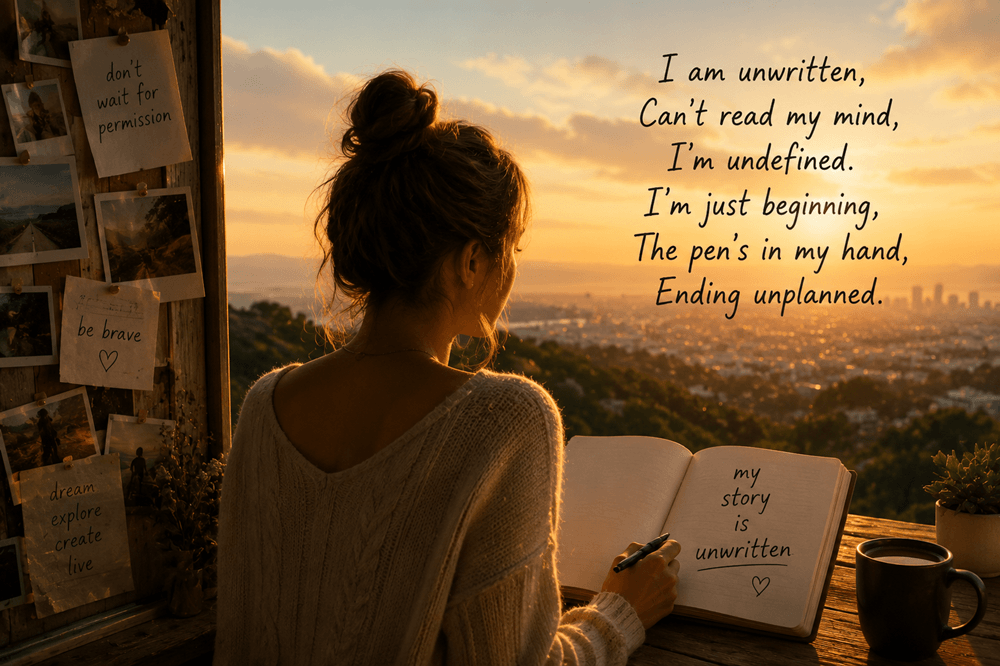
The narrator sees the future as a blank page. She does not yet know exactly who she will become, what choices she will make or how her story will end. Instead of treating that uncertainty as a weakness, she presents it as freedom.
The song’s central message is:
Your future has not been decided for you. You begin shaping it by acting, expressing yourself and experiencing life before you feel completely prepared.
“Unwritten” is often described as a motivational song, but its message is more thoughtful than simple positive thinking. It recognizes that beginning something new can be frightening. People hesitate because they fear mistakes, judgment and uncertainty.
The song responds by arguing that an imperfect life you actively create is better than a safe life controlled by hesitation.
Listeners can hear the complete recording through Natasha Bedingfield’s official music video.
What is “Unwritten” about?
“Unwritten” is about taking responsibility for a future that has not yet been defined.
The narrator begins without a finished identity. She cannot give other people a complete explanation of who she is because she is still discovering the answer herself.
That does not mean she is empty or directionless.
It means she is unfinished.
The distinction matters because people are often pressured to define themselves early. Teenagers are asked to choose careers. Young adults are expected to have plans for relationships, education and financial success. Even older adults may feel embarrassed when their lives change direction.
“Unwritten” rejects the belief that uncertainty represents failure.
Not knowing what comes next can mean that several possibilities remain open.
The song encourages listeners to:
- Stop waiting for complete certainty
- Accept that mistakes are part of growth
- Express ideas they have kept hidden
- Pay attention to real experiences
- Resist social pressure to follow one approved path
- Participate in life instead of observing it from a distance
- Recognize that today’s decisions influence tomorrow’s story
The future may be unknown, but it is not beyond influence.
What does the title “Unwritten” mean?
The title represents a life story that has not yet been completed.
When something is unwritten, it has no fixed ending. Its direction can still change, and new possibilities can still enter the story.
The narrator applies this idea to identity.
She does not believe she must remain the person others currently see. Her present circumstances, earlier mistakes and existing reputation are not the final version of her life.
The title also challenges the idea that people should know everything about themselves before they begin.
In reality, identity is often discovered through action.
People learn what they value by making decisions. They discover their abilities by attempting difficult things. They understand relationships by participating in them, not by planning every emotion in advance.
Being unwritten therefore means being free to develop.
It also means accepting responsibility. A page does not fill itself. The future remains open, but a person must eventually decide what to place on it.
Why does the song compare life to a blank page?
A blank page can feel hopeful or intimidating.
For a writer, it contains unlimited possibility. Nothing has gone wrong yet, and the story could move in almost any direction.
At the same time, the absence of words creates pressure. The writer must make the first decision without knowing whether it will lead to something successful.
That is similar to beginning a new stage of life.
Someone may be:
- Starting college
- Choosing a career
- Moving to another city
- Leaving a relationship
- Recovering from failure
- Beginning a creative project
- Becoming a parent
- Rebuilding after a major loss
In each situation, the person has possibilities but no guarantee of the result.
“Unwritten” argues that the page becomes meaningful only when someone is willing to make a mark on it.
Waiting for the perfect first sentence may leave the page empty forever.
Is “Unwritten” about finding yourself?
Yes, but the song does not treat the true self as something hidden and already complete.
Instead, the narrator seems to believe that identity is created gradually.
You do not simply search until you find one permanent version of yourself. You develop through experiences, choices, relationships and mistakes.
This approach makes the song especially reassuring for anyone who feels behind.
A person may think everyone else has already discovered their purpose. From the outside, other lives can appear organized and certain. However, many people are improvising while trying to look confident.
“Unwritten” removes some of that pressure.
The narrator gives herself permission to be in progress.
She does not need to provide a final definition because her life is still unfolding.
What does the dirty window symbolize?
The dirty window represents the beliefs, fears and habits that prevent someone from seeing possibilities clearly.
A window should allow light to enter. When it becomes covered, the world outside may appear darker or more limited than it really is.
The narrator encourages the listener to open that barrier.
This can symbolize moving beyond:
- Fear of embarrassment
- Negative self-talk
- Family expectations
- Perfectionism
- Past disappointment
- Social comparison
- A narrow idea of success
- The belief that change is no longer possible
The outside light has not disappeared. It has simply been blocked.
Opening the window does not instantly solve every problem. It allows the person to recognize choices that fear had made difficult to see.
The image turns personal growth into something physical. Change begins when someone stops remaining sealed inside the same thoughts.
What does the rain symbolize?
The rain represents direct experience.
Instead of remaining protected from discomfort, the narrator encourages listeners to step into life and feel it personally.
Rain is unpredictable and impossible to control. It can be cold, inconvenient and uncomfortable, but it can also feel refreshing and freeing.
That mixture fits the song’s larger message.
A meaningful life will not be perfectly clean or carefully managed. It will include:
- Disappointment
- Excitement
- Vulnerability
- Failure
- Pleasure
- Surprise
- Confusion
- Emotional risk
The narrator does not promise that every experience will feel good.
She argues that experiences must be lived firsthand. Another person cannot feel them on your behalf, just as another person cannot create your identity for you.
The rain therefore represents the physical reality of being alive rather than merely thinking about life from a safe distance.
What does the song say about fear?
Fear appears in “Unwritten” as inhibition—the internal force that prevents action.
A person may know what they want to say or do, yet remain silent because they are imagining everything that could go wrong.
They might fear:
- Being laughed at
- Choosing the wrong path
- Disappointing their family
- Failing publicly
- Looking inexperienced
- Changing their mind later
- Discovering they are not as talented as they hoped
The song does not argue that fear is imaginary.
It suggests that fear should not be given authorship of the future.
Courage in “Unwritten” is not the complete absence of anxiety. It is the willingness to participate even when the outcome remains uncertain.
Is “Unwritten” about breaking rules?
The song supports breaking unhelpful expectations, but it is not encouraging reckless behavior.
The narrator questions traditions and social conditioning that teach people to avoid mistakes at any cost.
Many systems reward predictability. Schools often emphasize correct answers. Workplaces may punish experimentation. Families can pressure children toward familiar careers or lifestyles.
These structures can make mistakes feel like proof of personal failure.
“Unwritten” offers another view.
Mistakes can provide information.
A failed attempt may reveal:
- What a person needs to learn
- Which direction does not suit them
- What they genuinely care about
- How they respond under pressure
- Whether they should adapt or continue
The song’s rebellion is not about ignoring consequences. It is about refusing to make perfection the price of participation.
What does it mean to write your own story?
Writing your own story means making conscious choices rather than allowing other people to make every important decision for you.
No one has complete control over life. Family circumstances, health, money, discrimination and unexpected events can limit available choices.
The song does not erase those realities.
Its message is that personal agency can still exist within uncertainty.
Writing your story may mean:
- Saying what you actually believe
- Leaving a path chosen mainly to satisfy others
- Beginning again after a failure
- Setting boundaries in a relationship
- Developing a talent privately before sharing it
- Accepting an opportunity that feels frightening
- Changing an outdated definition of success
The metaphor does not require becoming famous or accomplishing something dramatic.
Small decisions also become part of the story.
Why did Natasha Bedingfield write “Unwritten”?
Bedingfield originally wrote the song as a birthday gift for her younger brother Joshua, who was turning 14.
She was working in Los Angeles and had missed his birthday. Rather than sending a conventional present, she developed a song around the pressure teenagers feel when adults repeatedly ask them to decide what they will do with their lives.
Bedingfield later explained that the song began as a poem. Songwriter and producer Danielle Brisebois helped expand the idea that a young person could be seen as an open page capable of shaping a personal future.
Readers can learn more about the writing and recording process in Bedingfield and Brisebois’s interview with The Guardian.
Although the original audience was a teenager, the message was broad enough to apply to almost any age.
Adults also experience periods when their established identity disappears. Divorce, career changes, illness, parenthood and relocation can return someone to the frightening openness of a blank page.
Who wrote “Unwritten”?
“Unwritten” was written by Natasha Bedingfield, Danielle Brisebois and Wayne Rodrigues.
Brisebois also co-produced the recording with Rodrigues. Her background included acting and membership in the New Radicals, the group known for “You Get What You Give.”
The collaboration helped transform Bedingfield’s original poem and personal message into a large pop recording.
Bedingfield’s debut album shared the song’s title and reached No. 1 on the UK Albums Chart. Its complete chart history can be viewed through the Official Charts album archive.
Why does the song have a gospel-like chorus?
The layered voices make the chorus feel communal.
Although the song emphasizes individual responsibility, its sound suggests that personal liberation can be celebrated with other people.
Bedingfield wanted the recording to contain the energy of a choir. She connected that sound to childhood experiences in an African-Caribbean church in London, where young people were encouraged to participate in music.
A full choir was not available during the recording session, so Bedingfield, her sister Nikola and singer Jessi Collins layered their voices to create the larger effect.
This production choice helps explain why the song works so well at graduations, sporting events and public celebrations.
The verses sound personal and reflective. The chorus opens outward, turning one person’s private decision into a shared release.
Why does “Unwritten” sound so uplifting?
The production continually moves from restraint toward openness.
The earlier parts of the song feel controlled, matching the narrator’s initial uncertainty. As additional voices and instruments enter, the recording begins to feel wider and more physically expressive.
The music reflects the emotional journey:
- The narrator begins undefined.
- She confronts the empty future.
- She recognizes the habits limiting her.
- She chooses participation over fear.
- The song expands into a communal celebration.
The brightness is effective because the song does not begin with confidence.
It earns its optimism by moving through hesitation first.
This is why “Unwritten” often feels more emotionally satisfying than a song that simply repeats that everything will be fine.
It does not promise a perfect ending.
It celebrates the freedom of not knowing the ending yet.
How successful was “Unwritten”?
“Unwritten” became Natasha Bedingfield’s defining international hit.
The single originally peaked at No. 6 in the United Kingdom. Its Official Charts history shows both its original performance and its later returns to the chart.
In the United States, it reached No. 5 on the Billboard Hot 100 and became one of the most recognizable pop songs of 2006.
The recording also earned Bedingfield a nomination for Best Female Pop Vocal Performance at the 49th Grammy Awards. Her nomination is listed in the Recording Academy’s official artist archive.
Its commercial success was important, but the song’s cultural lifespan has become even more remarkable.
Many successful singles remain strongly associated with the year in which they were released. “Unwritten” repeatedly found new audiences through television, films, streaming and social media.
How was “Unwritten” used in The Hills?
In 2006, “Unwritten” became closely associated with MTV’s reality series The Hills.
The song’s message fit the show’s original premise. Lauren Conrad moved to Los Angeles and attempted to build a new adult life involving work, friendships and relationships.
The future appeared glamorous but uncertain.
Using “Unwritten” as the theme framed each episode as another stage in a young woman’s unfinished story.
The association became so strong that many listeners who discovered the song through television continue to connect its opening with Los Angeles scenery and the hopeful atmosphere of mid-2000s reality programming.
The placement gave the song an identity beyond radio.
It became musical shorthand for entering a new stage of life.
Why did “Unwritten” become popular again?
The song received a major revival after appearing in the 2023 romantic comedy Anyone But You.
In the film, it serves as a calming song for Ben, the character played by Glen Powell. It later becomes part of a joyful group performance.
The placement reminded older listeners of the song while introducing it to younger audiences. Videos connected to the film spread across TikTok, helping “Unwritten” return to the UK Top 20 during its 20th-anniversary period.
The revival worked because the film did not use the song only as background music.
It made “Unwritten” part of the characters’ emotional language.
The sequence also emphasized something already present in the recording: the song becomes especially powerful when people sing it together.
Why is “Unwritten” used at graduations?
Graduation marks an ending, but it also creates a new blank page.
Students leave a structured environment where schedules, expectations and goals were often decided for them. They enter a stage with greater independence and less certainty.
That transition matches the song almost perfectly.
“Unwritten” does not tell graduates that success is guaranteed. It reminds them that their future is not restricted to the identity they developed at school.
A person who struggled academically may succeed in another environment.
Someone with a detailed plan may discover a different calling.
Someone who feels confident may later need to begin again.
The song allows all of these possibilities.
Its message is not “your future will be easy.”
It is “your future is still open.”
Is “Unwritten” realistic or overly optimistic?
The song is optimistic, but it does not claim that positive thinking controls every outcome.
Its strongest argument is about participation.
People cannot guarantee success, but they can decide whether fear will prevent every attempt. They cannot control all external conditions, but they can question the expectations that have limited them.
The song becomes unrealistic only when interpreted as a promise that anyone can achieve anything without barriers.
That is not necessary to appreciate its message.
A more grounded interpretation is:
- You may not control the entire story.
- You may not have chosen its beginning.
- Other people and circumstances will affect many chapters.
- You still have some ability to choose your response and direction.
The page is not completely empty, but it is not completely filled either.
Why do people still connect with “Unwritten”?
The song speaks to a common conflict between freedom and fear.
People often say they want possibilities, but possibilities require uncertainty. A fixed path can feel restrictive, yet it can also feel safe because it removes the burden of choosing.
“Unwritten” encourages listeners to tolerate that discomfort.
It remains meaningful during moments such as:
- Graduation
- A new job
- A breakup
- Moving away from home
- Recovery from illness
- Starting a business
- Returning to school
- Beginning a relationship
- Becoming a parent
- Entering a new year
The specific situation changes, but the emotional question remains the same:
What will you do when the next part of your life has not been decided?
Final meaning
“Unwritten” is about accepting that your identity and future are still developing.
The narrator begins without a complete definition of herself. She faces an open page and recognizes that fear, perfectionism and social conditioning have made her hesitant to begin.
Rather than waiting until every decision feels safe, she chooses experience.
The window represents the mental barriers that block possibility. The rain represents life as something that must be felt directly. The unwritten page represents both freedom and responsibility.
No one else can fully experience life for you, express your hidden thoughts or make every important decision on your behalf.
The song does not promise that the story will unfold exactly as planned.
It offers something more useful: permission to begin before you know the ending.
Your earlier chapters may influence you, but they do not contain the complete story.
The next page is still open.