
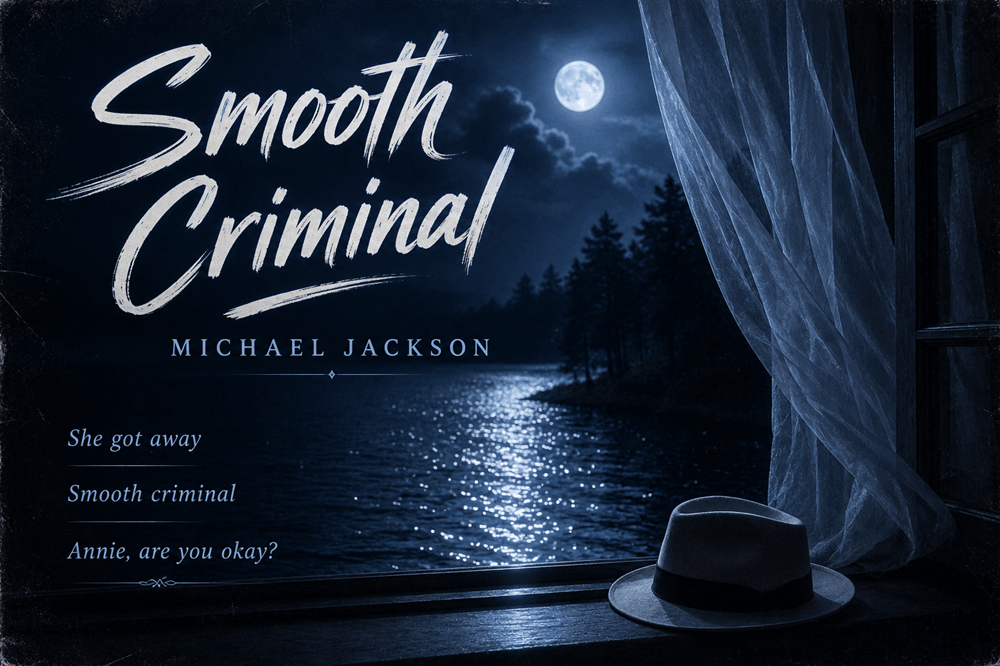
“Smooth Criminal” Lyrics Meaning: Michael Jackson’s Song About Violence, Shock and a Victim Named Annie
Michael Jackson’s “Smooth Criminal” is about a woman named Annie who has been violently attacked inside her home.
The narrator reconstructs the scene through scattered details: an intruder enters, Annie is struck, blood is discovered and people repeatedly try to determine whether she survived. Rather than explaining the crime calmly, the song traps listeners inside the confusion immediately after it happens.
Its central meaning is:
“Smooth Criminal” is about the terrifying gap between witnessing evidence of violence and not knowing whether the victim can still be saved.
The title describes the attacker. He is “smooth” because he appears controlled, efficient and difficult to stop. The polished word contrasts with the brutality of the crime, making him seem even more disturbing.
Although the recording is famous for its dance routine, white suit and impossible-looking forward lean, its story is much darker than its visual elegance suggests.
Listeners can hear the complete recording through Michael Jackson’s official “Smooth Criminal” short film. The song was written and composed by Jackson, produced by Quincy Jones and co-produced by Jackson for the 1987 album Bad.
What is “Smooth Criminal” about?
“Smooth Criminal” describes the aftermath of an attack on Annie.
The song does not begin by introducing her personality, relationship history or ordinary life. It begins with evidence that something has gone badly wrong.
Annie appears to have been surprised inside her apartment. The attacker enters, harms her and leaves behind a scene that other people must interpret.
The narration focuses on:
- The point of entry
- The physical attack
- Blood inside the home
- Annie collapsing
- People questioning her condition
- The possibility that the attacker escaped
This approach makes the song feel like a crime report that has been broken into fragments.
Listeners understand that Annie is in danger, but they never receive a complete explanation of who attacked her, why she was targeted or whether she ultimately survives.
That uncertainty drives the song.
Who is Annie?
Within the story, Annie is the victim of the attack.
Very little is revealed about her beyond what happened to her. She is not given a detailed identity because the song concentrates on the emergency rather than her biography.
This has an unsettling effect.
Annie becomes recognizable mainly through other people’s concern. The repeated question about her condition suggests that someone is trying to wake her, assess her injuries or determine whether she is responsive.
Her lack of characterization can also make her feel universal.
She could represent anyone whose ordinary private space suddenly becomes unsafe.
The song does not turn her into a romantic interest or a dramatic villain. She is simply a person caught in an act of unexplained violence.
Is Annie a real person?
There is no confirmed evidence that “Smooth Criminal” recounts a specific real assault involving a woman named Annie.
The name is widely associated with Resusci Anne, the CPR training mannequin used to teach people how to check responsiveness and perform resuscitation.
Resusci Anne was developed by Åsmund S. Lærdal with physicians Peter Safar and Bjørn Lind as an early realistic CPR training mannequin. Its face was inspired by a death mask associated with an unidentified young woman found in the River Seine.
During CPR training, rescuers may address an unresponsive person while checking whether they react. That medical context closely matches the urgent questioning in “Smooth Criminal.”
However, it is safest to treat the connection as a strong and widely accepted explanation rather than claim that Jackson publicly provided a detailed, definitive origin story for Annie.
Within the song itself, Annie functions as a fictional victim whose condition remains uncertain.
Why does everyone keep asking whether Annie is okay?
The repeated question sounds like an attempt to check consciousness after a serious injury.
It may be spoken by:
- A witness
- A friend
- A medical responder
- The narrator
- Several people gathered around her
The song never identifies the speaker clearly. That ambiguity makes the repetition feel collective, as though the entire scene has become focused on Annie’s survival.
The question also serves several emotional purposes.
It communicates panic
The speaker does not have enough information to make a calm statement. Repetition reflects fear and disbelief.
It keeps Annie at the center
The song may be named after the criminal, but the emotional focus remains on the victim.
It creates suspense
Listeners never receive a clear answer. Every repetition renews the uncertainty.
It resembles an emergency check
The wording feels immediate and practical rather than poetic. Someone may literally be trying to make Annie respond.
The repetition is memorable because it combines rhythm with helplessness. The people around Annie can ask the question, but they cannot guarantee the answer.
What does “smooth criminal” mean?
A smooth criminal is someone who commits a crime with confidence, precision and apparent control.
“Smooth” can describe a person who is:
- Calm under pressure
- Persuasive
- Stylish
- Difficult to read
- Skilled at avoiding suspicion
- Able to escape before others understand what happened
The adjective does not praise the attacker morally.
Instead, it emphasizes how dangerous he is.
A visibly nervous or disorganized criminal may make mistakes. A smooth criminal seems prepared. He enters, acts quickly and leaves others struggling to reconstruct the event.
The title also creates a deliberate contradiction.
“Smooth” sounds elegant.
“Criminal” describes someone who has caused violence and terror.
That contrast became central to the song’s identity. Jackson performs the story with extraordinary control while describing a situation in which control has been violently taken away from Annie.
Why is the attacker never identified?
The criminal is defined more by his method than by his identity.
Listeners are not told:
- His name
- His relationship to Annie
- His motive
- Whether he planned the attack
- Whether he was caught
This makes him feel less like a complete character and more like a threatening presence.
The song concentrates on what he leaves behind: damage, confusion and uncertainty.
Keeping him unidentified also prevents the story from becoming a conventional detective narrative. The main question is not “Who did it?”
The immediate question is whether Annie is alive.
That choice gives the song emotional urgency. Solving the crime can happen later. First, someone must respond to the injured person.
Why does the song sound exciting when the story is violent?
“Smooth Criminal” uses a tense, danceable rhythm rather than slow, mournful music.
That contrast is one of its defining qualities.
The beat suggests:
- Pursuit
- A racing heartbeat
- An alarm
- Rapid footsteps
- A crime unfolding in real time
Jackson’s sharply controlled delivery makes the narration feel urgent without becoming chaotic. The music moves with the precision associated with the criminal in the title.
This creates an uncomfortable attraction.
The listener is drawn into a stylish performance while hearing a story about an assault.
The recording does not allow the audience to remain emotionally distant. Its rhythm makes the danger feel physical.
You do not simply hear about the scene.
You feel pushed through it.
Is the narrator a witness?
Possibly, although the song never confirms his exact role.
The narrator knows enough details to describe the intrusion and Annie’s injuries, but that knowledge could come from direct observation, evidence found later or a story being retold.
He might be:
- Someone who discovered Annie
- A witness reconstructing the attack
- A detached storyteller
- A voice representing the people around her
- A performer dramatizing the event
His emotional position is also difficult to define.
He sounds urgent, but he does not pause to explain his personal relationship with Annie. The rapid narration leaves little room for grief or reflection.
That makes him resemble someone reporting an emergency while it is still unfolding.
The lack of a fixed narrator also helps the song function like a cinematic scene. Different voices, questions and observations seem to move around Annie rather than coming from one clearly identified person.
Why is Annie’s apartment important?
A home normally represents privacy and safety.
The attack becomes more disturbing because it appears to happen inside Annie’s own space.
An intruder entering an apartment crosses several boundaries at once:
- Physical security
- Personal privacy
- Emotional safety
- Control over one’s surroundings
The setting suggests that Annie did not knowingly enter a dangerous environment. Danger came to her.
The apartment also limits the scene.
Instead of an attack occurring in a public place with many witnesses, it takes place somewhere enclosed. That may explain why so much remains uncertain and why the aftermath must be reconstructed from physical evidence.
Once violence enters the home, even familiar objects and rooms become part of the crime scene.
Why does the song focus on blood and physical evidence?
The story is told through observable details rather than emotional explanation.
Blood confirms that the danger is real. It is not merely a threat, argument or frightening misunderstanding.
The physical evidence tells the audience what the narrator cannot fully explain:
- Annie was seriously hurt.
- The confrontation became violent.
- The criminal left before the situation was understood.
- Something irreversible may have happened.
This makes the song resemble visual storytelling.
Jackson does not need to describe the attacker’s personality at length. The condition of the room reveals the result of his actions.
The lyrics offer enough information to create a scene while withholding enough to keep it unresolved.
What is the meaning of the heartbeat-like opening?
The song’s opening creates the impression of a body under stress.
It can be heard as a heartbeat, mechanical pulse or medical signal, immediately connecting the music with Annie’s uncertain physical condition.
The pulse also establishes the track’s relentless movement.
Once it begins, the song rarely feels relaxed. Its rhythm keeps pushing forward, as though time is running out.
Symbolically, the heartbeat can represent:
- Annie’s life hanging in the balance
- The panic of those who find her
- The listener’s physical response to danger
- The criminal’s calculated timing
- The countdown-like tension of an emergency
Whether interpreted medically or cinematically, the opening prepares listeners to enter a scene where the body itself has become evidence.
How does the music video change the song’s meaning?
The official short film expands the song from a contained crime story into a stylized battle between Michael Jackson’s character and an organized criminal world.
The musical sequence takes place in “Club ’30s,” a fantasy nightclub filled with gangsters, dancers and sharply dressed figures. Jackson enters wearing a white pinstripe suit and fedora before taking control of the room through dance.
The visual design draws partly from classic Hollywood gangster films and Fred Astaire’s “Girl Hunt Ballet” sequence in The Band Wagon.
This setting shifts the emphasis.
In the audio recording, the smooth criminal appears to be the attacker.
In the short film, Jackson himself adopts the appearance and confidence of a stylish underworld figure while opposing a larger villain.
That creates deliberate ambiguity. He looks as smooth as the criminal described in the song, but the film positions him as a heroic presence.
The result separates style from morality.
A person may look dangerous without being the true threat, while a powerful villain may hide behind respectability and control.
What is the anti-gravity lean supposed to represent?
The famous forward lean is primarily a choreographic spectacle, but it also fits the song’s central ideas.
Jackson and the dancers tilt beyond what appears physically possible while keeping their bodies controlled.
The move visually expresses:
- Defiance of normal limits
- Extreme balance
- Danger without visible panic
- The illusion of supernatural control
- A world in which ordinary rules no longer apply
That makes it ideal for “Smooth Criminal.”
The song describes a violent event through precise rhythm. The lean similarly presents apparent instability through precise movement.
The official Michael Jackson description identifies the short film as the debut of the iconic anti-gravity lean.
It became so closely associated with the song that many people remember the choreography before they think about Annie’s story.
How does Moonwalker expand the story?
The “Smooth Criminal” short film serves as a major sequence in Jackson’s 1988 film Moonwalker.
Within that larger story, Michael and several children confront Mr. Big, a drug lord played by Joe Pesci. Mr. Big plans to make children dependent on drugs, turning the film into a fantasy struggle between innocence and organized corruption.
This plot is not contained in the original song lyrics.
It is a cinematic framework built around them.
The connection works because both stories involve vulnerable people facing calculated violence. Annie is attacked inside her home, while the children in Moonwalker are threatened by a powerful criminal operation.
In each version, the criminal is dangerous partly because he acts with planning and confidence.
Who wrote “Smooth Criminal”?
Michael Jackson wrote and composed the song.
Quincy Jones produced the recording, with Jackson serving as co-producer. It appears on Jackson’s seventh studio album, Bad, released in August 1987.
The single followed in October 1988.
The recording reflects a major feature of Jackson’s writing: he often built songs around rhythm, sound effects and physical movement as much as conventional narrative explanation.
“Smooth Criminal” can be understood even before every word is processed.
The pulse, sharp vocal sounds and repeated emergency question create the scene immediately.
How successful was “Smooth Criminal”?
“Smooth Criminal” became another major international hit from Bad.
It reached the Top 10 in several countries and peaked at No. 8 on the UK Official Singles Chart. The track later returned to the British chart in 2006 and again following Jackson’s death in 2009.
Its long-term reputation has been shaped as much by the short film and choreography as by its original chart position.
The white suit, fedora, nightclub set and anti-gravity lean turned the song into one of Jackson’s most recognizable visual works.
Why did the Alien Ant Farm version become popular?
Alien Ant Farm released a rock cover of “Smooth Criminal” in the early 2000s.
Their version replaced much of Jackson’s tightly controlled pop and funk production with distorted guitars and a more aggressive band sound.
The cover worked because the original composition was already rhythmically strong. Its urgent structure could survive a major stylistic change without losing its identity.
Alien Ant Farm’s version reached No. 3 on the UK Singles Chart and topped the UK Rock & Metal Singles Chart.
The cover also introduced the story and chorus to a younger rock audience, helping “Smooth Criminal” remain culturally visible beyond Jackson’s original era.
What is the deeper meaning of “Smooth Criminal”?
The song’s deeper meaning lies in the contrast between polished performance and uncontrolled violence.
Almost everything about the recording appears precise:
- The beat
- Jackson’s delivery
- The criminal’s method
- The choreography
- The visual styling
Annie’s condition is the one thing nobody can control.
That contrast makes the title more disturbing.
The criminal may be smooth, but the aftermath is not. His apparent competence leaves other people panicked, repetitive and uncertain.
The song also reveals how quickly a person can become reduced to a question during an emergency.
Annie is no longer described through her ambitions, relationships or ordinary identity. Everything narrows to whether she can respond.
The repeated concern sounds compassionate, but it also demonstrates how violence interrupts a life and replaces it with a crisis.
Final meaning
“Smooth Criminal” is about a woman named Annie who is attacked inside her apartment by a controlled and efficient intruder.
The lyrics describe the aftermath through physical evidence, urgent questions and incomplete information. The listener knows that Annie has been badly hurt but never learns exactly who attacked her, why he did it or whether she survives.
The title refers to the attacker’s composure.
He is “smooth” not because his actions are admirable, but because he appears skilled at entering, causing harm and escaping before anyone can stop him.
The song’s music intensifies that meaning. Its relentless pulse resembles a heartbeat or emergency signal, while Jackson’s precise delivery mirrors the criminal’s calculated movement.
The short film adds a glamorous 1930s gangster world, classic-Hollywood influences and the famous anti-gravity lean. Those images make “Smooth Criminal” look elegant, but the original story remains brutal.
That contrast explains the song’s lasting power.
It presents violence through extraordinary control while keeping one question unresolved:
After all the rhythm, movement and spectacle, can Annie still answer?