
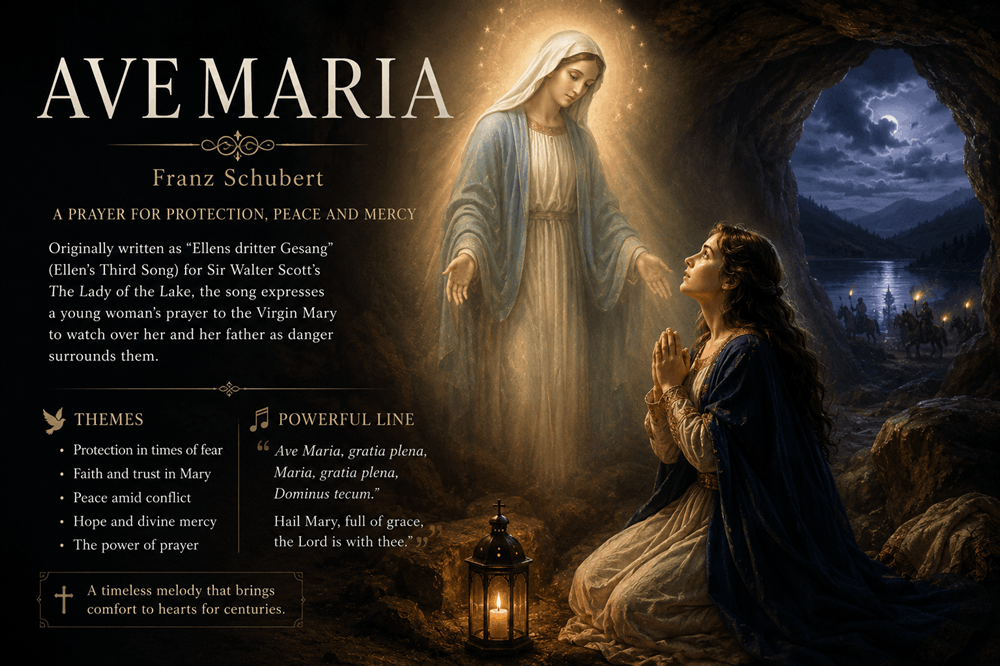
“Ave Maria” Lyrics Meaning: Schubert’s Prayer for Protection, Peace and Mercy
Franz Schubert’s “Ave Maria” is about a frightened young woman asking the Virgin Mary to protect her family during a time of violence and uncertainty.
Although the piece is now commonly performed using the traditional Latin Hail Mary prayer, Schubert did not originally compose it as a setting of that complete prayer. Its original title was “Ellens dritter Gesang,” or “Ellen’s Third Song,” and its words came from a German translation of Sir Walter Scott’s narrative poem The Lady of the Lake.
The song’s central meaning is:
When human safety disappears, prayer offers a place where fear can be expressed and peace can still be imagined.
Ellen is hiding with her exiled father while conflict gathers around them. She appeals to Mary not from a peaceful church but from a cave surrounded by danger.
That context explains why Schubert’s melody feels both comforting and sorrowful. The music creates calm, but the person singing has not yet escaped the situation that frightens her.
Listeners can hear historical recordings through the Library of Congress’s National Jukebox collection or explore the original score and German text through IMSLP.
What is “Ave Maria” about?
Schubert’s original song is a prayer spoken by Ellen Douglas, a character in Walter Scott’s The Lady of the Lake.
Ellen and her father have been forced into hiding because of a political conflict involving King James V of Scotland and the Highland leader Roderick Dhu. They seek refuge in a cave while armed men prepare for battle.
Inside that uncertain setting, Ellen asks the Virgin Mary to watch over them.
Her prayer expresses:
- Fear for her father and herself
- Trust in Mary’s protection
- A desire for peace during the night
- Hope that threatening forces will remain outside
- Willingness to accept God’s will
- The need to feel less alone
The song is therefore not simply a general celebration of Mary.
It is a prayer arising from immediate danger.
In Scott’s poem, Roderick Dhu hears Ellen singing as he passes nearby with his warriors. Her quiet appeal for mercy exists beside preparations for violence, creating a strong contrast between prayer and war.
What does “Ave Maria” mean?
“Ave Maria” is Latin for “Hail Mary.”
The expression is a greeting addressed to Mary, the mother of Jesus. “Ave” can be understood as “hail,” while Christian interpretation also connects the greeting with an invitation to rejoice. Pope John Paul II explained that the prayer recalls the angel’s greeting to Mary and directs attention toward the Incarnation—the Christian belief that Jesus became human through her.
In the traditional Hail Mary prayer, the speaker:
- Greets Mary as someone who has received God’s grace.
- Acknowledges Jesus as the blessed child she carried.
- Asks Mary to pray for sinners.
- Requests her intercession both now and at the time of death.
The United States Conference of Catholic Bishops provides the complete traditional prayer on its official Hail Mary page.
The prayer does not ask Mary to replace God.
It asks her to intercede—to pray on behalf of the person speaking.
Are Schubert’s original lyrics the traditional Hail Mary?
No.
This is the most important fact to understand about the song.
Schubert’s melody is now frequently performed with the Latin Hail Mary prayer, but his original composition used German words adapted from Walter Scott’s The Lady of the Lake.
The original song begins and repeatedly returns to “Ave Maria,” but the rest of the text describes Ellen’s particular fears and surroundings.
She asks Mary to:
- Hear a young woman’s prayer
- Protect those sleeping in the cave
- Drive away threatening forces
- Bring comfort to troubled hearts
- Help them submit peacefully to God’s will
Because the opening invocation fit so naturally with the Catholic prayer, performers later began singing the full Latin text to Schubert’s melody.
That version became so familiar that many listeners now assume Schubert composed the tune specifically for the standard Hail Mary. Classic FM notes that this is a common misconception: Schubert wrote “Ellen’s Third Song,” not a piece originally titled simply “Ave Maria.”
Who is Ellen?
Ellen Douglas is the central woman in Scott’s The Lady of the Lake.
She is caught inside a conflict she did not create. Political exile, family loyalty, romantic rivalry and the threat of war all place pressure on her life.
By the time she sings the prayer, she and her father have taken shelter in the Goblin’s Cave near Loch Katrine in the Scottish Highlands.
Ellen is not praying from a position of religious certainty untouched by fear.
She is afraid.
That makes her prayer emotionally believable.
She turns to Mary because she needs a maternal protector—someone imagined as gentle enough to hear a frightened young woman yet powerful enough to offer safety against the violence outside.
The song’s tenderness comes from this relationship between two female figures:
- Ellen, the vulnerable daughter trying to protect her family
- Mary, the spiritual mother asked to shelter them
What does the cave symbolize?
The cave is both a refuge and a reminder of danger.
Its walls protect Ellen and her father from people searching for them. At the same time, hiding inside a cave confirms that they have lost the ordinary security of home.
The setting can symbolize:
- Isolation
- Exile
- Fear of discovery
- Temporary protection
- Darkness before relief
- A retreat from human conflict
Ellen’s prayer changes the meaning of the space.
Without prayer, the cave is only a hiding place.
Through prayer, it becomes a temporary sanctuary.
This transformation helps explain why “Ave Maria” is often associated with sacred spaces even though the original scene does not take place in a church. Ellen creates holiness through the act of praying where she is.
Why does Ellen pray to Mary?
Ellen sees Mary as someone capable of understanding both vulnerability and maternal fear.
In Christian tradition, Mary is associated with gentleness, obedience, grace and protection. She is also a mother who experiences uncertainty, suffering and the eventual death of her son.
Ellen therefore appeals to a figure who seems close enough to human pain to understand it.
She does not ask for victory over her enemies.
She asks for safety and peace.
That distinction matters.
The prayer is defensive rather than triumphant. Ellen is not trying to destroy the people outside the cave. She wants violence to remain distant and for the frightened people beside her to survive the night.
What do the threatening spirits represent?
The original text describes dark or hostile forces that should retreat before Mary’s presence.
These can be understood literally within the poem’s religious and supernatural language. They can also symbolize the human dangers surrounding Ellen.
The threatening forces may represent:
- Armed enemies
- Fear inside the cave
- Nightmares
- Political violence
- Despair
- The feeling that evil is approaching
Ellen believes Mary’s presence can restore order.
The prayer does not necessarily remove every external threat immediately. Its first effect is internal: it gives Ellen a way to contain fear.
By naming a protector greater than the danger, she prevents the danger from controlling her entire mind.
Why does the music sound peaceful if Ellen is in danger?
Schubert’s music expresses the peace Ellen is seeking rather than the violence surrounding her.
The piano accompaniment moves in a continuous, gently flowing pattern. It can sound like a harp, a rocking cradle or quiet water.
Above that movement, the vocal melody unfolds slowly and repeatedly returns to the same invocation.
The effect is not dramatic panic.
It is controlled pleading.
This musical restraint suggests that Ellen is trying to calm herself and the people around her. The external situation may be unstable, but the prayer creates an inner rhythm that remains steady.
The contrast produces the song’s emotional power:
- The setting is dangerous.
- The melody is serene.
- Ellen is frightened.
- Her prayer sounds trusting.
- The future is uncertain.
- The music briefly makes peace feel possible.
The listener hears both fear and comfort without the song needing to become loud.
Is “Ave Maria” a sad song?
It is sorrowful, but not hopeless.
The song contains fear, exile and the possibility of violence. Ellen does not know whether her family will remain safe.
Yet she continues to pray because she believes protection may still be possible.
The sadness comes from vulnerability.
The hope comes from trust.
This balance allows “Ave Maria” to fit many different emotional occasions. It can express grief without becoming despairing and peace without sounding emotionally empty.
The melody acknowledges suffering while offering somewhere for that suffering to rest.
Is Schubert’s “Ave Maria” a Catholic hymn?
It became closely associated with Catholic devotion, but its origin is more complicated.
Schubert’s original composition was a Romantic art song for solo voice and piano, based on a literary poem translated into German. IMSLP identifies the original work as D. 839, Op. 52, No. 6, composed in April 1825 and published in 1826.
Because Ellen’s prayer repeatedly invokes Mary, the music easily entered religious performance traditions.
The later use of the complete Latin Hail Mary strengthened that association.
Today, the melody may be heard:
- In churches
- At funerals
- At weddings
- During memorial services
- In concerts
- In films
- In instrumental arrangements
- As private devotional music
Its sacred reputation is therefore genuine, even though Schubert’s starting point was a literary scene rather than the full Catholic prayer.
Why is “Ave Maria” often performed at funerals?
The traditional Latin text asks Mary to pray for people “now and at the hour of our death.” That request naturally connects the prayer with mortality, comfort and the hope of spiritual protection.
Schubert’s music adds emotional qualities well suited to mourning:
- A slow pace
- A gentle melody
- Repetition that resembles prayer
- A sense of solemn acceptance
- Comfort without forced happiness
The piece does not deny death or attempt to make grief disappear.
Instead, it creates a quiet space around grief.
For mourners, the music can express emotions that are difficult to state directly: sadness, love, fear, gratitude and the hope that the person who died is now at peace.
Why is it also performed at weddings?
At weddings, “Ave Maria” can represent blessing, devotion and a request for guidance.
Mary is often associated with faithful love, family and spiritual protection. A couple may choose the prayer as a way of placing their marriage within a religious tradition.
The melody also carries a sense of tenderness and seriousness.
Unlike a triumphant wedding march, it creates a reflective moment. It reminds the couple and congregation that love involves vulnerability, trust and the need for support beyond individual strength.
However, practices differ among churches and ceremonies, so couples typically need to discuss musical selections with the relevant officiant or parish.
Who wrote “Ave Maria”?
The answer depends on which part of the work is being discussed.
Franz Schubert wrote the music
He composed “Ellens dritter Gesang” in 1825 when he was 28 years old.
Sir Walter Scott wrote the original poetic scene
The words came from his 1810 narrative poem The Lady of the Lake. The complete poem is available through Project Gutenberg.
Adam Storck created the German translation
Schubert set Storck’s German adaptation rather than Scott’s original English words.
The traditional Hail Mary developed separately
The familiar Catholic prayer combines biblical greetings to Mary with a later request for her intercession.
Schubert did not write the prayer itself. His melody was later paired with its Latin words.
Is Schubert’s “Ave Maria” the same as Bach and Gounod’s?
No.
Two famous pieces are frequently called “Ave Maria,” and they are different compositions.
Schubert’s “Ave Maria”
Schubert wrote an original melody and piano accompaniment for Ellen’s prayer from The Lady of the Lake.
Bach-Gounod’s “Ave Maria”
Charles Gounod composed a new vocal melody over Johann Sebastian Bach’s Prelude No. 1 in C major. Gounod’s adaptation was published in the 1850s and later became another famous setting of the Latin prayer.
Bach himself did not compose an “Ave Maria” vocal setting. His keyboard prelude existed first, and Gounod placed the later melody above it.
Both works are often heard at religious ceremonies, and both are known simply as “Ave Maria,” which can cause confusion.
Why do different recordings have different words?
Performers may choose from several traditions.
A recording might use:
- Schubert’s original German text
- Walter Scott’s English poetic text
- The traditional Latin Hail Mary
- A translated version of the prayer
- An instrumental arrangement without words
- A specially adapted text for film or performance
This flexibility helped the melody spread across countries and religious traditions.
Listeners may recognize the tune while hearing completely different language.
The Library of Congress preserves early vocal and instrumental recordings under both “Ave Maria” and “Ellens Gesang,” showing how quickly the piece moved beyond its original voice-and-piano form.
Why has the melody become so famous?
The music communicates devotion even when listeners do not understand the words.
Its emotional direction is immediately clear.
The melody rises as though reaching upward, then settles gently. The accompaniment continues beneath it with a steadiness that feels protective.
This makes the piece adaptable to many experiences:
- Prayer
- Grief
- Romantic commitment
- Fear
- Reflection
- Hope
- Remembrance
The melody is also technically suited to expressive singers. A performer can shape its long phrases with great intimacy or fill a large space with operatic power.
That flexibility has allowed the song to be recorded by opera singers, choirs, popular vocalists and instrumentalists.
Its meaning can remain personal even when the performance becomes grand.
What is the deeper meaning of “Ave Maria”?
The deeper meaning concerns the human need for protection when control has been lost.
Ellen cannot stop the political conflict surrounding her. She cannot guarantee her father’s safety or force armed men to choose peace.
What she can do is pray.
Prayer does not give her physical control over the situation. It gives her a language for fear and a relationship with someone she believes can hear it.
The song therefore presents faith not as the absence of terror but as a response to terror.
Ellen is brave because she continues to hope while hiding.
The melody preserves that hope. It creates the sound of peace before peace has actually arrived.
Final meaning
Schubert’s “Ave Maria” is about Ellen Douglas asking the Virgin Mary to protect her and her father while they hide from political violence.
The original composition was not a setting of the complete Latin Hail Mary prayer. Schubert wrote “Ellen’s Third Song” using Adam Storck’s German translation of words from Walter Scott’s The Lady of the Lake.
Ellen prays inside a cave, asking Mary to hear her fear, drive away threatening forces and bring peace to those sheltering beside her.
Later performers began singing the traditional Latin prayer to Schubert’s melody. That version became so popular that the piece gradually entered churches, weddings, funerals and devotional traditions around the world.
Both versions share the same emotional center.
A vulnerable person reaches toward Mary for protection, mercy and reassurance.
The music does not promise that suffering will disappear immediately. It offers something quieter: the belief that fear can be heard, grief can be held and peace can exist even before the darkness outside has passed.