“November Rain” Lyrics Meaning: Love, Fear, and Change
Guns N’ Roses’ “November Rain” is often described as a breakup song, but its emotional conflict is more complicated than two people simply deciding to separate.
The narrator still wants love. What he no longer trusts is the idea that love can remain effortless, unchanged, or protected from fear. Both people seem guarded, and neither appears certain that the relationship can survive the strain surrounding it.
The song moves between two needs that may seem contradictory: the need for distance and the need for companionship. It accepts that feelings and relationships change without concluding that love is pointless.
Listen to “November Rain” and read the full lyrics
We do not reproduce the complete copyrighted lyrics here, but you can read and follow every line through these authorized music services:
- Read the complete “November Rain” lyrics on Apple Music — sign in and select View Full Lyrics. This page accompanies the official 2022 orchestral version.
- Read the lyrics on Shazam — the lyrics are supplied through Musixmatch, alongside recording information and video access.
- Listen to the original 1991 recording on Apple Music — this is the familiar Use Your Illusion I album version.
- Watch the official “November Rain” music video — the current official upload is synchronized with the updated 2022 orchestral audio.
Apple Music explicitly provides a sign-in option to view the complete lyrics, while Shazam presents licensed lyrics powered by Musixmatch. The original and 2022 versions use the same words; the principal difference is the orchestral arrangement.
“November Rain” at a glance
- Artist: Guns N’ Roses
- Album: Use Your Illusion I
- Album released: September 17, 1991
- Released as a single: 1992, with dates varying by market
- Songwriter: Axl Rose
- Original duration: 8 minutes, 56 seconds
- Producers: Mike Clink and Guns N’ Roses
- Music-video director: Andy Morahan
Apple Music dates Use Your Illusion I to September 17, 1991 and lists the original track at 8:56. In the United Kingdom, “November Rain” reached No. 4 on the Official Singles Chart.
What is “November Rain” about?
“November Rain” is about a relationship strained by fear, uncertainty, and the recognition that love cannot be guaranteed forever.
The narrator senses emotional restraint in his partner, but he does not present himself as completely open or fearless. He admits that he feels a similar hesitation. The problem belongs to both people.
That mutual uncertainty matters. This is not simply a story about one devoted partner pursuing someone who feels nothing. It describes two people who may still care deeply for each other but have become afraid of what emotional closeness requires.
The narrator does not demand an immediate decision. He asks for time and honesty, suggesting that the relationship may still have a future if both people can acknowledge what they have been avoiding.
The song never tells us whether they succeed. It leaves the couple at a difficult threshold: they can continue protecting themselves from possible pain, or they can accept that loving another person always involves uncertainty.
What does “November rain” symbolize?
November stands between autumn and winter. Warmth is fading, the days are becoming darker, and the colder season is approaching.
That makes it an effective setting for a relationship that has not completely ended but no longer feels safe or secure.
Rain can suggest several connected experiences:
- Grief and disappointment
- An emotional period that cannot simply be avoided
- Feelings outside either partner’s control
- Cleansing and gradual change
- A storm that feels overwhelming but will eventually pass
The most important point is that the rain’s meaning changes as the song develops.
At first, the cold weather threatens whatever warmth remains between the couple. Later, the narrator realizes that the rain itself cannot continue indefinitely.
The central image therefore contains both fear and hope. Love may change, but the pain surrounding that change can also pass.
The candle in the cold rain
The candle presents love as something warm but vulnerable.
A flame can illuminate darkness and provide comfort, but it needs protection. Cold rain creates conditions in which even a carefully maintained flame may struggle to survive.
The candle can therefore be read as the relationship itself. Affection may still be present, but distrust, emotional distance, and fear have made it difficult to preserve.
This is an editorial interpretation rather than a confirmed explanation from Axl Rose. The image does not necessarily represent only one person carrying an unreturned love. Because the song establishes hesitation on both sides, the threatened flame more naturally represents a connection that both people are struggling to maintain.
The two meanings of “nothing lasts forever”
The statement “nothing lasts forever” initially sounds pessimistic.
It recognizes that feelings can change, relationships can weaken, and promises cannot prevent every loss. Even sincere love cannot be guaranteed to remain exactly as it began.
Wanting permanence does not make permanence possible.
When the idea returns later, however, its emotional purpose changes. If nothing lasts forever, then fear, loneliness, and the “cold November rain” cannot last forever either.
The statement supports two opposing truths:
- Love and happiness are vulnerable to change.
- Pain and emotional distance are also temporary.
This reversal gives the song much of its depth. “November Rain” does not promise that the couple will remain together, but neither does it treat their current suffering as permanent.
Impermanence is frightening because good things can end. It is also comforting because difficult seasons end too.
Solitude versus companionship
The narrator repeatedly accepts that both people may need time alone.
Within the song, solitude appears to offer space for reflection. The couple has been struggling, and their attempts to avoid pain may have created further confusion rather than resolving anything.
Time apart does not automatically mean the relationship is finished. It may allow each person to understand feelings that are difficult to examine while they remain caught in the conflict.
The song later turns toward the belief that “everybody needs somebody.” That does not cancel the earlier need for space. Instead, it acknowledges that solitude cannot satisfy every emotional need.
A person may require distance without wanting permanent isolation. The narrator appears to believe that reflection and human connection can both be necessary.
The ending also makes the couple’s fear feel less shameful. Neither person is uniquely weak for needing support. Loneliness and the desire for companionship are presented as shared human experiences.
Is “November Rain” hopeful or sad?
The song is both.
It is sad because the narrator accepts that love can change and that no promise can eliminate uncertainty. Neither person appears confident that the relationship will survive.
It is hopeful because he refuses to treat their current pain as the final condition of their lives.
The rain may be cold, but it will end. Emotional distance may be real, but it does not make reconciliation impossible. The couple may need time apart without losing every possibility of connection.
The song’s hope is cautious rather than naïve. It does not claim that patience will save every relationship. It suggests that fear should not make the decision before honesty has been attempted.
How the music tells the same story
“November Rain” begins as a measured piano ballad and gradually expands into a large orchestral rock performance.
That structure mirrors the narrator’s emotional movement. He begins cautiously, trying to discuss the relationship without forcing an answer. As the recording progresses, restraint becomes increasingly difficult to maintain.
The arrangement passes through several distinct stages:
- Quiet uncertainty
- A careful attempt at emotional honesty
- Expanding orchestral intensity
- Instrumental emotional release
- A darker and more urgent final movement
Axl Rose had been developing the composition for years before it appeared on Use Your Illusion I. Early versions were considerably longer than the finished recording. An early documented take ran for about 18 minutes, while Slash later joked that the song had once lasted roughly 25 minutes.
That long development helps explain why the finished track feels less like a conventional radio single and more like a sequence of connected emotional movements.
The song does not simply repeat one mood. It grows from hesitation into desperation.
Why Slash’s guitar solos matter
Slash’s guitar solos are not merely technical showcases placed between Axl Rose’s vocal sections. They give the song another emotional voice.
The earlier passages are melodic and relatively patient. They complement the narrator’s cautious attempt to communicate without becoming confrontational.
As the arrangement grows, the guitar becomes more forceful. The final solo arrives after the music has shifted into a darker section and can feel like an emotional release after the narrator has exhausted what he can say directly.
The final solo also avoids giving the relationship a neat answer. It turns unresolved feeling into sound rather than explaining what the couple eventually decides.
MusicRadar notes that the closing section moves into a minor key, with Slash using the final solo to create greater tension and suspense.
The song reaches an enormous musical climax, but the human conflict remains open.
The 2022 orchestral version
In 2022, Guns N’ Roses released a revised version of “November Rain” for the anniversary reissue of the Use Your Illusion albums.
The updated track retains the central band performance while replacing the original sampled orchestral elements with a newly recorded 50-piece orchestra arranged and conducted by Christopher Lennertz.
The new orchestration gives the strings and other instruments a more physical sense of movement and space, especially during the song’s largest transitions.
The official music video was also resynchronized with the 2022 audio.
The update does not replace the importance of the 1991 recording. The original remains the version through which the song became famous. The 2022 edition instead offers another way to hear the scale Rose imagined for the arrangement.
What does the “November Rain” music video mean?
The famous video tells a related but separate story.
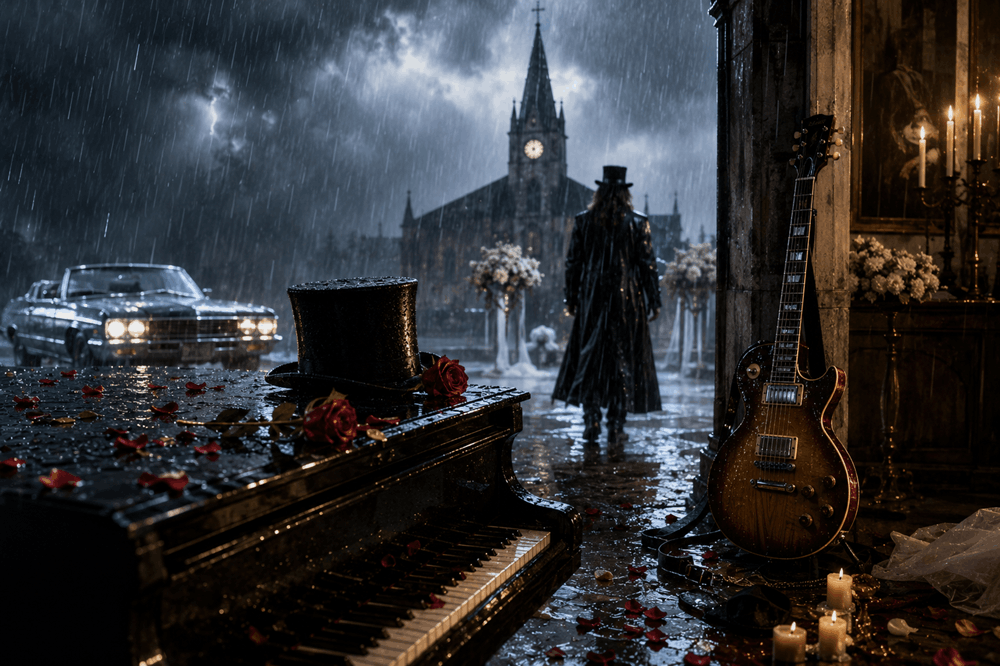
It follows a couple played by Axl Rose and Stephanie Seymour through an elaborate church wedding, an outdoor reception interrupted by rain, and a funeral at which Rose’s character mourns his bride.
Directed by Andy Morahan, the video was loosely inspired by Del James’s short story Without You, about a rock musician haunted by the death of a former partner. James has discussed the story’s role in inspiring the production, and the connection is acknowledged in accounts of the video’s creation.
The video transforms the song’s themes of love, impermanence, and fear of loss into a literal tragedy.
The wedding represents romantic commitment. The funeral turns emotional uncertainty into permanent physical separation. Sudden rain connects the celebration and disaster, making the weather a visual force rather than only a lyrical metaphor.
However, the song itself never mentions a wedding, a dead bride, or a funeral. The video should not be treated as a direct illustration of every line.
How does the bride die?
The video never clearly shows how the bride dies.
Viewers move from the chaotic wedding reception to the funeral without seeing the event that caused her death. A mirrored panel covers part of her face inside the casket, but the video does not explain why it is there.
The short story that influenced the production involves a woman dying by suicide, which has shaped many interpretations of the funeral scene. The video itself, however, does not explicitly confirm suicide, a gunshot, or any other precise cause.
That distinction matters. Details from Without You can illuminate the video’s background, but they should not automatically be treated as events visibly shown onscreen.
The unexplained transition also fits the video’s dreamlike construction. Its emotional movement from celebration to grief matters more than presenting a complete and logically detailed plot.
Why does someone jump through the wedding cake?
When the rain begins during the outdoor reception, guests rush for shelter. One man dives through the wedding cake rather than simply moving around it.
The scene has inspired years of questions, but director Andy Morahan has declined to supply a definitive symbolic explanation.
The destruction of the cake can be read as visual shorthand for a carefully planned celebration collapsing into disorder. Something created to represent a perfect occasion is ruined within seconds.
That remains an interpretation. The moment also reflects the video’s preference for spectacle over realistic behavior. It is exaggerated, strange, and memorable—qualities shared by much of the production.
The correct Guns N’ Roses video trilogy
“November Rain” is commonly placed within an unofficial trilogy of ambitious Guns N’ Roses videos:
- “Don’t Cry”
- “November Rain”
- “Estranged”
All three were directed by Andy Morahan. They share emotional themes, characters, and a similarly grand visual style, although they do not form a perfectly continuous plot.
In an interview about the trilogy, Morahan described the videos as reflecting the fractured condition of the band during the Use Your Illusion era rather than following one tightly controlled narrative.
The official Guns N’ Roses upload of “Estranged” remains available through the band’s YouTube channel, and contemporary discussions consistently identify it as the third entry after “Don’t Cry” and “November Rain.”
Stephanie Seymour appeared in “Don’t Cry” and “November Rain,” but her real-life relationship with Rose ended before the production of “Estranged.” The final video consequently moved toward a more abstract and surreal visual direction.
“This I Love” is not part of the trilogy.
Is the video the literal meaning of the song?
No.
The song is primarily concerned with emotional restraint, fear of changing love, the need for time, and the difficulty of remaining open after being hurt.
The video translates those concerns into an extravagant story about marriage, death, memory, and grief.
The two works complement each other, but they ask different questions.
The song asks whether a relationship can survive uncertainty and change. The video imagines a more extreme form of loss in which the possibility of reconciliation has disappeared entirely.
Keeping the two separate allows each to retain its power. The song remains emotionally open-ended, while the video becomes one dramatic interpretation rather than the only correct explanation.
Why “November Rain” still resonates
“November Rain” does not offer a simple rule about whether a relationship should continue.
It recognizes that love can be sincere without remaining unchanged forever. Two people can care for each other while still feeling afraid, exhausted, or uncertain.
The song also understands that impermanence cuts in both directions.
Happiness can end, but sorrow can end too. Love can change, but people can heal. A painful period may feel endless while it is happening without becoming the permanent shape of someone’s life.
The narrator cannot promise that the relationship will survive. What he can offer is time, honesty, and the belief that neither person should face every difficulty alone.
Final meaning
“November Rain” is not simply about a love affair ending. It is about trying to remain emotionally open when both people know that love can change.
Its central weather image initially suggests that warmth cannot survive an emotional storm. The song then reverses that fear by recognizing that the storm cannot last forever either.
The narrator accepts that permanent certainty is impossible. He still believes that honesty, patience, and companionship may make love worth attempting.
That tension gives “November Rain” its lasting power. It mourns the fragility of love without surrendering the possibility that people can endure change together.