
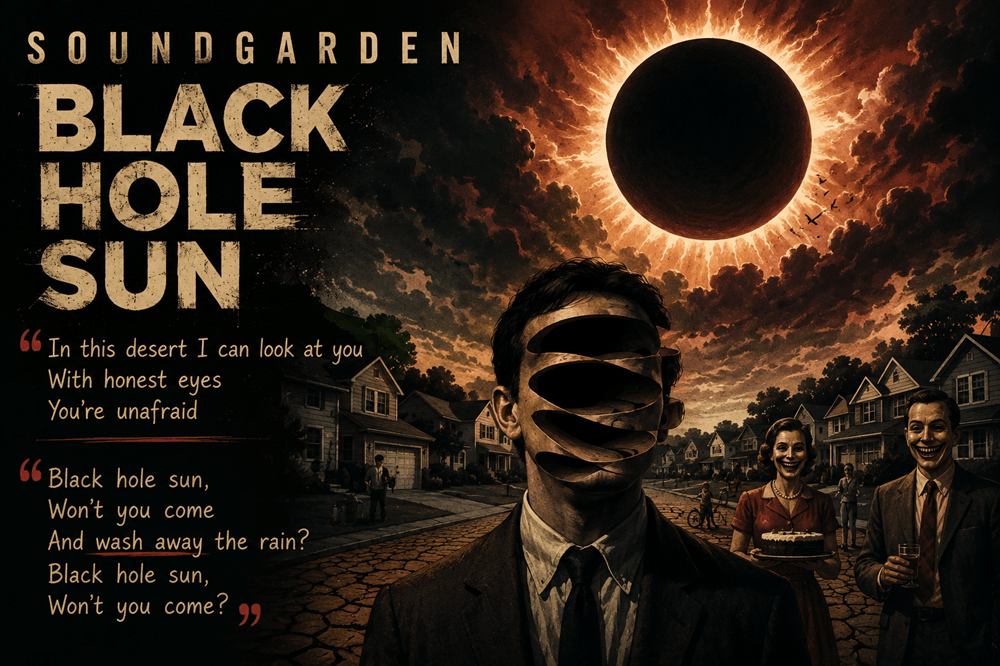
“Black Hole Sun” Lyrics Meaning: Soundgarden’s Surreal Song About Darkness, Disgust and the Desire for Renewal
Soundgarden’s “Black Hole Sun” is about looking at a corrupted, emotionally empty world and wishing for a force powerful enough to erase it.
The song is filled with heat, rain, deception, damaged faces and a sun that behaves like a black hole. These images do not form a literal story. Instead, they create a dreamlike landscape in which familiar life has become distorted and unpleasant.
Its central meaning is:
When the world feels false, oppressive or spiritually exhausted, destruction can begin to resemble cleansing.
The narrator appears disgusted by dishonesty and emotional numbness. He does not ask for ordinary sunshine to restore happiness. He calls for an impossible “black hole sun” to arrive and wash everything away.
Chris Cornell repeatedly explained that the words were not written around one clear message. He described the song as a surreal dreamscape created largely by playing with language and allowing the title to guide the imagery. Its emotional meaning is therefore stronger than its literal meaning.
Listeners can watch Soundgarden’s official “Black Hole Sun” music video or explore the song through the band’s official website.
What is “Black Hole Sun” about?
“Black Hole Sun” describes a world that appears normal from a distance but becomes disturbing when examined closely.
The narrator notices:
- People hiding behind false appearances
- Heat and discomfort replacing natural beauty
- Smiles that appear exaggerated or dishonest
- Social relationships becoming emotionally empty
- Rain functioning as both sadness and possible cleansing
- A desire for something overwhelming to end the situation
There is no named character, location or single event.
The song works more like a nightmare in which unrelated images are connected by mood. The listener enters a landscape where everything feels slightly wrong, but the cause of that wrongness remains difficult to identify.
This uncertainty makes the song widely adaptable.
It can sound like a response to:
- Depression
- Social hypocrisy
- Environmental decay
- Political disappointment
- Personal isolation
- A relationship built on deception
- General disgust with modern life
Cornell did not provide one official explanation that limits the song to any of these subjects. He said it created a feeling he could not fully define, allowing listeners to connect its dark imagery with their own circumstances.
What does the “black hole sun” symbolize?
The phrase combines two opposite cosmic images.
The sun normally represents:
- Light
- Warmth
- Life
- Clarity
- Growth
- Hope
A black hole represents:
- Darkness
- Absence
- Destruction
- Unknowable power
- Something from which nothing escapes
Placing the two together creates an impossible object: a source of light that is also a void.
Cornell said this contrast interested him. He described the black hole as an enormous emptiness and the sun as the giver of life, creating a combination of brightness, darkness, hope and underlying sadness.
The black hole sun can therefore symbolize several things at once.
A destructive form of salvation
The narrator wants relief, but he imagines relief arriving through erasure rather than repair.
Depression covering everything
A sun should illuminate the world. This one darkens it, reflecting a mind that transforms even positive things into something bleak.
A cleansing force
The narrator connects the black hole sun with washing away rain, shame or corruption. Destruction becomes a form of purification.
A contradiction too large to explain
The phrase expresses an emotion that ordinary language cannot contain. It is hopeful and hopeless at the same time.
The title is powerful because it does not resolve those contradictions.
It gives the listener an image that feels meaningful before it becomes logically understandable.
Is the black hole sun good or dangerous?
It is both.
The narrator welcomes its arrival, suggesting that it represents rescue. Yet anything with the power of a black hole would also be terrifying and destructive.
This creates the song’s central tension.
The narrator appears so tired of the current world that complete erasure seems preferable to continuing inside it.
That does not necessarily mean he literally wants the planet destroyed. The extreme image expresses emotional exhaustion:
If this cannot be repaired, perhaps it should disappear.
People sometimes experience a similar desire during periods of intense frustration. They do not truly want everything to end; they want the unbearable version of everything to end.
The black hole sun offers that fantasy.
It can remove lies, heat, shame, pain and artificial smiles in one overwhelming act.
The danger is inseparable from the comfort.
Why does the song contain so many images of disguise?
The song repeatedly suggests that faces and identities cannot be trusted.
People appear to conceal themselves behind social performances. Their expressions do not necessarily reflect what they feel, and their outward appearance may hide resentment, fear or dishonesty.
This imagery can be interpreted as criticism of social hypocrisy.
The narrator sees a world in which people:
- Smile because they are expected to
- Hide emotional pain
- Pretend relationships are healthy
- Perform happiness
- Use politeness to conceal hostility
- Protect themselves through false identities
The disgust in the song comes partly from recognizing these performances while feeling unable to escape them.
The narrator does not sound confident that removing one disguise would reveal a pure or innocent person underneath. The deception appears to have spread too deeply.
That may be why he calls for total cleansing rather than individual honesty.
What does the dead-looking sky represent?
The sky usually suggests openness, freedom and possibility.
In “Black Hole Sun,” it feels lifeless.
The narrator describes an atmosphere transformed by heat, darkness and decay. Nature itself appears affected by the emotional corruption he sees around him.
The dead sky may symbolize:
- Depression changing how the world looks
- Environmental anxiety
- A city trapped beneath oppressive summer heat
- The loss of spiritual hope
- A society continuing physically while feeling emotionally dead
This is one reason the song feels larger than a private breakup.
The narrator’s dissatisfaction seems to affect the entire environment.
His inner state and the external world become difficult to separate. The sky may truly look threatening, or he may be projecting his despair onto it.
Either way, the result is the same.
There is nowhere neutral to look.
What do the heat and summer imagery mean?
Summer is normally associated with freedom, brightness and pleasure.
Cornell reverses those associations.
The season becomes uncomfortable, dirty and suffocating. Heat exposes unpleasant smells, increases irritation and makes the environment feel impossible to escape.
This reversal matches the black hole sun itself.
Things that should be positive have become threatening:
- Sunshine becomes darkness.
- Summer becomes decay.
- Smiling becomes deception.
- Rain becomes something that needs to be washed away.
The song repeatedly takes familiar sources of comfort and corrupts them.
That pattern can reflect depression, because depression often changes the emotional meaning of ordinary experiences. A beautiful day may feel empty. Social contact may feel artificial. Rest may feel impossible.
The problem is not only what exists.
It is how everything is being experienced.
Why does the narrator want the rain washed away?
Rain often symbolizes sadness, grief or emotional cleansing.
In “Black Hole Sun,” the narrator asks for something to wash away the rain itself.
This creates another contradiction.
If rain normally cleans the world, why must it also be removed?
One interpretation is that ordinary forms of relief are no longer enough.
The narrator has already experienced sadness, tears or attempted renewal, yet the corruption remains. He now wants a more powerful force to remove both the pain and the failed attempts to heal it.
The phrase may also represent a desire for emotional emptiness.
He does not simply want to feel better.
He wants the entire cycle of suffering and temporary recovery to stop.
The black hole sun becomes a final cleansing beyond rain.
Is “Black Hole Sun” about depression?
Cornell did not define it specifically as a clinical description of depression.
However, many listeners interpret it that way because the song reproduces several depressive experiences:
- The world appears lifeless.
- Positive images become dark.
- Other people seem false or unreachable.
- Time feels oppressive.
- The narrator wants disappearance rather than ordinary change.
- Hope and destruction become difficult to separate.
The song’s emotional power comes partly from this lack of diagnostic language.
It does not explain symptoms.
It creates an atmosphere.
A listener can feel the heaviness without being told exactly what condition produced it.
Cornell described the song’s meaning as more personal and emotional than intellectual. He suggested that its openness allowed different people to make it a soundtrack to their own moments.
Is the song about Kurt Cobain?
No.
A common interpretation connected “Black Hole Sun” with Kurt Cobain’s death because Soundgarden’s song became widely popular during the same period.
However, the song had already been written and recorded before Cobain died in April 1994. Superunknown was released on March 8, 1994, nearly a month before his death.
Cornell acknowledged that some listeners made the connection, but it was not the song’s original subject.
The association is understandable.
Both the song and Cobain’s death became connected with the darker emotional atmosphere surrounding Seattle rock in 1994.
Still, “Black Hole Sun” should not be treated as a memorial written for him.
Its surreal images came from Cornell’s imagination before that tragedy occurred.
How did Chris Cornell come up with the title?
Cornell said the phrase began with something he misheard on television.
A news presenter said something he did not understand clearly, and Cornell’s mind transformed part of the sentence into “black hole sun.”
He immediately thought it sounded like a compelling title.
The misheard phrase then created its own musical world.
Cornell developed much of the song mentally while driving home from Bear Creek Studio in Woodinville, Washington. He held the melodies and arrangement in his memory during the drive, then recorded the idea into a Dictaphone after arriving home.
This origin explains the song’s dreamlike logic.
The title came first.
The words were then built around the feeling produced by that strange combination.
Cornell was not starting with a political argument or autobiographical event. He was following an image to see what kind of song it wanted to become.
Did Chris Cornell understand the lyrics?
Not in a conventional, literal sense.
Cornell said the song was among the clearest examples of him using words for their sound, emotional effect and relationship to the title rather than constructing a fully identifiable narrative.
He described it as surreal and admitted that he would not know how to interpret it literally.
Years later, he said he understood the song even less and remained surprised by the meanings other people found in it.
That does not mean the lyrics are meaningless.
Meaning can operate through:
- Sound
- Association
- Emotional contrast
- Repeated images
- Unconscious connections
- The listener’s personal experience
A dream may feel meaningful even when its events cannot be translated into a logical story.
“Black Hole Sun” works similarly.
Its emotional structure is clear even when its literal structure is not.
Why does the music sound beautiful and threatening?
The song combines a memorable, almost soothing melody with heavy guitars and an uneasy atmosphere.
This mirrors the contrast inside the title.
The music can sound:
- Warm but distorted
- Melodic but ominous
- Dreamy but physically heavy
- Hopeful but resigned
- Familiar but slightly unnatural
Producer Michael Beinhorn recalled being overwhelmed when he first heard Cornell’s demo. He was struck by its melody, unusual chord movement and the way wistfulness and darkness existed together.
The full band then added its own character.
Kim Thayil’s guitar work introduced a noisier psychedelic element, especially through the solo, while the band preserved the strong melodic foundation that made the song unusually accessible for Soundgarden.
The result is not a conventional heavy-metal song or a straightforward pop ballad.
It occupies an unstable space between them.
Why does the chorus feel comforting?
The chorus uses a smooth, memorable melody and repeated invitation.
Even without understanding the verses, listeners can recognize the emotional request.
The narrator wants something to arrive.
Repetition makes that arrival feel almost inevitable.
Yet the thing he welcomes is not a lover, sunrise or peaceful rain. It is an impossible dark sun capable of washing the world away.
The comfort therefore comes from surrender.
The narrator no longer wants to solve every problem individually. He imagines a larger force taking responsibility.
This can feel reassuring because control itself has become exhausting.
The chorus offers the fantasy that the narrator does not need to fix the world.
Something else will come and remove it.
What does the music video mean?
Howard Greenhalgh directed the famous music video, which places Soundgarden inside an exaggerated suburban nightmare.
People smile with unnaturally stretched faces. Families participate in ordinary activities that become grotesque. The sky darkens, the sun appears unnatural and the world begins to collapse.
The visual style does not attempt to explain the lyrics literally.
It translates their emotional distortion into images.
The video presents a community where:
- Happiness looks artificial
- Religious and social rituals become unsettling
- Consumer comfort hides emptiness
- Facial expressions become masks
- Destruction appears strangely beautiful
The band’s official site credits Greenhalgh as director and notes that the video became a major MTV success. It won Best Metal/Hard Rock Video at the 1994 MTV Video Music Awards and later received a Clio Award.
The video became so closely associated with the song that many listeners now visualize its melting suburban world as soon as the opening guitar begins.
Why are the people smiling so unnaturally?
The distorted smiles represent false happiness.
A smile is normally evidence of pleasure, friendliness or emotional safety. In the video, smiling becomes threatening because the expressions are too large and too fixed.
The people appear determined to maintain cheerful appearances while something deeply wrong surrounds them.
This can be interpreted as criticism of:
- Suburban conformity
- Advertising
- Forced optimism
- Social respectability
- Public images that hide private dysfunction
The exaggerated faces also resemble the emotional experience of distrusting everyone around you.
When a person feels alienated, ordinary friendliness may begin looking rehearsed or manipulative.
The video takes that suspicion and makes it physically visible.
What does the destruction at the end represent?
The end of the video gives the narrator what he requested.
The black hole sun arrives, and the distorted world is pulled away.
This destruction can feel frightening, but it is also satisfying because the world being erased has been presented as artificial and grotesque.
The ending represents:
- Cleansing
- Judgment
- Escape
- The collapse of false appearances
- A fantasy of beginning again
- The inability to imagine reform without destruction
The band remains connected to the chaos rather than standing completely outside it.
They are performers inside the same world, not morally perfect observers sent to judge everyone else.
This prevents the ending from becoming a simple punishment of “bad” people.
Everything is consumed because the corruption appears universal.
Which album includes “Black Hole Sun”?
“Black Hole Sun” appears on Soundgarden’s fourth studio album, Superunknown.
The album was released on March 8, 1994, debuted at No. 1 on the Billboard 200 and became Soundgarden’s major commercial breakthrough. The band’s official history describes it as an album exploring fear, pain, fury and defiance while expanding the group’s musical range.
The track sits among songs dealing with:
- Mortality
- Depression
- Addiction
- Alienation
- Self-destruction
- The difficulty of experiencing life fully
“Black Hole Sun” is one of the album’s most melodic recordings, but its emotional world fits the surrounding material.
Its accessibility did not require Soundgarden to abandon darkness.
It allowed that darkness to reach a much larger audience.
Was Soundgarden confident it would become a hit?
The band recognized the song’s commercial potential but felt uncertain about how it fit Soundgarden’s established identity.
Cornell initially wondered whether it sounded too different from the band’s heavier material. Kim Thayil and other members also understood that a major crossover hit could change what audiences expected from them.
Former bassist Hiro Yamamoto reportedly identified the track as an obvious hit when he heard it, strengthening the sense that the song could reach beyond the band’s existing audience.
The concern was justified.
Once “Black Hole Sun” became enormous, Soundgarden had to balance its popularity against a catalog filled with heavier and more experimental music.
The song opened doors.
It also risked becoming the one track casual listeners expected them to reproduce repeatedly.
How successful was “Black Hole Sun”?
“Black Hole Sun” became Soundgarden’s signature international hit.
It reached No. 12 on the UK Official Singles Chart in August 1994 and remained in the UK Top 100 for five weeks.
The song also topped Billboard’s rock chart and became one of the defining rock singles of 1994.
At the 1995 Grammy Awards, Soundgarden won Best Hard Rock Performance for “Black Hole Sun.” The same ceremony also brought the group a Best Metal Performance win for “Spoonman,” while Superunknown received a Best Rock Album nomination.
The success helped transform Soundgarden from an influential heavy-rock band into one of the most recognizable groups of the 1990s.
Why did the song appeal beyond grunge audiences?
“Black Hole Sun” does not fit neatly inside one genre.
It contains:
- Heavy guitar
- Psychedelic textures
- A highly melodic chorus
- Surreal words
- Pop accessibility
- Dark emotional weight
- A visually unforgettable video
Listeners did not need to follow the Seattle scene or identify with a specific subculture to respond to it.
The chorus communicates longing almost immediately.
The verses provide enough mystery to reward repeated listening.
The video adds recognizable imagery without removing the ambiguity.
Cornell believed that the song’s refusal to fit a clear category may have helped it travel internationally. Its openness allowed listeners to treat it as a soundtrack for different emotional experiences.
Why does “Black Hole Sun” still resonate?
The song captures the feeling that something is wrong even when the problem cannot be named clearly.
That feeling remains familiar.
People may look at their surroundings and sense:
- Public happiness is artificial.
- Social institutions are failing.
- The environment feels unstable.
- Other people are emotionally unavailable.
- Ordinary solutions are not strong enough.
- The world needs cleansing, but nobody knows what should replace it.
“Black Hole Sun” does not turn those feelings into a political program or personal confession.
It turns them into weather.
Darkness spreads across the sky. Heat becomes unbearable. Faces lose their humanity. An impossible sun approaches.
This allows listeners to experience emotional collapse on a mythic scale.
What is the deeper meaning of “Black Hole Sun”?
The deeper meaning concerns the attraction of destruction when hope has become difficult to imagine.
The narrator still wants change.
That means some form of hope remains.
However, he cannot picture gradual improvement. The world appears too false and damaged for small corrections.
His hope therefore takes a destructive shape.
The black hole sun will not persuade people to become honest. It will not repair relationships or cool the oppressive air.
It will wash everything away.
This is the song’s most unsettling idea:
The desire for renewal and the desire for disappearance can begin to resemble each other.
The narrator wants relief so intensely that he no longer separates healing from erasure.
Final meaning
Soundgarden’s “Black Hole Sun” is a surreal song about looking at a false, decaying world and longing for something powerful enough to remove it.
Chris Cornell did not write it as a literal narrative. The title came from a phrase he misheard on television, and much of the song formed in his mind while he drove home from a recording studio. He later described its words as a dreamscape created through sound, imagery and unconscious association.
The black hole sun combines life and emptiness.
It appears to offer salvation, but only through destruction.
The narrator welcomes it because ordinary light, rain and human interaction have all become corrupted. Smiles hide dishonesty, summer feels diseased and the sky itself appears dead.
The famous music video expands that mood into a grotesque suburban world where cheerful faces become masks and everyday life collapses beneath an unnatural sky.
Yet the song never explains exactly what should be washed away.
That ambiguity is its greatest strength.
For one listener, the black hole sun may represent depression.
For another, it may represent social hypocrisy, grief, anger or the desire to escape an exhausting period of life.
Cornell created an image large enough to contain all of those meanings without belonging completely to any one of them.
“Black Hole Sun” is ultimately about wanting a new beginning while being unable to imagine one that does not first require the old world to disappear.