“Crazy Train” Lyrics Meaning: Ozzy Osbourne’s Warning About Fear, Control and a World Losing Its Mind
Ozzy Osbourne’s “Crazy Train” is not simply a song about personal madness. It is a warning about a society being pushed toward chaos by hatred, political control, media influence and inherited conflict.
The narrator looks at the world around him and sees millions of people treating one another as enemies. Leaders demand obedience, public voices spread fear, and ordinary people inherit problems created by previous generations.
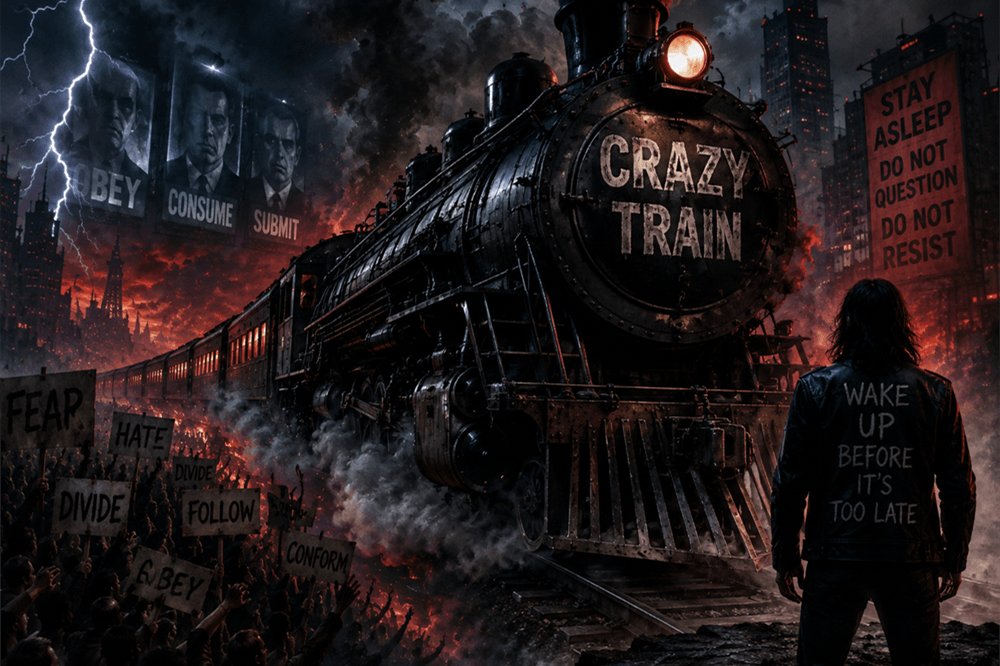
The “crazy train” represents this destructive system. Everyone is riding it together, but no one appears capable of slowing it down or changing its direction.
The song’s central message is:
Humanity is moving toward disaster because people are being taught to fear, hate and control one another instead of learning how to live together.
Although “Crazy Train” is remembered for its explosive guitar riff and Ozzy’s theatrical performance, its lyrics are surprisingly serious. Beneath the energy is a song about Cold War anxiety, psychological pressure and the feeling that the world is being governed by people who have lost control.
The complete words are available through Ozzy Osbourne’s official “Crazy Train” lyrics page.
What is “Crazy Train” about?
“Crazy Train” is about a world caught in a cycle of conflict.
The narrator sees people divided into opposing groups. Rather than solving shared problems, they are encouraged to view one another as threats. Hatred becomes normal, while peace and understanding begin to seem unrealistic.
The song was released during the Cold War, when tensions between nuclear powers created widespread fear of global destruction. However, its meaning is broader than one historical conflict.
It also addresses:
- Political manipulation
- Media influence
- Social conditioning
- Mental exhaustion
- Inherited violence
- Public fear
- The loss of independent thought
- The possibility of changing direction before it is too late
The narrator is not observing the crisis from a safe distance. He feels trapped inside it.
He is also riding the train.
That makes the song different from a simple political protest. The narrator does not claim to have escaped society’s confusion. The pressure is affecting his own mind, leaving him angry, overwhelmed and unsure whom to blame.
What does the “crazy train” symbolize?
The train symbolizes society moving along a dangerous track.
A train usually follows a fixed route. Once it gains speed, changing direction is difficult. Passengers may recognize that something is wrong, but they do not necessarily control the engine.
That makes it an effective metaphor for large political and social systems.
People are born into conflicts they did not create. They inherit national rivalries, prejudices, economic problems and political fears. By the time they understand what is happening, the train is already moving.
The image can represent several connected ideas.
Society moving toward destruction
The train appears to be heading somewhere dangerous, even though most passengers continue behaving as if the journey is normal.
A loss of personal control
The narrator feels as though outside forces are directing his life. Political figures, preachers, media voices and social expectations all tell him what to believe.
Collective madness
The entire world seems to participate in behavior that would appear irrational if viewed from a distance.
A personal mental breakdown
The train may also represent the narrator’s own thoughts. Constant exposure to conflict and fear has left him feeling psychologically unstable.
The metaphor works because it is both personal and global. The world is losing control, and the narrator feels himself losing control with it.
Is “Crazy Train” about mental illness?
Mental distress is an important part of the song, but “Crazy Train” is not simply a description of one person’s mental illness.
The narrator repeatedly refers to emotional wounds that have not healed. He feels mentally numb, overwhelmed and close to breaking down.
However, the song connects those feelings to the world around him.
His distress is caused or intensified by:
- Constant conflict
- Messages of fear
- Pressure to obey
- Political uncertainty
- Social hatred
- The belief that ordinary people have little control
The narrator is not saying that his mind has become unstable without reason. He believes society itself is producing psychological damage.
This gives the song a wider meaning.
The “madness” is not located only inside one person. It exists in the systems that ask people to accept hatred, violence and manipulation as normal.
What does the song say about hatred?
The opening idea of “Crazy Train” is that enormous numbers of people are living as enemies.
That observation immediately establishes the song’s moral concern. Human beings share the same world, yet they continue dividing themselves through politics, religion, nationality and ideology.
The narrator believes the situation can still change.
He suggests that people could choose love instead of hatred. The wording is hopeful, but the hope is uncertain. He does not know whether society will change before it crosses a point of no return.
This contrast gives the song much of its emotional power.
The music sounds confident and energetic, but the message is anxious. The narrator wants to believe that humanity can learn, yet nearly everything he observes suggests the opposite.
People continue fighting because hostility has become part of the system carrying them forward.
What does “heirs of a Cold War” mean?
The phrase refers to generations inheriting the consequences of political struggles they did not begin.
An heir receives something from those who came before. Usually, inheritance suggests money, property or status. In “Crazy Train,” the inheritance is fear, hostility and unresolved conflict.
The Cold War created a world shaped by:
- Nuclear anxiety
- Military competition
- Suspicion between nations
- Propaganda
- Ideological division
- The possibility of sudden mass destruction
Young people did not choose this political environment, but they were expected to live inside it.
The song argues that one generation’s conflicts become the next generation’s psychological burden.
That idea remains relevant beyond the Cold War. Children frequently inherit social divisions, political resentments and historical trauma from adults. They are taught which groups to distrust before they have the opportunity to form their own opinions.
The train keeps moving because each generation boards it without rebuilding the track.
Why does the song mention preachers and fools?
The narrator has listened to many people claiming to understand the world, but their guidance has not brought him peace.
“Preachers” may refer literally to religious leaders, but the word can also describe anyone who speaks with moral certainty. Politicians, commentators and public personalities often behave like preachers by telling audiences what is right, wrong or dangerous.
The “fools” are people whose confidence exceeds their wisdom.
The narrator places the two groups together because authority does not guarantee truth. Someone may speak powerfully, appear respectable or attract millions of followers while still leading people in a harmful direction.
He has heard many voices, yet he remains confused.
This section encourages listeners to question authority rather than accepting every message presented with confidence.
The narrator’s problem is not a lack of information. It is that too many people are trying to control how he interprets that information.
What does “one person conditioned to rule and control” mean?
This part of the song describes how people can be trained to accept power structures.
A person may be taught that someone else should rule, while the ruler may be conditioned to believe that control is natural or deserved.
The result is a system in which both obedience and domination become normalized.
The line may refer to political dictators, but it can also describe smaller forms of control. Families, religious organizations, workplaces and media systems can all teach people to follow roles without questioning them.
Conditioning happens gradually.
People repeatedly hear that:
- Certain leaders must be trusted
- Certain enemies must be feared
- Certain rules cannot be challenged
- Certain social roles are natural
- Certain opinions are unacceptable
- Certain sources define reality
Eventually, the system feels inevitable.
“Crazy Train” challenges that inevitability. The narrator recognizes that people are being shaped by forces they may not fully understand.
What does the song say about the media?
The lyrics suggest that media does more than report reality. It also teaches people how to interpret reality and which roles they should occupy.
The narrator is concerned that repeated messages can become a kind of script.
People see images of success, authority, danger and acceptable behavior. They then begin performing the identities presented to them, often without realizing how strongly those messages have influenced their choices.
The song does not claim that every piece of media is dishonest. Its concern is the power of mass communication to shape public thinking.
When one message is repeated often enough, people may stop questioning it.
This theme has become even more relevant in the age of social media. Algorithms, political content, advertising and online communities constantly compete to define what people should fear, desire and believe.
The technology has changed, but the warning remains recognizable.
Who is to blame in “Crazy Train”?
The narrator asks who or what should be held responsible, but the song does not provide one simple answer.
Several forces share the blame:
- Leaders who seek control
- Media systems that reinforce fear
- Public figures who spread false certainty
- Generations that pass down unresolved hatred
- Individuals who stop thinking independently
- Societies that accept conflict as normal
The narrator includes himself in the problem.
He is not standing outside the train accusing everyone else. He is struggling with the same confusion, pressure and anger affecting the people around him.
That makes the song more honest.
Large social problems are rarely caused by one villain. They continue because many people participate in them, benefit from them or feel unable to resist them.
The question of blame remains unresolved because the train is a collective creation.
Is “Crazy Train” an anti-war song?
It can be interpreted as an anti-war song, especially because of its references to the Cold War and inherited political conflict.
However, its message is wider than opposition to military violence.
The song criticizes the conditions that make war possible:
- Dehumanizing other people
- Accepting propaganda
- Allowing fear to replace reason
- Following leaders without questioning them
- Treating hatred as normal
- Passing conflict from one generation to another
War is one result of these behaviors, but the same pattern can affect everyday life.
Communities, families and political groups can all become trapped in cycles of hostility. People may no longer remember how the conflict began, yet they continue participating because the division has become part of their identity.
“Crazy Train” asks whether people can interrupt that cycle before the consequences become irreversible.
Why does the music sound exciting when the lyrics are dark?
The contrast between the music and the message is one of the song’s defining features.
Randy Rhoads’ guitar riff is fast, bright and immediately energizing. The rhythm creates forward motion, making the listener feel as though the train is already racing down the track.
The music does not sound helpless.
Instead, it transforms anxiety into momentum.
This creates an unusual emotional combination. The lyrics describe fear, manipulation and psychological collapse, while the performance feels powerful enough to confront those forces.
The guitar can be heard as the sound of the train itself—mechanical, relentless and difficult to stop.
It can also represent resistance.
The narrator may feel trapped in a chaotic world, but he is still shouting a warning. He has not surrendered completely.
The original recording features Ozzy Osbourne on vocals, Randy Rhoads on guitar, Bob Daisley on bass and Lee Kerslake on drums. “Crazy Train” appeared on Osbourne’s debut solo album, Blizzard of Ozz, which also included “Mr. Crowley” and “Goodbye to Romance.”
Why is Randy Rhoads’ guitar part so famous?
Randy Rhoads combines heavy-metal aggression with a precise, melodic style.
The opening riff is immediately recognizable, but the guitar work does more than introduce the song. It gives the recording its restless personality.
The main riff moves with the repetitive force of machinery. Later guitar passages become more expressive and unpredictable, reflecting the narrator’s growing emotional intensity.
Rhoads’ solo is especially admired because it feels carefully constructed rather than randomly fast. It combines speed, melody and dramatic phrasing while remaining connected to the song’s larger emotional direction.
The official Ozzy Osbourne album page notes that Rhoads’ “Crazy Train” solo was ranked among the greatest guitar solos in a Guitar World readers’ poll.
His contribution also helped establish the sound of Ozzy Osbourne’s solo career. After leaving Black Sabbath, Osbourne needed a musical identity that could acknowledge his heavy-metal past without simply repeating it.
Rhoads provided that difference.
Was “Crazy Train” Ozzy Osbourne’s first solo song?
“Crazy Train” was the first single released from Osbourne’s debut solo album, Blizzard of Ozz.
The recording marked an important new beginning following his departure from Black Sabbath. Rather than sounding like a weakened continuation of his former band, the song introduced a faster and more technically adventurous style built around Rhoads’ guitar playing.
Ozzy Osbourne’s official website dates the track to September 20, 1980, while the album became the foundation of his independent career. The official album page describes “Crazy Train” as his first Top 10 U.S. rock single and states that it sold more than two million copies.
Listeners can hear the original recording through Apple Music or watch Ozzy Osbourne’s official animated video.
How successful was “Crazy Train”?
The song’s long-term popularity became much greater than its original mainstream chart position might suggest.
On its first UK release in 1980, “Crazy Train” peaked at No. 49 on the Official Singles Chart. Decades later, it returned to the UK chart and reached a new peak of No. 25 in August 2025.
Ozzy Osbourne’s official site lists the track as double platinum in the United States. The Recording Academy has also described it as a classic-rock radio staple and one of the defining songs of Osbourne’s solo career.
Its popularity has extended well beyond metal audiences.
The song frequently appears at sporting events, in television, in movies and in other situations that require an immediate burst of energy. Even listeners who do not follow Ozzy Osbourne’s music often recognize the opening laugh or guitar riff.
Its musical excitement made it universally accessible, while its lyrics gave it enough depth to remain meaningful.
Why is “Crazy Train” played at sporting events?
The song’s introduction creates instant anticipation.
The laughter, shouted opening and guitar riff work like a signal that something dramatic is about to happen. Stadiums can use only a few seconds of the recording and still produce a recognizable response from the crowd.
The chorus also fits the emotional chaos of sports.
Fans arrive expecting uncertainty, competition and moments when events suddenly move out of control. The idea of a wild train captures that energy, even when the deeper political meaning of the lyrics is not the focus.
This is one reason the song has developed two public identities.
For casual audiences, it is an exciting heavy-metal anthem.
For listeners paying attention to the words, it is a warning about a civilization becoming unstable.
Both meanings can exist at the same time.
Is “Crazy Train” meant to be funny?
The theatrical opening is playful, but the song’s main message is serious.
Ozzy Osbourne’s exaggerated laugh establishes a strange, almost carnival-like atmosphere. It prepares listeners for a performance filled with chaos and personality.
However, the humor does not weaken the warning.
Instead, it reflects the absurdity of the situation. The world is behaving irrationally, yet everyone continues acting as though the system makes sense.
The laughter may sound like the response of someone who has reached the limits of frustration. When events become too unreasonable, laughing can feel like the only possible reaction.
The song is therefore entertaining without being meaningless.
Its theatrical style helps listeners approach subjects that might otherwise feel too political or depressing.
Why does “Crazy Train” remain relevant?
The details of global politics have changed since 1980, but the song’s larger concerns have not disappeared.
People still experience:
- Political polarization
- Propaganda
- Fear-based media
- International conflict
- Distrust of institutions
- Pressure to choose opposing sides
- Mental exhaustion from constant bad news
- Social systems that reward anger
The image of people being carried toward chaos remains powerful because modern life often feels difficult to control.
Individuals receive more information than ever, yet greater access to information does not always produce greater understanding. People can become trapped inside competing versions of reality, each supported by its own media sources and communities.
The song’s question is therefore still urgent:
Can people recognize the direction of the train and change it before the journey ends in disaster?
Is there hope in “Crazy Train”?
Despite its dark subject, the song is not completely hopeless.
The narrator believes it may still be possible for people to learn compassion and abandon hatred. The possibility is uncertain, but it exists.
He also continues speaking.
Rather than becoming silent or accepting the world’s direction, he warns others that something is wrong. His voice suggests that awareness is the first step toward resistance.
The train may be moving quickly, but the song never says that destruction is guaranteed.
People created the systems carrying them forward. That means people may also have the power to change those systems.
The narrator’s frustration comes partly from believing that a better direction is possible.
If he believed nothing could change, there would be no reason to shout.
Final meaning
“Crazy Train” is about humanity being carried toward chaos by hatred, manipulation and inherited political conflict.
The train represents a society following a dangerous route while its passengers struggle to understand who is controlling it. Leaders seek power, media messages shape public behavior, and one generation passes its fears to the next.
The narrator feels the psychological effects of living inside this system. His emotional wounds remain open, and the pressure of the world around him is pushing him toward a breaking point.
Yet the song still contains a small amount of hope.
People may be able to choose understanding over hatred. They may be able to question the voices controlling them and refuse to repeat conflicts inherited from the past.
“Crazy Train” has survived because it works on several levels at once. It is a heavy-metal anthem, a display of Randy Rhoads’ guitar brilliance, a description of mental pressure and a political warning.
The music makes listeners feel the speed of the train.
The lyrics ask whether anyone is willing to stop it.