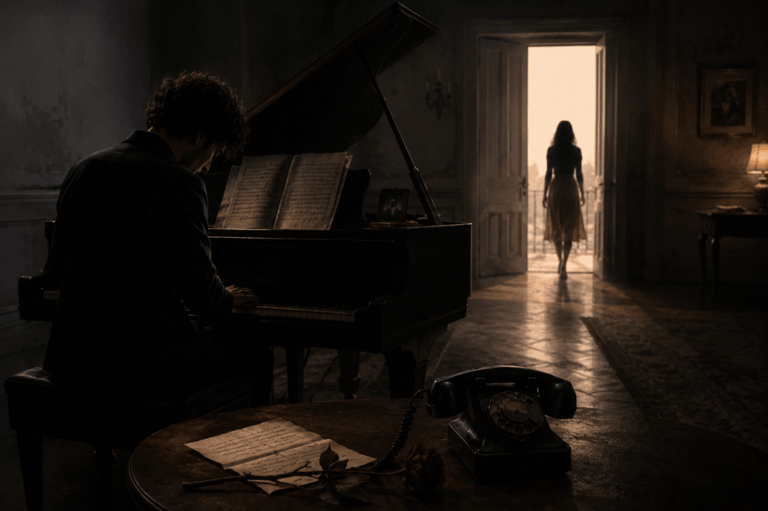

“Sparks” Lyrics Meaning: Coldplay’s Quiet Song About Regret, Devotion and a Love Slipping Away
Coldplay’s “Sparks” is a quiet confession from someone who believes he may have damaged an important relationship.
Instead of defending himself or blaming the other person, the narrator admits that he was wrong. He senses that his actions have created distance, and he responds by promising loyalty, protection and continued love.
The central meaning of the song is simple:
He is afraid he has driven away the person he loves, but he still hopes his devotion can save the relationship.
“Sparks” does not explain exactly what went wrong. That uncertainty is one reason the song feels so personal. Listeners can connect it to a breakup, an argument, emotional neglect, unfaithfulness or any moment when love remains present but trust has been weakened.
The complete words can be found on Coldplay’s official “Sparks” lyrics page.
What is “Sparks” by Coldplay about?
“Sparks” is about regret after a romantic mistake.
The narrator begins by wondering whether he caused his partner to withdraw. He already seems to know the answer, but asking the question shows that he is not yet ready to accept the full consequences of what happened.
His partner has probably become colder, quieter or less available. The narrator notices this change and worries that the relationship may be ending.
Rather than describing a dramatic confrontation, the song captures the emotional silence that often follows one.
Two people may still love each other, but something between them no longer feels safe. One person waits for reassurance while the other struggles to find words that can repair the damage.
The narrator offers a promise: he will continue looking out for this person, even if she no longer trusts him as she once did.
That promise sounds sincere, but it also carries sadness. He may be making it too late.
What does the beginning of “Sparks” mean?
The opening presents the narrator’s greatest fear: that his own behavior has pushed someone away.
He is not confused about why the relationship has changed. His question sounds more like an admission than a genuine request for information.
He understands that the other person may respond with frustration. She has apparently heard his explanations or romantic gestures before, and they may no longer be enough.
The narrator seems to know her reaction in advance. This suggests that their conflict is not entirely new.
Perhaps he has:
- Repeated the same mistake
- Failed to keep an earlier promise
- Taken her affection for granted
- Avoided an important conversation
- Been emotionally inconsistent
- Hurt her and expected forgiveness too quickly
The song never identifies the exact offense. Instead, it focuses on the emotional result: she is moving away, and he feels powerless to stop it.
Why does the narrator promise to look out for her?
The promise reveals that his feelings have not disappeared.
Even if the relationship is damaged, he still sees himself as someone who should protect, support or care for her. He wants her to believe that his mistake does not represent the full truth of his feelings.
He may have acted carelessly, but he insists that his love remains dependable.
There are two ways to interpret this promise.
The generous interpretation is that he genuinely wants to become a better partner. He recognizes that love should be expressed through care, not merely felt privately.
A sadder interpretation is that he can promise devotion only after realizing he may lose her.
People often become most certain of their feelings when a relationship is already slipping away. Fear produces clarity. The narrator now understands the value of the connection, but the other person may have needed that understanding earlier.
What does “my heart is yours” mean in the song?
The declaration is one of complete emotional surrender.
The narrator is telling his partner that, despite his mistakes, his deepest attachment belongs to her. She is not temporary or replaceable. She remains the person he holds onto emotionally.
However, giving someone your heart does not automatically repair the harm you caused.
That tension sits at the center of “Sparks.”
The narrator believes his love is real, but the song quietly asks whether real love is enough when someone has behaved badly. A person may feel deeply devoted and still fail to make their partner feel secure.
His heart may belong to her, yet she may still have good reasons to leave.
The declaration therefore sounds romantic and desperate at the same time. He is offering the strongest proof of love he has, but he cannot guarantee that she will accept it.
What did the narrator do wrong?
Coldplay never gives listeners a specific answer.
The brief admission—“I know I was wrong”—confirms his responsibility, but it does not explain the event.
This deliberate lack of detail allows several interpretations.
He may have neglected the relationship
The narrator may have failed to give his partner enough attention, affection or reassurance. He realizes her importance only after she begins creating distance.
He may have broken her trust
His mistake could have involved dishonesty, disloyalty or a promise he did not keep. His repeated assurances suggest that she now doubts whether she can depend on him.
He may have been emotionally unavailable
He could love her while still struggling to communicate. The song itself feels like a person finally saying what should have been said much earlier.
He may have ended the relationship impulsively
It is also possible that he pushed her away during an argument and now regrets the decision.
The absence of a clear story makes “Sparks” less like a detailed narrative and more like an emotional memory. Listeners do not need to know what happened. The song is about the feeling that comes afterward.
Is “Sparks” a breakup song?
“Sparks” can be heard as a breakup song, but it appears to take place before the separation is completely final.
The narrator still speaks as though there is a connection worth saving. He has not accepted that the relationship is over, and he continues making promises about the future.
At the same time, his partner seems emotionally distant. She may already have decided that his words are no longer reliable.
The song therefore occupies the uncertain space between conflict and separation.
This is the stage when:
- Love still exists
- Trust has been damaged
- Apologies have been offered
- One person wants another chance
- The other person has not decided whether to stay
- Every silence feels like a possible ending
That uncertainty makes the song more painful than a straightforward breakup anthem. The narrator has not lost her completely, but he can feel the possibility approaching.
What do the “sparks” symbolize?
Sparks usually suggest sudden attraction, chemistry or the beginning of romantic love.
People often describe an immediate emotional connection as “feeling a spark.” It is the small flash that may grow into something warmer and more lasting.
In Coldplay’s song, the sparks appear after the narrator has admitted his mistake. This gives the image several possible meanings.
A memory of their original attraction
The narrator may be remembering the moments when their relationship first felt exciting and effortless.
Seeing those sparks again reminds him of what they once had and what he is now in danger of losing.
Evidence that love still remains
The sparks may suggest that the relationship is damaged but not completely extinguished.
A spark is small, but it can survive when a larger fire appears to have gone out. The narrator may believe that enough feeling remains for them to begin again.
A brief moment that cannot last
Sparks are beautiful but temporary. They flash, glow and disappear quickly.
This interpretation makes the song more tragic. The narrator sees something meaningful between them, yet he may be watching its final moments rather than its rebirth.
Painful emotional recognition
The sparks may also represent the sudden clarity of realizing how much someone matters.
Only when he senses her leaving does the narrator fully understand his attachment.
The song does not choose one fixed meaning. The image contains attraction, hope, memory and disappearance at the same time.
Does the relationship survive?
“Sparks” does not reveal what happens next.
The narrator promises not to disappoint his partner, but the performance itself makes that promise feel uncertain. He sounds tender and sincere, yet also fragile.
His words express intention rather than proof.
He says what he will do, but listeners do not know whether his behavior will truly change. The partner does not respond, so her feelings remain outside the song.
That silence is important.
The narrator controls the story because he is the only person speaking. We hear his regret, his love and his promises, but we do not hear the hurt that caused her to withdraw.
She may forgive him.
She may still love him but decide that leaving is healthier.
She may have heard the same assurances before.
The unresolved ending allows the song to remain suspended in hope. The relationship might survive, but the narrator cannot save it through words alone.
Why does “Sparks” sound so intimate?
The arrangement is restrained and spacious.
Chris Martin sings softly rather than trying to overpower the music. The guitar moves gently beneath his voice, while the rhythm remains controlled and unhurried.
The band avoids the dramatic build that later became associated with many Coldplay songs. There is no enormous chorus designed for a stadium. “Sparks” feels closer to a private conversation recorded late at night.
That quietness supports the story.
A louder performance might make the apology sound theatrical. The understated production makes the narrator seem vulnerable, as though he is speaking directly to one person rather than performing for an audience.
The music also leaves space around his words. Pauses matter. The listener can feel the things he cannot fully explain.
Coldplay recorded “Sparks” for its debut album, Parachutes, which was released on July 10, 2000. The track appears fourth on the album, between “Spies” and “Yellow,” according to the band’s official Parachutes track listing.
How does “Sparks” fit into the Parachutes album?
Sparks shares the intimate, uncertain mood found throughout Parachutes.
Many songs on the album explore emotional hesitation. The narrators want closeness but are unsure how to create or preserve it. They offer devotion while fearing rejection, failure or abandonment.
“Sparks” is one of the album’s quietest expressions of that theme.
Where “Yellow” turns devotion into something open and expansive, “Sparks” keeps it private. Its love is not triumphant. It is cautious, apologetic and afraid.
The album’s restrained guitars and vulnerable writing helped establish Coldplay’s early identity. Parachutes reached No. 1 on the UK Official Albums Chart and spent decades returning to the rankings. Readers can view its full history through the Official Charts archive.
Why did “Sparks” become popular again?
“Sparks” was not originally released as one of the main singles from Parachutes. For many years, it remained a quieter favorite known mainly by listeners who explored the full album.
Its popularity grew dramatically in the streaming and short-video era.
The gentle opening, intimate vocal and emotional ambiguity made the song especially suitable for personal videos about relationships, nostalgia, loneliness and memories. Younger listeners began discovering it without necessarily hearing it in the context of the original album.
In June 2025, approximately 25 years after its original release, “Sparks” entered the Billboard Hot 100 for the first time. It debuted at No. 93 following renewed streaming interest and viral use on TikTok.
The revival demonstrates how streaming has changed the lifespan of music. An album track no longer has to disappear after its original release cycle. A new emotional context, video trend or generation of listeners can transform an older song into a current hit.
The song can be heard through Spotify or Coldplay’s official YouTube upload.
Why do listeners connect with “Sparks”?
The song describes a feeling that many people recognize: realizing that an apology may not be enough.
The narrator does not lack love. He lacks certainty that his love will still be accepted.
That distinction is emotionally powerful.
Some heartbreak songs focus on anger, betrayal or complete separation. “Sparks” focuses on a quieter fear—the possibility that someone has become tired of being disappointed.
Listeners may connect the song to:
- Wanting another chance
- Regretting words spoken during an argument
- Realizing they neglected someone
- Loving a person who no longer trusts them
- Remembering the beginning of a finished relationship
- Making promises they are not sure they can keep
- Watching emotional warmth slowly disappear
Because the story is incomplete, people can place their own experiences inside it.
The narrator’s mistake becomes whatever the listener regrets. The distant partner becomes whoever they wish they could speak to again.
Is “Sparks” a love song or an apology?
It is both.
The narrator expresses genuine devotion, but every declaration is shaped by guilt. He is not simply telling someone that he loves her. He is trying to make his love meaningful after his behavior has created doubt.
The song shows that love and regret can exist together.
Someone can care deeply and still cause pain.
Someone can make a sincere promise and still have a history that makes the promise difficult to believe.
Someone can recognize a relationship’s value only after beginning to lose it.
That emotional contradiction gives “Sparks” its lasting power. The narrator’s love feels real, but the outcome remains uncertain because love must compete with the damage already done.
Final meaning
“Sparks” is about someone who believes he has pushed away the person he loves.
He admits that he was wrong, promises to remain devoted and searches for signs that their connection has not completely disappeared. The sparks represent the attraction they once shared, the love that may still survive and the fragile possibility of starting again.
Yet the song never confirms that the relationship can be repaired.
The narrator offers his heart, but he cannot demand forgiveness. His partner remains silent, leaving him alone with his promises and memories.
That is what makes “Sparks” so affecting.
It is not a grand declaration that love will overcome everything. It is the voice of someone hoping that a small amount of warmth remains after trust has begun to fade.
He sees the sparks—but he does not know whether they are the beginning of another fire or the final light before the relationship goes dark.