“White Ferrari” Lyrics Meaning: Frank Ocean’s Song About Memory, Lost Love and Accepting an Ending
Frank Ocean’s “White Ferrari” is about looking back on a relationship that felt beautiful and deeply important but could not remain unchanged forever.
The song begins inside a car with two people sharing an intimate drive. As the memory unfolds, the narrator moves beyond the physical journey and begins thinking about time, emotional distance, alternate lives and the possibility that love can remain meaningful even after a relationship ends.
Its central meaning is:
Some relationships do not fail because the love was false. They end because two people grow in different directions, leaving memory to preserve what reality could not.
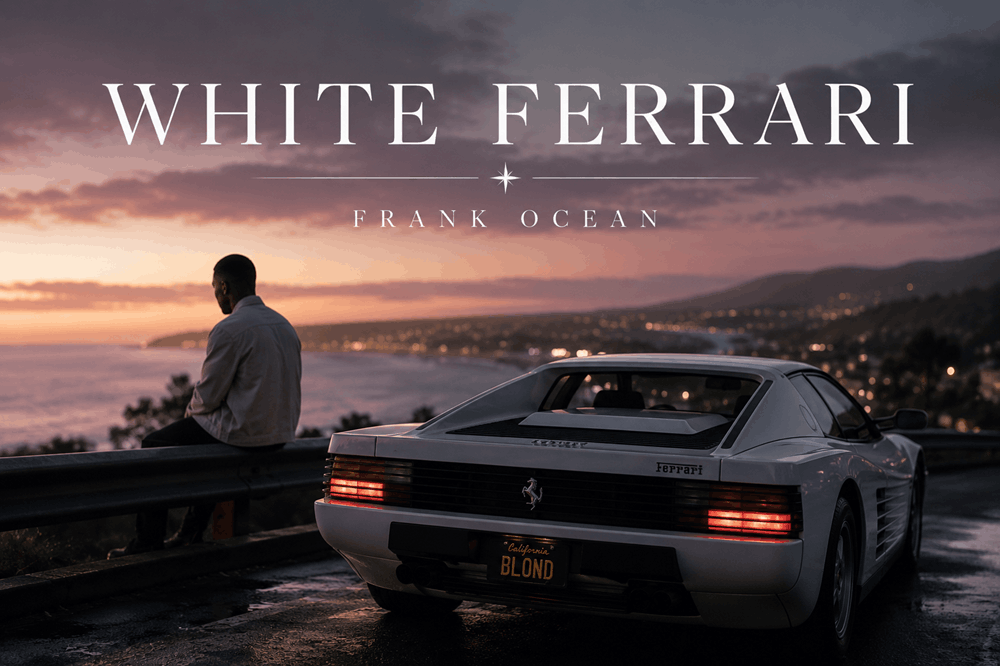
The white Ferrari represents more than an expensive car. It becomes a container for the relationship—a private space associated with youth, motion, closeness and a period that now exists mainly in the narrator’s mind.
Ocean does not turn the breakup into an argument. There is no obvious villain and no dramatic betrayal. The sadness comes from recognizing that something genuine can still become impossible to continue.
Listeners can hear the complete recording through Frank Ocean’s official “White Ferrari” audio. The song appears on his 2016 album Blonde.
What is “White Ferrari” about?
“White Ferrari” follows the memory of a relationship through several emotional stages.
At first, the narrator recalls riding in a car with someone he loves. The atmosphere is private and almost weightless. They seem separated from the outside world, watching the landscape pass while their thoughts drift.
The memory then becomes less concrete.
Ocean begins reflecting on:
- The time they spent together
- Things they failed to say
- The way they understood life differently
- The possibility of existing differently somewhere else
- The love that remains after separation
- The need to continue without denying what happened
The song does not describe one clear chronological event from beginning to end. It moves like memory itself.
One detail leads to another. A drive becomes a relationship. The relationship becomes a philosophical question. That question eventually becomes acceptance.
The narrator is not trying to recover the past exactly as it was.
He is trying to understand why it still matters.
What does the white Ferrari symbolize?
The car can be read literally.
Frank Ocean frequently uses cars as settings for relationships, private conversations and self-reflection. In an essay accompanying the Boys Don’t Cry magazine released with Blonde, he reflected on how much of his life had taken place inside vehicles. Cars appear throughout his work because they function as both transportation and temporary private rooms.
In “White Ferrari,” the car symbolizes several things at once.
Youth and freedom
A drive creates the illusion that the people inside can go anywhere. The road remains open, and the future appears undecided.
Privacy
Inside the car, the couple occupies a small world that belongs only to them. They can be physically close while remaining hidden from everyone outside.
Movement
The vehicle continues forward even when the relationship cannot. This makes the drive an appropriate image for time: neither the road nor life can be paused permanently.
Beauty and fragility
A Ferrari is desirable, powerful and carefully designed. It can represent a relationship that felt rare and extraordinary but was difficult to maintain.
Memory
Long after the drive ends, the car remains attached to the emotional experience. Remembering the Ferrari means returning to the person who once sat beside him.
The color white can suggest innocence, brightness or an image made almost unreal by nostalgia. However, Ocean has not provided a definitive explanation that reduces the title to one fixed symbol.
Its openness is part of the song’s power.
Why is the car ride so important?
The drive gives the narrator and his partner somewhere to be together without requiring them to decide what happens next.
They are moving physically, but emotionally they may already be stuck.
This contrast appears throughout the song:
- The car moves while the relationship slows down.
- The road continues while communication becomes difficult.
- The couple remains close physically while their inner lives separate.
- The memory feels vivid even though the moment is gone.
Cars can delay arrival.
As long as the couple remains on the road, they do not have to confront the destination. The drive becomes a temporary space where the relationship can still feel intact.
That may explain the narrator’s tenderness toward the memory.
He is not only remembering transportation. He is remembering a period before the ending became unavoidable.
Is “White Ferrari” about a breakup?
Yes, although it is less about the moment of separation than the emotional understanding that comes afterward.
The narrator appears to recognize that the relationship has already passed into memory. He is not bargaining for another opportunity or accusing the other person of abandoning him.
Instead, he accepts two truths:
- The relationship could not continue in its previous form.
- The love experienced within it was still real.
Many breakup songs simplify the past after a relationship ends. A former partner becomes cruel, dishonest or unworthy, allowing the narrator to leave with certainty.
“White Ferrari” resists that simplification.
The narrator continues to care. He remembers what was beautiful and acknowledges that some form of emotional responsibility remains, even when the two people are no longer together.
This makes the song more painful but also more mature.
He does not need to pretend the relationship was meaningless in order to survive its ending.
Why do the two people seem emotionally different?
The final part of the song suggests that the narrator and his former partner do not view existence in the same way.
The narrator imagines that life may be larger than the limits they currently experience. He considers other dimensions, other forms of being and a reality beyond what can be seen directly.
His partner appears more doubtful.
One voice wants to believe their connection has a larger cosmic meaning. The other seems to see human life as small and temporary.
This difference can represent a deeper incompatibility.
Couples do not separate only because of dramatic conflict. They can love one another while disagreeing about:
- What gives life meaning
- What their future should look like
- How much hope is reasonable
- Whether love can overcome practical limitations
- How seriously the relationship should define them
The song never declares that one perspective is correct.
The narrator’s idealism may be beautiful, but it may also prevent him from accepting reality. The partner’s skepticism may sound cold, but it may be a more honest recognition of their limitations.
Their emotional distance is philosophical as well as romantic.
What does the alternate dimension represent?
The alternate dimension is a fantasy of a reality in which the relationship might have worked differently.
In ordinary life, the two people are restricted by timing, personality, circumstance and the limits of their bodies. In another dimension, the narrator imagines them as larger versions of themselves—less confined and perhaps better able to understand what they shared.
This idea expresses a common feeling after losing someone:
Maybe the relationship was right in a world that did not exist here.
The fantasy protects the love from being judged solely by its ending.
If the couple could not remain together, the narrator can still imagine that their connection belongs to something larger than the practical relationship that failed.
However, the alternate dimension also reveals avoidance.
Imagining another universe is easier than changing the conditions of this one. The narrator may be using cosmic ideas to give permanence to something time has already taken away.
The song leaves both possibilities open.
The fantasy can be comforting and self-deceptive at the same time.
Is the song about one real person?
Ocean has not publicly confirmed a complete factual explanation identifying the person or providing a precise timeline for every event in the song.
The second-person language makes the relationship feel intimate, but the identity remains deliberately unclear.
This ambiguity matters because Blonde frequently blends:
- Personal memory
- Fictional reconstruction
- Altered chronology
- Multiple relationships
- Philosophical reflection
- Details that may be symbolic rather than literal
“White Ferrari” should therefore not be treated as a private document whose every image can be matched to a publicly known person.
The emotional truth is more important than solving the biography.
The song describes what it feels like to remember someone who remains emotionally present despite being absent from your current life.
That experience does not require listeners to know the person’s name.
Why does the song sound so empty and quiet?
The production creates emotional space around Ocean’s voice.
There is no large chorus, dramatic beat drop or conventional pop climax. Instruments enter carefully and often feel as though they are disappearing while the listener notices them.
The arrangement includes keyboards from Buddy Ross, Malay and Jon Brion, programming by SebastiAn and guitar from Alex Giannascoli, better known as Alex G. Ocean, Brion and Om’Mas Keith are credited as producers.
Alex G later explained that he played the guitar heard near the end of the song.
The sparse production reflects the emotional situation.
The relationship is no longer fully present, so the music does not feel completely solid. It arrives in fragments:
- A distant texture
- A faint harmony
- A guitar line
- A voice that changes in weight
- Silence surrounding individual thoughts
The song feels like someone remembering late at night, when the mind enlarges small details and removes everything unimportant.
Its quietness also forces listeners to lean closer.
Ocean does not perform grief as spectacle. He allows absence to become part of the arrangement.
Why does Frank Ocean’s voice change?
Ocean layers and alters his vocals throughout “White Ferrari,” creating the impression that more than one version of the narrator is speaking.
These voices can be heard as different emotional ages:
- The younger person inside the relationship
- The older person remembering it
- The hopeful self who believed it could last
- The realistic self who understands why it ended
The vocal changes fit Blonde, an album frequently concerned with divided identity and the difference between experiencing a moment and remembering it later. Pitchfork described the album’s stripped-down sound as a setting for reflections on love, loss and changing consciousness.
By the end of “White Ferrari,” the voice sounds less connected to the physical car ride and more like a thought floating outside time.
The shift transforms a private memory into something nearly spiritual.
What is the Beatles connection?
“White Ferrari” interpolates The Beatles’ “Here, There and Everywhere.”
An interpolation does not necessarily use the original recording. Instead, it reuses or adapts part of an earlier composition, such as its melody or phrasing.
Because of that connection, John Lennon and Paul McCartney are credited as songwriters alongside Frank Ocean, Malay and Kanye West. Apple Music’s official credits also list the song’s performers, arrangers and producers.
The Beatles reference is emotionally appropriate.
“Here, There and Everywhere” is about wanting love to exist across every part of life. “White Ferrari” looks back at what happens when that desire cannot be sustained in ordinary reality.
Ocean transforms the earlier song’s romantic certainty into something more fragile.
Love may still feel present everywhere in memory, even when the relationship is present nowhere in daily life.
The interpolation is subtle enough to feel like another memory entering the song—an older love song resurfacing inside a newer one about loss.
Why are Kanye West and other musicians credited?
The final physical-edition credits list Kanye West as one of the writers of “White Ferrari,” although the exact nature of his contribution has not been publicly explained in detail.
Jon Brion, Om’Mas Keith, Buddy Ross, Malay, SebastiAn and Alex G also contributed to the song’s production or instrumentation.
The number of contributors is striking because the finished recording sounds so intimate.
The song does not advertise its production complexity. Much of the work appears to have gone into deciding what should remain quiet, distant or absent.
That restraint fits Ocean’s larger approach on Blonde.
The music feels personal not because one person necessarily created every sound alone, but because every sound serves the same private emotional atmosphere.
Did Frank Ocean record many versions of “White Ferrari”?
Ocean reportedly created approximately 50 versions before choosing the one released on Blonde.
He explained that his younger brother immediately preferred the version that eventually appeared on the album, even while Ocean remained uncertain about it. The story was reported in a 2016 interview with The New York Times and has since become an important part of the song’s history.
That creative process helps explain the recording’s unusual calmness.
The finished song sounds spontaneous, almost as though Ocean began remembering and allowed the thoughts to arrive naturally.
In reality, that apparent simplicity required extensive revision.
The many versions also reflect the song’s subject.
Just as the narrator revisits the relationship from different emotional angles, Ocean repeatedly revisited the recording, searching for the version that felt truthful enough to release.
At Coachella in 2023, he performed a substantially reworked version of “White Ferrari,” demonstrating that the song remained open to reinterpretation even years later.
How does the song fit into Blonde?
“White Ferrari” is the fourteenth track on the digital version of Blonde, placed near the album’s emotional conclusion. The album was released on August 20, 2016.
Its position is important.
Earlier songs explore attraction, youth, independence, jealousy and relationships while they are still unfolding. By the time “White Ferrari” arrives, the album has become quieter and more reflective.
The song leads into “Seigfried” and “Godspeed,” tracks concerned with identity, separation and releasing someone with love.
Together, these songs create the feeling of emotional departure.
“White Ferrari” is the drive before the final goodbye.
The narrator is still close enough to remember the other person vividly, but far enough away to understand that remembering cannot restore the relationship.
Why does “White Ferrari” resonate with listeners?
The song captures a form of heartbreak that is difficult to explain.
There is no clear betrayal to condemn.
There is no simple lesson.
There is only the realization that:
- The relationship mattered.
- The love may still exist.
- The two people could not remain together.
- Memory is both comforting and painful.
- Moving on does not require emotional erasure.
Many people continue caring about someone after deciding not to return to them. That feeling can be confusing because culture often presents separation as a choice between total reunion and total rejection.
“White Ferrari” offers another possibility.
A person can accept the ending while protecting the meaning of what came before.
The song also avoids explaining everything. Its open spaces allow listeners to place their own road, car, former partner or unfinished conversation inside it.
Final meaning
“White Ferrari” is about remembering a relationship that remains emotionally beautiful even though it could not survive in its original form.
The car represents the private world the couple once shared. It carries them through physical space while time quietly moves them toward separation.
As the song develops, the drive becomes a meditation on memory, alternate realities and the limits of love. The narrator imagines that somewhere beyond ordinary life, the two people might exist differently and understand each other completely.
In this world, however, they must accept distance.
The song’s quiet production reflects that acceptance. Rather than building toward anger or dramatic closure, it gradually dissolves, leaving behind only voice, guitar and unresolved thought.
Ocean does not ask the listener to decide whether the relationship succeeded or failed.
Its value is not measured only by whether it lasted.
The relationship gave the narrator a memory powerful enough to revisit years later, but accepting its importance no longer means trying to live inside it.
That is the final movement of “White Ferrari”:
The car continues down the road.
The relationship enters the past.
The love remains—changed, distant and no longer asking to be recovered.