
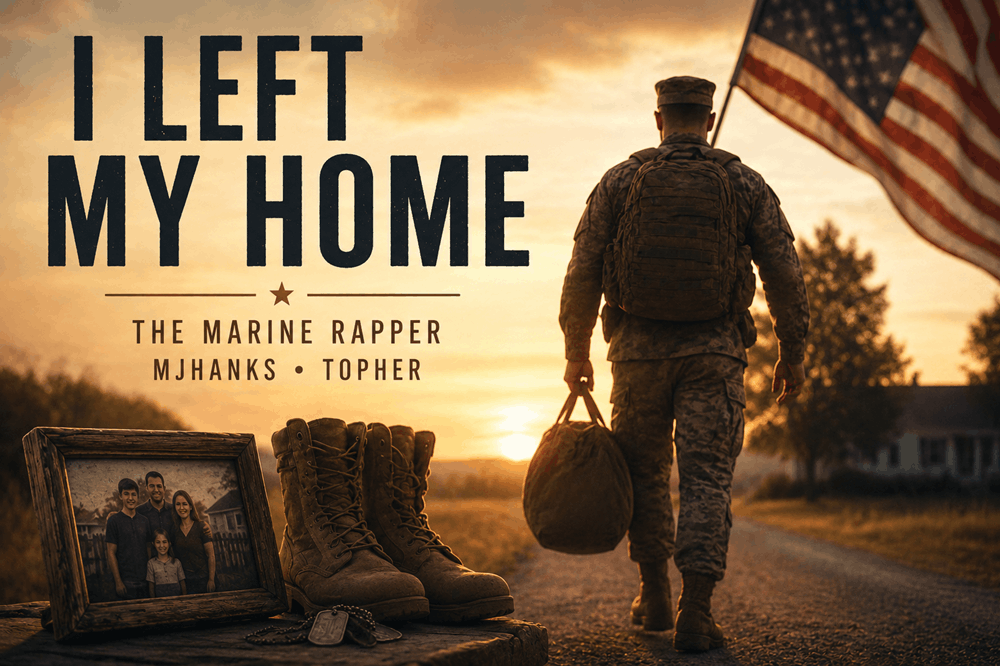
“I Left My Home” Lyrics Meaning: MJHanks, Topher and The Marine Rapper’s Song About Service, Sacrifice and Family
“I Left My Home” by MJHanks, Topher and The Marine Rapper is about the personal cost of leaving family behind to enter military service.
Built around a traditional Army cadence, the song moves between pride and grief. Its narrators describe the discipline, confidence and sense of purpose that military life can provide, but they also remember the parents, partners and children who remain at home.
The song’s central meaning is:
Joining the military may create strength, identity and brotherhood, but every departure begins with a painful separation from the people a service member loves.
The title sounds simple, yet “home” represents much more than a building. It includes family, childhood, safety and the version of oneself that existed before training, deployment and war.
The complete recording is available through the official “I Left My Home” music video. The single was released on September 24, 2021, and credits MJHanks, Topher and The Marine Rapper as its principal performers.
What is “I Left My Home” about?
“I Left My Home” describes the emotional and psychological journey of people who leave their families to serve in the armed forces.
The song begins with the familiar structure of a marching cadence. A caller delivers a phrase, and a group answers. This call-and-response pattern creates the feeling of recruits moving together as one unit.
The rap verses then expand the traditional cadence into personal stories about:
- Leaving parents behind
- Separating from a spouse or partner
- Missing a child
- Enduring demanding training
- Finding confidence through discipline
- Entering combat
- Losing fellow service members
- Continuing a family tradition of military service
The song does not treat military life as entirely tragic or entirely heroic. It presents both sides.
Leaving home can lead to pride, maturity and belonging. It can also produce fear, grief and permanent absence.
What does “I left my home” mean?
On the surface, the phrase refers to physically departing for military training.
At a deeper level, it describes leaving an entire identity behind.
Home can represent:
- Childhood
- Family protection
- Familiar routines
- Emotional security
- Civilian freedom
- A life in which war remains distant
A person who joins the military does not merely change locations. Training changes how they speak, move, think and respond to authority.
The individual who eventually returns may not be the same person who left.
The song therefore treats departure as a boundary between two lives:
- Life before service
- Life shaped by service
Crossing that boundary can create pride, but it may also bring experiences that cannot easily be explained to people who stayed home.
Why does the song mention so many family members?
The traditional cadence identifies the people and even the animals who remain behind when a recruit leaves.
The list initially sounds playful, especially when it includes household pets. However, its repetition gradually makes the departure feel larger.
The recruit is not leaving one person.
They are leaving an entire world.
Each family member represents a different emotional bond:
- A mother may express fear and grief.
- A father may associate departure with adulthood.
- A spouse must accept uncertainty and separation.
- A child may not understand why a parent is leaving.
- Siblings remain connected to the recruit’s earlier life.
- Pets and familiar objects represent the ordinary home that continues without them.
The list also shows how military service affects more than the person wearing the uniform.
One enlistment changes the lives of everyone who waits.
Why does the mother believe her child could die?
For a parent, military service contains risks that cannot be controlled.
Training accidents, deployments and combat may all place a service member in danger. Even when a recruit speaks confidently about the future, a parent may imagine the worst possible outcome.
The mother’s fear gives the song emotional weight before any battle begins.
She does not know what will happen.
That uncertainty is the problem.
The person leaving may focus on opportunity, purpose or personal growth. The parent sees the child they raised walking toward an institution capable of sending them into war.
Neither perspective is presented as foolish.
The recruit needs confidence to leave.
The mother’s fear reflects the reality that not everyone comes home.
Why does the father connect military service with becoming a man?
The father’s response reflects a traditional idea of adulthood.
Military service is often associated with:
- Independence
- Responsibility
- Discipline
- Physical endurance
- Courage
- Providing for others
- Accepting danger
By approving of his child’s decision, the father treats departure as a rite of passage.
However, the song complicates this proud moment.
Becoming an adult also means leaving parental protection. The handshake that recognizes maturity may be the final physical contact between father and child for a long time—or possibly forever.
The scene therefore contains pride and fear at once.
The father acknowledges growth while accepting that he can no longer keep his child safe.
Why is the child’s reaction especially important?
A young child may not understand military duty, national service or deployment schedules.
The child understands only that a parent is leaving.
This changes the emotional perspective of the song. The service member is not merely someone’s child; they may also be a parent whose own family must experience the same separation.
Military service can create a repeated cycle:
- One generation watches a parent leave.
- That child grows up and enlists.
- Their own child then watches them depart.
The song presents this pattern as both tradition and sacrifice.
Following a parent into service may produce pride. It may also recreate the same pain that the service member once experienced from the other side.
What is a military cadence?
A military cadence is a rhythmic call-and-response chant used while troops march or run.
One person calls the lines, and the formation answers. The rhythm helps service members remain in step, control their breathing and continue moving together during physically demanding activity.
Cadences are also known as jody calls or jodies.
The U.S. Army Center of Military History explains that modern cadences developed from military drill traditions and Black musical influences, including work songs and blues-based call-and-response patterns. Cadences improve coordination and morale while turning a group of individuals into a more unified formation. (Read the Army’s history of military cadences)
That communal function matters to “I Left My Home.”
The personal stories concern individual families, but the repeated answers show that thousands of service members recognize the same experience.
Each person leaves a different home.
Together, they sing the same departure.
Is “I Left My Home” an original cadence?
The core cadence predates the 2021 rap recording.
Its precise original author is not known. Like many military cadences, it has been passed between units and generations, with callers changing lines or adding details.
Jonathan Michael Fleming, who has recorded numerous military cadences, describes it as a traditional work whose author is unknown and which has circulated through the armed forces over time. He also notes that it gained widespread civilian attention after a video of Drill Sergeant Michael DePalo calling it during training became popular online. (Read Fleming’s history of the cadence)
MJHanks, Topher and The Marine Rapper did not invent the central call-and-response idea.
Their version transforms it.
They preserve the cadence’s familiar emotional foundation while adding original rap verses about ambition, combat experience, military history and the psychological consequences of service.
How do the rap verses change the traditional cadence?
The cadence concentrates on departure.
The rap verses ask what happens afterward.
They introduce experiences that the family members standing at home cannot yet see:
- Training creates discipline.
- Fear is converted into motivation.
- Recruits learn to function as part of a unit.
- Service becomes a source of identity.
- Combat exposes them to violence and loss.
- Returning home does not erase what happened.
This makes the song more than a marching chant.
It becomes a compressed military life story.
The narrators leave as sons, partners and parents. They return—when they return at all—as veterans carrying memories that may be difficult to share.
The verses also prevent the song from becoming purely mournful. Military service is portrayed as a source of confidence and achievement as well as pain.
That tension is essential to the song’s meaning.
Is “I Left My Home” a pro-military song?
The song expresses respect for military service, but it does not pretend that service is free of suffering.
Its performers emphasize:
- Courage
- Discipline
- Duty
- Patriotism
- Historical military achievement
- Pride in completing difficult work
At the same time, the recording acknowledges:
- Families crying at departure
- The possibility of dying at war
- Violent combat
- Fallen comrades
- Children growing up during a parent’s absence
- Veterans carrying war home psychologically
The result is patriotic without being emotionally simple.
The song respects the decision to serve while recognizing what that decision can cost.
Its message is not that every departure produces glory.
Its message is that the people who leave—and those who wait for them—deserve to have their sacrifices understood.
Who is The Marine Rapper?
The Marine Rapper is the stage name of Raymond Lott, a former U.S. Marine combat correspondent.
Lott served in the Marine Corps from 2004 to 2014 and completed deployments connected to Iraq, Afghanistan and Africa. His work involved documenting the experiences of Marines through journalism, photography and storytelling. He later applied those skills to music focused heavily on military and veteran experiences.
His background gives his verse additional significance.
He is not imagining military separation only from the outside. His writing is informed by years inside the institution and by exposure to war.
The Marine Rapper’s participation also broadens the song beyond one branch.
Although the traditional refrain mentions joining the Army, the emotions of leaving home, serving overseas and remembering fallen friends are shared across the military community.
Who are MJHanks and Topher?
MJHanks, whose name is Michael Hanks, led the recording and directed the official video with Peter Molnar.
Topher, whose name is Christopher Townsend, is an Air Force veteran and rapper. The Marine Rapper contributes the Marine veteran’s perspective.
The official song credits list Townsend, Hanks and Raymond Lott as writers of the released version.
Their different backgrounds allow the song to feel collaborative rather than autobiographical in only one narrow sense.
Each performer contributes a personal voice, while the cadence connects those voices to a much older military tradition.
What does the song say about inner battles?
Not every battle in the song is physical.
The narrators also describe confronting fear, doubt and the pressure to prove themselves.
Military training often demands that recruits continue functioning when they are exhausted, uncomfortable or uncertain. The song connects that discipline to internal struggles.
Victory can therefore mean:
- Completing training
- Resisting self-doubt
- Controlling fear
- Continuing after loss
- Accepting responsibility
- Finding direction
- Surviving memories of war
This expands the meaning of service.
The soldier is not only fighting an outside enemy. They may also be fighting the belief that they cannot continue.
The disciplined rhythm supports this theme. The repeated steps and answers suggest that progress is made one movement at a time.
Why does the song refer to earlier military heroes?
The Marine Rapper’s section invokes historical service members and military groups, including Black Americans whose contributions were once ignored or minimized.
These references place the narrator inside a longer tradition.
He is not serving alone. He sees himself as following people who fought both national enemies and discrimination within their own country.
The historical references add another meaning to the idea of leaving home.
For many earlier service members, wearing the uniform offered pride and opportunity while their rights remained restricted in civilian society.
Their service therefore contained contradiction:
- They defended a nation that did not always treat them equally.
- They demonstrated loyalty while demanding recognition.
- Their achievements created paths for later generations.
By remembering them, the song presents military identity as something inherited through history as well as family.
What does the song say about inherited service?
One narrator recognizes that he has followed the same path as his father.
This realization can create pride because military service becomes a family tradition. The younger generation proves that it can meet the standard established before it.
It can also create sadness.
The narrator may finally understand experiences his father could never fully explain.
Before serving, a child sees the uniform.
After serving, they understand the separation, fear and memories inside it.
Inherited service therefore creates a bond between generations, but it may also transmit emotional burdens from one generation to the next.
The song does not present that inheritance as entirely good or bad.
It shows why people continue it even after witnessing the cost.
What does the official music video add?
The official video turns the recording into a memorial.
Released on Veterans Day in 2021, it was dedicated to the 13 U.S. service members killed during the August 26, 2021, attack at Kabul airport during the Afghanistan evacuation. The video includes references to their lives, families and military service.
This context changes how the song is heard.
The possibility of not returning home is no longer an abstract warning. The video connects it to identifiable people whose families experienced exactly that loss.
Scenes of departure and military formation are therefore placed beside a more painful reality:
Some families say goodbye without knowing it is the final time.
The memorial focus also prevents the performers’ confident verses from becoming empty celebration. Confidence exists beside remembrance.
The service members are honored not only as uniformed figures but as children, siblings, spouses, parents and friends.
Why does the song connect with veterans and military families?
The song gives both groups a recognizable emotional role.
Veterans may connect with:
- The rhythm of cadence calls
- Memories of training
- Leaving civilian life behind
- Pride in completing difficult experiences
- Combat memories
- The loss of fellow service members
- The complicated meaning of returning home
Military families may connect with:
- Fear during departures
- Long periods of uncertainty
- Children missing parents
- Pride mixed with resentment or worry
- The possibility of receiving devastating news
- The difficulty of understanding how service changed someone
Many patriotic songs concentrate on flags, national ideals or victory.
“I Left My Home” begins somewhere smaller and more intimate: the front door.
Its emotional argument is that national service always begins with a private goodbye.
Is there another version by The Marine Rapper?
Yes.
In 2023, The Marine Rapper released another version featuring Jonathan Michael Fleming and Chelse Hill as part of the album Warrior’s Anthem. It combines the familiar cadence with a newer rock-oriented presentation.
The later version reflects how adaptable the cadence is.
It can function as:
- A marching chant
- A rap song
- A rock anthem
- A memorial
- A motivational recording
- A shared memory for veterans
Its continued reinterpretation is consistent with military cadence tradition. Cadences survive because new callers and performers adapt them to their own units, eras and experiences.
What is the deeper meaning of “I Left My Home”?
The deeper meaning concerns the distance between public honor and private sacrifice.
From the outside, military service may be represented through:
- Uniforms
- Medals
- ceremonies
- Heroic language
- National pride
Inside a family, it may be experienced through:
- An empty bedroom
- A parent’s fear
- A child’s confusion
- Missed birthdays
- Unanswered calls
- A person who returns changed
- A person who does not return
The song joins these perspectives.
It does not reject pride, but it refuses to separate pride from its cost.
The repeated cadence creates unity among service members, while the family stories remind listeners that every uniform contains an individual life.
Before becoming part of a formation, each person belonged to a home.
Final meaning
“I Left My Home” is about the moment a person leaves family, safety and civilian identity to enter military service.
The traditional cadence gives the song its emotional foundation. Parents, partners, children and familiar parts of home remain behind while the recruit moves toward training and possible war.
MJHanks, Topher and The Marine Rapper expand that foundation through verses about discipline, confidence, combat, military heritage and fallen comrades.
The song respects service without hiding its consequences.
Leaving home can create purpose and brotherhood. It can also cause lifelong separation, trauma and grief.
The official video makes that cost especially clear by honoring the 13 U.S. service members killed during the Kabul evacuation. Their stories remind listeners that phrases about sacrifice describe real families whose loved ones never walked back through the door.
“I Left My Home” endures because it holds pride and sorrow together.
Its rhythm keeps a formation moving forward.
Its story remembers everything—and everyone—that movement leaves behind.