“Ice Ice Baby” Lyrics Meaning: Vanilla Ice’s Song About Confidence, Miami Nightlife and Sudden Danger
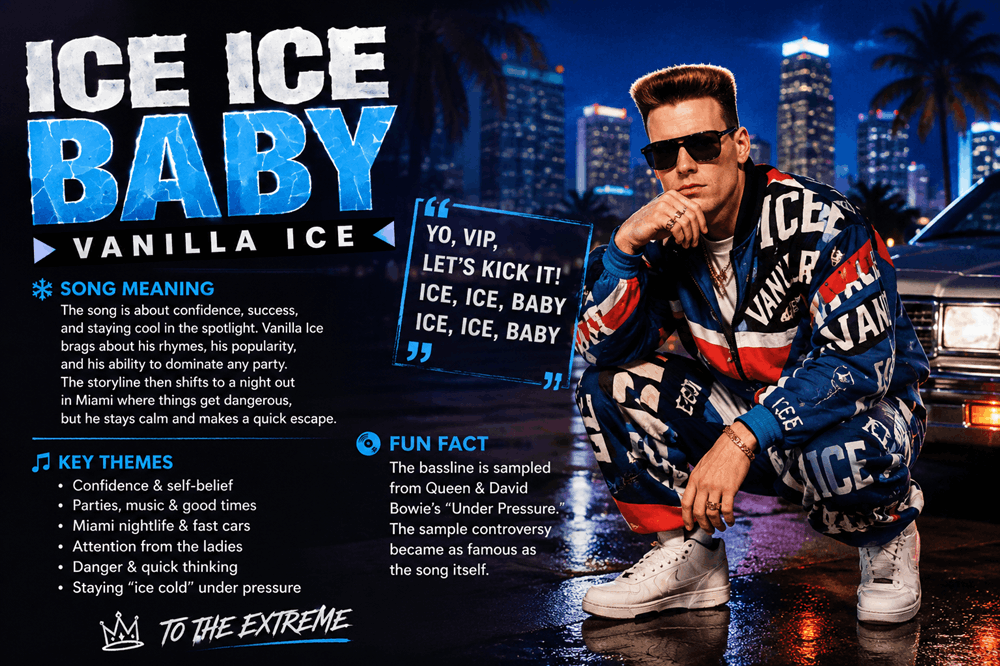
Vanilla Ice’s “Ice Ice Baby” is about a rapper presenting himself as the most exciting, confident and commanding person in the room.
The song begins as a performance of pure self-belief. The narrator boasts about his rhyming ability, his popularity and his power to control a party. He then shifts into a nighttime story involving fast cars, Miami streets, women and sudden violence.
Its central meaning is:
Confidence can turn an ordinary young man into a larger-than-life character, but the world surrounding that character is less controlled than he wants it to appear.
“Ice Ice Baby” is not built around one complicated message. Its appeal comes from attitude, rhythm and memorable imagery. Vanilla Ice creates a persona who is cool under pressure, able to dominate a dance floor and ready to escape danger without losing his composure.
The song later became equally famous for the bassline it borrowed from Queen and David Bowie’s “Under Pressure,” turning a party record into one of pop music’s most recognizable sampling controversies.
Listeners can hear the complete recording through Vanilla Ice’s official “Ice Ice Baby” music video. The single was released in 1990 through SBK Records.
What is “Ice Ice Baby” about?
“Ice Ice Baby” moves through two connected scenes.
The first takes place around a performance or party. The narrator arrives with confidence, commands attention and describes his music as something powerful enough to fill a room and force people to move.
The second scene moves outside.
He drives through South Florida, notices women, encounters a dangerous situation and quickly leaves before becoming trapped in it.
Together, the scenes establish his public identity:
- He is a successful rapper.
- He believes his flow is unusually powerful.
- People recognize him.
- Women notice him.
- He drives through the city with confidence.
- He remains calm when danger appears.
The song is therefore less about telling a detailed story than building a character.
Vanilla Ice wants listeners to believe he is talented, stylish, unpredictable and impossible to intimidate.
What does “ice” mean in the song?
“Ice” refers primarily to Vanilla Ice himself.
The word suggests coolness, composure and a personality that appears unaffected by pressure. It also functions as a shortened form of his stage name, allowing the hook to repeatedly announce his identity.
The repetition turns his name into a brand.
“Ice” can suggest:
- Emotional control
- Confidence
- Style
- Toughness
- A cool public image
- Someone who does not panic
That last meaning matters because the song eventually describes a threatening street encounter.
The narrator wants to appear just as calm around danger as he does onstage.
The title therefore works like an introduction and a command. It tells the audience who is present and asks everyone to focus on him.
Why does he describe himself so dramatically?
Bragging has always been an important part of rap.
An MC often establishes authority by claiming to be more skilled, original, attractive or successful than competitors. The purpose is not always to provide a literal and measurable biography. It is to make the performer sound powerful enough to hold the listener’s attention.
Vanilla Ice uses that tradition in a highly accessible pop form.
He portrays himself as someone whose rhymes:
- Arrive quickly
- Overpower weaker performers
- Control the crowd
- Create physical excitement
- Remain memorable after the song ends
The exaggerated language is part of the performance.
A quiet or uncertain narrator would not suit the bassline and dance rhythm. The song requires someone who sounds completely convinced of his own importance.
That certainty became both its greatest strength and one reason some listeners later mocked it.
The performance leaves almost no room for self-doubt.
What does the party represent?
The party is the environment where the narrator’s confidence becomes visible.
Before the music starts, his claims are only words. Once people dance and respond, the crowd appears to confirm that he possesses real power.
The party represents:
- Recognition
- Popularity
- Control
- Sexual attention
- Escape from ordinary life
- Proof that the music works
The narrator does not describe a private emotional experience. His identity depends on being seen.
He wants a room full of people to react at the same time.
This helps explain why “Ice Ice Baby” became such an effective crossover hit. The song does not require listeners to understand a complex background or follow a dense story. It offers a strong bassline, simple commands and a performer who tells the audience exactly how exciting the moment should feel.
Why does the song move from dancing to violence?
The shift makes the song’s world feel less safe than its opening confidence suggests.
At first, the narrator appears to control everything:
- The music
- The room
- The audience
- His image
- His car
- The direction of the night
When violence appears, that control becomes uncertain.
The narrator encounters a threatening scene involving armed people and decides to leave rather than test how serious the danger might become.
This moment does not destroy his confident persona. He presents retreat as intelligence rather than fear.
The decision suggests that being “cool” does not require standing still in front of unnecessary danger. It can also mean recognizing risk quickly and escaping before the situation becomes worse.
The story adds motion to the song.
It begins with performance, moves through the city and ends with the narrator still free to continue his night.
What is the meaning of the Miami setting?
The song’s geographical references place the story in South Florida’s nightlife and car culture.
The city is presented through:
- Busy roads
- Loud music
- Customized cars
- Attractive strangers
- Nighttime movement
- The possibility of street violence
Miami functions as both a real location and part of the narrator’s image.
The warm climate, beach culture and nightlife make the setting feel glamorous. At the same time, the dangerous encounter prevents it from becoming a completely harmless vacation fantasy.
The narrator wants the audience to imagine him moving easily through both sides of the city:
- The party and the street
- Attraction and threat
- Entertainment and danger
He belongs to a world where excitement can change direction very quickly.
What is the significance of A1A?
A1A is a major coastal road in Florida.
Its appearance gives the song one of its most specific and memorable location references. Rather than describing an anonymous street, the narrator connects his story to a recognizable part of Florida life.
The road is associated with beaches, tourism and coastal movement, which fits the song’s fast, warm-weather atmosphere.
It also helps the lyrics sound like a report from a particular night instead of a completely invented boast.
The narrator may exaggerate his importance, but the setting feels geographically grounded.
That combination—larger-than-life personality inside a real location—is central to the song’s appeal.
Is the narrator frightened during the dangerous scene?
He does not present himself as frightened.
However, his quick decision to leave shows that he understands the threat.
The song’s persona depends on emotional control, so fear is translated into action. Instead of pausing to describe panic, he gets away.
This creates two possible interpretations.
He is genuinely calm
The narrator recognizes the danger and responds efficiently.
He is protecting his image
He may have been afraid, but he retells the event in a way that preserves his reputation.
Both readings fit the song.
Rap narrators often shape real or imagined experiences into stories that strengthen their public character. The important point is not whether he felt fear privately.
The important point is how he wants the audience to remember him:
Alert, quick and still in control.
Why is the bassline so recognizable?
The song uses the central bass pattern from Queen and David Bowie’s “Under Pressure.”
That bassline is minimal but immediately distinctive. Its repeated notes create tension and forward movement without requiring a complicated melody.
In “Ice Ice Baby,” the pattern supports the narrator’s delivery by giving him a steady space in which to rap. It is dark enough to suit the dangerous street story but simple enough to remain effective in a party setting.
The bassline performs much of the song’s emotional work.
It creates:
- Suspense
- Confidence
- Familiarity
- Dance energy
- A sense that something is approaching
Apple Music now identifies Queen and David Bowie as sampled artists and credits Bowie and all four members of Queen among the songwriters, alongside Robert Van Winkle, Floyd Brown and Mario Johnson.
What happened with the “Under Pressure” sample?
The use of the bassline became highly controversial because the original rights holders were not credited when “Ice Ice Baby” first became successful.
Vanilla Ice also became known for arguing that his version was different because of a small rhythmic change. That explanation was widely mocked because the resemblance remained obvious to listeners.
The issue was eventually resolved, and later official credits recognized Queen and David Bowie’s contribution. Today, major music services list the original writers and sampled artists directly.
The controversy became inseparable from the song.
For many listeners, the bassline represents two things at once:
- The musical element that made the recording instantly compelling
- The disputed borrowing that damaged Vanilla Ice’s credibility
This is one reason discussions of “Ice Ice Baby” often focus more on its instrumental foundation than its lyrics.
Does the sampling controversy make the entire song unoriginal?
Not completely.
The bassline is the recording’s most recognizable musical element, but Vanilla Ice added a different vocal performance, rhythm, hook and narrative.
Sampling is a longstanding part of hip-hop. Producers frequently transform existing recordings by placing them in new rhythmic and cultural contexts.
The main problem was not simply that an earlier composition was used.
It was that the rights and credits were not properly handled at the beginning.
Once that distinction is made, “Ice Ice Baby” can be understood as both:
- A new rap recording built around an existing musical idea
- A famous example of why sample clearance and songwriting credit matter
The song’s identity depends heavily on “Under Pressure,” but it is not identical to it.
Queen and Bowie created the musical foundation.
Vanilla Ice turned that foundation into a brash early-1990s pop-rap hit.
Who wrote and produced “Ice Ice Baby”?
The current songwriting credits include Robert Van Winkle, better known as Vanilla Ice, along with Floyd Brown, Mario Johnson, David Bowie and Queen members Freddie Mercury, Brian May, John Deacon and Roger Taylor.
Apple Music lists Vanilla Ice as the producer and lead vocalist. It also identifies David Bowie and Queen as sampled artists. The recording runs approximately four and a half minutes in its album form.
The song appeared on Vanilla Ice’s breakthrough album, To the Extreme.
His official website identifies the single as a 1990 SBK Records release.
How successful was “Ice Ice Baby”?
The song became a major international hit.
It reached No. 1 on the UK Official Singles Chart and remained there for four weeks. It spent nine weeks inside the UK Top 10.
In the United States, it became the first rap single to top the Billboard Hot 100, reaching No. 1 in November 1990.
The recording also received a Grammy nomination for Best Rap Solo Performance at the 1991 ceremony. It lost to MC Hammer’s “U Can’t Touch This.”
Its success was historically significant because it demonstrated that a rap record could become a dominant mainstream pop single.
That achievement remains important even though the song and performer later received heavy criticism.
Why was Vanilla Ice criticized so strongly?
Some criticism concerned the music itself, especially the sample controversy and the pop-friendly presentation.
Other criticism focused on authenticity.
Hip-hop had developed from Black and Latino communities, particularly in New York, and many listeners believed Vanilla Ice was being marketed as a simplified, commercially safe version of a culture he had not created.
His clothing, dance routines, biography and public image were examined intensely.
Critics questioned whether:
- His background was being exaggerated
- His street image was manufactured
- His music was too dependent on pop marketing
- His success came at the expense of more established rap artists
- Mainstream audiences accepted him partly because he was white
These debates became larger than the song itself.
“Ice Ice Baby” arrived at a moment when rap was becoming commercially powerful, and Vanilla Ice became a symbol of the tension between cultural origin and mass-market packaging.
Did the song help hip-hop or hurt it?
It arguably did both.
Its enormous commercial success introduced many listeners to rap who had previously treated the genre as marginal or threatening.
A rap single reaching No. 1 demonstrated that hip-hop could dominate mainstream pop charts.
However, the person achieving that milestone mattered.
Some listeners felt that the industry rewarded a white performer for presenting a highly commercial version of music created and developed primarily by Black artists.
The contradiction remains part of the song’s legacy.
“Ice Ice Baby” helped prove rap’s commercial reach, but it also revealed how the music industry could choose which version of rap it found easiest to market.
The song can therefore be historically important without being treated as the most artistically important rap record of its era.
Is “Ice Ice Baby” a novelty song?
It is often treated like one, but that description is incomplete.
The exaggerated hairstyle, dance moves, repeated hook and highly recognizable bassline make it easy to use as a symbol of early-1990s pop culture.
The song is frequently played for nostalgia, comedy or instant audience recognition.
Yet it was not created merely as a joke.
Vanilla Ice was seriously presenting himself as a rapper and entertainer. The record’s success was real, its chart impact was significant and its influence on pop culture lasted far beyond a brief novelty cycle.
A more accurate description would be:
A genuine rap crossover hit that later became a novelty symbol.
Its current appeal often includes irony, but listeners continue to respond to the same qualities that originally made it successful:
- A strong bassline
- A simple hook
- A confident vocal
- A rhythm suited to parties
- Immediate recognition
Why has the song lasted?
“Ice Ice Baby” survives because it can be understood within seconds.
The bassline begins, the hook arrives and listeners know exactly what song is playing.
That instant recognition makes it useful for:
- Parties
- Sporting events
- Comedy
- Advertising
- Film and television
- 1990s nostalgia
- Dance performances
Its controversies also keep it culturally relevant.
The song regularly returns in discussions about:
- Sampling
- Copyright
- Cultural appropriation
- Rap’s crossover into pop
- Manufactured celebrity
- One-hit wonders
- The commercial history of hip-hop
Few songs are remembered equally for their sound, success and arguments surrounding them.
“Ice Ice Baby” is one of them.
What is the deeper meaning of “Ice Ice Baby”?
The deeper meaning lies in the creation of a public identity.
Vanilla Ice turns himself into a character who is:
- Colder
- Faster
- More confident
- More desirable
- More talented
- More controlled than an ordinary person
The song asks listeners to believe in that character for four minutes.
The party proves his popularity.
The women prove his attractiveness.
The danger proves his awareness.
The performance proves his skill.
Yet the song’s later history shows how fragile such an image can be.
Once questions emerged about the sample, biography and marketing, the same extreme confidence that made the recording exciting began to look vulnerable.
The song is therefore an example of both the power and risk of self-invention.
A larger-than-life persona can create fame quickly.
It also gives audiences a larger target when they stop believing it.
Final meaning
“Ice Ice Baby” is about a rapper creating a fearless, stylish and highly confident version of himself.
He commands a party, celebrates his musical ability, drives through Miami and escapes a dangerous street encounter without allowing the story to damage his cool image.
The title repeatedly reinforces that identity.
“Ice” represents the performer, but it also represents emotional control. The narrator wants to appear calm enough to dominate every situation, whether he is facing a crowd or sudden danger.
The song’s famous bassline gives that confidence its musical foundation. Borrowed from Queen and David Bowie’s “Under Pressure,” it helped make the recording instantly recognizable while also creating the controversy that would follow Vanilla Ice for decades.
“Ice Ice Baby” became the first rap single to reach No. 1 on the Billboard Hot 100 and also topped the UK chart. Its success helped demonstrate rap’s enormous mainstream potential, even as critics questioned how the music industry packaged and promoted hip-hop.
That complicated legacy explains why the song remains difficult to dismiss.
It can sound boastful, dated and unintentionally funny.
It can also fill a room within seconds.
The narrator’s world may be exaggerated, but the song achieved exactly what he promises at the beginning:
It made everyone stop and listen.