
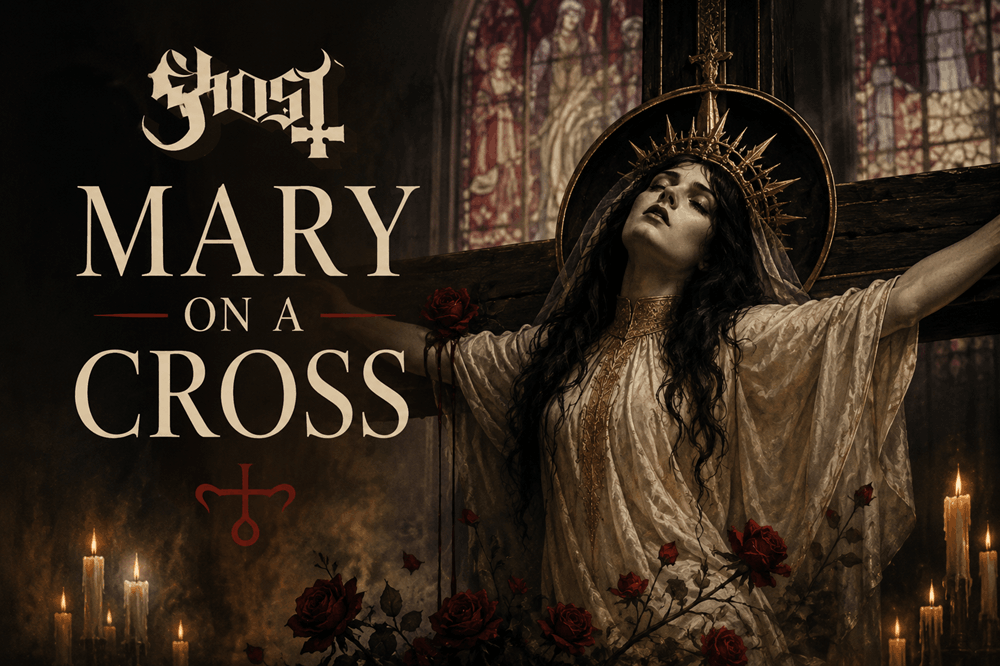
“Mary on a Cross” Lyrics Meaning: Ghost’s Song About a Broken Bond, Misjudgment and Fame
Ghost’s “Mary on a Cross” is about two people who once shared an intense bond, pursued success together and eventually discovered that their relationship could not survive the journey.
Its religious language and suggestive wordplay make the song sound like a deliberately offensive story about the Virgin Mary. Tobias Forge, however, has explained that its central subject is closer to friendship, changing relationships and a person who has been unfairly judged.
The song’s central meaning is:
Two people can share ambition, excitement and genuine affection, yet still reach a point where their lives no longer fit together.
“Mary” represents someone who appears one way to the outside world but has a more complicated identity underneath. The cross can therefore symbolize public judgment, sacrifice and the burden of being misunderstood.
The song remains intentionally provocative. Ghost combines sacred imagery, romantic memory and double meanings rather than giving listeners one completely literal story.
The complete recording is available through Ghost’s official “Mary on a Cross” music video, while the original single can be streamed through the band’s official release page.
What is “Mary on a Cross” about?
“Mary on a Cross” looks back on a relationship between two people who once moved through life together.
They shared excitement, ambition and perhaps a period of public success. Yet the rewards they expected did not bring lasting happiness. Fame and adventure eventually gave way to disappointment.
The narrator remembers:
- Traveling or moving quickly through life together
- Experiencing recognition or success
- Discovering sadness beneath the glamorous surface
- Refusing to follow ordinary expectations
- Feeling affection even after the relationship changed
- Seeing the other person as misunderstood
The relationship can be interpreted as romantic, but Forge has described the song more broadly as being about friendship and the way two people may once have been something important together before becoming something different.
That explanation makes the song less like a conventional love story and more like a memory of a former partnership.
The narrator does not deny that the bond mattered. He accepts that it no longer exists in the same form.
Who is Mary?
Mary is not necessarily one specific biblical figure.
Forge has said that listeners should not automatically assume the song concerns Mary, the mother of Jesus. He suggested that Mary Magdalene is a more useful symbolic reference because she has historically been portrayed in conflicting and often unfair ways.
In that interpretation, Mary represents someone who has been:
- Misjudged
- Reduced to a public reputation
- Described inaccurately by others
- Treated as one thing despite being something more complicated
- Remembered through stories she did not control
The narrator appears to understand this person more deeply than outsiders do.
He sees beyond the image attached to her.
That makes “Mary” suitable for a song about a former companion whose real intentions or character may have been overlooked. The biblical association gives the character immediate weight, but the emotional story can apply to an ordinary relationship.
Mary may be a lover, friend, collaborator or partly fictional combination of several people.
Is the song about the Virgin Mary?
Not literally, according to Forge’s explanation.
The title uses one of Christianity’s most recognizable names beside an image of crucifixion. That combination is designed to attract attention and provoke discomfort, especially because Ghost frequently uses inverted religious imagery as part of its theatrical identity.
However, Forge has said the song has little to do with making a factual claim about the Virgin Mary. He described its wording as layered and tongue-in-cheek rather than a straightforward retelling of Christian history.
The religious language performs several functions:
It creates immediate drama
A cross suggests suffering, judgment and public punishment.
It makes the relationship feel larger
The narrator speaks as though the other person’s struggles have become legendary.
It introduces deliberate ambiguity
Sacred and romantic meanings overlap without resolving completely.
It fits Ghost’s artistic world
The band regularly presents religious symbols through theatrical inversion, satire and dark humor.
The song can therefore use Christian imagery without being solely about Christianity.
Its emotional subject is a human bond that has changed.
What does “Mary on a cross” symbolize?
A cross can symbolize suffering, sacrifice and public condemnation.
Someone placed “on a cross” is exposed before an audience and punished in a way that becomes part of history. Applied metaphorically, the image suggests a person whose reputation has been damaged or whose true identity has been replaced by a simplified public story.
Mary may be “on a cross” because she has been judged by others.
The narrator, however, remembers her differently.
He sees beauty, complexity and perhaps loyalty in someone the outside world misunderstands.
The image can also describe the relationship itself.
Their bond may have been sacrificed to:
- Fame
- Ambition
- Public expectations
- Personal differences
- A demanding lifestyle
- The passage of time
The relationship becomes something both people carry even after it has ended.
The cross is therefore not merely religious decoration. It expresses how affection, reputation and suffering become tied together.
What does “go down” mean?
The expression contains an intentional double meaning.
One interpretation is suggestive and contributes to the song’s provocative tone. Another is the familiar phrase “go down in history,” meaning to become remembered or permanently associated with an event.
Forge specifically said listeners should not assume the wording has only a sexual meaning. It may also describe someone’s fall, historical reputation or eventual rise into legend.
Those meanings can coexist:
- A relationship becomes physically intimate.
- A person experiences a fall from grace.
- Someone becomes famous or infamous.
- A misunderstood figure is remembered incorrectly.
- Private behavior becomes part of a public story.
The ambiguity is deliberate.
Ghost’s lyrics often place sincere emotion inside language that can sound comic, irreverent or scandalous. The double meaning invites listeners to react before they have fully considered the larger relationship being described.
Is “Mary on a Cross” a love song?
It can be heard as one, although it is not a simple declaration of lasting romance.
The narrator speaks with tenderness and appears willing to remain close to the other person despite judgment from outsiders. He remembers shared experiences and suggests that physical appearance, reputation or conventional morality do not reduce his affection.
Yet the song is told from a position of distance.
The two people were once moving together. By the time the narrator looks back, that unity seems to have changed.
It is therefore best understood as a song about love or friendship after transformation.
The narrator’s feelings may remain, but the relationship itself cannot return unchanged.
This gives the song a bittersweet emotional structure:
- Two people become close.
- They pursue excitement or recognition.
- Their success does not eliminate sadness.
- Their paths separate.
- The narrator continues to defend the meaning of their bond.
The song honors what existed without pretending it still exists in the same way.
Why does the song mention stardom and sadness?
Success is presented as something the two people chased together.
They may have expected recognition to give their relationship direction or make their difficulties worthwhile. Instead, public achievement produced its own form of unhappiness.
This contrast supports Forge’s explanation that the song concerns a partnership that changed.
Ambition can strengthen a relationship while two people are working toward the same goal. It can also reveal differences once that goal begins to arrive.
Fame may create:
- Pressure
- Competition
- Exhaustion
- Public scrutiny
- Conflicting priorities
- Less room for private intimacy
The narrators’ shared adventure appears exciting from the outside, but the emotional reward is disappointing.
They gain a story worth remembering while losing the closeness that originally made the story meaningful.
Is the song about Tobias Forge’s own life?
Forge has described the song as personal, but he has not publicly provided a complete biography of the person being addressed.
His explanation points toward a relationship or friendship that changed over time, yet the song also operates inside Ghost’s fictional universe. That makes it difficult—and unnecessary—to match every image to one real event.
Another possible personal layer is Forge’s former stage name Mary Goore, which he used while fronting the Swedish death-metal band Repugnant. The name was itself a play on guitarist Gary Moore. Forge has mentioned that connection while discussing the song’s many possible meanings.
“Mary” could therefore contain several identities at once:
- A former friend or partner
- Mary Magdalene as a symbol
- Forge’s earlier musical persona
- A fictional character inside Ghost’s mythology
- Anyone whose public image hides a different private reality
The song remains effective because none of these possibilities cancels the others.
Is “Mary on a Cross” about marijuana?
A popular listener theory connects the title’s sound to the word “marijuana.”
Other phrases involving altered states, movement and being “high” have encouraged that interpretation. However, Forge’s own explanation focuses on friendship, reputation, double meanings and the symbolism of Mary Magdalene rather than identifying marijuana as the song’s primary subject.
The theory is possible as wordplay, especially because Ghost frequently writes lyrics with several simultaneous jokes.
It should not be treated as the confirmed meaning.
The relationship narrative is much more consistent across the song:
- Two people shared a journey.
- Success did not make them happy.
- Their connection changed.
- The narrator remembers the other person sympathetically.
- Public judgment failed to capture who she really was.
Any drug reference would be an additional layer, not the entire story.
Why does the song sound like it came from the 1960s?
“Mary on a Cross” uses warm organ sounds, bright vocal melodies and psychedelic rock textures associated with the late 1960s.
The music is surprisingly cheerful when compared with the provocative title.
That contrast is essential to Ghost’s style.
A listener may first hear an inviting retro-pop song and only later notice the darker religious imagery and emotional disappointment underneath it.
The retro arrangement also supports Ghost’s fictional history.
Within the band’s mythology, “Mary on a Cross” and “Kiss the Go-Goat” were supposedly recorded in 1969 by an earlier Ghost lineup fronted by Papa Nihil. In reality, the songs were written and recorded decades later and released together in 2019.
The false history allows Ghost to imitate a lost psychedelic single while expanding its larger theatrical universe.
Who are Papa Nihil and Sister Imperator?
Papa Nihil and Sister Imperator are characters in Ghost’s fictional mythology.
Papa Nihil is presented as an earlier leader of the band, while Sister Imperator is closely connected to the organization behind Ghost’s succession of masked frontmen.
The 2024 animated music video for “Mary on a Cross” develops their history as a complicated romance. It was created in connection with Ghost’s concert film Rite Here Rite Now and continues visual ideas introduced through “Kiss the Go-Goat.”
The video gives the song a more specific fictional couple.
Papa Nihil and Sister Imperator share attraction, ambition and resentment. Their history contains affection, betrayal and unresolved emotional ties, closely matching the song’s themes of two people who were once important to each other but could not remain together.
The video does not prove that the original lyrics were written only about these characters.
It adapts the song to fit Ghost’s ongoing story.
Who wrote “Mary on a Cross”?
“Mary on a Cross” was written by Tobias Forge with Swedish songwriters Salem Al Fakir and Vincent Pontare, who work together as Vargas & Lagola.
Apple Music credits Forge as the lead vocalist, the three writers for the composition and Gene Walker as producer. The original recording lasts four minutes and four seconds.
The song was released digitally on September 13, 2019, as part of Seven Inches of Satanic Panic. It originally appeared alongside “Kiss the Go-Goat,” with “Mary on a Cross” positioned as the B-side of the vinyl single.
Its eventual success was unexpected partly because it was not originally presented as a major standalone release.
Why did “Mary on a Cross” become popular years later?
The song gained widespread attention in 2022 after a slowed and reverberated version began circulating through short-form videos, including edits connected to Stranger Things.
Ghost responded by officially releasing a “slowed + reverb” version on August 26, 2022.
The trend introduced the band to listeners who might not normally search for theatrical rock or metal.
Several qualities made the song especially suitable for short videos:
- The chorus is immediately recognizable.
- The melody sounds romantic and nostalgic.
- The words are ambiguous enough to fit many stories.
- The slowed version creates a dreamy atmosphere.
- The religious imagery attracts curiosity.
- The emotional tone works for romantic and tragic edits.
The song subsequently reached No. 28 on the UK Official Singles Chart and remained in the UK Top 100 for seven weeks.
Its revival also made it Ghost’s first song to enter the Billboard Hot 100, where it reached No. 90.
Why did some listeners find the song offensive?
The title combines Mary, one of Christianity’s most revered names, with crucifixion imagery and suggestive wordplay.
Listeners who interpreted the chorus literally viewed it as sexualizing or mocking a sacred figure.
That reaction is understandable at the surface level because Ghost deliberately uses religious provocation. The band’s costumes, characters and lyrics frequently imitate church imagery while reversing its meaning.
Forge nevertheless argued that many reactions ignored the song’s multiple layers. He emphasized that Mary need not represent the Virgin Mary and that the central expression can refer to reputation, history and a misunderstood person rather than only physical intimacy.
The disagreement reflects the song’s design.
It is supposed to sound both beautiful and improper.
Ghost uses that tension to make listeners question whether their first interpretation tells the whole story.
What is the deeper meaning of “Mary on a Cross”?
The deeper meaning concerns the difference between a person and the story told about them.
Mary has become an image.
Outsiders see a reputation, scandal or religious symbol. The narrator remembers someone more complicated: a person with whom he shared ambition, disappointment and genuine closeness.
The song asks whether public judgment can ever describe a private relationship accurately.
It also recognizes that two people may remember the same journey differently.
To the outside world, they may have appeared successful.
Privately, success brought sadness.
To history, Mary may appear disgraced.
To the narrator, she remains beautiful and worthy of affection.
The song therefore defends emotional truth against simplified reputation.
Final meaning
“Mary on a Cross” is about two people who once shared a close relationship, pursued excitement or success together and eventually grew apart.
Its sacred language is intentionally provocative, but Tobias Forge has explained that the song is not simply a literal attack on the Virgin Mary. Its deeper themes involve friendship, changing bonds and people whose intentions or identities have been unfairly represented.
Mary may symbolize Mary Magdalene, Forge’s former Mary Goore persona, a past companion or several ideas at once.
The cross represents public judgment and sacrifice. The song’s double meanings connect physical intimacy with reputation, decline and being remembered by history.
The narrator cannot restore what he once shared with Mary.
He can still refuse to accept the shallow version of her that other people see.
That is what gives the song its unexpected tenderness.
Beneath the psychedelic organ, religious provocation and playful language is a memory of someone who was misunderstood—and of a relationship that remained meaningful even after it stopped working.