
“Stick Season” Lyrics Meaning: Noah Kahan’s Song About Heartbreak, Isolation and Being Left Behind
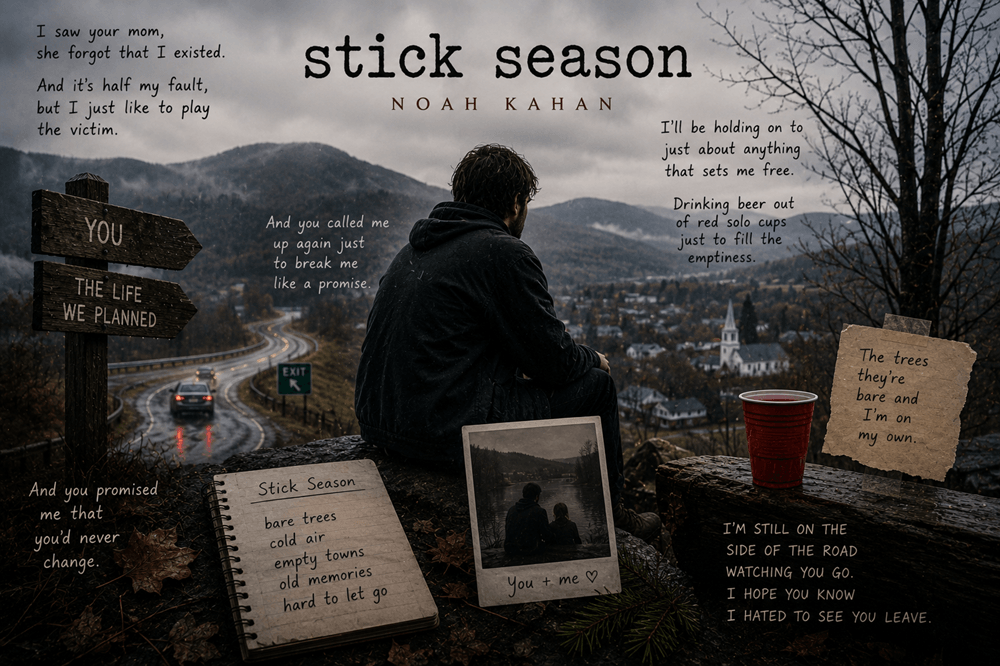
Noah Kahan’s “Stick Season” is about remaining in the place where a relationship ended while the other person has already moved on.
The narrator is surrounded by reminders of his former partner: familiar roads, changing weather, her family and the lonely months before his friends return home for the holidays. He understands that the breakup was partly his fault, yet he still slips into anger, self-pity and unhealthy ways of avoiding the loss.
The song’s central meaning is:
Heartbreak can trap someone between two stages of life—unable to recover what they lost but not yet ready to build something new.
The title refers to a real period in Vermont and other parts of New England. After the autumn leaves have fallen but before snow covers the ground, the trees are bare and the landscape can feel gray, empty and unfinished.
Kahan uses that physical season as a metaphor for emotional limbo. The relationship is gone, but healing has not arrived.
Listeners can hear the complete recording through Noah Kahan’s official “Stick Season” music video and follow the words through the song’s lyrics page on Shazam.
What is “Stick Season” about?
“Stick Season” is about the emotional aftermath of a breakup that happened without satisfying closure.
The narrator remembers his partner promising that the distance between them would not destroy their relationship. During a drive, however, her attitude apparently changed. Instead of turning toward the future they had imagined together, she continued away from him.
The road becomes a metaphor for their separation.
One direction would have led back to their shared life. The other carries her forward without him.
She chooses the second route.
The narrator is left in Vermont trying to understand how a relationship that once appeared permanent could disappear so suddenly.
His pain is intensified because he cannot escape the environment connected to her. Every familiar place reminds him that she is gone.
What does “stick season” mean?
Stick season is the period after New England’s colorful autumn foliage has disappeared but before consistent winter snow arrives.
The trees have lost their leaves, leaving only bare branches. The landscape is no longer bright with fall color, yet it has not gained the clean visual transformation of winter.
Kahan described it as a transitional time that he connected with loneliness. Growing up in Vermont, he watched friends return around Thanksgiving and leave again, making him feel left behind once the holidays ended. He said the isolation of the COVID-19 period brought that feeling back to the front of his mind.
In the song, stick season represents several things at once:
- The space between a breakup and recovery
- The emptiness left after someone departs
- The loneliness of remaining in a small hometown
- A period when life appears emotionally colorless
- The fear that change is happening everywhere except within you
It is not fully autumn and not fully winter.
Similarly, the narrator is no longer in the relationship, but he has not yet created a life beyond it.
Why is Vermont so important to the song?
Vermont is both the narrator’s home and the place trapping him inside his memories.
He still loves it. The landscape, roads, weather and local relationships are part of his identity.
However, loving a place does not prevent it from becoming painful.
After a breakup, familiar surroundings can change meaning. A road becomes the road someone used to leave. Rain becomes connected to a particular memory. A small town becomes a collection of places where a former relationship once existed.
The narrator cannot separate Vermont from the person he lost.
This creates an emotional contradiction:
Home is where he belongs, but home is also where he feels most alone.
Kahan has described the larger Stick Season project as rooted in his New England experiences and in the feeling of returning to memories and places he could no longer see while traveling.
What does the opening drive represent?
The opening presents the breakup as a physical departure.
The former partner had apparently promised that distance would not outweigh their connection. During the journey, however, her voice becomes less certain. She passes the exit that would have brought her toward him and continues driving.
This image suggests that the relationship ended through a decision she had already begun making.
The narrator may not have received a dramatic final conversation. Instead, he heard her withdraw emotionally and then watched her choose a different direction.
The exit sign represents a final opportunity.
She could have turned toward the future they discussed, but she did not.
Her departure leaves the narrator with two unanswered questions:
- When did she change her mind?
- Was the relationship already ending before he realized it?
That uncertainty helps explain why he remains stuck. He cannot stop replaying the moment because he does not understand exactly when the future disappeared.
Why is the narrator caught between anger and blame?
He wants to blame his former partner, but he knows the breakup was not entirely her fault.
Anger allows him to tell a simple story: she promised to stay, changed her mind and abandoned him.
Self-reflection creates a more difficult story. He may have contributed to the relationship’s failure through his behavior, emotional struggles or inability to communicate.
The narrator openly acknowledges that responsibility was shared. He also admits that playing the victim is emotionally easier than confronting his own mistakes.
That self-awareness is one of the song’s most important qualities.
He is not presenting himself as perfectly innocent. He knows that some of his reactions are unfair and self-destructive.
However, recognizing a harmful pattern does not mean he knows how to stop repeating it.
He understands himself well enough to identify the problem but not well enough to escape it.
What does the rain symbolize?
The rain functions as an emotional trigger.
Weather is normally impersonal, but the narrator now associates it with his former partner. A rainy day can unexpectedly return him to a moment, place or feeling connected to the relationship.
That makes the weather frightening.
He cannot control when it rains, just as he cannot control when memories return.
The image reflects how grief often operates. A person may feel stable until a familiar smell, season, road or song suddenly brings the past back with full emotional force.
Rain also fits the song’s larger seasonal imagery.
The narrator is living through an exposed, uncomfortable period. There are no leaves to soften the landscape and no snow to cover what remains.
Everything is visible.
Why can’t the narrator simply leave Vermont?
A doctor has apparently advised him to travel, perhaps as a way of improving his mental health or escaping his current environment.
The pandemic makes that solution difficult.
The reference to COVID places the story inside a specific period when travel felt uncertain and many people were physically confined to places they wanted to escape.
This creates two forms of entrapment:
- He is emotionally stuck in the relationship.
- He is physically stuck in the place associated with it.
Even without travel restrictions, leaving might not solve the deeper problem.
The narrator carries the relationship inside his thoughts. A different city could provide temporary distraction, but it would not automatically remove his anger, guilt or idealized memories.
Why does seeing his ex’s mother hurt so much?
The narrator encounters his former partner’s mother and realizes that he no longer occupies a meaningful place in her family’s life.
During the relationship, he may have believed he was becoming part of that family. He was known, remembered and connected to their routines.
After the breakup, that belonging disappears.
Her mother’s failure to acknowledge or remember him symbolizes emotional erasure.
The narrator has not forgotten the relationship. He continues organizing his emotional life around it.
Her family, meanwhile, appears to have continued without him.
That imbalance makes the loss feel humiliating. He is still grieving a world in which he no longer seems to exist.
Why does he admit to playing the victim?
The admission prevents the song from becoming a one-sided accusation.
The narrator knows he is emphasizing the ways he was hurt while avoiding the ways he may have hurt someone else.
Playing the victim gives him several temporary comforts:
- It protects him from guilt.
- It allows him to direct anger outward.
- It makes the breakup appear easier to explain.
- It preserves an idealized version of himself.
- It delays the work of changing his behavior.
Yet he cannot fully believe his own story.
He admits that responsibility was divided between them. This suggests that part of his suffering comes from knowing the breakup might have been preventable.
He is not only mourning the person who left.
He is mourning the version of himself who might have behaved differently.
What does the drinking represent?
The narrator uses alcohol to pass the time until his friends return home for Christmas.
This is not presented as healthy healing. It is temporary avoidance.
His loneliness is seasonal as well as romantic. During stick season, friends who have moved away are still absent. He waits for the holidays because their return may briefly restore the community he remembers.
Until then, drinking becomes a way to reduce the emotional intensity of waiting.
The pattern reveals that his breakup is connected to a larger fear of abandonment.
His partner left.
His friends left town.
His ex’s family no longer recognizes him.
The narrator remains in the same place while everyone else appears to be building a life somewhere beyond him.
Why does he dream about a different version of his ex?
The person appearing in his dreams may not be the real former partner.
She may be an idealized version created from memory, longing and regret.
After a breakup, people often separate a former partner into several imagined versions:
- The person they first fell in love with
- The person they hoped they would become
- The person they were during the happiest moments
- The person they might have been if the relationship had survived
- The person remembered after painful details have faded
The narrator may never have completely possessed the version he dreams about.
That allows him to tell himself that he did not truly lose her. The perfect version remains alive inside his imagination because she may never have existed in reality.
This is emotionally comforting but also dangerous.
He cannot move beyond the relationship while comparing reality with a person created by memory.
What do the tire tracks and shoes symbolize?
The remaining objects reduce an entire relationship to signs of departure.
Tire tracks show where someone went, but they cannot tell the narrator where she is now or whether she will return.
Shoes usually suggest presence and movement. A single remaining pair can feel strangely intimate, especially after the person who wore them is gone.
These images show how ordinary objects become emotionally charged after separation.
The narrator is left with evidence but not companionship.
He can see that she was once there. He cannot transform those traces into a future.
The physical details also make the breakup feel final. The former partner is no longer an active person in his daily life. She has become tracks, belongings and memories.
Why does the narrator feel split in half?
He had built part of his identity around the relationship.
When his partner leaves, he does not feel like a complete individual who has simply lost a companion. He feels as though part of his own self has disappeared.
This suggests emotional dependence.
Her presence may have provided:
- A sense of direction
- Reassurance about his value
- Relief from family-related pain
- A person who appreciated his humor
- Hope that his future could differ from his past
- A feeling of belonging
Without her, the narrator must confront parts of himself that the relationship temporarily softened.
His statement that the remaining half will have to be enough sounds resigned rather than confident.
He is not celebrating independence.
He is acknowledging that surviving as an incomplete version of himself is currently his only option.
What is the “darkness” inherited from his father?
The narrator suggests that some of his emotional difficulties began before the relationship.
The inherited darkness could represent depression, anxiety, family trauma, unhealthy behavior or a general belief that pain passes from one generation to the next.
He hoped that adding enough good experiences to his life would cancel out the damage.
The relationship may have been one of those good things.
He believed love could outweigh everything difficult he carried from his family history. When the relationship ended, the old darkness remained.
This reveals that he may have expected his partner to do something no partner could permanently accomplish.
Another person can provide support, but they cannot erase inherited pain through love alone.
The narrator must eventually confront that pain as his own problem rather than treating a relationship as proof that it has disappeared.
The song does not define the family reference precisely, allowing it to represent the complicated ways parents can shape a child’s emotional life. The official credits identify Noah Kahan as the song’s sole writer.
Why does he say he is no longer funny?
His sense of humor depended partly on his former partner’s response.
She laughed, and that laughter confirmed that he was entertaining, lovable and understood.
After she leaves, being funny no longer feels meaningful.
This suggests that identity is partly relational. People learn who they are through the reactions of those closest to them.
Someone may feel intelligent around one partner, attractive around another or emotionally safe with a particular friend.
When that relationship ends, those qualities can seem to disappear even though they still exist.
The narrator has not literally lost his ability to make jokes. He has lost the person whose laughter made that part of himself feel alive.
What does the unanswered phone call represent?
The former partner once spoke as though their relationship would last permanently.
Now she will not respond.
The contrast between earlier promises and present silence is more painful than a simple rejection.
The narrator is forced to question whether the earlier declarations were ever sincere.
Several possibilities trouble him:
- She meant them at the time but later changed.
- She said them because they felt romantic.
- He misunderstood the strength of her commitment.
- His own behavior caused her to withdraw.
- Their idea of “forever” was never the same.
Her silence prevents him from receiving a final explanation.
He continues calling emotionally, even if not literally, because he wants the person who made the promise to explain why she no longer stands behind it.
Is “Stick Season” about seasonal depression?
The song contains imagery that can remind listeners of seasonal depression, but it is not limited to a medical description.
Bare trees, gray weather, isolation and reduced social contact all reflect the emotional heaviness some people experience during colder months.
However, the narrator’s sadness has several sources:
- A breakup
- Pandemic isolation
- Family pain
- Friends moving away
- Alcohol use
- Unresolved guilt
- Feeling trapped in his hometown
Stick season intensifies these problems because the environment reflects his internal condition.
The landscape looks as exposed and unfinished as he feels.
The song is therefore less about weather directly causing sadness and more about weather giving sadness a visible form.
Is the narrator trying to move on?
He wants the pain to pass, but most of his behavior keeps him connected to it.
He remains in the same environment, dreams about his former partner, seeks temporary relief through substances and repeatedly reconstructs the breakup.
At the same time, his self-awareness suggests that movement may eventually be possible.
He recognizes that:
- He shares responsibility.
- He is using victimhood as protection.
- His coping methods are temporary.
- The version of his ex in his mind may not be real.
- The relationship was carrying older emotional problems.
- He must continue with the half of himself that remains.
These realizations are not complete healing, but they are more honest than simple blame.
Moving on often begins before someone feels ready.
The narrator may still be emotionally stuck, yet he has begun identifying the reasons.
Is “Stick Season” a love song?
It is a love song written from the emptiness after love has ended.
The narrator still loves his former partner, but his feelings are mixed with resentment, dependency and nostalgia.
He misses the person, but he also misses:
- The future they planned
- The family connection she provided
- The way she responded to his personality
- The possibility of escaping inherited pain
- The version of himself who existed beside her
This distinction matters.
Sometimes people believe they want a former partner back when they actually want the emotional life associated with that relationship.
The narrator may love her, but he is also grieving what she allowed him to believe about himself.
Why does the music sound energetic when the story is sad?
“Stick Season” pairs painful words with fast acoustic strumming and a chorus built for group singing.
The energetic arrangement creates movement even though the narrator feels emotionally stationary.
This contrast reflects the way many people experience grief.
Life continues around them. Friends gather, holidays arrive and music plays, even while part of them remains focused on what ended.
The upbeat folk sound also prevents the song from becoming emotionally distant. Listeners can sing loudly with it while expressing feelings that might be difficult to discuss directly.
Kahan’s ability to combine specific personal details with an accessible chorus helped the song connect far beyond Vermont. He has said that honest details matter because they let listeners feel as though they are visiting a real place rather than hearing a generic story.
How was “Stick Season” written?
Kahan began sharing part of the unfinished song on TikTok before its official release.
He later explained during a Grammy-related panel that he nearly deleted the post because he feared nobody liked it. He forgot to remove it, and the clip began spreading widely.
Kahan said he wrote the first verse and chorus in approximately 20 minutes, while the second verse required about three months of rewrites. He also recalled realizing the song had connected when an audience in Syracuse began singing it back to him.
The story fits the song’s message.
“Stick Season” succeeded because Kahan stopped trying to remove the details that made his experience unusually specific. Vermont, Christmas, bare trees and pandemic travel restrictions became the elements that allowed listeners elsewhere to recognize their own loneliness.
How does the song fit into the album?
“Stick Season” is the title track of Kahan’s third studio album.
The larger project examines hometown identity, mental health, family relationships, loneliness and the difficulty of deciding whether to leave or remain connected to the place where you grew up.
The title song introduces those themes in a compact form.
Its narrator is caught between:
- Home and escape
- Anger and accountability
- Love and resentment
- Memory and reality
- Family history and personal change
- The person he was and the person he must become
The album was later expanded as Stick Season (We’ll All Be Here Forever) and again through additional releases. The original and expanded editions are available through Noah Kahan’s official album collection.
How successful was “Stick Season”?
“Stick Season” grew from a viral preview into an international breakthrough.
In the United Kingdom, the song reached No. 1 and remained there for seven weeks. It also helped Kahan achieve a simultaneous UK chart double when the single and its parent album both occupied the top positions in February 2024.
The Official Charts Company later named it the United Kingdom’s biggest song of 2024. Olivia Rodrigo’s performance of the song in BBC Radio 1’s Live Lounge also helped introduce it to a wider British audience. Its complete performance history is available through the Official Charts archive.
In the United States, the song eventually peaked at No. 9 on the Billboard Hot 100, while the album reached No. 2 on the Billboard 200.
Kahan’s breakthrough during the Stick Season era also earned him a nomination for Best New Artist at the 2024 Grammy Awards. His nominations are listed in the Recording Academy’s official artist archive.
Why did the song become so popular?
The song combines regional specificity with a widely recognizable emotional experience.
Most listeners have never spent stick season in rural Vermont, but many understand:
- Watching friends leave
- Feeling trapped in a hometown
- Being reminded of an ex everywhere
- Knowing a breakup was partly their fault
- Using distraction instead of confronting grief
- Missing an idealized version of someone
- Wondering whether pain will ever pass
- Feeling that everyone else has moved ahead
The details make the song believable.
The emotions make it universal.
Its popularity also grew during a period when many listeners were processing pandemic isolation and changes in their relationships, work and sense of home. The song gave those unsettled feelings a seasonal image.
Bare trees became a symbol for being between lives.
Is “Stick Season” ultimately hopeful?
The song offers limited hope rather than a reassuring resolution.
The narrator wants to believe that the pain is temporary, but he doubts his own optimism.
He does not announce that he has healed, found someone new or forgiven himself.
What he does achieve is recognition.
He can see his self-pity.
He can acknowledge his responsibility.
He can identify the family pain beneath the breakup.
He can admit that part of the person he misses may exist mainly in his imagination.
Those realizations do not make him feel better immediately, but they create the possibility of change.
Stick season is temporary.
The landscape may look lifeless, but winter will arrive, followed eventually by spring.
The narrator cannot feel that renewal yet. The metaphor allows listeners to recognize that it remains possible.
Final meaning
“Stick Season” is about being emotionally abandoned in a place filled with reminders of the person who left.
The narrator’s former partner changed direction and continued toward a life without him. He remains in Vermont, caught between anger and accountability while the bare landscape reflects his emotional emptiness.
The song’s title describes the uncomfortable period after autumn but before winter. Kahan transforms it into a metaphor for the stage after a breakup when the relationship has ended but healing has not begun.
The narrator uses alcohol, dreams and self-pity to avoid the full loss. He imagines an ideal version of his former partner and mourns the identity he experienced beside her.
At the same time, he knows the breakup was partly his fault.
That admission gives the song its emotional depth. He is not simply a victim of abandonment. He is someone beginning to understand that grief, family history and personal responsibility have become tangled together.
The former partner is gone.
His friends will eventually return for Christmas and leave again.
The weather will change, but not quickly enough to comfort him.
For now, he must live as the half of himself that remains.
That is the meaning of “Stick Season”: surviving the exposed, colorless period between losing an old life and becoming ready for the next one.