
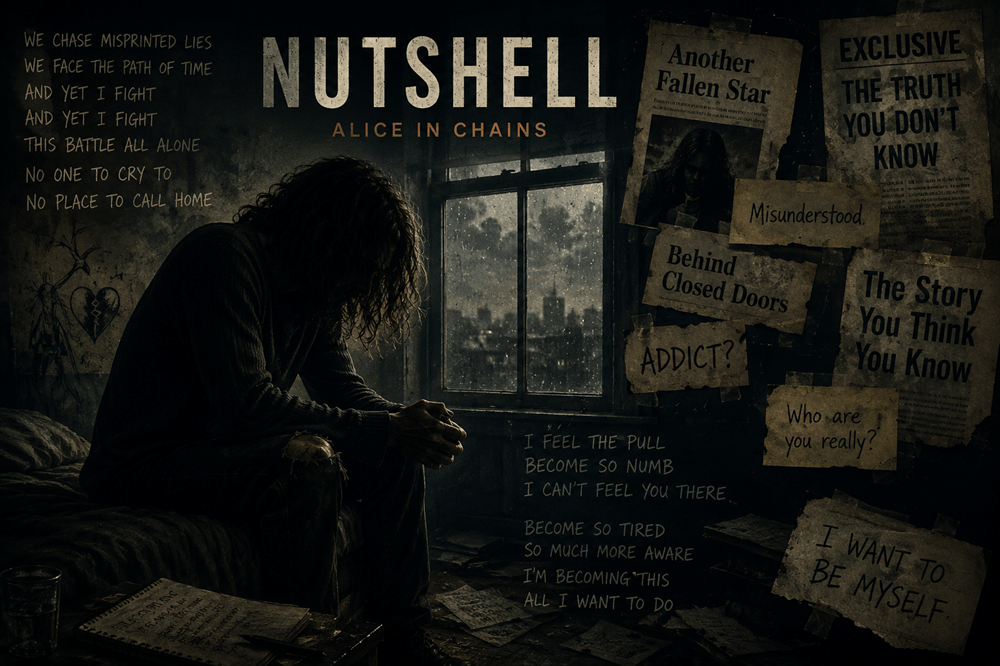
“Nutshell” Lyrics Meaning: Alice in Chains’ Song About Isolation, Lost Privacy and the Fight to Remain Yourself
Alice in Chains’ “Nutshell” is about a person who feels exposed, misunderstood and completely alone in a private emotional struggle.
The narrator believes the outside world has taken ownership of his identity. Other people judge him through rumors, false stories and public expectations, while his real self remains hidden behind those impressions.
At the same time, he is fighting an internal battle without a dependable home, a trusted person to confide in or a clear path out of his pain.
The song’s central meaning is:
When someone loses privacy, connection and control over their identity, simply remaining themselves can begin to feel like an impossible fight.
“Nutshell” is often connected to Layne Staley’s experiences with fame, addiction and isolation. Those associations are understandable, but the lyrics never reduce the song to one specific problem. It can also speak to depression, loneliness, public judgment, broken relationships or the feeling that nobody sees who you truly are.
Listeners can follow the complete words on the song’s lyrics page.
What is “Nutshell” by Alice in Chains about?
“Nutshell” is primarily about isolation and the loss of personal identity.
The narrator is surrounded by other people’s stories about him. Instead of being understood directly, he is represented through distorted information, expectations and judgments.
He tries to continue living under that pressure, but the struggle has become deeply lonely.
There is no obvious enemy he can confront. The problem exists both outside and inside him:
- The public misunderstands him.
- His privacy has disappeared.
- Time continues moving forward.
- He has nowhere that feels like home.
- He cannot find anyone who fully understands his struggle.
- His own mind repeats painful thoughts he cannot escape.
The song does not describe someone asking to be rescued. The narrator sounds as though he has already stopped expecting help.
That resignation is what makes “Nutshell” so devastating. He is still fighting, but he no longer seems confident that fighting will change anything.
What does the title “Nutshell” mean?
The title has several possible meanings.
The most familiar expression is “in a nutshell,” which means reducing a complicated subject to its simplest summary.
The song can therefore be heard as the narrator’s entire life compressed into a few painful statements. He does not provide a detailed biography or explanation. He summarizes his condition: he feels misrepresented, exposed and alone.
The title may also refer to a protective shell.
A shell separates its vulnerable contents from the outside world. Someone who feels judged or emotionally unsafe may create a similar defense by becoming quieter, more private and less willing to trust others.
However, a shell can also become a prison.
It may protect a person from further pain while preventing anyone from reaching them. The narrator wants privacy, yet his isolation leaves him without emotional support.
The title therefore captures a painful contradiction:
He wants protection from the world, but complete protection would also mean complete loneliness.
What are the “misprinted lies”?
The phrase suggests false stories that have been published, repeated or accepted as truth.
“Misprinted” immediately brings newspapers, magazines and media coverage to mind. Because Alice in Chains had become internationally famous by the time “Nutshell” appeared, listeners often interpret this image as a reaction to press coverage and public speculation.
A famous person can lose control over their own story. Interviews are shortened, private struggles become entertainment, and rumors may be repeated until audiences accept them as fact.
The narrator feels trapped between the person he knows himself to be and the person presented to the public.
However, the idea also applies outside celebrity culture.
Many people experience being defined by:
- Gossip
- Family expectations
- Workplace rumors
- Social-media posts
- Past mistakes
- Medical or personal labels
- Other people’s incomplete memories
Once a false version of someone becomes established, correcting it can feel impossible.
The narrator is not merely annoyed by misunderstanding. He feels that repeated falsehoods have begun replacing his authentic identity.
Why does the song focus on privacy?
Privacy allows people to decide which parts of themselves they share and with whom.
The narrator feels that this choice has been taken away. His emotional life has become something others can examine, discuss and interpret without his permission.
That loss creates more than embarrassment. It weakens his ability to feel that he belongs to himself.
When private experiences become public property, a person may begin wondering whether anything remains that is truly their own.
This is one reason “Nutshell” remains relevant in the social-media era.
People now regularly experience strangers examining their relationships, appearance, opinions and personal history. A mistake can be copied, reposted and preserved indefinitely. Even people without traditional fame can feel as though their lives are being watched.
The technology has changed, but the song’s concern remains familiar: what happens when everyone believes they know you, but almost nobody actually does?
What does the song mean by fighting alone?
The narrator is dealing with a struggle that other people cannot see or do not understand.
He continues resisting, but he has no dependable person to comfort him and no place that provides emotional safety.
The battle could represent several experiences:
Depression
A person may appear functional while privately struggling with hopelessness, exhaustion and thoughts that repeat without relief.
Addiction
The narrator may be fighting a destructive dependency while feeling unable to explain the experience to people around him.
Fame
Public attention can surround someone with admirers while leaving them uncertain about whom they can genuinely trust.
Alienation
He may feel disconnected from family, friends, society and even his earlier sense of self.
The passage of time
The song recognizes that life continues moving regardless of whether a person is emotionally prepared. Time can carry people farther from relationships, safety and the version of themselves they remember.
The lack of one confirmed explanation allows these meanings to overlap. The narrator may be confronting all of them at once.
Is “Nutshell” about addiction?
Addiction is one valid interpretation, especially when the song is considered alongside Layne Staley’s publicly documented struggles.
However, calling “Nutshell” only an addiction song limits its meaning.
The lyrics do not directly identify a substance or describe intoxication. Instead, they focus on the emotional conditions that can surround addiction:
- Secrecy
- Shame
- Isolation
- Loss of control
- Public judgment
- Repetitive thoughts
- Difficulty trusting others
- Feeling separated from home
These feelings can occur during addiction, but they can also occur in depression, grief or other periods of emotional crisis.
The song is powerful because it describes the inner experience without explaining it away. Listeners hear the loneliness before they assign it a cause.
Is “Nutshell” about fame?
Fame is another important interpretation.
By 1994, Alice in Chains had already become one of the most prominent bands associated with Seattle’s rock scene. Their music, personalities and personal difficulties attracted considerable attention.
“Nutshell” describes the darker side of being publicly visible.
Fame promises recognition, but recognition is not the same as understanding.
A performer may be known by millions while feeling that the person beneath the image has disappeared. Fans, journalists and the music industry may all claim a piece of that identity.
The narrator appears exhausted by this process.
He has offered himself through music, but that gift has not necessarily created connection. Instead, self-expression has made him more available for judgment.
This creates one of the song’s deepest contradictions:
The narrator uses music to reveal himself, yet being revealed has made him want to hide.
What does the song say about identity?
The final idea in “Nutshell” centers on the need to remain one’s own person.
For the narrator, personal autonomy is not a minor preference. It is the last thing separating him from complete emotional collapse.
He feels that the outside world has already taken his privacy and rewritten his story. If he also loses his internal sense of self, nothing meaningful will remain.
This is why the ending feels so severe.
It is not simply an expression of sadness. It is a declaration that identity is essential to survival.
The narrator would rather disappear than continue living as a version of himself created by other people.
That statement should not be romanticized. It reflects a person who has reached an emotionally dangerous point and cannot imagine a tolerable compromise.
The song’s power comes from presenting that desperation without decorating it or pretending that love automatically solves it.
Is “Nutshell” a suicide song?
The ending contains an unmistakable reference to death, so the song can be interpreted as expressing suicidal despair.
However, it is not necessarily a literal plan or farewell.
The final thought may represent an emotional boundary: the narrator believes life would lose its meaning if he could no longer control his own identity.
In that reading, the song is partly defiant.
He is saying that the world may judge him, expose him and misunderstand him, but it cannot be allowed to define who he is internally.
The statement contains both despair and resistance.
That complexity matters. “Nutshell” should not be reduced to a prediction of Layne Staley’s later death. Doing so risks treating his pain as though it existed only to create a tragic story for listeners.
The song deserves to be heard as a complete work about autonomy, loneliness and emotional survival—not simply as evidence of what eventually happened.
Why is the song so short?
“Nutshell” communicates its message with very few words.
There are no detailed verses explaining the narrator’s childhood, relationships or specific circumstances. The song presents only the emotional core.
That restraint matches the title.
The narrator has reduced everything to a nutshell because he may no longer have the energy to explain himself. He states the problem, acknowledges the struggle and then allows the music to carry what language cannot.
The wordless sections are especially important.
They do not feel like empty spaces between verses. Layne Staley’s voice communicates exhaustion and grief without needing additional statements.
A longer explanation might weaken the effect. The narrator has already said enough for listeners to understand that something inside him is breaking.
Why does “Nutshell” sound so sad?
The arrangement is gentle, but it never feels comforting.
Jerry Cantrell’s acoustic guitar establishes a repeating pattern that sounds reflective and inescapable. The music moves forward, yet it repeatedly returns to the same emotional place.
That repetition mirrors the narrator’s mental condition. He continues thinking about the same problems without finding a resolution.
Mike Inez’s bass adds warmth and depth, while Sean Kinney’s restrained percussion avoids turning the song into a dramatic rock performance. Layne Staley sings with very little protection around his voice.
The official credits identify Staley as the lyricist, with Cantrell, Inez and Kinney credited as composers. The original studio recording runs four minutes and 19 seconds and appears as the second track on Jar of Flies.
The band could have surrounded the subject with heavy guitars, but the quieter arrangement makes the pain feel closer.
There is nowhere for the narrator to hide.
How does “Nutshell” fit into Jar of Flies?
“Nutshell” appears on Alice in Chains’ 1994 EP Jar of Flies, between the hypnotic opening track “Rotten Apple” and “I Stay Away.”
The seven-song project was released on January 25, 1994. The band’s official album page lists the full track sequence and links to authorized streaming platforms.
The EP showed that Alice in Chains did not require distorted guitars or enormous volume to create heaviness.
Its weight comes from atmosphere and subject matter. The songs address loneliness, damaged relationships, regret and the consequences of destructive choices.
“Nutshell” may be the project’s most concentrated expression of those themes. It removes nearly everything except the feeling of being alone with thoughts that have become impossible to silence.
Listeners can hear the complete EP through Apple Music.
How successful was Jar of Flies?
Although “Nutshell” was not originally promoted as one of the EP’s major singles, it appeared on an enormously successful release.
Jar of Flies became the first EP to debut at No. 1 on the Billboard 200, selling approximately 141,000 copies during its opening week. The achievement was especially unusual for a largely acoustic seven-track project created outside the traditional expectations of a major studio album.
In the United Kingdom, the combined Jar of Flies/Sap release reached No. 4 on the Official Albums Chart. The band’s broader chart history is available through the Official Charts archive.
Its success proved that listeners were willing to follow Alice in Chains beyond the aggressive sound for which the group was already known.
The quieter songs did not make the band less heavy. They revealed that emotional exposure could be heavier than distortion.
Why is the MTV Unplugged version so famous?
Alice in Chains’ 1996 MTV Unplugged performance gave “Nutshell” a second life.
The band opened the concert with the song. Layne Staley entered slowly, sat beneath the stage lights and delivered a performance that felt even more exposed than the studio recording.
The audience’s reaction before he begins is part of what makes the footage so moving. He appears fragile and distant, yet the room responds with intense affection.
The performance creates a painful contrast between public love and private loneliness.
Thousands of people may value someone’s work, but admiration cannot automatically reach the part of that person that feels isolated.
The official HD recording of the performance can be watched on Alice in Chains’ YouTube channel.
For many listeners, this became the definitive version because the visual performance makes the song’s emotional tension impossible to ignore.
Why does Layne Staley’s performance feel so personal?
Staley does not sing as though he is trying to impress the audience.
His voice is controlled but worn. He does not turn the pain into theatrical anger or attempt to prove his technical ability.
Instead, he sounds like someone reporting his condition as plainly as possible.
That restraint makes the performance feel authentic.
Listeners are not being told how intensely to react. The emotion emerges from the distance between the quiet arrangement and the severity of what the narrator is expressing.
Staley’s voice also carries a particular mixture of strength and vulnerability.
He can sustain powerful notes, but the strength does not suggest victory. It sounds like the effort required to continue speaking while emotionally exhausted.
Why do so many listeners relate to “Nutshell”?
Most listeners have never experienced fame on the scale of Alice in Chains, but many understand the song’s central feelings.
People connect with “Nutshell” when they feel:
- Alone in a crowded room
- Judged by people who know only part of the story
- Unable to explain their emotional condition
- Disconnected from family or home
- Trapped by a reputation or past mistake
- Afraid of losing their identity
- Exhausted from fighting an invisible struggle
- Unsure whom they can trust
The song does not offer advice or a reassuring conclusion.
It simply recognizes the experience.
That recognition can be meaningful. A listener may still feel alone, but hearing the feeling expressed so accurately can make the isolation seem less invisible.
Is “Nutshell” hopeless?
The song is deeply bleak, but a small form of resistance remains.
The narrator continues fighting.
He may feel abandoned and exposed, yet he still recognizes that his inner identity belongs to him. His refusal to surrender that identity shows that the outside world has not completely defeated him.
There is no promise that the situation will improve. “Nutshell” does not provide the emotional release of a song in which pain leads to healing.
Its hope is more limited:
The narrator can still name what is happening to him.
He can still distinguish between his authentic self and the false versions created by others.
He can still communicate his loneliness through music.
Those actions do not erase his suffering, but they prove that some part of him remains present.
Final meaning
“Nutshell” is about a person struggling to preserve his identity after feeling exposed, misrepresented and emotionally abandoned.
The world has turned his private self into something public. False stories and outside expectations surround him, while his internal battle leaves him without a dependable home or person to trust.
The title suggests that the song is his life reduced to its emotional essence. It also evokes the protective shell he has created around himself—a defense that keeps judgment out but leaves him trapped inside.
The song can be connected to fame, addiction and Layne Staley’s personal struggles, but its meaning extends beyond biography.
It speaks to anyone who has felt that other people’s version of them is becoming more powerful than the truth.
“Nutshell” offers no easy recovery and no promise that love will arrive in time. It captures the moment when a person has almost nothing left except the right to remain themselves.
That is why the song continues to feel so intimate.
It does not ask listeners to solve the narrator’s pain.
It asks them to hear it.