Words With Multiple Meanings: 75 Common Examples and How to Understand Them
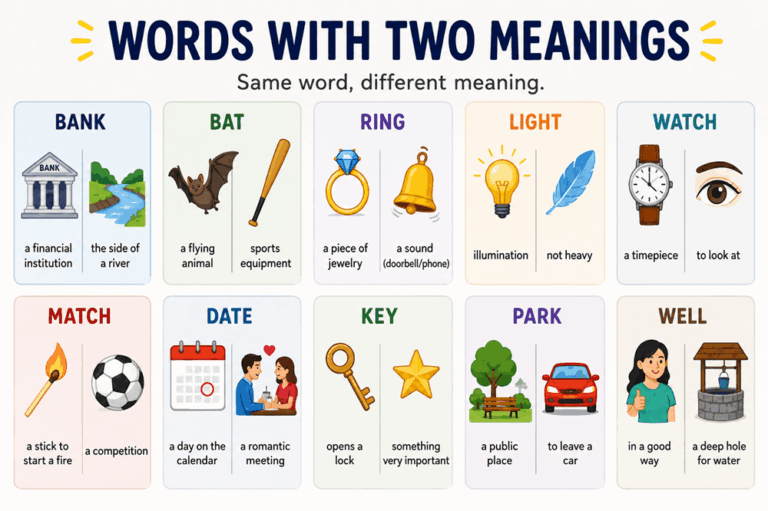
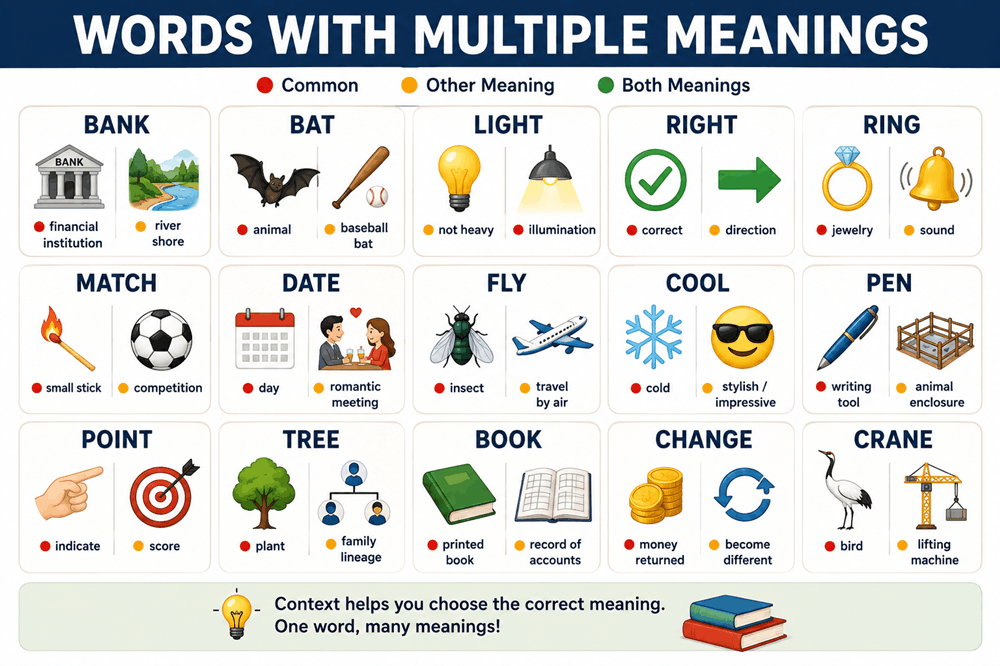
Words with multiple meanings are words that can mean different things depending on how they are used. For example, “bank” can mean a financial institution or the land beside a river, while “bat” can describe a flying animal or a piece of sports equipment. Context usually tells you which meaning is intended.
English contains thousands of words like these. Some meanings are closely related, while others seem completely unrelated. Learning them is useful for vocabulary, reading comprehension, writing, jokes, word games, and understanding everyday conversation.
What Are Words With Multiple Meanings Called?
Several language terms can describe words that have more than one meaning.
Polysemy refers to one word having several related meanings.
For example, the word “head” can mean the part of your body, the leader of a department, or the top of something.
Those meanings are different, but they share the general idea of being at the top or in control.
Homonyms are words that have the same spelling or pronunciation but different meanings.
For example, “bat” can mean an animal or a baseball bat.
In everyday conversation, however, people usually just call them words with multiple meanings.
1. Bank
Meaning 1: A place that handles money.
“She deposited her paycheck at the bank.”
Meaning 2: The land beside a river.
“They sat on the river bank.”
2. Bat
Meaning 1: A flying mammal.
“A bat flew out of the cave.”
Meaning 2: A piece of equipment used in baseball or cricket.
“He swung the bat and hit the ball.”
3. Bark
Meaning 1: The sound made by a dog.
“The dog’s bark woke the neighbors.”
Meaning 2: The outer covering of a tree.
“The bark was rough and dark.”
4. Light
Meaning 1: Illumination.
“Turn on the light.”
Meaning 2: Not heavy.
“This suitcase is surprisingly light.”
Meaning 3: Pale in color.
“She painted the room light blue.”
5. Right
Meaning 1: Correct.
“Your answer is right.”
Meaning 2: The direction opposite left.
“Turn right at the traffic light.”
Meaning 3: A legal or moral entitlement.
“Everyone has the right to express an opinion.”
6. Left
Meaning 1: A direction.
“Turn left at the corner.”
Meaning 2: Past tense of leave.
“She left the office early.”
Meaning 3: Remaining.
“There are only two cookies left.”
7. Match
Meaning 1: A small stick used to start a fire.
“He lit the candle with a match.”
Meaning 2: A competition.
“We watched the soccer match.”
Meaning 3: Something that goes well with something else.
“Those shoes are a perfect match for the dress.”
8. Ring
Meaning 1: A circular piece of jewelry.
“She wore a silver ring.”
Meaning 2: The sound of a telephone or bell.
“I heard the phone ring.”
Meaning 3: A circular area.
“The boxers entered the ring.”
9. Spring
Meaning 1: The season after winter.
“Flowers bloom in spring.”
Meaning 2: A coiled piece of metal.
“The mattress contains metal springs.”
Meaning 3: To jump suddenly.
“The cat sprang onto the table.”
Meaning 4: A natural source of water.
“Fresh water flowed from the mountain spring.”
10. Date
Meaning 1: A day on the calendar.
“What is today’s date?”
Meaning 2: A romantic meeting.
“They went on their first date.”
Meaning 3: A sweet fruit.
“She added dates to the dessert.”
11. Current
Meaning 1: Happening now.
“The current situation is improving.”
Meaning 2: The movement of water or air.
“The ocean current carried the boat south.”
Meaning 3: The flow of electricity.
“Electric current passes through the wire.”
12. Crane
Meaning 1: A large bird.
“A crane stood near the water.”
Meaning 2: A machine used to lift heavy objects.
“The construction crew used a crane.”
13. Fan
Meaning 1: A device that moves air.
“Turn on the fan because the room is hot.”
Meaning 2: Someone who strongly likes a person, team, or activity.
“She is a huge basketball fan.”
14. Jam
Meaning 1: A fruit spread.
“He put strawberry jam on his toast.”
Meaning 2: A situation where something becomes stuck.
“There was a paper jam in the printer.”
Meaning 3: Heavy traffic.
“We were stuck in a traffic jam.”
15. Nail
Meaning 1: The hard covering at the end of a finger or toe.
“She painted her nails red.”
Meaning 2: A metal fastener.
“He hammered a nail into the wall.”
16. Point
Meaning 1: A sharp end.
“The pencil has a sharp point.”
Meaning 2: An idea or argument.
“You made a good point.”
Meaning 3: A unit in a game.
“The team scored another point.”
Meaning 4: To indicate something with a finger.
“She pointed toward the exit.”
17. Rock
Meaning 1: A stone.
“He picked up a small rock.”
Meaning 2: A genre of music.
“They listen to classic rock.”
Meaning 3: To move gently back and forth.
“She rocked the baby to sleep.”
18. Watch
Meaning 1: A small clock worn on the wrist.
“His watch stopped working.”
Meaning 2: To look at something carefully.
“Let’s watch a movie.”
19. Letter
Meaning 1: A character in the alphabet.
“B is the second letter of the alphabet.”
Meaning 2: A written message.
“She mailed a letter to her grandmother.”
20. Fly
Meaning 1: To move through the air.
“Birds can fly.”
Meaning 2: A small insect.
“A fly landed on the table.”
21. Fine
Meaning 1: Good or acceptable.
“Everything is fine.”
Meaning 2: Money paid as a penalty.
“He received a parking fine.”
Meaning 3: Very thin or small.
“The powder has a fine texture.”
22. Blue
Meaning 1: A color.
“The sky is blue.”
Meaning 2: Sad.
“She was feeling blue after her friend moved away.”
23. Bright
Meaning 1: Giving off a lot of light.
“The sun is very bright today.”
Meaning 2: Intelligent.
“He is a bright student.”
Meaning 3: Cheerful or promising.
“Her future looks bright.”
24. Cool
Meaning 1: Slightly cold.
“The evening air was cool.”
Meaning 2: Fashionable, impressive, or appealing.
“That’s a cool jacket.”
Meaning 3: Calm.
“Try to stay cool under pressure.”
25. Sharp
Meaning 1: Having a cutting edge.
“Be careful with that sharp knife.”
Meaning 2: Intelligent or quick-thinking.
“She has a sharp mind.”
Meaning 3: Exactly at a particular time.
“The meeting begins at nine sharp.”
26. Mean
Meaning 1: To signify or represent.
“What does this word mean?”
Meaning 2: Unkind.
“That was a mean thing to say.”
Meaning 3: An average in mathematics.
“Calculate the mean of these numbers.”
27. Bear
Meaning 1: A large animal.
“A bear crossed the road.”
Meaning 2: To tolerate.
“I can’t bear the noise anymore.”
Meaning 3: To carry or support.
“The bridge must bear a heavy load.”
28. Bowl
Meaning 1: A round container used for food.
“She ate soup from a bowl.”
Meaning 2: To roll a ball in bowling or cricket.
“It was his turn to bowl.”
29. Fair
Meaning 1: Just and reasonable.
“The decision was fair.”
Meaning 2: A public event with rides, games, or exhibitions.
“We went to the county fair.”
Meaning 3: Light in color.
“He has fair hair.”
30. File
Meaning 1: A collection of information stored together.
“Save the document as a new file.”
Meaning 2: A tool used to smooth a surface.
“He used a metal file on the edge.”
Meaning 3: To formally submit something.
“They filed a complaint.”
31. Ground
Meaning 1: The surface of the earth.
“The keys fell onto the ground.”
Meaning 2: Past tense of grind.
“She ground the coffee beans.”
Meaning 3: A reason or basis.
“There are no grounds for that accusation.”
32. Key
Meaning 1: An object used to open a lock.
“I lost my house key.”
Meaning 2: A button on a keyboard.
“Press the Enter key.”
Meaning 3: Something extremely important.
“Practice is the key to improvement.”
Meaning 4: A musical system of notes.
“The song is in the key of C major.”
33. Pitch
Meaning 1: To throw something.
“The pitcher will pitch the ball.”
Meaning 2: How high or low a sound is.
“Her voice rose in pitch.”
Meaning 3: A sales presentation.
“He gave investors his business pitch.”
34. Season
Meaning 1: One of the divisions of the year.
“Fall is my favorite season.”
Meaning 2: To add flavor to food.
“Season the vegetables with salt and pepper.”
35. Scale
Meaning 1: A device used to measure weight.
“She stepped onto the scale.”
Meaning 2: A range or system of measurement.
“Rate the pain on a scale of one to ten.”
Meaning 3: A series of musical notes.
“The pianist practiced scales.”
Meaning 4: A small plate covering a fish or reptile.
“The fish had shiny scales.”
36. Wave
Meaning 1: Moving water.
“A large wave hit the shore.”
Meaning 2: A hand movement used as a greeting.
“She gave us a wave.”
Meaning 3: A repeated pattern of energy.
“Sound travels in waves.”
37. Park
Meaning 1: A public outdoor area.
“The children played in the park.”
Meaning 2: To leave a vehicle in a place.
“You can park behind the building.”
38. Sink
Meaning 1: A basin used for washing.
“The dishes are in the sink.”
Meaning 2: To move downward in water.
“The damaged boat began to sink.”
39. Tie
Meaning 1: A piece of clothing worn around the neck.
“He wore a blue tie.”
Meaning 2: To fasten something.
“Tie your shoes.”
Meaning 3: An equal score.
“The game ended in a tie.”
40. Duck
Meaning 1: A water bird.
“A duck swam across the pond.”
Meaning 2: To lower your head or body quickly.
“Duck before the ball hits you!”
41. Address
Meaning 1: The location where someone lives or works.
“Write your address on the form.”
Meaning 2: To speak to someone or deal with an issue.
“The manager addressed the problem.”
42. Change
Meaning 1: To make something different.
“I need to change my password.”
Meaning 2: Coins or small amounts of money returned after a purchase.
“Keep the change.”
43. Check
Meaning 1: To examine something.
“Check the door before leaving.”
Meaning 2: A written order for money.
“He paid by check.”
Meaning 3: A mark showing something is correct or complete.
“Put a check beside each finished task.”
44. Club
Meaning 1: An organization or social group.
“She joined the photography club.”
Meaning 2: A heavy stick or sporting implement.
“He selected a golf club.”
Meaning 3: A nightclub.
“They went dancing at a club.”
45. Cold
Meaning 1: Having a low temperature.
“The water is cold.”
Meaning 2: A common illness.
“She stayed home because she had a cold.”
Meaning 3: Emotionally unfriendly.
“His response seemed cold.”
46. Draft
Meaning 1: An early version of writing.
“This is only the first draft.”
Meaning 2: A current of air.
“A cold draft came through the window.”
Meaning 3: Selection for military service or a sports team.
“He entered the professional football draft.”
47. Drop
Meaning 1: A small amount of liquid.
“A drop of rain landed on her hand.”
Meaning 2: To let something fall.
“Don’t drop the glass.”
Meaning 3: To decrease.
“Temperatures will drop tonight.”
48. Foot
Meaning 1: A body part.
“My left foot hurts.”
Meaning 2: A measurement equal to 12 inches.
“The shelf is three feet long.”
Meaning 3: The bottom of something.
“They stood at the foot of the mountain.”
49. Head
Meaning 1: The upper part of the body.
“He nodded his head.”
Meaning 2: A leader.
“She is the head of the department.”
Meaning 3: To move toward a place.
“Let’s head home.”
50. Hold
Meaning 1: To carry or grip.
“Hold my bag for a moment.”
Meaning 2: To delay or pause.
“Please hold while I transfer your call.”
Meaning 3: To contain.
“The bottle can hold one liter.”
51. Mine
Meaning 1: Something belonging to the speaker.
“That book is mine.”
Meaning 2: A place where minerals are removed from the earth.
“His grandfather worked in a coal mine.”
Meaning 3: An explosive device.
“The area contained land mines.”
52. Novel
Meaning 1: A long fictional book.
“She is reading a mystery novel.”
Meaning 2: New or unusual.
“They developed a novel solution.”
53. Palm
Meaning 1: The inside surface of the hand.
“She wrote the number on her palm.”
Meaning 2: A type of tropical tree.
“Palm trees lined the beach.”
54. Pen
Meaning 1: A writing tool.
“Can I borrow your pen?”
Meaning 2: An enclosure for animals.
“The sheep were kept in a pen.”
55. Pool
Meaning 1: A place for swimming.
“The hotel has a large pool.”
Meaning 2: A game played on a table with balls and cues.
“They played pool after dinner.”
Meaning 3: A shared collection of resources.
“Everyone contributed money to the prize pool.”
56. Ruler
Meaning 1: A tool used to measure length.
“Use a ruler to draw a straight line.”
Meaning 2: A person who governs.
“The ruler controlled the kingdom.”
57. Sole
Meaning 1: The bottom of a foot or shoe.
“The sole of his shoe was worn out.”
Meaning 2: The only one.
“She was the sole survivor.”
Meaning 3: A type of flatfish.
“The restaurant serves grilled sole.”
58. Trunk
Meaning 1: The main stem of a tree.
“The tree has a thick trunk.”
Meaning 2: The nose of an elephant.
“The elephant lifted its trunk.”
Meaning 3: The storage compartment of a car.
“Put the bags in the trunk.”
59. Bill
Meaning 1: A request for payment.
“The restaurant brought the bill.”
Meaning 2: Proposed legislation.
“Lawmakers debated the bill.”
Meaning 3: The beak of certain birds.
“The duck has a broad bill.”
60. Bolt
Meaning 1: A metal fastener.
“Tighten the bolt with a wrench.”
Meaning 2: To run away suddenly.
“The horse bolted through the gate.”
Meaning 3: A flash of lightning.
“A lightning bolt lit the sky.”
61. Chest
Meaning 1: The upper front part of the body.
“He felt pain in his chest.”
Meaning 2: A large storage box.
“They found an old wooden chest.”
62. Court
Meaning 1: A place where legal cases are decided.
“The case went to court.”
Meaning 2: An area used for sports.
“They met on the tennis court.”
Meaning 3: To seek someone’s romantic affection.
“He courted her for several years.”
63. Face
Meaning 1: The front part of the head.
“She washed her face.”
Meaning 2: The front surface of an object.
“The clock face was cracked.”
Meaning 3: To confront something.
“We need to face the problem.”
64. Flat
Meaning 1: Level or smooth.
“The table has a flat surface.”
Meaning 2: A tire without enough air.
“We got a flat on the highway.”
Meaning 3: An apartment in British English.
“They rented a flat in London.”
65. Leaves
Meaning 1: Plural of leaf.
“The leaves changed color.”
Meaning 2: Goes away.
“The train leaves at noon.”
66. Mouse
Meaning 1: A small rodent.
“A mouse ran across the floor.”
Meaning 2: A computer input device.
“Click the icon with your mouse.”
67. Net
Meaning 1: Woven material used to catch or contain things.
“The ball hit the net.”
Meaning 2: Money remaining after deductions.
“Her net income increased.”
Meaning 3: A shortened form of internet in some contexts.
“He found the information on the net.”
68. Present
Meaning 1: Happening now.
“Focus on the present moment.”
Meaning 2: A gift.
“She opened her birthday present.”
Meaning 3: To show or introduce something.
“He will present the report tomorrow.”
69. Second
Meaning 1: A unit of time.
“Wait one second.”
Meaning 2: Coming after first.
“She finished in second place.”
Meaning 3: To support a proposal.
“I second the motion.”
70. Sign
Meaning 1: A notice containing information.
“The sign says STOP.”
Meaning 2: Evidence that something exists or may happen.
“Dark clouds are a sign of rain.”
Meaning 3: To write your name.
“Please sign the form.”
71. Spot
Meaning 1: A small mark.
“There was a dark spot on the shirt.”
Meaning 2: A particular place.
“We found a quiet picnic spot.”
Meaning 3: To notice.
“Can you spot the difference?”
72. Store
Meaning 1: A place where things are sold.
“We went to the grocery store.”
Meaning 2: To keep something for later use.
“Store the boxes in the garage.”
73. Trip
Meaning 1: A journey.
“We took a trip to the mountains.”
Meaning 2: To stumble.
“Be careful not to trip over the cord.”
74. Type
Meaning 1: A category or kind.
“What type of music do you like?”
Meaning 2: To enter words using a keyboard.
“Type your password.”
75. Well
Meaning 1: In a good or satisfactory way.
“She performed well.”
Meaning 2: Healthy.
“I haven’t been feeling well.”
Meaning 3: A deep hole used to obtain water.
“The village drew water from a well.”
Why Does English Have So Many Words With Multiple Meanings?
Languages change over time.
A word that originally described one object can gradually take on figurative meanings.
For example, “head” originally refers to part of the body, but because the head is at the top of the body and associated with thought, the word can also describe a leader or the top of an organization.
Technology creates new meanings too.
“Mouse” once referred only to the animal. When computers needed a name for a small hand-controlled pointing device, its shape inspired a new meaning.
That process happens constantly.
How Do You Know Which Meaning Is Correct?
Context is the key.
Consider this sentence:
“He went to the bank.”
You cannot be completely certain which bank is meant.
Now add more context:
“He went to the bank to withdraw cash.”
The financial meaning becomes obvious.
Or:
“He sat on the bank and watched the river.”
Now the geographical meaning is clear.
When you encounter an unfamiliar meaning, read the entire sentence rather than focusing on the word alone.
Why Are Multiple-Meaning Words Useful for Jokes?
Many jokes and puns work by making you think of one meaning before suddenly switching to another.
For example:
“Why did the baseball player get arrested?”
“Because he stole second.”
“Stole” normally suggests theft, but in baseball, stealing second means successfully running to second base.
The humor comes from both meanings being possible.
Writers use the same technique in headlines, advertising, riddles, song lyrics, and wordplay.
Are Words With Multiple Meanings the Same as Homophones?
No.
Homophones are different words that sound alike.
Examples include:
- Two, to, and too
- Sea and see
- Flower and flour
- Right and write
- Pair and pear
Words with multiple meanings usually keep the same spelling while one word carries several definitions.
For example, “spring” can mean a season, a water source, or a coiled piece of metal.
What Are the Best Multiple-Meaning Words for Kids?
Simple words with clear visual meanings are easiest for children to learn.
Good examples include:
- Bat
- Bark
- Bank
- Ring
- Watch
- Fly
- Duck
- Mouse
- Light
- Spring
You can turn them into a simple game by giving a child one word and asking them to draw two different meanings.
For “bat,” they might draw a baseball bat and an animal.
For “ring,” they could draw jewelry and a ringing telephone.
Visual comparison makes the idea much easier to remember.
The Bottom Line
Words with multiple meanings are everywhere in English.
A bank can hold your money or border a river. A bat can fly through the night or hit a baseball. A ring can sit on your finger, describe a sound, or surround a boxing match.
The word itself does not always tell you which meaning is intended.
The surrounding sentence does.
That is why understanding context is one of the most important vocabulary skills you can develop.
Once you start noticing multiple-meaning words, you will find them in ordinary conversations, books, advertisements, jokes, songs, headlines, and almost everywhere else English is used.