Funny Old Sayings and Their Meanings: 50 Expressions That Still Make Sense Today
Funny old sayings often sound strange until you learn what they actually mean. Phrases such as “mad as a hatter,” “hold your horses,” “the whole nine yards,” and “not my cup of tea” have survived because they express everyday ideas in colorful, memorable ways. Some come from old trades, rural life, military language, food, animals, or long-forgotten customs.
Here are 50 funny old sayings, their meanings, and examples of how people still use them today.
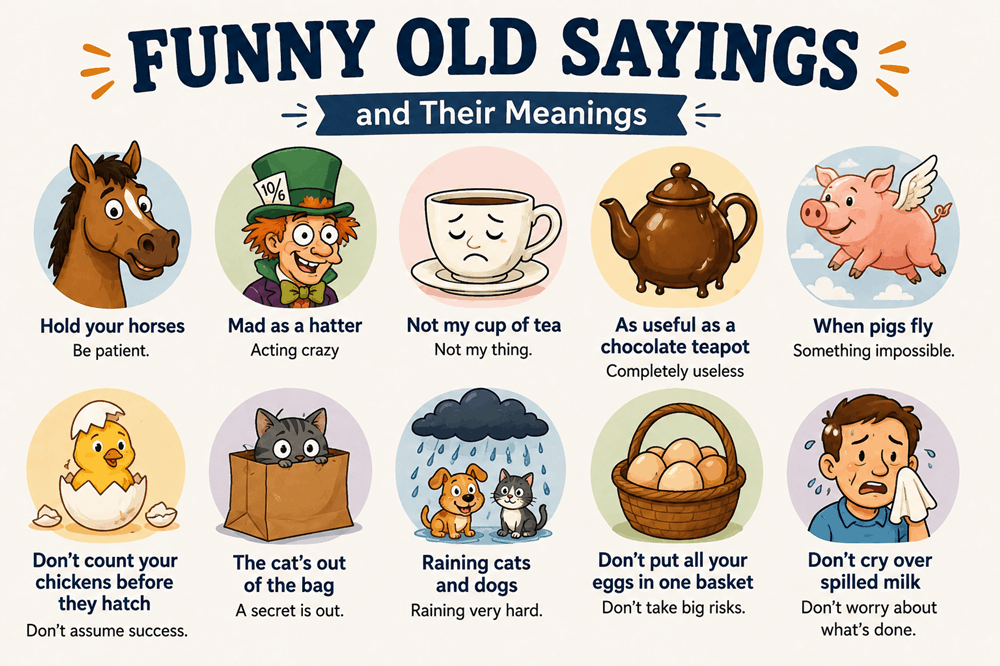
1. Hold Your Horses
Meaning: Slow down, wait, or be patient.
The saying comes from a time when horses were a common form of transportation. Literally holding the horses meant stopping them from moving forward.
Example: “Hold your horses—we haven’t even decided where we’re going yet.”
2. Mad as a Hatter
Meaning: Acting extremely strange or irrational.
The expression became associated with hat makers because some historically worked with mercury compounds, which could cause serious neurological symptoms after long exposure.
Today, the saying is usually used jokingly.
3. Not My Cup of Tea
Meaning: Not something you particularly like or enjoy.
Example: “Camping in the rain isn’t really my cup of tea.”
The phrase sounds politely understated, which is part of its charm.
4. As Useful as a Chocolate Teapot
Meaning: Completely useless.
A teapot made of chocolate would melt as soon as hot water was poured into it.
The image makes the insult much funnier than simply saying something does not work.
5. When Pigs Fly
Meaning: Something will never happen.
Example: “He says he’s going to clean the garage voluntarily.”
“Sure—when pigs fly.”
The absurd image of flying pigs makes the impossibility obvious.
6. Don’t Count Your Chickens Before They Hatch
Meaning: Do not assume success before it actually happens.
Eggs do not guarantee chicks.
Likewise, plans, promises, or opportunities are not guaranteed outcomes.
7. The Cat’s Out of the Bag
Meaning: A secret has been revealed.
Example: “We were planning a surprise party, but now the cat’s out of the bag.”
The exact historical origin is debated, but the modern meaning is clear.
8. Let the Cat Out of the Bag
Meaning: Accidentally or deliberately reveal a secret.
This is the action that causes “the cat’s out of the bag.”
Example: “Don’t let the cat out of the bag about her birthday present.”
9. Raining Cats and Dogs
Meaning: Raining extremely heavily.
No animals are actually involved.
The phrase is simply an exaggerated way to describe a downpour.
10. More Than One Way to Skin a Cat
Meaning: There are several ways to accomplish the same task.
The wording sounds harsh and strange today, but the expression is meant figuratively.
Example: “If that method doesn’t work, there’s more than one way to skin a cat.”
11. Curiosity Killed the Cat
Meaning: Being too curious can get you into trouble.
It is often said jokingly when someone asks too many questions.
The expression warns against unnecessary snooping.
12. A Bird in the Hand Is Worth Two in the Bush
Meaning: Something certain is more valuable than something better that you might never get.
If you already have one bird, it may be foolish to release it while chasing two others.
The saying is really about risk.
13. Barking Up the Wrong Tree
Meaning: Blaming the wrong person or pursuing the wrong idea.
The expression comes from hunting dogs that might bark at a tree even after their target has moved elsewhere.
Example: “If you think I deleted the file, you’re barking up the wrong tree.”
14. Straight From the Horse’s Mouth
Meaning: Information received directly from the original or most reliable source.
Example: “I heard it straight from the horse’s mouth—the manager confirmed it.”
The expression is often associated with checking a horse’s age by looking at its teeth.
15. You Can Lead a Horse to Water, but You Can’t Make It Drink
Meaning: You can give someone an opportunity, but you cannot force them to take it.
This old saying remains useful because it applies to advice, education, work, and relationships.
16. Don’t Look a Gift Horse in the Mouth
Meaning: Do not criticize something you received for free.
A horse’s teeth can give clues about its age and condition.
Examining a gifted horse’s mouth could therefore look ungrateful.
17. Get Off Your High Horse
Meaning: Stop acting superior.
Historically, being physically elevated on a horse could be associated with status and authority.
Today, the phrase targets arrogance.
18. Beat a Dead Horse
Meaning: Keep discussing or trying something after it is already pointless.
Example: “We’ve already made the decision, so there’s no point beating a dead horse.”
19. A Different Kettle of Fish
Meaning: A completely different situation.
Example: “Fixing a bicycle is easy. Rebuilding a car engine is a different kettle of fish.”
The phrase is particularly common in British English.
20. Fine Kettle of Fish
Meaning: A messy or difficult situation.
Someone might say:
“Well, this is a fine kettle of fish.”
It usually means things have gone wrong in an inconvenient way.
21. Full of Beans
Meaning: Energetic and lively.
Example: “The children were full of beans after breakfast.”
The phrase is funny because it makes energy sound like something physically packed inside a person.
22. Spill the Beans
Meaning: Reveal secret information.
Example: “Come on, spill the beans. What happened?”
It is similar to “let the cat out of the bag,” but often sounds more playful.
23. Cool as a Cucumber
Meaning: Very calm, especially in a stressful situation.
Example: “Everyone else panicked, but she stayed cool as a cucumber.”
24. In a Pickle
Meaning: In a difficult or awkward situation.
Example: “I locked my keys in the car, so now I’m in a bit of a pickle.”
The phrase turns a problem into something almost comically manageable.
25. Bring Home the Bacon
Meaning: Earn money or achieve success.
Today it most often refers to earning income for a household.
Example: “Someone has to bring home the bacon.”
26. Chew the Fat
Meaning: Chat casually for a long time.
Example: “We sat on the porch chewing the fat for an hour.”
The exact origin is uncertain, but the phrase remains an old-fashioned way to describe relaxed conversation.
27. Butter Someone Up
Meaning: Flatter someone, usually because you want something.
Example: “He’s buttering up the boss before asking for Friday off.”
The food image makes the manipulation sound almost harmless.
28. Take It With a Grain of Salt
Meaning: Do not believe something completely.
Example: “Take his story with a grain of salt—he tends to exaggerate.”
It is a warning to remain skeptical.
29. The Proof Is in the Pudding
Meaning: You can judge something properly only by seeing how it performs.
The older form was closer to “the proof of the pudding is in the eating.”
In other words, you cannot know whether a pudding is good until you taste it.
30. Too Many Cooks Spoil the Broth
Meaning: Too many people trying to control something can make the result worse.
The saying works especially well for committees, group projects, and family decisions.
31. Don’t Cry Over Spilled Milk
Meaning: Do not waste time being upset about something that cannot be changed.
Once milk is spilled, worrying will not put it back in the container.
The same logic applies to small mistakes.
32. Half a Loaf Is Better Than None
Meaning: Getting part of what you wanted is better than getting nothing.
This saying encourages compromise and practicality.
33. Easy as Pie
Meaning: Very easy.
Example: “Once you learn the shortcut, the job is easy as pie.”
Whether baking pie is actually easy is another question.
34. Have Your Cake and Eat It Too
Meaning: Want two advantages that cannot logically exist together.
If you eat your cake, you no longer have it.
The expression points out an unrealistic desire to keep both outcomes.
35. Put All Your Eggs in One Basket
Meaning: Risk everything on one plan or opportunity.
If all your eggs are in one basket and the basket falls, everything is lost.
The saying is still common in discussions about money and careers.
36. An Apple a Day Keeps the Doctor Away
Meaning: Healthy habits can help prevent illness.
The phrase should not be taken literally as a medical guarantee.
Its point is simply that everyday healthy choices matter.
37. The Apple Doesn’t Fall Far From the Tree
Meaning: Children often resemble their parents in behavior, personality, or abilities.
Example: “His father was a musician too. The apple doesn’t fall far from the tree.”
38. As Happy as a Clam
Meaning: Very happy and content.
The fuller older phrase was “happy as a clam at high water,” when clams were safer from being collected.
The shortened version sounds wonderfully odd without that context.
39. Happy as a Pig in Mud
Meaning: Extremely happy and comfortable.
Pigs enjoy wallowing in mud, especially for cooling and protection.
The expression usually suggests someone is perfectly satisfied with their situation.
40. Sweating Like a Pig
Meaning: Sweating heavily.
Ironically, pigs do not sweat effectively the way humans do.
The phrase is common even though the biology behind the image is questionable.
41. The Whole Hog
Meaning: Do something completely or without holding back.
Example: “If we’re renovating the kitchen, we might as well go the whole hog.”
42. Till the Cows Come Home
Meaning: For a very long time.
Example: “You can argue till the cows come home, but I’m not changing my mind.”
The saying comes from the slow, predictable return of livestock.
43. Don’t Have a Cow
Meaning: Do not become extremely upset or angry.
This expression became particularly popular in more recent decades but has the same exaggerated rural humor as many older sayings.
44. Like a Bull in a China Shop
Meaning: Very clumsy, careless, or tactless.
A bull surrounded by delicate china would probably cause chaos.
The saying can describe both physical clumsiness and someone handling a sensitive situation badly.
45. Put the Cart Before the Horse
Meaning: Do things in the wrong order.
A horse is supposed to pull the cart.
Putting the cart first makes the entire arrangement backward.
46. Close the Barn Door After the Horse Has Bolted
Meaning: Take action only after it is too late to prevent the problem.
Example: “Installing security after everything was stolen is closing the barn door after the horse has bolted.”
47. Make Hay While the Sun Shines
Meaning: Take advantage of a good opportunity while it lasts.
Farmers historically needed dry weather to cut and store hay properly.
The phrase now applies to almost any temporary opportunity.
48. Don’t Put the Fox in Charge of the Henhouse
Meaning: Do not give responsibility to someone whose interests conflict with the job.
A fox guarding chickens has an obvious reason not to protect them.
The saying is often used when discussing trust and conflicts of interest.
49. A Stitch in Time Saves Nine
Meaning: Fix a small problem early before it becomes much bigger.
One stitch repairing a small tear now may prevent you from needing many stitches later.
The saying applies to repairs, health, finances, and almost anything that gets worse when ignored.
50. Penny Wise and Pound Foolish
Meaning: Save a small amount of money while making a much more expensive mistake.
Someone might buy the cheapest possible tool and then replace it repeatedly when it breaks.
The phrase warns against focusing on tiny savings while ignoring larger costs.
Why Do Old Sayings Sound So Strange?
Many sayings were created when everyday life looked very different.
People regularly dealt with:
- Horses
- Livestock
- Farming
- Wood fires
- Hand sewing
- Traditional trades
- Food preservation
As technology changed, the expressions survived even when the original situation became unfamiliar.
Someone can say “hold your horses” today without ever having touched a horse.
You can “hang up the phone” even when your smartphone has nothing to hang.
Language remembers old technology much longer than people use it.
Why Are So Many Old Sayings About Animals?
Animals were far more visible in everyday life when many traditional expressions developed.
Horses provided transportation.
Cows, chickens, and pigs were part of farming.
Cats and dogs lived around homes and businesses.
People observed their behavior closely, making animals useful metaphors for human behavior.
That gave English expressions such as:
- Hold your horses
- Barking up the wrong tree
- When pigs fly
- Let the cat out of the bag
- Till the cows come home
Which Funny Old Sayings Are Still Common?
Several expressions remain completely natural in modern conversation.
Examples include:
- Hold your horses
- Spill the beans
- In a pickle
- Not my cup of tea
- Cool as a cucumber
- Barking up the wrong tree
- Don’t count your chickens before they hatch
- Take it with a grain of salt
Other sayings sound noticeably more old-fashioned but are still understood.
What Are Some Funny Old Sayings About People?
Older English has plenty of colorful ways to describe personality and behavior.
Someone can be:
Full of beans — energetic.
Cool as a cucumber — calm.
Mad as a hatter — acting strangely.
On a high horse — acting superior.
Like a bull in a china shop — clumsy or tactless.
These comparisons are memorable because they create an instant mental picture.
Why Do People Still Use Old Sayings?
A good saying compresses an entire idea into a few memorable words.
“Don’t count your chickens before they hatch” is more vivid than saying:
“Avoid making assumptions about positive outcomes before sufficient evidence exists.”
The saying is shorter, easier to remember, and more fun.
That is why these expressions survive.
Even when the original farming, cooking, or transportation reference becomes outdated, the lesson remains useful.
The Bottom Line
Funny old sayings survive because they turn ordinary advice into memorable pictures.
Hold your horses means be patient.
Spill the beans means reveal the secret.
In a pickle means you are in trouble.
When pigs fly means never.
Cool as a cucumber means extremely calm.
Barking up the wrong tree means pursuing the wrong idea.
A stitch in time saves nine means fix problems before they grow.
Some of these expressions come from worlds of horses, farms, sewing, cooking, and trades that most people no longer experience every day.
But the situations behind them are still familiar.
People still become impatient, make bad assumptions, reveal secrets, chase the wrong answers, waste money, and find themselves in a pickle.
The language is old.
The problems are not.