Unusual Words With Beautiful Meanings: 50 Rare Terms Worth Knowing and Using
Some words are beautiful because of how they sound. Others become beautiful once you discover what they describe. An ordinary phrase such as “the smell after rain” becomes petrichor, while the peaceful pleasure of being alone can be described as solitude rather than loneliness. Unusual words give names to feelings, moments, and experiences that can otherwise be difficult to explain.
Below are 50 unusual words with beautiful meanings, including rare English terms, poetic words, and borrowed expressions that have found a place in English writing and conversation.
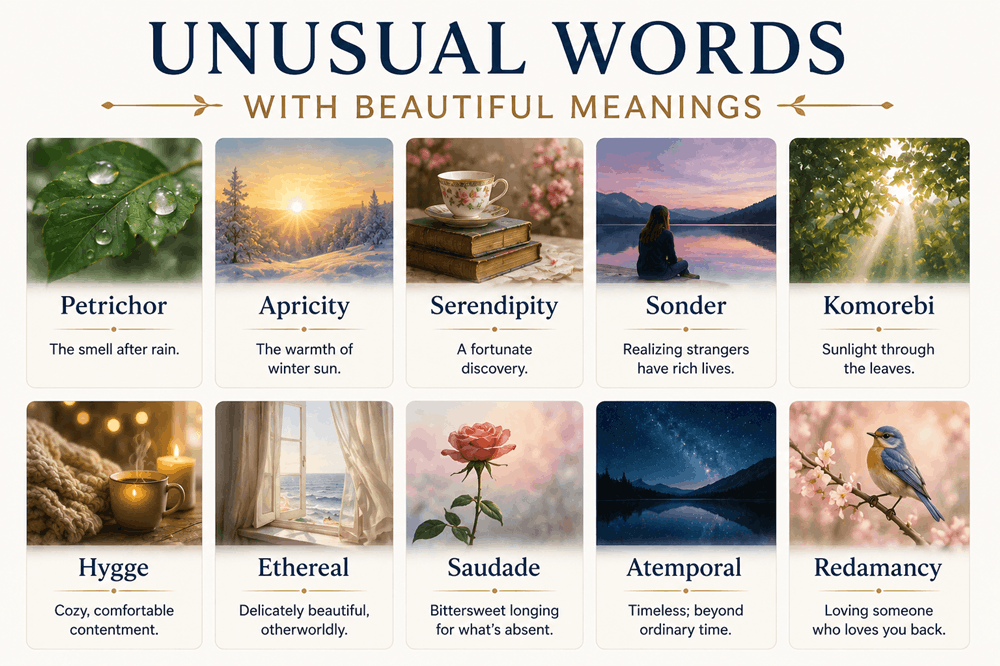
1. Petrichor
Meaning: The pleasant earthy smell that rises after rain falls on dry ground.
Petrichor is one of those words people are delighted to discover because almost everyone recognizes the experience.
After a long dry period, the first drops of rain hit the soil and release that unmistakable fresh, earthy smell.
Now you know it has a name.
Example: “The petrichor after the summer storm drifted through the open window.”
2. Serendipity
Meaning: Finding something valuable or delightful unexpectedly.
Serendipity describes a happy discovery you were not deliberately trying to make.
You might walk into the wrong café and meet someone important, open a random book and find exactly the idea you needed, or discover a favorite place after taking a wrong turn.
It is more than luck.
It is fortunate discovery.
3. Sonder
Meaning: The realization that every stranger has a life as complicated and detailed as your own.
Sonder describes a strangely humbling moment.
You look at someone passing on the street and suddenly remember that they have their own memories, worries, relationships, routines, secrets, and dreams.
To you, they are a stranger.
To someone else, they may be the center of the world.
4. Apricity
Meaning: The warmth of the sun during winter.
Apricity describes one of winter’s quiet pleasures.
The air may be cold, but sunlight falls across your face and briefly makes the season feel softer.
The word is rare today, which somehow makes its meaning feel even more special.
5. Mellifluous
Meaning: Pleasantly smooth, flowing, and sweet to hear.
A mellifluous voice seems to glide effortlessly.
The word can describe:
- Singing
- Speech
- Music
- Poetry
- Any sound that feels rich and pleasant
Example: “Her mellifluous voice made even an ordinary story sound beautiful.”
6. Ephemeral
Meaning: Lasting for only a short time.
Ephemeral does not necessarily mean something is unimportant.
In fact, the word often makes something seem more precious because it will not last.
A sunset is ephemeral.
A flower’s bloom is ephemeral.
Childhood is ephemeral.
Sometimes beauty matters precisely because it disappears.
7. Ethereal
Meaning: Extremely delicate, light, beautiful, or seemingly not of this world.
Ethereal is often used for something that feels almost supernatural in its beauty.
You might describe:
- Mist over a lake
- A quiet singing voice
- Moonlight
- A dancer’s movement
- A dreamlike landscape
It suggests something too delicate to feel completely ordinary.
8. Halcyon
Meaning: Calm, peaceful, happy, and free from trouble.
You often see halcyon used when someone looks back on a peaceful period:
“The halcyon days of childhood.”
The word carries a feeling of warmth and nostalgia.
It describes a time when life seemed unusually peaceful.
9. Limerence
Meaning: An intense state of romantic infatuation and longing for another person.
Limerence is stronger than simply having a crush.
Someone experiencing it may constantly think about the other person, replay interactions, search for signs that feelings are returned, and feel enormous excitement over small moments of attention.
The feeling can be beautiful, overwhelming, or both.
10. Ineffable
Meaning: Too powerful, beautiful, or extraordinary to be adequately expressed in words.
Some experiences seem to resist description.
A person might describe the view from a mountain summit as ineffable.
The word itself expresses the frustration:
You know what you felt.
You just cannot explain it properly.
11. Solace
Meaning: Comfort during sadness, grief, or difficulty.
Solace is not necessarily the end of pain.
It is the thing that makes pain easier to carry.
Music can provide solace.
So can a friend, a quiet walk, a familiar book, or simply knowing someone understands.
12. Eunoia
Meaning: Beautiful thinking or goodwill toward others.
Eunoia has become popular partly because both its sound and meaning are appealing.
It suggests a mind inclined toward kindness and good intentions.
It is also famous for containing all five traditional vowels in a remarkably short word.
13. Luminous
Meaning: Giving off light or appearing to glow.
Luminous can be literal:
“The moon looked luminous.”
But it can also describe someone’s presence.
A luminous person seems bright, alive, and full of warmth.
14. Resplendent
Meaning: Brilliantly impressive or beautiful in appearance.
Resplendent is not subtle beauty.
It is the kind of beauty that demands attention.
A palace can look resplendent.
A bird’s feathers can be resplendent.
Someone dressed beautifully for a celebration can look resplendent.
15. Saudade
Meaning: A deep, bittersweet longing for someone or something absent.
Saudade comes from Portuguese and describes a feeling English struggles to capture in one word.
It combines:
- Missing
- Love
- Nostalgia
- Sadness
- Longing
You may feel saudade for a person, a place, a period of life, or something you know may never return.
16. Fernweh
Meaning: A longing for faraway places.
Fernweh is a German word sometimes described as the opposite of homesickness.
Instead of wanting to go home, you ache to go somewhere else.
You may not even know exactly where.
You simply feel pulled toward distant places and unfamiliar experiences.
17. Komorebi
Meaning: Sunlight filtering through the leaves of trees.
This Japanese word describes a visual experience most people have seen but English does not capture neatly in one everyday term.
Picture yourself walking through a forest while sunlight flickers between branches and leaves.
That shifting pattern of light is komorebi.
18. Wabi-Sabi
Meaning: An appreciation of beauty that is imperfect, incomplete, and temporary.
Wabi-sabi is a Japanese aesthetic idea rather than simply one easily translated word.
It encourages appreciation for things that show age, simplicity, irregularity, and change.
A cracked ceramic bowl can be beautiful.
Weathered wood can be beautiful.
A fading flower can be beautiful.
Perfection is not required.
19. Meraki
Meaning: Putting creativity, care, or part of yourself into what you do.
Meraki is a Greek word frequently used in English-language lifestyle writing.
It describes work done with genuine attention and personal feeling.
Cooking a meal with meraki means you did more than follow instructions.
You put something of yourself into it.
20. Hygge
Meaning: A feeling of coziness, comfort, warmth, and relaxed companionship.
Hygge is closely associated with Danish culture.
It might involve:
- Warm lighting
- A blanket
- Coffee or tea
- A quiet evening
- Good conversation
- A simple meal with friends
The important part is not the objects themselves.
It is the atmosphere they create.
21. Lagom
Meaning: Just the right amount—not too much and not too little.
This Swedish word expresses balance and moderation.
Lagom can describe:
- Food
- Work
- Interior design
- Social life
- Spending
- Daily routines
It rejects both excess and deprivation.
Enough can be enough.
22. Frisson
Meaning: A sudden thrill or shiver of excitement.
You may feel frisson when a song reaches a powerful moment and goosebumps spread across your skin.
It can also happen during an emotional speech, a dramatic movie scene, or an unexpected moment of beauty.
It is excitement you can physically feel.
23. Susurrus
Meaning: A soft whispering or rustling sound.
Leaves moving gently in the wind create a susurrus.
So can:
- Quiet conversation
- Grass moving
- Distant rain
- Pages being turned
Even the word sounds somewhat like the soft noise it describes.
24. Psithurism
Meaning: The sound of wind moving through leaves.
Psithurism gives a very specific name to one of nature’s most peaceful sounds.
You sit beneath trees.
The wind arrives.
Thousands of leaves begin moving together.
That sound is psithurism.
25. Murmuration
Meaning: A large flock of starlings flying together in constantly changing patterns.
A murmuration can look almost impossible.
Thousands of birds turn at once, forming enormous moving shapes across the sky.
The word refers to both the flock and the remarkable collective movement.
26. Aurora
Meaning: Dawn; also the glowing atmospheric lights seen near Earth’s polar regions.
Aurora comes from the Roman goddess of dawn.
Today, most people recognize the word from the aurora borealis and aurora australis.
The name naturally carries associations with light appearing in darkness.
27. Reverie
Meaning: A pleasant state of being lost in thought or daydreaming.
A reverie happens when your attention drifts away from the immediate world.
You may be remembering something, imagining the future, or simply letting thoughts wander.
Unlike anxious overthinking, reverie usually feels peaceful.
28. Eloquence
Meaning: The ability to express ideas beautifully, clearly, and persuasively.
Eloquence is not merely using complicated vocabulary.
Someone can speak simply and still be eloquent.
The beauty comes from saying exactly what needs to be said in exactly the right way.
29. Incandescent
Meaning: Glowing with heat or light; figuratively, brilliantly alive or passionate.
A lamp can literally be incandescent.
But the word becomes especially beautiful when applied figuratively.
Someone can be incandescent with happiness.
A performance can be incandescent.
The word suggests energy almost bright enough to become visible.
30. Amaranthine
Meaning: Undying, unfading, or everlasting.
Amaranthine comes from the amaranth flower and the old idea that it did not easily fade.
In poetry, it can describe:
- Eternal beauty
- Undying love
- Lasting memory
- Something that remains fresh forever
It is a useful alternative to simply saying “eternal.”
31. Verdant
Meaning: Green with abundant vegetation.
A verdant landscape is richly alive with plants.
You might use the word for:
- Rolling green hills
- Dense gardens
- Forest valleys
- Tropical landscapes
It suggests more than the color green.
It suggests growth.
32. Cerulean
Meaning: A deep, clear sky-blue color.
Cerulean is one of those color words that immediately makes a description more vivid.
Instead of saying:
“The sky was blue,”
you can say:
“The sky was cerulean.”
The word often evokes clear water, summer skies, and openness.
33. Gossamer
Meaning: Something extremely light, thin, and delicate.
Gossamer originally refers to very fine spider silk.
The word can also describe:
- Fabric
- Clouds
- Wings
- Mist
- Anything nearly weightless
It gives descriptions a fragile, airy quality.
34. Evanescent
Meaning: Quickly fading or disappearing.
Evanescent is similar to ephemeral, but it emphasizes the act of vanishing.
Morning fog can be evanescent.
So can a smile, a reflection, or a fleeting memory.
It is beauty in the process of disappearing.
35. Redamancy
Meaning: The act of loving someone who loves you in return.
Redamancy is an uncommon word with an unusually lovely meaning.
Many words describe longing for someone.
Redamancy describes something much simpler and happier:
Love returned with love.
36. Philocalist
Meaning: A lover of beauty.
A philocalist notices and appreciates beauty in art, nature, people, design, or everyday life.
The word does not require someone to be an artist.
It simply describes a person who deeply values beautiful things.
37. Querencia
Meaning: A place where someone feels safe, strong, comfortable, or truly themselves.
Querencia comes from Spanish.
It can mean much more emotionally than simply “home.”
Your querencia might be:
- Your childhood kitchen
- A library
- A beach
- Someone’s house
- A quiet corner of your own room
It is the place where your defenses seem to lower naturally.
38. Serein
Meaning: Fine rain falling from a seemingly clear evening sky.
Serein describes an unusual weather experience.
Rain begins falling lightly even though the sky overhead may not look obviously stormy.
The word has a gentle sound that matches the phenomenon.
39. Lucent
Meaning: Glowing softly or shining with light.
Lucent is similar to luminous but often feels quieter.
Something lucent does not necessarily blaze.
It simply seems filled with light.
A softly illuminated window at dusk might be lucent.
40. Efflorescence
Meaning: The process of flowering or developing into a fuller, more beautiful state.
Efflorescence can refer literally to blooming.
Figuratively, it can describe a period of creativity, growth, or cultural development.
Someone entering an especially creative stage of life might experience a personal efflorescence.
41. Palimpsest
Meaning: Something that retains traces of what existed before it.
Historically, a palimpsest was a manuscript page that had been reused after earlier writing was erased, leaving faint traces underneath.
Today, the word can be used metaphorically.
A city can be a palimpsest of different historical periods.
A person’s identity can feel like a palimpsest of everything they have experienced.
The past is never completely gone.
42. Numinosity
Meaning: A sense of mysterious spiritual awe or presence.
Numinosity describes moments that feel greater than ordinary experience.
You might feel it:
- Inside an ancient building
- Beneath an enormous night sky
- During a religious experience
- In a place of extraordinary natural beauty
The feeling combines wonder with mystery.
43. Coruscate
Meaning: To flash, sparkle, or give off sudden points of light.
Sunlight coruscates across moving water.
Jewels can coruscate beneath bright light.
The word is unusual but vivid.
It turns ordinary sparkling into something almost energetic.
44. Diaphanous
Meaning: Delicate, light, and almost transparent.
Diaphanous is commonly used for fabric, curtains, mist, or clothing.
A diaphanous curtain allows sunlight to pass softly through it.
The word suggests fragility and lightness without complete transparency.
45. Dulcet
Meaning: Sweet and pleasing to hear.
Dulcet usually describes sound.
Someone may speak in dulcet tones.
A gentle melody can be dulcet.
Like mellifluous, it is especially useful when you want to describe pleasant sound without simply saying “nice.”
46. Ebullience
Meaning: Energetic enthusiasm, cheerfulness, and excitement.
An ebullient person seems to overflow with positive energy.
Their enthusiasm spreads easily to other people.
Ebullience is happiness with movement in it.
47. Pluviophile
Meaning: Someone who loves rain or finds rainy weather comforting.
Pluviophile is a modern word formed from roots associated with rain and loving.
A pluviophile may enjoy:
- Gray skies
- Rain against windows
- Walking with an umbrella
- The smell after rain
- Quiet stormy afternoons
For some people, sunshine creates happiness.
For others, rain does.
48. Noctivagant
Meaning: Wandering or moving about at night.
Noctivagant is a rare word with a wonderfully atmospheric meaning.
It can describe someone walking through quiet streets after dark or wandering beneath a night sky.
It sounds almost like something from a gothic novel.
49. Scintilla
Meaning: A tiny spark, trace, or small amount of something.
You might speak of:
“A scintilla of hope.”
Or:
“A scintilla of doubt.”
The word gives a tiny amount surprising importance.
Sometimes a single small spark is enough.
50. Atemporal
Meaning: Existing outside ordinary ideas of time or seeming timeless.
Something atemporal feels as though it belongs to no particular era.
A piece of music may feel atemporal.
So can a landscape, story, or work of art.
The word is especially useful for beauty that does not seem tied to fashion or a specific historical moment.
Why Are Rare Words So Appealing?
An unusual word can do something a long explanation cannot.
Consider:
“The pleasant smell produced when rain falls on dry ground.”
That describes the experience accurately.
But:
“Petrichor.”
does it instantly.
Words like these are satisfying because they reveal that a seemingly private or difficult-to-explain experience has already been noticed closely enough for someone to name it.
That can make language feel larger.
Which Unusual Words Describe Happiness?
Several unusual words on this list carry particularly positive meanings:
Serendipity — an unexpectedly fortunate discovery
Ebullience — overflowing happiness and enthusiasm
Halcyon — peaceful and happy
Redamancy — love returned
Eunoia — beautiful thinking and goodwill
Hygge — cozy contentment
These words describe different forms of happiness rather than treating happiness as one simple emotion.
Which Rare Words Describe Love?
If you want something more unusual than simply saying “love,” try:
Redamancy — loving someone who loves you back
Limerence — intense romantic infatuation
Saudade — bittersweet longing for someone absent
Querencia — a place or person around whom you feel safe and strong
Love has many forms.
Language becomes more interesting when we distinguish them.
Which Words Describe Nature Beautifully?
Nature gives us some of the most poetic unusual words:
Petrichor — smell after rain
Komorebi — sunlight through leaves
Psithurism — wind moving through leaves
Serein — fine evening rain from a seemingly clear sky
Murmuration — coordinated flight of starlings
Apricity — warmth of winter sunlight
Verdant — rich with green vegetation
These words turn ordinary observations into something more precise.
Which Rare Words Describe Beauty?
Try these:
Ethereal — delicately beautiful and almost otherworldly
Resplendent — brilliantly beautiful
Luminous — glowing or radiant
Gossamer — extremely delicate and light
Diaphanous — light and almost transparent
Amaranthine — unfading or eternal
Philocalist — someone who loves beauty
The interesting part is that each describes a different kind of beauty.
How Can You Remember Unusual Words?
Do not try to memorize a long dictionary list all at once.
Connect each word to an image.
For petrichor, imagine stepping outside after rain.
For apricity, imagine winter sunlight warming your face.
For komorebi, picture sunlight moving through green leaves.
For redamancy, imagine two people realizing they love each other equally.
For fernweh, picture staring at a map and wanting to disappear somewhere far away.
A vivid image is much easier to remember than a definition alone.
Should You Use Rare Words in Everyday Writing?
Yes—but selectively.
An unusual word is most effective when it says something more precisely than an ordinary one.
If every sentence contains obscure vocabulary, the writing becomes difficult to read.
But one well-chosen word can make a sentence memorable.
Instead of trying to sound sophisticated, use unusual words when they genuinely fit what you mean.
That is what makes vocabulary beautiful rather than distracting.
The Bottom Line
Unusual words with beautiful meanings give names to experiences that often feel too specific for ordinary language.
Petrichor is the scent after rain.
Apricity is winter sunlight warming your skin.
Sonder is realizing strangers have lives as complicated as yours.
Saudade is bittersweet longing.
Fernweh is longing for distant places.
Komorebi is sunlight filtering through leaves.
Redamancy is love returned.
Querencia is the place where you feel safe and fully yourself.
Learning rare words is not just about expanding vocabulary.
Sometimes discovering a word feels like discovering that a feeling you thought belonged only to you has existed long enough for someone else to name it.
And that may be one of the most beautiful things language can do.