
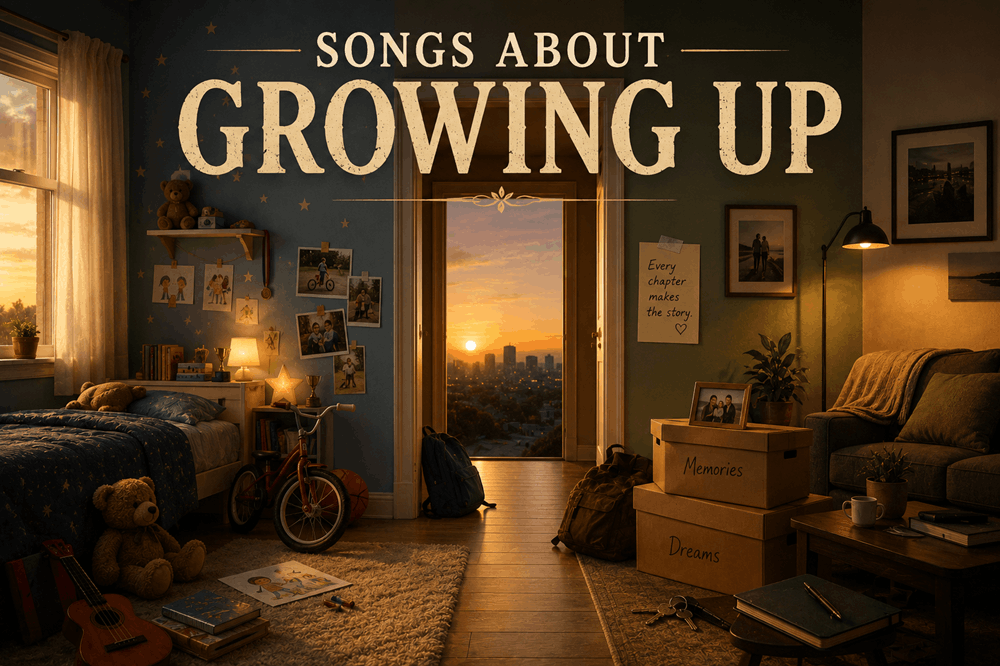
12 Songs About Growing Up, Getting Older and Leaving Childhood Behind
The best songs about growing up are rarely simple celebrations of becoming an adult.
They capture the strange mixture of wanting independence, missing childhood, fearing the passage of time and slowly realizing that adulthood does not provide all the answers people expected it to.
Some songs look forward from childhood. Others look back after years have already passed. A few focus on leaving home, watching parents grow older or recognizing that the life once imagined will never arrive exactly as planned.
These 12 songs approach growing up from different ages and perspectives, making them suitable for graduation playlists, coming-of-age moments or quiet reflection on how quickly life changes.
1. Joni Mitchell — “The Circle Game”
“The Circle Game” is one of the clearest songs ever written about the passage from childhood into adulthood.
Joni Mitchell follows a boy through several stages of life. As a child, he is frightened by time. Later, he becomes impatient for adulthood, believing greater freedom is waiting just beyond his current age. Once those years arrive, he realizes that time has moved faster than expected and that some childhood dreams have become unreachable.
The carousel represents life’s repeating movement. People feel as though they are traveling forward, yet the seasons and emotional patterns continually return.
Mitchell once introduced the song as being about “a carousel of time” and about people growing older and younger. Her official archive identifies her recording as part of the 1970 album Ladies of the Canyon.
The song is bittersweet, but it is not hopeless. Losing one dream does not mean life has ended. New hopes can appear even when the painted ponies continue moving beyond anyone’s control.
2. Taylor Swift — “Never Grow Up”
“Never Grow Up” begins as a gentle wish directed toward a child and gradually becomes a warning to the singer’s younger self.
The early verses notice small details adults often overlook: a child’s room, the security of being carried home and the comfort of having someone else make the important decisions.
As the song develops, that innocence becomes painful because the narrator knows it cannot be preserved.
Growing up promises independence, but it also introduces loneliness, responsibility and regret. The adult narrator remembers wanting greater freedom and now understands that freedom required leaving behind a home she did not fully appreciate while living inside it.
Swift recorded the original for Speak Now and released a new version on Speak Now (Taylor’s Version) in 2023.
The song works particularly well for parents, graduations and moving-away moments because it holds two perspectives at once: the child eager to grow and the adult wishing time had moved more slowly.
3. Lorde — “Ribs”
“Ribs” captures the fear of realizing that youth is already disappearing while you are still living inside it.
The song takes place around a gathering of young friends, but its emotional focus is not the party itself. Lorde is disturbed by the knowledge that these nights will eventually become memories.
Her fear is not simply that adulthood will be difficult.
It is that growing older may change the friendships, places and feelings that currently seem permanent.
The production begins softly and becomes increasingly restless. Repeated phrases create the sensation of thoughts circling faster than the narrator can control them. The music captures the anxiety of being young enough to depend on familiar people but old enough to recognize that dependence cannot last forever.
“Ribs” appeared on Lorde’s 2013 album Pure Heroine. Contemporary descriptions of the song have highlighted its increasingly frantic sound and its concern with maturity and approaching adult problems.
Few songs describe teenage nostalgia so effectively because “Ribs” feels nostalgic before the experience has even ended.
4. Lukas Graham — “7 Years”
“7 Years” turns an entire imagined lifetime into a sequence of remembered and anticipated ages.
The narrator begins in childhood, when parental advice and neighborhood friendships shape his understanding of the world. He then moves through ambition, musical success, family life and the possibility of old age.
The unusual feature is that part of the song looks backward while another part looks forward.
The singer remembers experiences that have already happened, but he also imagines himself at ages he has not yet reached. Growing up becomes a story people continually rewrite as their priorities change.
At seven, belonging matters.
In youth, achievement and friendship dominate.
Later, family and the fear of loneliness become more important.
The song reached No. 1 on the United Kingdom’s Official Singles Chart in 2016 and remained on the chart for more than a year, reflecting how widely its life-stage structure connected with listeners.
“7 Years” is sentimental, but its strongest idea is realistic: people understand the meaning of one age only after they have already entered the next.
5. John Mayer — “Stop This Train”
“Stop This Train” describes the moment adulthood stops feeling like freedom and begins feeling like an unstoppable movement toward loss.
The train represents time.
The narrator wants to return home, slow down and remain near the people who have always made life feel stable. He is particularly troubled by watching his parents grow older because their aging proves that his own adulthood cannot be reversed.
A conversation with his father changes the song’s direction. The older perspective does not provide a way to stop time. It suggests that every generation eventually experiences the same fear.
The only possible response is learning to remain present while the train continues.
The song appeared on John Mayer’s 2006 album Continuum, a period of his career that received major Grammy recognition.
“Stop This Train” is especially powerful for listeners in their twenties and thirties, when childhood may feel recent but parents, homes and family routines have already begun changing.
6. Billy Joel — “Vienna”
“Vienna” speaks to ambitious young people who believe they must achieve everything immediately.
Billy Joel addresses someone moving so quickly toward the future that they are neglecting the life already happening around them.
The song does not criticize ambition itself.
It criticizes the fear underneath it—the belief that slowing down means falling behind and that personal value depends on reaching every goal early.
Vienna represents the later stages of life that remain available. The narrator does not need to become a complete person before youth ends. There will be time for different identities, failures and forms of meaning.
Joel has explained through his official site that the song was inspired by a visit connected with his father, while the lyrics repeatedly tell the “crazy child” to slow down because Vienna will continue waiting.
“Vienna” is a song about growing up without rushing through youth. Its message becomes more relevant in cultures where people constantly compare careers, relationships and milestones.
7. Fleetwood Mac — “Landslide”
“Landslide” is about confronting change before knowing whether you are prepared for it.
Stevie Nicks uses mountains, snow and a landslide to describe a life that no longer feels secure. The narrator is questioning relationships, career choices and the identity she has constructed.
The most memorable fear is not simply that circumstances may change.
It is that the narrator may change with them.
Childhood encourages people to imagine that they possess one stable self. Adulthood reveals how much identity depends on relationships, environments and dreams that may not last.
Nicks originally wrote “Landslide” before Fleetwood Mac recorded it for the band’s 1975 self-titled album. The group’s official live video comes from its 1997 Warner Bros. Studios performance.
“Landslide” has become a common choice for graduations, weddings and family milestones because it does not define change as completely positive or negative.
Change can create growth.
It can also feel like losing the ground beneath you.
8. Tracy Chapman — “Fast Car”
“Fast Car” is a coming-of-age story in which adulthood arrives through economic pressure rather than personal readiness.
The narrator dreams of leaving a difficult home and building a better life with a partner. The car initially represents escape, movement and the possibility of becoming someone different.
But changing location does not automatically change the patterns surrounding her.
Adult responsibilities arrive quickly. She works, supports the household and watches the relationship begin resembling the unstable life she hoped to escape.
The song captures a painful part of growing up: understanding that hope is necessary but does not guarantee transformation.
“Fast Car” became one of Tracy Chapman’s defining recordings and has remained visible across generations, including through later interpretations. Its original version has repeatedly returned to major charts.
Unlike nostalgic growing-up songs, “Fast Car” does not focus on missing childhood.
Its narrator was forced to become responsible before receiving the security that childhood should have provided.
9. Arcade Fire — “The Suburbs”
“The Suburbs” looks back at childhood landscapes after adulthood has changed their meaning.
The narrator remembers roads, houses, bicycles and neighborhoods that once seemed large enough to contain an entire world. Returning mentally or physically to those places reveals that they can no longer provide the same sense of possibility.
The song is not simply criticizing suburban life.
It understands that childhood places become emotionally powerful because children do not yet recognize their limitations. The same streets that later appear repetitive once held adventure, friendship and an apparently endless future.
As adults, the narrators worry that they will reproduce the same environment for another generation without knowing whether they are preserving safety or repeating emptiness.
“The Suburbs” became the title track of Arcade Fire’s acclaimed 2010 album, which remains a central part of the band’s official discography.
The song is ideal for anyone who has returned to a childhood neighborhood and discovered that the place remained familiar while they became someone else.
10. Green Day — “Good Riddance (Time of Your Life)”
“Good Riddance (Time of Your Life)” has become a graduation standard because it recognizes that major transitions contain gratitude and resentment at the same time.
The title sounds hostile.
The chorus sounds affectionate.
That contradiction makes the song more honest than a purely celebratory farewell. Growing up often requires leaving situations that mattered deeply but were also frustrating, painful or impossible to preserve.
The narrator does not claim to understand why everything happened.
He accepts that life is unpredictable and that the meaning of an experience may become clear only later.
Green Day released the song on Nimrod in 1997. Its acoustic sound differed from much of the band’s louder catalog, and it went on to become one of their most widely used farewell songs.
It suits graduations because it does not promise that the next stage will be easy. It simply hopes that the experience being left behind was worth having.
11. Five for Fighting — “100 Years”
“100 Years” compresses a lifetime into a few minutes.
The narrator moves among several ages rather than telling the story chronologically. Fifteen, twenty-two, thirty-three and ninety-nine appear almost beside one another, making an entire life feel frighteningly brief.
Each age carries different desires.
Youth imagines unlimited possibility.
Early adulthood focuses on love and identity.
Middle age recognizes responsibility and family.
Old age looks back at how quickly all those stages passed.
Five for Fighting’s official biography describes “100 Years” as a reflection on time, family and purpose that has continued resonating across generations. The song appeared on the 2003 album The Battle for Everything.
The song’s emotional lesson is not that life is literally limited to 100 years.
It is that every age feels permanent while you are living it and temporary once it has passed.
12. Macklemore & Ryan Lewis featuring Ed Sheeran — “Growing Up”
“Growing Up (Sloane’s Song)” approaches the subject from a parent’s perspective.
Macklemore addresses his infant daughter while admitting that he does not possess complete wisdom. He offers advice about confidence, kindness, friendship, creativity and the pressure young people face to become acceptable to others.
The song understands that parents cannot prevent every mistake.
They can provide principles and hope that those principles remain useful when the child begins making independent choices.
Ed Sheeran’s chorus softens the detailed verses, giving the song the feeling of a promise made while knowing that time will eventually make the promise difficult to keep.
In the description accompanying the official release, Macklemore explained that part of the song consists of advice about growing up and part reflects his own uncertainty about becoming a father.
“Growing Up” works for new parents because it reverses the usual coming-of-age perspective. The adult is also growing, learning how to care for someone whose future cannot be controlled.
More songs about growing up
Several other songs fit naturally into a growing-up playlist:
- The Beatles — “In My Life”
- Bob Dylan — “Forever Young”
- Bruce Springsteen — “Glory Days”
- Harry Chapin — “Cat’s in the Cradle”
- ABBA — “Slipping Through My Fingers”
- The Chicks — “Wide Open Spaces”
- Miley Cyrus — “The Climb”
- My Chemical Romance — “The Kids From Yesterday”
- Harry Styles — “Matilda”
- Kenny Chesney — “There Goes My Life”
Some focus on childhood memories, while others examine parenthood, leaving home or discovering that adulthood has not developed according to plan.
The best songs for different growing-up moments
For a graduation playlist, begin with “Good Riddance,” “Vienna” and “The Circle Game.”
For leaving home, choose “Never Grow Up,” “Fast Car” and “Wide Open Spaces.”
For teenage nostalgia, “Ribs” and “The Suburbs” capture the fear that friendships and familiar places are already becoming memories.
For parents and children, “Growing Up,” “Slipping Through My Fingers” and “Cat’s in the Cradle” examine how family relationships change as children become independent.
For fear of aging, “Stop This Train,” “100 Years” and “Landslide” offer the most direct emotional language.
Why songs about growing up feel so personal
Growing up is universal, but no one experiences it at exactly the same speed.
One person leaves home early.
Another remains close to childhood friends for decades.
Some people are forced into adult responsibility before they feel ready. Others reach traditional milestones and still do not feel grown.
Songs provide shape to that uncertainty.
A three-minute recording can connect the person you were, the person you expected to become and the person you are now. The listener may understand one verse as a teenager and hear something completely different in it 20 years later.
That ability to change meaning alongside the audience is what makes the strongest growing-up songs endure.
Final thoughts
Songs about growing up are really songs about time.
“The Circle Game” sees life as a carousel that keeps moving.
“Ribs” fears the moment when youth becomes memory.
“Vienna” argues that people do not need to complete their lives early, while “Stop This Train” admits how frightening it is to watch time carry family and childhood further away.
These songs do not agree on whether growing older is hopeful or tragic.
Most suggest that it is both.
Adulthood brings freedom, love, experience and the opportunity to create a life beyond childhood.
It also brings responsibility, distance and the knowledge that no moment can be kept permanently.
The best growing-up songs do not tell listeners to avoid change.
They remind them to notice life before the next stage arrives.