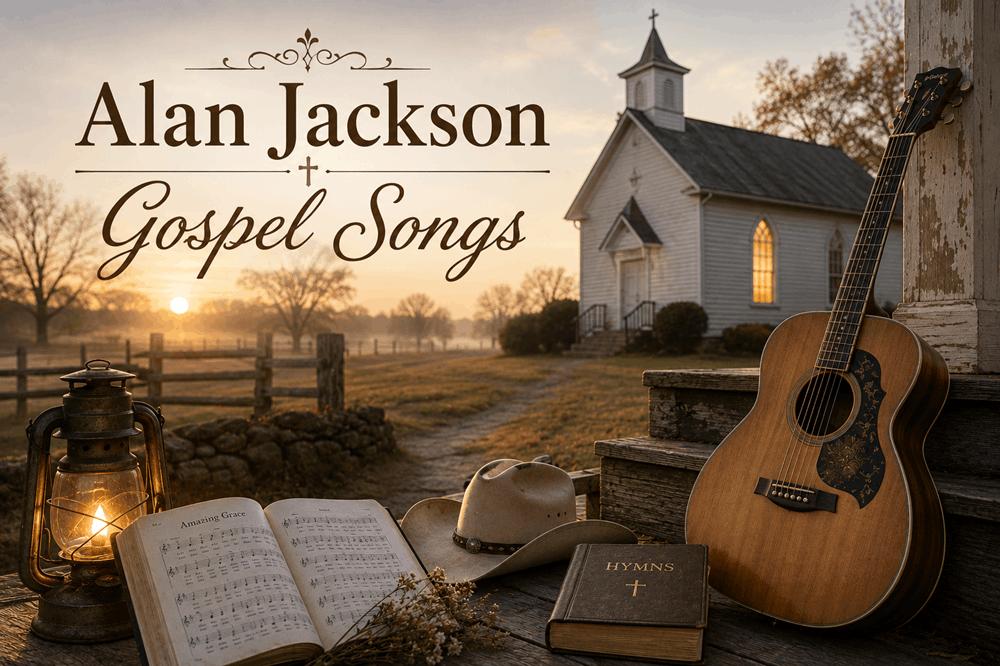
Alan Jackson Gospel Songs: 12 Essential Hymns From Precious Memories
Alan Jackson’s best gospel songs are not built around modern Christian-pop production or elaborate vocal performances. They sound more like hymns sung in a small country church: acoustic guitar, piano, organ, familiar melodies and a voice that rarely tries to overpower the message.
His most beloved gospel recordings include “Blessed Assurance,” “I’ll Fly Away,” “The Old Rugged Cross,” “How Great Thou Art,” “Amazing Grace” and “Precious Memories.”
Most come from two albums: 2006’s Precious Memories and 2013’s Precious Memories Volume II. The first album began as a private Christmas gift for Jackson’s mother and was recorded simply with piano and acoustic guitar. After family and friends encouraged him to release it publicly, it became the first gospel album to debut at No. 1 on Billboard’s country-albums chart. (Alan Jackson)
Jackson later explained that he and his wife, Denise, had originally assembled a much longer list of favorite hymns. The songs left over from that list eventually formed Volume II, produced by his longtime collaborator Keith Stegall. (Alan Jackson)
These 12 recordings provide the strongest introduction to Alan Jackson’s gospel catalog.
1. “Blessed Assurance”
Listen to “Blessed Assurance.”
“Blessed Assurance” opens the first Precious Memories album and immediately establishes its purpose.
Jackson does not transform the hymn into a country-radio production. He sings it plainly, allowing the familiar melody and declaration of faith to remain at the center.
That restraint is one reason the recording connects so strongly with listeners who grew up hearing hymns in church. It feels less like a star performing sacred music and more like someone joining a congregation in a song he has known for years.
The arrangement also suits Jackson’s voice. His low, unhurried delivery gives the hymn confidence without making it sound forceful. Assurance is presented as calm trust rather than emotional excitement.
The official album credits identify Fanny J. Crosby and Phoebe P. Knapp as the hymn’s writers. “Blessed Assurance” also opened Jackson’s Precious Memories: Live at the Ryman performance. (Wikipedia)
2. “Softly and Tenderly”
Listen to “Softly and Tenderly.”
“Softly and Tenderly” is an invitation hymn, and Jackson performs it with exactly the gentleness its title promises.
The song does not describe faith through thunder, punishment or spectacle. Its central image is a patient call toward people who are tired, distant or uncertain.
Jackson’s voice never sounds as though he is pressuring the listener. He leaves space around the words, making the invitation feel personal and voluntary.
That approach separates the recording from more theatrical gospel performances. The emotion comes from familiarity and compassion rather than a large choir or dramatic key change.
“Softly and Tenderly” was written by Will L. Thompson and appears as the second track on Precious Memories. It was also included as a bonus performance in the Ryman concert release. (Wikipedia)
3. “I Love to Tell the Story”
Listen to “I Love to Tell the Story.”
“I Love to Tell the Story” explains why familiar hymns continue to matter even when listeners already know every verse.
Its message is not that faith requires constant novelty. The old story remains worth repeating because its meaning deepens through experience.
That idea fits the entire Precious Memories project.
Jackson was not attempting to introduce unknown compositions or reinvent gospel music. He was preserving songs associated with family, childhood and church. Their familiarity was not a creative limitation; it was the reason for recording them.
His performance is warm and steady, with enough rhythmic movement to prevent the hymn from feeling solemn. The result sounds like testimony delivered through memory rather than argument.
The official album page credits Katherine Hankey and William G. Fischer with the hymn. (Alan Jackson)
4. “I’ll Fly Away”
“I’ll Fly Away” is one of the most energetic recordings in Jackson’s gospel catalog.
The song imagines death not primarily as an ending but as release from limitation. Its language of flight gives the transition movement, lightness and hope.
Jackson keeps the tempo lively without turning the hymn into a polished contemporary-country single. Acoustic instruments and close harmonies retain the feeling of an informal church or family performance.
His delivery is especially effective because he does not exaggerate the joy. He sounds comfortable inside the song, as though the hope it expresses has been repeated so often that it no longer requires dramatic proof.
The contrast with slower songs such as “The Old Rugged Cross” also gives Precious Memories variety. The album moves between reflection, invitation and celebration while remaining stylistically consistent.
Albert E. Brumley wrote “I’ll Fly Away,” and Jackson placed it eighth on the original album. (Wikipedia)
5. “What a Friend We Have in Jesus”
Listen to “What a Friend We Have in Jesus.”
“What a Friend We Have in Jesus” presents faith through companionship.
Rather than focusing on doctrine, the hymn describes the relief of carrying fear, grief and difficulty to someone who listens without withdrawing.
Jackson’s understated singing makes that relationship sound dependable. The performance does not portray comfort as an immediate disappearance of every problem. It suggests that hardship becomes more bearable when it is no longer carried alone.
The simple production is particularly important here. A large arrangement could make the song feel formal or distant. Acoustic guitar and keyboard keep it close to the emotional scale of a private prayer.
Joseph Scriven wrote the words, and Charles Converse composed the familiar tune. Jackson’s version appears on both the studio album and the live Ryman program. (Wikipedia)
6. “Turn Your Eyes Upon Jesus”
Listen to “Turn Your Eyes Upon Jesus.”
“Turn Your Eyes Upon Jesus” is one of the quietest and most contemplative performances on Precious Memories.
The hymn is about changing attention.
It does not deny that trouble, temptation or uncertainty exists. It argues that those things lose some of their power when they are viewed from a larger spiritual perspective.
Jackson sings slowly enough for the listener to remain inside each phrase. Piano and soft accompaniment create the feeling of a closing prayer rather than a public performance.
The result is especially suited to personal reflection, memorial services or moments when reassurance needs to be gentle rather than triumphant.
Helen H. Lemmel wrote the hymn, and producer Keith Stegall played piano on Jackson’s recording. (Wikipedia)
7. “The Old Rugged Cross”
Listen to “The Old Rugged Cross.”
“The Old Rugged Cross” is one of the most emotionally weighty songs in Jackson’s gospel collection.
The cross functions through contrast. It is associated with suffering and shame, yet it becomes precious because of what the believer understands it to represent.
Jackson does not attempt to soften that contradiction. His weathered country voice gives the hymn a seriousness that would be difficult to create through a more decorative vocal style.
The performance also demonstrates why traditional country and gospel have remained closely connected. Both genres often depend on direct storytelling, mortality, family memory and the belief that hardship can carry meaning.
George Bennard wrote “The Old Rugged Cross.” Jackson’s recording has remained one of the most widely heard selections from Precious Memories, and it was featured in the Ryman concert release. (Wikipedia)
8. “How Great Thou Art”
Listen to “How Great Thou Art.”
“How Great Thou Art” is often performed as a vocal showcase. Jackson takes a quieter route.
He allows the hymn’s images of nature, creation and redemption to provide their own scale. His voice grows in intensity, but the performance never becomes a contest between singer and song.
That restraint makes the final sections feel earned.
The hymn begins with observation: the natural world causes the narrator to recognize something larger than himself. It then moves from wonder toward personal faith.
Jackson’s country phrasing keeps the performance grounded. Even at its most expansive, it still sounds connected with a small church rather than a concert hall.
The recording closes the central emotional arc of Precious Memories before the more intimate final track, “I Want to Stroll Over Heaven with You.” The album page credits the version to Stuart K. Hine. (Wikipedia)
9. “I Want to Stroll Over Heaven With You”
Listen to “I Want to Stroll Over Heaven With You.”
“I Want to Stroll Over Heaven With You” brings romantic devotion into Jackson’s gospel catalog.
The song imagines heaven not only as a place of worship or freedom from suffering, but as somewhere two people can finally experience everything time prevented them from sharing on earth.
That perspective gives the recording unusual tenderness.
The narrator is not longing for heaven because earthly life has been meaningless. He values earthly companionship so deeply that he wants it to continue beyond death.
Jackson’s delivery feels conversational, almost like a vow being made privately to a spouse. The song therefore works equally well as a religious recording, an anniversary tribute or a memorial selection.
Dale Dodson wrote the song, and Jackson chose it as the closing track of the original Precious Memories. (Alan Jackson)
10. “Amazing Grace”
“Amazing Grace” opens Precious Memories Volume II.
Jackson approaches one of the world’s most familiar hymns without trying to create a definitive or unusual version. He trusts the melody, the history of the words and the emotional associations listeners already bring to it.
That simplicity fits the hymn’s subject.
Grace is presented as something received rather than achieved. A performance filled with technical display could work against that humility.
Jackson sings with a calm clarity that makes the recording feel suitable for church services, funerals and private listening. The accompaniment supports him without instructing the listener how intensely to respond.
John Newton wrote the original text, and Jackson’s official album page lists the track as the opening selection on Volume II. (Alan Jackson)
11. “Just As I Am”
“Just As I Am” is about approaching faith without first becoming worthy of it.
The narrator does not arrive with certainty, achievement or a completed transformation. Doubt, conflict and need remain present.
Jackson’s performance understands that vulnerability. He avoids adding excessive vocal confidence to a song whose message depends on admitting insufficiency.
The hymn has long been associated with invitations and moments of commitment in Protestant worship. Jackson preserves that reflective atmosphere, allowing the repeated act of coming forward to remain the song’s emotional center.
Charlotte Elliott wrote the words, and William B. Bradbury composed the tune credited on Jackson’s official album page. (Alan Jackson)
12. “Precious Memories”
Listen to “Precious Memories.”
“Precious Memories” may be the song that best explains the emotional purpose of both gospel albums.
Its faith is inseparable from family memory.
Parents praying, childhood homes and scenes from an earlier life return during quiet moments. The past is not presented as perfect, but as spiritually formative. The beliefs carried into adulthood are connected with the people who first demonstrated them.
That theme closely matches Jackson’s project. The original album was created for his mother, and the songs came from the church tradition surrounding his Georgia upbringing. “Precious Memories” therefore sounds like more than another hymn added to a track list. It acts as a summary of why he returned to these songs at all. (Alan Jackson)
The recording appeared on Volume II, while its official video uses the song as the title piece for the wider collection. J.B. Wright is credited as its writer. (YouTube)
More Alan Jackson gospel songs worth hearing
Jackson’s two gospel albums contain many other strong performances.
From the first volume, “In the Garden” creates a peaceful, personal image of meeting Jesus away from the noise of the world. “Leaning on the Everlasting Arms” is warmer and more communal, while “Standing on the Promises” turns faith into steady forward movement.
Volume II includes “He Lives,” “Love Lifted Me,” “O How I Love Jesus,” “There Is Power in the Blood,” “Sweet Hour of Prayer,” “When the Roll Is Called Up Yonder” and “Wherever He Leads I’ll Go.” The official album contains 11 traditional hymns, all produced by Keith Stegall. (Alan Jackson)
The 2016 Precious Memories Collection brought both albums together and added “It’s All About Him” and “That’s the Way.” The first was inspired by Denise Jackson’s book, while Jackson had sung “That’s the Way” to her at their wedding. (Alan Jackson)
Why Alan Jackson’s gospel recordings work
Jackson does not sing these hymns like someone trying to modernize them.
The melodies remain recognizable. The arrangements use familiar acoustic instruments, and the tempos allow the words to remain clear.
His country voice is also important.
It carries age, rural church tradition and ordinary human imperfection. These songs do not sound separated from the life that produced them. They sound connected with parents, funerals, Sunday mornings, weddings and memories of voices singing from nearby pews.
That is why Precious Memories became more successful than Jackson initially expected. It was a personal family project, but listeners recognized their own histories inside it. The album topped the country, Christian and Christian-and-gospel charts during its release week, and demand eventually led to the second volume. (Alan Jackson Official Webstore)
Final thoughts
Alan Jackson’s best gospel songs are powerful because they rarely behave like performances designed to impress.
“Blessed Assurance” sounds calm and certain.
“I’ll Fly Away” brings movement and joy, while “The Old Rugged Cross” accepts the seriousness of sacrifice.
“How Great Thou Art” expands toward wonder without losing humility. “I Want to Stroll Over Heaven With You” connects eternal hope with marital love, and “Precious Memories” shows how faith can remain attached to parents, childhood homes and songs heard long ago.
Jackson did not write most of these hymns.
His contribution is interpretation.
He sings them as someone returning to music that existed before his career and will probably continue long after it. The recordings preserve the melodies without turning them into museum pieces.
They still sound lived in.