How to Become a Music Producer: A Practical Beginner’s Roadmap
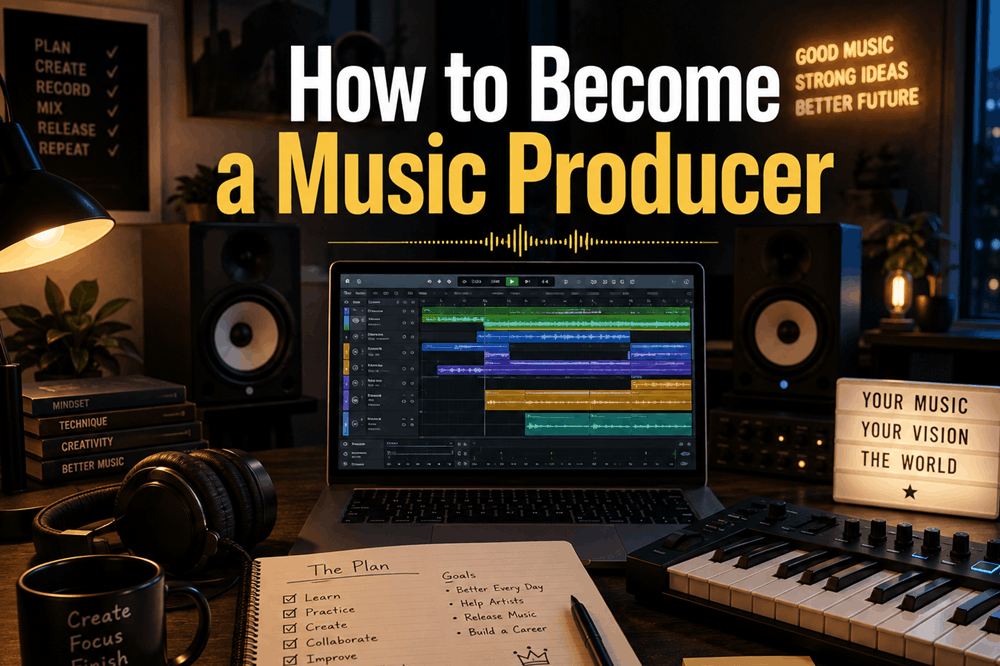
You become a music producer by learning how songs are built, becoming fluent in one digital audio workstation, completing many recordings and gradually earning the trust of artists.
You do not need an expensive studio, a record-label connection or a university degree to begin. A computer, headphones and basic production software are enough for your first projects.
The harder part is developing judgment.
A producer must recognize what a song needs, guide performers, make useful creative decisions and carry an unfinished idea toward a recording people want to hear again.
The clearest path is:
Choose one production program, learn the fundamentals, finish songs consistently, collaborate with musicians and build a small portfolio before trying to sell your services.
What does a music producer actually do?
A music producer helps shape a recording from its earliest idea to its finished form.
The exact role changes from project to project. One producer may create every instrumental part inside a laptop. Another may work with a live band, helping select songs, improve arrangements and guide performances. A third may focus primarily on songwriting, vocal production or electronic sound design.
Berklee describes producers as creative partners who may contribute throughout preproduction, recording, editing, mixing and mastering. They may help choose material, change arrangements, hire musicians, coach artists and work closely with recording engineers. (Berklee’s overview of the music-producer role) (berklee.edu)
A producer commonly makes decisions about:
- Song structure
- Tempo and key
- Instrumentation
- Vocal delivery
- Sound selection
- Recording methods
- Editing
- Effects
- Overall emotional direction
- When a track is finished
The producer does not always perform every technical task.
A recording engineer may operate microphones and recording equipment. A mixing engineer balances and processes the recorded tracks. A mastering engineer prepares the final mix for distribution.
On small independent projects, one person may perform all four roles.
Choose what kind of producer you want to become
“Music producer” is a broad title.
Before buying equipment or watching hundreds of tutorials, decide what type of work attracts you most.
Beat producer
A beat producer creates instrumentals, often for rappers, singers and online licensing.
This work may involve programming drums, selecting samples, writing bass lines and creating melodic loops.
Artist-producer
An artist-producer writes, records and produces their own music.
This path suits people who want full creative control over their releases.
Record producer
A record producer works directly with singers, bands or instrumentalists. The producer helps develop the song, directs recording sessions and keeps the project moving toward a finished result.
Songwriter-producer
A songwriter-producer participates in both composition and production. They may help create melodies, chords, lyrics and arrangements during the same session.
Berklee notes that songwriter-producers often manage several projects at once and may also create sync music, sample packs or music-library material. (Berklee’s songwriter-producer career guide) (berklee.edu)
Electronic producer
An electronic producer may build complete tracks through synthesis, sampling, sequencing and sound design.
Vocal producer
A vocal producer specializes in helping singers deliver, record and organize strong vocal performances. This can include choosing takes, creating harmonies and directing phrasing.
You do not need to remain inside one category permanently.
Choosing a starting direction simply prevents you from trying to learn every part of the recording industry at the same time.
Step 1: Learn one digital audio workstation
A digital audio workstation, usually shortened to DAW, is the main program used to record, arrange, edit and mix music.
Popular choices include:
- Ableton Live
- FL Studio
- Logic Pro
- GarageBand
- Pro Tools
- BandLab
- Cubase
- Studio One
- Reaper
The best DAW for a beginner is usually the one that runs reliably on their computer and encourages them to finish music.
Do not spend months comparing programs.
Most established DAWs can record audio, program drums, edit MIDI, use virtual instruments and mix songs. The interfaces differ, but the fundamental production skills transfer between them.
Mac users can begin with GarageBand, which Apple describes as a complete music-creation studio with instruments, guitar and vocal presets, session drummers and recording tools. (Apple’s GarageBand overview) (apple.com)
BandLab offers a free cloud-based studio that works through a browser and mobile app. It supports recording, editing, mixing and online collaboration without requiring a paid professional setup. (BandLab Studio) (bandlab.com)
Pro Tools Intro is another free starting option, while Ableton Live, FL Studio and other professional programs offer different workflows for people ready to invest in more advanced software. (Avid Pro Tools Intro) (Ableton Live overview)
Learn these functions first:
- Creating and saving a project
- Setting the tempo
- Recording audio
- Adding virtual instruments
- Programming MIDI notes
- Importing samples
- Copying and arranging sections
- Adjusting volume and stereo position
- Adding basic effects
- Exporting a finished audio file
Ignore advanced plugins until those tasks feel natural.
Step 2: Start with basic equipment
A beginner does not need a room filled with hardware.
A practical first setup can contain:
- A reliable computer
- One DAW
- Closed-back headphones
- An audio interface
- One microphone
- A MIDI keyboard, if useful for your style
Berklee lists a computer, DAW, MIDI controller, audio interface, microphone, headphones and monitor speakers among the common foundations of a production setup. It also emphasizes that music and human performance matter more than equipment. (Berklee Online’s music-production guide) (online.berklee.edu)
You may not need every item immediately.
A producer making electronic instrumentals can begin with a computer and headphones. Someone recording vocals will benefit more quickly from a microphone and interface. Studio monitors become useful when the room and budget allow them.
Do not assume expensive equipment automatically creates professional recordings.
A carefully arranged song made with basic tools will usually sound more convincing than a weak song processed through expensive hardware.
Step 3: Learn how music is constructed
Music theory is useful, but you do not need to master advanced notation before producing your first track.
Begin with practical concepts:
- Rhythm and meter
- Tempo
- Major and minor scales
- Chords
- Chord progressions
- Melody
- Bass lines
- Song sections
- Tension and release
- Repetition and variation
Ableton’s free Learning Music site lets beginners experiment with beats, bass lines, melodies, chords and song structure directly in a browser. It does not require prior software experience. (learningmusic.ableton.com)
Understanding these ideas helps you communicate with musicians and solve problems faster.
For example, theory can help you recognize that a melody conflicts with a chord or that changing the key may make a vocal more comfortable.
However, theory is a tool rather than a requirement for creativity.
Some successful producers are highly trained musicians. Others rely more heavily on rhythm, taste, communication and instinct. Berklee’s discussion of the producer’s role emphasizes that technical ability and musical skill are valuable, but the producer’s central responsibility is helping the artist achieve the strongest result. (Berklee on producers’ technical and musical skills) (berklee.edu)
Step 4: Study songs you admire
Listening is one of a producer’s most important forms of training.
Choose several professionally released songs in the style you want to create and analyze them carefully.
Ask:
- How long is the introduction?
- When does the vocal begin?
- What changes when the chorus arrives?
- Which instruments disappear during quieter sections?
- How often does the drum pattern change?
- Where are harmonies added?
- How does the producer create tension before a drop or chorus?
- How loud is the bass compared with the vocal?
- What makes the final chorus feel larger?
Place a reference song inside your DAW and mark where each section begins.
You are not trying to copy the finished recording for release. You are training yourself to recognize arrangement decisions that casual listeners may feel without consciously noticing.
A producer develops taste by connecting emotional reactions with specific musical choices.
Step 5: Recreate songs for practice
Recreating a song is one of the fastest ways to discover what you do not yet understand.
Choose a relatively simple track and rebuild its basic structure using your own sounds.
Try to reproduce:
- The approximate tempo
- Drum placement
- Chord movement
- Bass rhythm
- Section lengths
- Dynamic changes
- General sound balance
Your recreation does not need to match perfectly.
The purpose is to understand how the original works.
You may discover that the chorus feels large because the bass enters late, not because every instrument becomes louder. You may notice that the verse contains fewer sounds than you remembered or that a vocal delay appears only at the end of certain phrases.
Do not publish an unauthorized recreation as your own original song.
Keep it as a private technical exercise unless you have the necessary permission or are using the material within an appropriate legal context.
Step 6: Finish complete songs
Many beginners create hundreds of eight-bar loops and very few complete tracks.
A loop proves that you can generate one appealing idea.
A finished song requires:
- Development
- Transitions
- Contrast
- Editing
- Decision-making
- Quality control
- An ending
Finishing teaches you more than endlessly improving the first section of a project.
Set a manageable goal, such as completing one short instrumental each week. Early songs will not sound professional, and they do not need to.
A completed imperfect track gives you a full process to evaluate.
An unfinished perfect loop does not.
Ableton’s beginner learning resource recommends continuing to make music and learning through repeated experimentation after the basic lessons are complete. (Ableton’s “Where to go from here” guide) (learningmusic.ableton.com)
Step 7: Learn recording and editing fundamentals
Even electronic producers benefit from understanding how audio recording works.
Learn the basics of:
- Microphone placement
- Input gain
- Clipping
- Room noise
- Latency
- Comping
- Timing correction
- Pitch correction
- Crossfades
- File organization
A producer does not need to become an expert recording engineer immediately.
You should still be able to recognize whether a poor result comes from the performance, microphone position, recording level or production decision.
Editing should improve a performance without removing all of its human character.
Correcting every breath, timing difference and pitch variation can create a technically controlled recording that feels emotionally lifeless.
Step 8: Understand arrangement before mixing
Beginners often try to fix arrangement problems with mixing plugins.
If the vocal and guitar occupy the same musical space, equalization may help. Removing or changing the guitar part may help more.
Before mixing, ask:
- Are too many instruments playing at once?
- Does every part serve the song?
- Does the chorus actually contrast with the verse?
- Is the vocal melody supported by the chords?
- Is the bass rhythm fighting the kick drum?
- Does the song become repetitive?
- Could one section be shorter?
A strong arrangement makes mixing easier.
Production is largely the process of choosing what the listener should hear at each moment.
Step 9: Learn basic mixing
Mixing is the process of balancing the recorded elements into a coherent stereo track.
Begin with:
- Volume
- Panning
- Equalization
- Compression
- Reverb
- Delay
- Automation
Learn what each tool solves before adding it.
Equalization adjusts frequency balance. Compression controls dynamic range. Reverb creates a sense of space. Delay creates repeated echoes. Automation changes settings over time.
Do not insert a long chain of effects simply because a tutorial did so.
The correct question is not, “Which plugins should every vocal have?”
It is, “What problem does this vocal currently have?”
Professional mixing is a separate craft that can require years of focused practice. You do not need to become an elite mix engineer before calling yourself a producer, but you should be able to create clear demonstrations of your ideas.
Step 10: Collaborate with real artists
Producing alone teaches software.
Producing another person teaches production.
An artist may dislike your favorite idea. A singer may struggle with a melody that sounded easy when programmed. A band may need encouragement, mediation or a clearer plan rather than another plugin.
Berklee’s production program emphasizes that producers need technical and musical knowledge as well as the ability to adapt to different personalities and help musicians perform at their best. (Berklee Music Production and Engineering) (college.berklee.edu)
Begin with low-pressure collaborations:
- Produce a song for a friend
- Record a local singer
- Trade stems with another beginner
- Join an online remix project
- Create music for a student filmmaker
- Help a songwriter turn a voice memo into a demo
Agree on expectations before beginning.
Discuss the style, deadline, number of revisions, credits and whether money or royalties are involved.
Even an unpaid collaboration should not rely on vague assumptions.
Step 11: Learn copyright, credits and splits
Music production creates both creative and legal questions.
In U.S. copyright law, the musical composition and the sound recording are separate works. The composition includes music and lyrics, while the sound recording is the recorded performance fixed in an audio file or another medium. (U.S. Copyright Office guide to musical works and recordings) (copyright.gov)
A producer may contribute to:
- The songwriting
- The sound recording
- Both
- Neither, while receiving a separate production fee
Before releasing a collaborative song, confirm:
- Who wrote the lyrics?
- Who wrote the melody and chords?
- Who owns the master recording?
- Is the producer receiving a fee?
- Does the producer receive royalties?
- How should every contributor be credited?
- Were all samples legally cleared?
Write the agreement down.
A simple split sheet completed during the project is better than trying to reconstruct everyone’s contributions after the song gains attention.
The U.S. Copyright Office provides educational resources explaining what musicians should know about compositions, recordings, ownership and registration. (Copyright resources for musicians) (copyright.gov)
Step 12: Build a focused portfolio
Your portfolio does not need 50 songs.
Three to six strong pieces are more useful than a large collection of unfinished or inconsistent work.
Choose tracks that show:
- Your strongest genre
- Vocal production
- Arrangement ability
- Recording skill
- Musical range
- A complete, release-ready idea
Do not include every early experiment.
A portfolio should help another artist quickly understand what you can offer.
Provide clear credits beside each track. Explain whether you produced, wrote, recorded, mixed or performed it.
When possible, make it easy to hear the music without requiring an account or complicated download.
Step 13: Find your first paid clients
Most beginning producers find work through relationships rather than formal job applications.
Start locally and within your existing network.
You might contact:
- Singers posting unfinished demos
- Local bands
- Rappers searching for beats
- Songwriters who need arrangements
- Student filmmakers
- Dance schools
- Podcasters
- Small game developers
- Independent content creators
Do not send the same generic message to hundreds of artists.
Listen to their work and explain specifically how you may be able to help.
A useful message might say:
“I like the vocal tone and writing in your latest demo. I produce atmospheric alternative R&B and think the chorus could become larger with a stronger low end and layered harmonies. Here are two relevant examples of my work.”
Early jobs may involve modest fees, portfolio exchanges or shared ownership. Make the arrangement clear before beginning and avoid providing unlimited revisions without boundaries.
Do you need a degree to become a music producer?
No. A formal degree is one possible route, not a universal requirement.
The Recording Academy’s career guide notes that producers enter the profession through many paths, including songwriting, DJing, engineering, performance and apprenticeships. Formal education can provide structure and technical foundations, but online lessons, software practice and direct studio experience have created other viable routes. (GRAMMY GO’s music-producer career guide) (go.grammy.com)
A college or production program may provide:
- Structured training
- Access to studios
- Experienced instructors
- Collaboration with musicians
- Internships
- Industry contacts
- Faster feedback
Self-teaching may provide:
- Lower costs
- Flexible pacing
- Freedom to specialize
- Immediate project experience
- Access to free educational material
The weakness of self-teaching is not a lack of information.
It is the lack of structure and reliable feedback.
A self-taught producer should actively seek collaborators, mentors and critical listeners instead of learning entirely in isolation.
Do you need to play an instrument?
No, but some keyboard ability is highly useful.
A small MIDI keyboard can help you understand chords, melodies and bass lines more intuitively. It also makes communication with trained musicians easier.
You do not need concert-level skill.
A producer who cannot perform fluently can still succeed through rhythm programming, sampling, editing, sound selection, communication and strong creative direction.
However, every additional musical skill gives you another way to solve problems.
How long does it take to become good?
There is no fixed timeline.
Someone practicing consistently and finishing projects may become capable of producing credible demos within a year. Developing a distinctive professional sound, reliable client workflow and strong industry reputation usually takes much longer.
Progress depends on:
- Practice frequency
- Quality of feedback
- Musical background
- Number of completed projects
- Collaboration experience
- Genre complexity
- Technical discipline
- Willingness to revise
Do not measure progress only by how long you have owned a DAW.
Measure it through completed work.
Common beginner mistakes
Buying too much equipment
New equipment can be exciting, but it often delays the more uncomfortable work of finishing songs.
Changing DAWs repeatedly
Switching software whenever production becomes difficult prevents fluency.
Collecting plugins instead of learning fundamentals
Volume, arrangement and sound selection usually matter more than another expensive effect.
Copying tutorials without understanding them
Reproducing settings can teach a technique, but you should know what problem each step solves.
Mixing before the song is arranged
A beautifully processed weak arrangement remains weak.
Never collaborating
Production is partly the management of people, emotion and communication.
Ignoring credits and ownership
Friendly collaborations can become disputes when expectations were never written down.
Waiting until your music is perfect
Your first releases and portfolio pieces need to be competent, not historically important.
A simple 12-week beginner plan
Weeks 1–2
Choose one DAW and learn navigation, recording, MIDI and exporting.
Weeks 3–4
Create short drum patterns, chord progressions, bass lines and melodies.
Weeks 5–6
Recreate the basic arrangements of two songs you admire.
Weeks 7–8
Finish two original instrumentals or demos.
Weeks 9–10
Record or collaborate with another musician.
Weeks 11–12
Edit, mix and publish one polished portfolio track with accurate credits.
At the end of 12 weeks, you will not know everything.
You will understand the complete production process, which is more valuable than knowing hundreds of disconnected tricks.
Final answer
To become a music producer, begin with one DAW and a basic setup. Learn rhythm, chords, arrangement, recording and mixing through small projects rather than trying to master every technical subject first.
Study professional recordings.
Recreate songs privately.
Finish original tracks.
Then work with real artists, because production is not only the manipulation of sound. It is the ability to recognize an artist’s intention and help turn it into a recording.
You do not need a degree, expensive studio or perfect instrumental technique.
You do need:
Taste.
Patience.
Communication.
Technical reliability.
And a growing collection of finished work.
Your first goal should not be becoming famous or earning a major-label placement.
It should be completing one song that sounds better than the song you completed before it.
That repeated improvement is how a beginner becomes a producer.