Is Listening to Music a Hobby? Yes—Here’s What Makes It One
Yes, listening to music can absolutely be a hobby.
A hobby is an interest or activity to which someone regularly devotes time for pleasure. It does not have to involve making a physical object, developing a difficult skill or producing something other people can see. Merriam-Webster defines a hobby as an interest or activity pursued for enjoyment, which comfortably includes intentional music listening. (Merriam-Webster’s definition of “hobby”)
The important distinction is intention.
Hearing music while it plays in a supermarket is not a hobby. Turning on random background music while completing another task may not feel like one either.
But regularly exploring albums, building playlists, attending concerts, collecting records, studying artists or simply setting aside time to listen closely can all form a genuine hobby.
You do not need to sing, play an instrument or understand music theory to call yourself a music enthusiast.
Listening itself can be the activity.
Why listening to music qualifies as a hobby
People sometimes assume that a hobby must be active in an obvious physical sense.
Gardening produces flowers. Knitting produces clothing. Woodworking produces furniture. Playing guitar produces sound through a visible skill.
Listening appears more passive because the listener is receiving something another person created.
However, many accepted hobbies are based primarily on attention and appreciation. Reading, watching films, birdwatching and visiting museums do not always produce a physical result. Their value comes from how the person engages with the experience.
Music listening works in the same way.
A dedicated listener may:
- Search for unfamiliar artists
- Compare different versions of the same song
- Follow the history of a genre
- Listen to complete albums in sequence
- Study lyrics and production choices
- Organize playlists by mood, period or theme
- Collect vinyl records, CDs or concert memorabilia
- Attend live performances
- Discuss music with other fans
- Keep track of favorite releases
These activities require curiosity, attention and personal investment.
The listener is not creating the recording, but listening can still involve interpretation, memory, judgment and emotional participation.
Casual listening and hobby listening are different
Almost everyone hears music, but not everyone treats it as a hobby.
The difference resembles the distinction between occasionally watching a movie and being seriously interested in cinema.
A casual listener may choose music mainly to fill silence, support a workout or make a commute more enjoyable. The music is useful, but it is not necessarily the main activity.
Someone who treats music as a hobby is more likely to make deliberate choices.
They may set aside an evening for a new album, research the samples used in a song or follow an artist’s development across several records. They may notice instrumentation, lyrics, mixing, vocal technique or the relationship between songs on an album.
Neither approach is better.
Music does not become more valuable only when it is analyzed carefully. A person can enjoy simple background listening without turning it into a project.
The point is that a hobby usually involves some degree of voluntary and repeated engagement.
Music becomes a hobby when you treat it as something worth returning to for its own sake.
You do not need musical talent to enjoy music seriously
One reason people hesitate to describe music listening as a hobby is that they associate “being musical” with performance.
They may believe music belongs mainly to people who can sing well, read notation or play an instrument.
That is not true.
Performing and listening are different forms of musical participation. A pianist develops control over an instrument. A listener may develop a detailed understanding of styles, emotional expression, songwriting or recording techniques.
These abilities sometimes overlap, but one does not require the other.
A person can recognize an extraordinary vocal performance without being able to reproduce it. They can understand why a film score changes a scene without knowing how to compose one. They can hear the difference between punk, post-punk and new wave without playing guitar.
The same principle applies to other arts.
You do not need to write novels to enjoy reading.
You do not need to direct films to study cinema.
You do not need to compose music to become an informed and passionate listener.
Active listening can make the hobby more rewarding
Active listening means giving music focused attention instead of treating it only as background sound.
This may involve using headphones, removing distractions and listening to a song or album from beginning to end. The listener may concentrate on one element at a time, such as the bass line, percussion, harmony, vocal delivery or lyrics.
On a second listen, the same recording may reveal details that were easy to miss initially.
Active listening can include questions such as:
- What changes between the verse and chorus?
- Which instrument creates the song’s mood?
- Does the singer sound sincere, distant, angry or playful?
- How do the lyrics and production support each other?
- Why was this song placed at this point on the album?
- Does a live version change the meaning?
- What earlier genres or artists influenced the recording?
This does not require formal music theory.
It simply means noticing.
Repeated listening can become similar to rereading a novel or revisiting a painting. The work remains the same, but your attention changes what you discover.
Music listening can support mood and emotional regulation
People often use music to manage how they feel.
A song can calm someone after a stressful day, provide energy during exercise or give shape to an emotion that is difficult to explain. Music may also bring back unusually vivid memories because songs can become connected with particular people, places and periods of life.
The American Psychological Association notes that self-selected music strongly engages brain systems connected with reward and identity, helping explain why personal musical choices can carry such powerful emotional and cultural meaning. (APA’s overview of music and the mind)
Research has also examined whether listening to music can support relaxation and recovery from stress. Findings are not identical across every study, and music should not be treated as a guaranteed medical treatment. However, studies have reported effects involving perceived relaxation, anxiety and aspects of the body’s stress response.
The U.S. National Center for Complementary and Integrative Health explains that both making and listening to music activate brain systems involved in emotion, thought, movement and sensation. The agency describes growing evidence that music-related activities may support health and symptom management in certain contexts, while also emphasizing that the strength of the evidence varies by condition and study design. (NCCIH’s guide to music and health)
A hobby does not need a health benefit to be worthwhile.
Still, the emotional usefulness of music helps explain why so many people make listening part of their daily routines.
Music can become part of your identity
Musical taste often feels more personal than preference in many other forms of entertainment.
People use songs to understand themselves, remember earlier versions of their lives and communicate values they may struggle to state directly.
A favorite artist may represent a period of growing up. A genre may connect someone with a community, culture or family history. A carefully chosen playlist can function almost like a personal diary, with each track attached to a memory or feeling.
Research into participation in musical activities—including listening—has connected people’s reasons for engaging with music to psychological needs involving mood regulation, belonging, identity, autonomy and well-being.
This is one reason disagreements about music can feel surprisingly intense.
People are not always arguing only about sound.
They may be defending memories, communities or versions of themselves.
Treating music as a hobby gives a person room to explore those connections intentionally rather than allowing an algorithm to choose everything automatically.
How to turn listening to music into a more active hobby
There is no need to make music listening complicated, but a few habits can deepen it.
Listen to complete albums
Streaming encourages people to move quickly between individual songs.
Listening to an album in its intended order can reveal pacing, recurring ideas and emotional development that disappear when songs are separated into playlists.
Not every album tells a story, but track order is usually a creative decision.
Explore one genre at a time
Choose a genre you know only vaguely and trace its development.
You might begin with blues, jazz, disco, punk, hip-hop, country, reggae, metal, electronic music or K-pop. Start with several influential recordings, then follow the connections into later subgenres.
Genre exploration makes musical history easier to hear.
Compare different recordings
Classical compositions, folk songs, jazz standards and frequently covered pop songs may exist in dozens or hundreds of versions.
Comparing them shows how tempo, arrangement, voice and instrumentation can change the emotional character of the same material.
Read about the music
Artist interviews, album credits, biographies and reliable music criticism can explain how a recording was created.
Learning who wrote, produced, arranged and performed a song often reveals that a familiar recording contains more collaboration than listeners initially assume.
Attend live performances
Concerts transform listening into a shared physical experience.
The crowd, venue, sound system and performer’s choices may cause a well-known song to feel different from its studio version. Live performances also support local musicians and introduce listeners to artists they may not discover through recommendation systems.
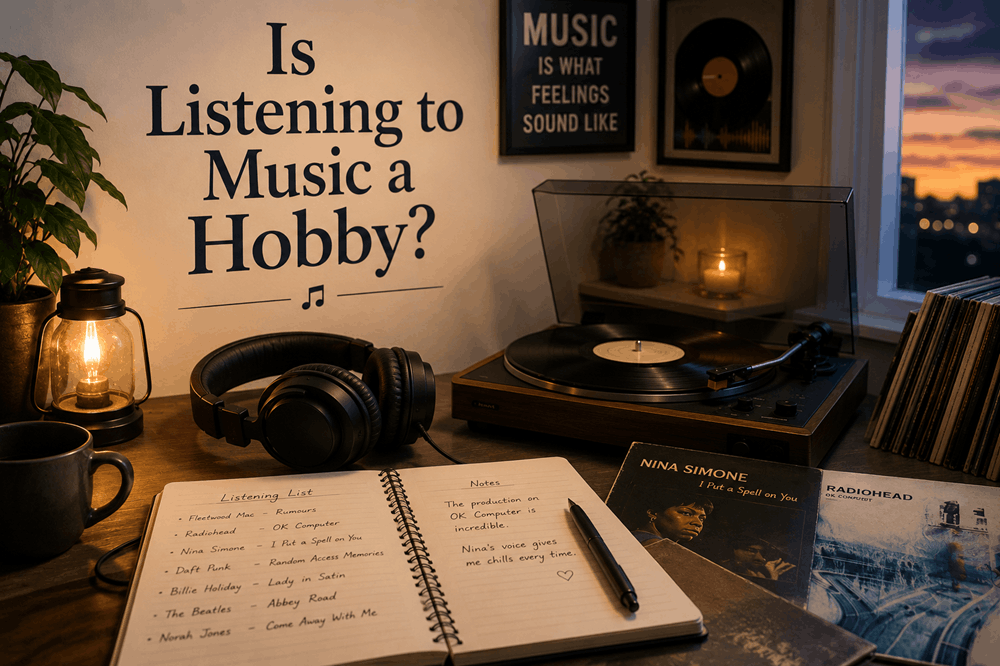
Keep a listening journal
A listening journal can be extremely simple.
Write down the album, date, favorite song and one or two observations. Over time, the notes reveal how your taste changes and which music continues to matter after the excitement of a first listen disappears.
Is making playlists a hobby?
Yes, playlist creation can be a hobby within music listening.
A thoughtful playlist involves selection, organization and an understanding of how songs interact. The creator may consider tempo, lyrics, mood, genre and transitions between tracks.
Some playlists serve a practical purpose, such as studying, exercising or sleeping. Others resemble small personal radio programs or mixtapes designed around a story.
A strong playlist is not merely a collection of favorite songs.
Its order creates an experience.
Playlist-making can also become social. People exchange recommendations, create collaborative lists or make personalized playlists for friends. The activity combines listening with curation and communication.
Is collecting vinyl records the same hobby?
Record collecting and music listening overlap, but they are not identical.
A music listener may care mainly about the sound and have no interest in physical media. A record collector may value artwork, pressing variations, rarity, historical significance and the process of finding an item.
Many people enjoy both.
Vinyl can encourage deliberate listening because a record must be selected, handled and turned over. The format makes it less convenient to skip constantly between unrelated songs.
However, physical ownership is not required for serious engagement with music.
A person using a basic streaming subscription can be just as knowledgeable or passionate as someone with an expensive record collection.
The hobby is defined by the person’s attention, not the cost of the equipment.
Can you list listening to music as a hobby?
You can describe listening to music as a hobby in casual introductions, profiles, applications and conversations.
However, the phrase becomes more informative when you add specificity.
Instead of writing only “listening to music,” you might say:
- Exploring jazz and soul albums
- Attending independent live concerts
- Collecting and reviewing vinyl records
- Studying film scores
- Building themed playlists
- Researching music history
- Following international pop scenes
- Comparing classical recordings
Specific wording shows what you actually do.
On a professional résumé, hobbies are usually worth including only when they add something relevant or distinctive. “Listening to music” alone may be too broad, while music reviewing, concert volunteering or managing a community playlist may communicate clearer interests or experience.
When is listening to music not really a hobby?
Listening does not have to qualify as a hobby every time music is playing.
It may function mainly as:
- Background noise
- A sleep aid
- Motivation during exercise
- A way to block distracting sounds
- Entertainment during commuting
- Part of a social event
- Support for another hobby
These uses are still valid.
The label depends on what music means within the person’s life. Someone who occasionally turns on a playlist may simply enjoy music. Someone who devotes regular attention to discovering, understanding or collecting it is more clearly practicing a hobby.
There is no test to pass.
The word “hobby” is useful only if it accurately describes how you spend your voluntary time.
Does a hobby need to be productive?
No.
Modern culture often encourages people to monetize their interests, document them online or turn them into measurable self-improvement.
That pressure can remove the pleasure that made the activity meaningful.
You do not need to start a review channel, become a DJ or build a large record collection to justify the hours you spend listening. Recreation is valuable partly because it offers relief from obligations and productivity demands. Merriam-Webster defines recreation as a means of refreshing the mind or body after work or worry and directly connects it with diversion and hobbies. (Merriam-Webster’s definition of “recreation”)
Listening closely to an album can be worthwhile even when nothing is posted, sold or achieved afterward.
Enjoyment is enough.
Final answer
Listening to music is a hobby when you choose to spend your free time doing it for pleasure, curiosity or personal meaning.
It can be as simple as setting aside time for favorite albums. It can also expand into playlist curation, concert attendance, record collecting, lyric interpretation, genre exploration or music-history research.
You do not need to play an instrument.
You do not need expensive headphones.
You do not need to prove that you learned something from every song.
A hobby is not defined by visible output. It is defined by repeated, voluntary engagement.
When listening becomes something you actively look forward to, return to and explore, music is not merely playing in the background.
It is your hobby.