
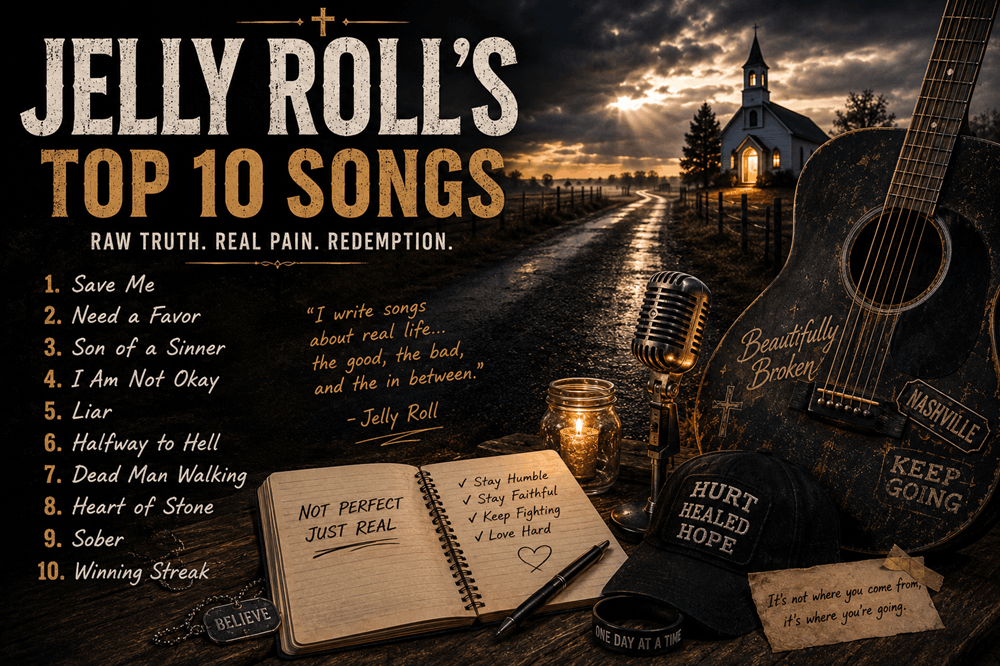
Jelly Roll’s Top 10 Songs: The Essential Tracks From “Save Me” to “Liar”
Jelly Roll’s best songs turn addiction, shame, faith, grief and recovery into music that feels communal rather than private.
His catalog stretches across Southern rap, hard rock, country, gospel and acoustic balladry. Yet the strongest recordings share one quality: they sound as though he is telling the truth before he has time to make that truth more flattering.
This ranking considers cultural impact, chart performance, emotional power and how clearly each song represents his musical identity. It focuses on recordings released with Jelly Roll as the lead artist; major guest appearances and collaborations are covered separately.
His breakthrough albums Ballads of the Broken and Whitsitt Chapel established him as a country-rock crossover artist, while 2024’s Beautifully Broken became his first No. 1 album on the Billboard 200. (Billboard Canada)
1. “Save Me”
“Save Me” is the defining Jelly Roll song because it contains nearly everything listeners respond to in his music: confession, exhaustion, self-awareness and a small remaining desire to survive.
The original version is strikingly simple. Acoustic guitar supports a vocal that sounds worn down rather than theatrically dramatic. Jelly Roll is not pretending that recognizing his destructive behavior has immediately given him the power to stop it. He understands the danger and still feels trapped inside it.
That honesty makes the song larger than one person’s addiction story. Anyone who has recognized a harmful pattern without knowing how to escape it can enter the song.
The later duet with Lainey Wilson expanded “Save Me” without weakening its intimacy. Her verse turns one person’s confession into a conversation between two damaged people. That version reached No. 19 on the Billboard Hot 100 and earned a Grammy nomination for Best Country Duo/Group Performance. (Billboard Canada)
Watch the original “Save Me” performance.
2. “Need a Favor”
“Need a Favor” is Jelly Roll’s most complete crossover record.
The song follows a man who rarely thinks about faith until fear gives him something urgent to ask for. He knows his sudden prayer may be selfish. He also knows desperation has removed his ability to pretend that he is fully in control.
That conflict gives the song more depth than a conventional spiritual anthem. The narrator is not presenting himself as redeemed. He is bargaining from the uncertain space between belief and doubt.
Musically, “Need a Favor” brings together country storytelling, gospel-style backing vocals and the weight of a rock song. Its appeal crossed genre boundaries so successfully that it became the first song to reach the top 10 of both Billboard’s Country Airplay and Mainstream Rock Airplay charts. (Billboard Canada)
The video and live performances also became central to Jelly Roll’s rise. At the 2024 CMT Music Awards, “Need a Favor” won Video of the Year, Male Video of the Year and CMT Performance of the Year. (AP News)
Watch the official “Need a Favor” video.
3. “Son of a Sinner”
“Son of a Sinner” is the song that made Jelly Roll’s country transition feel inevitable.
Its narrator is moving between repentance and relapse. He wants peace, but he remains attracted to the habits that continually prevent him from finding it. Rather than dividing himself into a good person and a bad person, he accepts that both impulses exist at once.
That tension gives the chorus its power. He does not claim to be permanently changed. He describes himself as someone still traveling, still failing and still trying to reach something better.
The arrangement is more traditionally country than much of Jelly Roll’s earlier work, but the emotional directness remains connected to his rap and rock background. The success of “Son of a Sinner” encouraged his full move toward country music, and the recording became his first No. 1 on Billboard’s Country Airplay chart. (Grammy)
It remains the clearest introduction to the central contradiction of his persona: he speaks openly about sin without treating himself as permanently condemned by it.
Watch the official “Son of a Sinner” video.
4. “I Am Not Okay”
“I Am Not Okay” begins with an admission many people spend considerable energy avoiding.
The narrator is struggling. He is losing sleep, barely functioning and concealing the extent of his pain. But the song does not remain entirely inside despair. Its reassurance is modest rather than unrealistic: feeling terrible now does not prove that life will always feel this way.
That balance is important.
Jelly Roll does not tell listeners to ignore depression or replace it with cheerful thinking. He first allows suffering to be named clearly. Hope becomes believable because it arrives after the confession rather than silencing it.
Released as the first major preview of Beautifully Broken, “I Am Not Okay” earned Grammy nominations for Best Country Solo Performance and Best Country Song. It also continued the run of country-radio success that followed Whitsitt Chapel. (Grammy)
The production gradually expands from vulnerable verses into a chorus suited to thousands of people singing together. A private sentence becomes a reminder that private pain is often widely shared.
Watch the official “I Am Not Okay” lyric video.
5. “Liar”
“Liar” turns addiction and destructive inner dialogue into an opponent the narrator can finally confront.
The title does not need to refer only to one dishonest person. The liar can be addiction, self-hatred, temptation or the voice insisting that change is impossible. It promises temporary relief while repeatedly leading the narrator toward the same damage.
Unlike the defeated perspective of “Save Me,” this song contains anger.
Jelly Roll sounds as though he has recognized the manipulation and is beginning to withdraw its power. The blues-rock production supports that change: heavy drums, forceful backing vocals and a growling lead performance turn recovery into a confrontation.
“Liar” became another Country Airplay No. 1 and also led Billboard Canada’s all-format airplay and country-radio charts. It followed “I Am Not Okay” as one of the key singles from the No. 1 album Beautifully Broken. (BMG)
The song’s strength comes from refusing to portray healing as gentle. Sometimes survival begins by becoming angry at the thing that has been controlling you.
Watch the official “Liar” music video.
6. “Halfway to Hell”
“Halfway to Hell” is one of Jelly Roll’s clearest statements about living between opposing identities.
The narrator is part sinner and part believer, shaped by church language but never fully separated from bars, bad decisions and temptation. He does not fit comfortably into either moral category.
That position is central to Jelly Roll’s wider appeal.
His songs rarely portray transformation as a clean line between a terrible past and a perfect present. The past remains visible, and improvement does not erase contradiction. “Halfway to Hell” turns that uncertainty into a confident, almost celebratory country-rock song.
The production is brighter and more energetic than the subject might suggest. Gospel-influenced vocals and a driving rhythm make the narrator’s divided identity feel less like a shameful secret and more like an honest description of being human.
The song became Jelly Roll’s fifth career country-radio No. 1 and his fourth consecutive chart-topper at the format. (BMG)
“Halfway to Hell” works because it does not demand that listeners prove which side they belong to before joining the song.
7. “Dead Man Walking”
Before country radio fully embraced Jelly Roll, “Dead Man Walking” established him as a serious rock artist.
The song is driven by distorted guitars, forceful drums and a vocal performance that sounds close to collapse. Its narrator recognizes that his lifestyle is destroying him, yet part of him continues moving toward the same ending.
The title presents self-destruction as a sentence already being carried out. He is physically alive but behaving as though the outcome has been decided.
That fatalism connects “Dead Man Walking” with “Save Me,” although the musical approaches are almost opposite. “Save Me” sounds like the quiet aftermath of a terrible night. “Dead Man Walking” sounds like the night while it is still happening.
The track topped Billboard’s Mainstream Rock Airplay chart, demonstrating that Jelly Roll’s mainstream rise did not begin exclusively within country music. (Billboard Canada)
Its placement on Ballads of the Broken also makes it essential to understanding his crossover identity: rock aggression, rap-era bluntness and country confession occupy the same recording.
8. “Heart of Stone”
“Heart of Stone” examines the fear that repeated pain can eventually destroy a person’s ability to feel.
The narrator has survived enough disappointment to understand why emotional hardness appears protective. But becoming unreachable would also cut him off from the love, faith and connection that make survival meaningful.
This is a more mature conflict than simply asking to be rescued.
The singer knows that healing requires remaining emotionally open, yet openness is precisely what allows other people to hurt him. The song lives inside that risk.
The arrangement uses a steady country-rock build rather than the explosive anger of “Liar.” Jelly Roll sounds less interested in defeating one enemy than in protecting the remaining compassionate part of himself.
In October 2025, “Heart of Stone” became his eighth consecutive No. 1 at U.S. country radio. BMG identified it as the latest chart-topper from Beautifully Broken, following “I Am Not Okay” and “Liar.” (BMG)
The song deserves a place in the top 10 because it shows his themes developing: staying alive is no longer enough if survival requires becoming emotionally empty.
9. “Sober”
“Sober” captures the confusing period after a person understands that substances are no longer delivering the escape they once promised.
The narrator knows intoxication is damaging him, but sobriety does not immediately feel peaceful. Removing the substance also removes the barrier that kept regret, shame and memory at a distance.
That emotional honesty separates the song from simplistic recovery narratives.
Sobriety is not presented as one victorious decision followed by permanent clarity. It exposes feelings that must now be experienced without chemical protection.
The restrained verses allow Jelly Roll’s voice to remain close and vulnerable before the arrangement rises around him. The performance suggests someone caught between wanting change and fearing what change will force him to confront.
“Sober” appeared on 2021’s Ballads of the Broken, the same crossover period that produced “Son of a Sinner” and “Dead Man Walking.” Jelly Roll’s official channel continues to group those recordings as the central songs from the album. (YouTube)
It may not carry the chart statistics of his later country singles, but it contains one of his most convincing portrayals of recovery as an ongoing process.
10. “Winning Streak”
“Winning Streak” is not a conventional victory song.
Its central scene involves people gathering with stories of addiction, regret and survival. The narrator’s apparent “winning streak” is measured not through money or fame but through the difficult accumulation of better choices.
The title contains deliberate tension.
Someone in recovery may be doing well without feeling triumphant. Each successful day matters, but the possibility of slipping backward remains. Progress must be recognized without being mistaken for permanent immunity.
The gospel and country elements make the song feel like a testimony delivered to a room rather than a polished celebration of celebrity success. Jelly Roll uses his own history to connect with people whose achievements may be invisible to everyone outside their recovery community.
He performed “Winning Streak” alongside “Liar” during his debut as musical guest on the 50th-season premiere of Saturday Night Live, giving the album track a major national introduction before Beautifully Broken was released. (People.com)
It earns the final position because it shows where Jelly Roll’s music has been moving: away from simply documenting destruction and toward understanding what rebuilding actually looks like.
The best Jelly Roll collaborations
Several major recordings fall outside the lead-artist ranking but remain important parts of his catalog.
“Hard Fought Hallelujah” with Brandon Lake brings together contemporary Christian music and Jelly Roll’s testimony-driven country style. The collaboration won the 2026 Grammy for Best Contemporary Christian Music Performance/Song. (Grammy)
“Wild Ones” with Jessie Murph emphasizes his rap-influenced delivery and rougher outlaw persona.
“Lonely Road” with MGK uses the familiar shape of “Take Me Home, Country Roads” for a song about isolation and a relationship that has become emotionally abandoned. (Billboard Canada)
“Somebody Save Me” with Eminem reuses Jelly Roll’s “Save Me” refrain inside Eminem’s confession about addiction, absence and regret as a father. (Billboard Canada)
“Amen” with Shaboozey continued Jelly Roll’s movement between country, gospel and pop audiences and earned a 2026 Grammy in the country duo/group category. (Grammy)
Where should new listeners begin?
A five-song introduction should begin with:
- “Save Me” for vulnerability
- “Need a Favor” for the country-rock-gospel crossover
- “Son of a Sinner” for his breakthrough country identity
- “I Am Not Okay” for mental-health honesty
- “Liar” for the more defiant side of recovery
Listeners who prefer rock should continue with “Dead Man Walking.” Those drawn to country should choose “Halfway to Hell” and “Heart of Stone.” “Sober” and “Winning Streak” provide the clearest bridge between the destructive past described in his early songs and the recovery-focused perspective of his later work.
Final thoughts
Jelly Roll’s best songs do not pretend that confession automatically produces change.
“Save Me” recognizes the need for rescue.
“Need a Favor” reaches toward faith without claiming certainty.
“Son of a Sinner” accepts contradiction, while “Liar” finally pushes back against the voice encouraging destruction.
That progression is the larger story running through his catalog.
The early recordings often sound like reports from inside addiction and despair. The later songs still acknowledge those forces, but the narrator has begun imagining a life beyond them.
His music connects because the improvement remains incomplete.
He does not speak from a distant position of perfection. He speaks as someone who understands that a person can be grateful, successful and loved while still carrying the habits and memories of an earlier life.
The songs do not promise that broken people stop being broken.
They argue that broken people are still worth saving.