“Human Nature” Lyrics Meaning: Why Michael Jackson Cannot Resist the City at Night
“Human Nature” by Michael Jackson is about the instinctive desire to escape confinement, enter the night and experience the excitement of human connection without having to justify it.
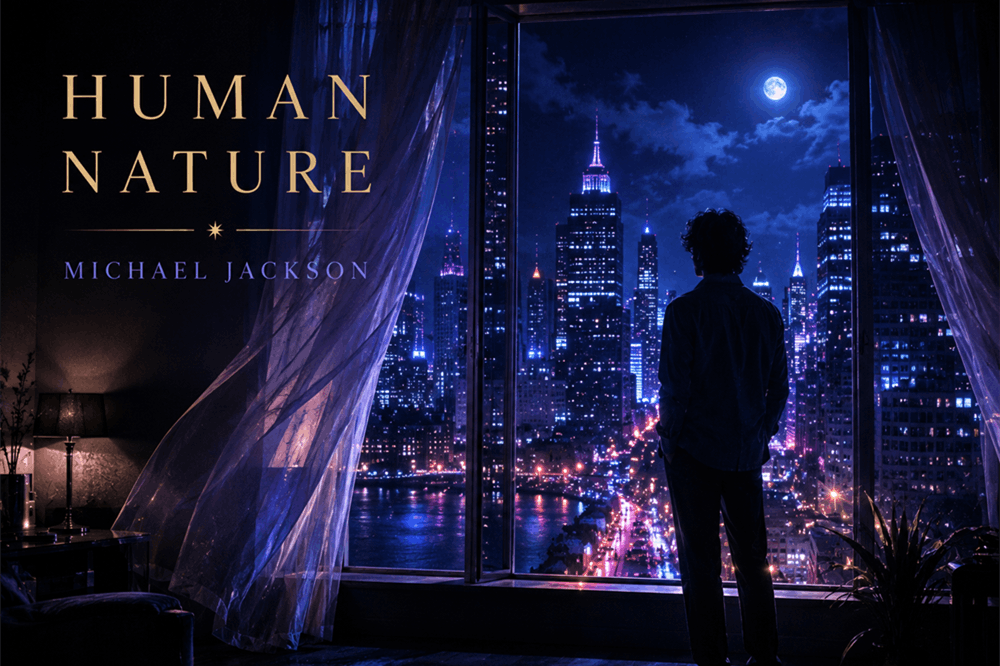
The narrator looks out from a room toward a city that seems alive without him. Lights flash, strangers pass and desire appears to move through the streets. Remaining indoors begins to feel impossible.
When others question his behavior, he offers a simple explanation: it is human nature.
That phrase does not mean every impulse is wise or harmless. In the song, it means that curiosity, attraction and the longing for freedom are basic parts of being alive. The narrator does not fully understand why the city pulls him outside, but he trusts the feeling enough to follow it.
This creates the song’s central tension:
He wants to lose himself in the freedom of the night, yet he is still being watched, questioned and judged.
“Human Nature” sounds gentle rather than rebellious because the narrator is not trying to destroy anything. He simply wants permission to experience the world directly.
What is “Human Nature” about?
The song begins with a man looking out over a sleepless city.
He hears the night calling through his window and feels trapped by the walls around him. Outside, the city offers movement, anonymity and the possibility of meeting someone new.
The narrator does not describe a carefully planned romantic relationship. His desire is immediate and instinctive. He wants to walk through the streets, observe strangers and respond to the electricity around him.
Several needs overlap:
- The desire to escape an enclosed room
- Curiosity about unfamiliar people
- Physical attraction
- The freedom of being anonymous
- Relief from social expectations
- A wish to participate rather than merely observe
The city becomes more than a location. It represents life occurring beyond the limits placed around him.
The narrator knows that people may question his choices. Instead of offering a detailed defense, he returns to the idea of human nature. He behaves this way because people naturally reach toward what attracts, excites or mystifies them.
The explanation is simple.
The emotions beneath it are not.
The city behaves like a living woman
From the opening verse, the city is given human qualities.
It appears to watch through countless lights, breathe through open streets and call to the narrator with a seductive voice. The urban landscape is not passive scenery. It behaves like a presence trying to draw him outside.
This personification allows the city and the woman he later notices to blend together.
Both are beautiful, mysterious and difficult to possess. The narrator wants to enter the city in the same way that he wants to approach another person: by crossing a boundary between observation and experience.
The city’s lights resemble eyes. Its sounds resemble breath. Its streets promise intimacy while remaining full of strangers.
This makes the attraction feel larger than one romantic encounter.
The narrator is seduced by the entire world beyond his window.
Why can the four walls no longer hold him?
The room represents safety, privacy and control.
Inside, the narrator is protected from strangers and from the uncertainty of the streets. He is also separated from everything that makes the city feel alive.
The walls therefore become both shelter and confinement.
His need to leave is not presented as a rational decision made after comparing risks. It arrives as physical restlessness. The room suddenly feels too small for the energy building inside him.
That feeling is central to the song’s meaning.
Human beings often want two opposing things:
- Safety and freedom
- Privacy and connection
- Stability and surprise
- Control and surrender
The narrator has safety, but at that moment safety feels like deprivation. He would rather face uncertainty than remain protected from experience.
“Human Nature” does not claim that one choice is always better. It captures the moment when the desire for movement becomes stronger than the desire for security.
What does the apple metaphor mean?
The narrator imagines the city as an apple he wants to taste.
The image works on several levels.
An apple is ordinary, physical and immediately appealing. A person does not need to create an elaborate philosophy before taking a bite. Hunger supplies its own explanation.
That supports the song’s argument about instinct. The city is present, desirable and full of possibility. The narrator wants to experience it because it is there.
The apple can also suggest temptation.
In Western culture, the fruit is often associated with forbidden knowledge, desire and the choice to cross a boundary. The narrator knows that entering the night may expose him to judgment or consequences, yet prohibition only makes the city more compelling.
There is also a connection to New York City, commonly called the Big Apple. Lyricist John Bettis shaped Steve Porcaro’s original song idea into a nighttime urban story, allowing the fruit image to describe both the city itself and the narrator’s appetite for experience.
The metaphor remains effective because it is not complicated.
The narrator is hungry for life.
He wants a taste.
“Human nature” is an explanation, not an excuse
The chorus responds to an imagined question: Why does he behave this way?
The narrator does not say that he has carefully considered every action. He points toward something instinctive inside himself.
This can sound like an excuse. People sometimes describe questionable behavior as natural when they do not want to accept responsibility for it.
But the song is not mainly defending cruelty or betrayal. Its narrator is explaining curiosity, attraction and the desire to move freely through the world.
He is asking why those feelings require justification at all.
The question may be coming from society, from another person or from an internal voice that has taught him to mistrust his own desires. Each time the doubt appears, the chorus pushes back.
The narrator does not apologize for wanting contact.
He treats the desire itself as evidence of being human.
Reaching toward a stranger
The second verse moves from watching the city to reaching toward someone inside it.
The narrator notices a woman and believes she is aware of his attention. For a brief moment, two strangers recognize each other across the crowded environment.
The song does not develop this into a conventional romance. We do not learn her name, hear a conversation or discover what happens afterward.
That absence is important.
The woman represents possibility rather than commitment. She is one of the countless unknown lives the narrator could encounter if he leaves his protected room.
The attraction is built on distance. He sees her eyes and interprets her response, but he does not truly know her.
This introduces uncertainty into the fantasy.
The narrator may be experiencing mutual interest. He may also be projecting meaning onto a brief glance. The city encourages that ambiguity because strangers can imagine entire stories about one another without exchanging a word.
The moment feels intimate precisely because it remains incomplete.
The “electric eyes” suggest attraction and surveillance
The city is filled with eyes.
Some belong to people. Others may be windows, streetlights, signs or reflections. Together, they create the feeling that the narrator is both observing and being observed.
This gives the song a subtle tension.
He wants the anonymity of the city, yet complete anonymity is impossible. Everywhere he looks, another light seems to look back.
The eyes are electric because they belong to a modern urban environment. They glow rather than simply see. Attraction becomes part of the city’s technology, atmosphere and movement.
But electric eyes can also suggest surveillance.
The narrator wants to behave naturally while remaining conscious that others may judge how he looks, whom he watches and what he desires. Even his supposedly private instincts exist inside a public space.
Freedom and exposure arrive together.
He leaves the four walls to escape confinement, only to discover that the open street contains its own forms of observation.
Why the song moves from night into morning
The final verse changes the setting.
The city’s night has ended, and morning begins to animate the streets again. Yet the narrator is still dreaming of being outside.
This prevents the song from functioning only as a description of one adventurous evening.
The street represents an ongoing desire.
Even after the city changes from seductive darkness to ordinary daylight, the narrator remains psychologically connected to it. He may be physically close to another person, but part of his imagination is still moving through the urban world.
Night and morning offer different versions of the city:
- At night, it is mysterious and seductive.
- In the morning, it becomes active and real.
- In both states, it calls him away from confinement.
The shift also suggests that the narrator’s experience may be partly imagined.
He could be remembering the night, dreaming about it or waking beside someone while his mind returns to the freedom of the street. The song never fixes the scene into one literal timeline.
That dreamlike uncertainty suits its meaning.
Human desire is not always organized into a clear story.
The song began with a very different human moment
“Human Nature” originated with Toto keyboardist Steve Porcaro.
Porcaro has explained that his young daughter came home upset after a boy had hurt or pushed her at school. While trying to comfort her, he suggested that the boy might have acted strangely because he liked her and that such confusing behavior was part of human nature.
The phrase stayed with him, and he began developing the melody and chorus.
The song reached producer Quincy Jones almost accidentally. Porcaro had prepared a cassette containing songs by Toto member David Paich for Jones to consider for Michael Jackson’s Thriller. Porcaro’s unfinished “Human Nature” demo happened to be on the other side of the tape. Jones heard it and recognized its potential.
That origin explains why the chorus feels broader and more innocent than the urban verses surrounding it.
Porcaro’s original idea concerned the confusing behavior people display when emotion has not yet learned how to express itself clearly. John Bettis later wrote new verses that placed the same idea inside a city at night.
The finished song therefore connects two kinds of human behavior:
A child acts awkwardly because he does not understand his feelings.
An adult enters the night because he cannot ignore his.
In both cases, emotion appears before explanation.
Michael Jackson changes the meaning through his performance
Although Jackson did not originate the central phrase or write the finished verses, his vocal performance makes the song feel inseparable from his artistic personality.
He sings softly, almost as though he is sharing private thoughts while looking through a window. There is desire in the performance, but very little aggression.
This matters because the lyrics involve watching strangers, escaping boundaries and following physical attraction. A more forceful performance could make the narrator sound entitled or predatory.
Jackson instead sounds curious and amazed.
His delivery turns the city into something dreamlike. He does not attack the night; he seems to float into it.
The repeated questions also contain vulnerability. The narrator acts confident about his desires, yet he keeps imagining that someone will challenge them. Beneath his freedom is the expectation of being misunderstood.
Jackson’s voice captures both impulses:
He wants to enter the world.
He also wants the world to accept why he needs to do it.
How the production creates a floating city
“Human Nature” appeared as the seventh track on Thriller and was released as the album’s fifth single in July 1983. The official Michael Jackson site lists Steve Porcaro and John Bettis as the songwriters and Quincy Jones as producer.
The recording is built around soft synthesizers, restrained percussion, guitar and layers of atmosphere.
Instead of recreating the noise of a real city, the production presents the city as the narrator imagines it. Traffic, crowds and hard pavement are replaced by glowing electronic textures.
The synthesizers resemble lights appearing across a skyline. Guitar phrases drift through the arrangement like distant voices. The rhythm moves steadily without becoming urgent.
This allows the song to feel suspended between indoors and outdoors.
The narrator has not fully entered the street, but he is no longer emotionally contained by his room. The music occupies the space between wanting and acting.
Members of Toto contributed significantly to the recording, including Steve Porcaro, David Paich, Steve Lukather and Jeff Porcaro. Steve Porcaro later recalled the disciplined studio environment around Jackson, Jones and Rod Temperton while working on Thriller.
The result is polished without feeling rigid.
Every element is controlled, while the song itself celebrates the desire to escape control.
Why the questions never receive a direct answer
The chorus repeatedly imagines people asking why.
But the song never identifies those people clearly.
They could be parents, romantic partners, strangers, journalists or society in general. They could also represent the narrator questioning himself.
Keeping the source of judgment vague gives the chorus wider meaning.
Most people have experienced desires they struggle to explain:
Why do we feel drawn to a stranger?
Why does a crowded city make us feel alive?
Why do we leave safe situations in search of uncertainty?
Why do we want to be seen while also wanting freedom from other people’s opinions?
“Human nature” does not answer these questions scientifically. It recognizes that some motivations exist before language can organize them.
The narrator’s explanation is therefore less a conclusion than an acceptance.
He may not know why.
He knows the desire is real.
Is “Human Nature” only about romantic attraction?
Romantic and physical attraction are central to the song, but they do not explain everything.
The narrator is drawn to the city before he identifies a particular woman. His first desire is to escape the room and participate in the world outside.
The stranger becomes one expression of that larger hunger.
The song can therefore also be heard as a statement about curiosity, independence and the need for direct experience.
A person who has lived under intense scrutiny or restriction may find the idea especially powerful. The city offers the possibility of becoming one person among millions rather than remaining the center of attention.
Jackson’s celebrity inevitably adds another layer, although it should be treated as interpretation rather than confirmed autobiography.
For one of the most recognizable people in the world, walking through a city as an anonymous observer would have been nearly impossible. His performance can make the narrator’s fantasy of ordinary street freedom feel unusually poignant.
He sings about watching strangers.
In real life, strangers were almost always watching him.
Why “Human Nature” stands apart on Thriller
Thriller contains confrontation, paranoia, romance, horror and dance-floor energy.
“Human Nature” creates a quieter space.
It does not depend on the dramatic narrative of “Billie Jean,” the aggression of “Beat It” or the cinematic spectacle of the title track. Its power comes from atmosphere and emotional suggestion.
The song became a U.S. top-10 hit during Thriller’s extraordinary run of successful singles, reaching No. 7 on the Billboard Hot 100.
Its influence also extended far beyond its original chart life. Artists have repeatedly sampled, interpolated and reinterpreted its melody, including SWV on the “Right Here (Human Nature Remix)” and Nas on “It Ain’t Hard to Tell.” Miles Davis recorded his own version for the 1985 album You’re Under Arrest.
Those reinterpretations work because the composition contains enough openness to survive outside its original setting.
Its melody can sound romantic, reflective, urban or lonely.
Like the city in the lyrics, it invites other people to enter and discover their own experience inside it.
Confirmed background versus interpretation
It is confirmed that Steve Porcaro created the original song idea, that John Bettis wrote the finished urban verses and that Quincy Jones selected the song for Michael Jackson’s Thriller. The official album credits identify Jones as producer, with Porcaro and Bettis as writers.
It is also confirmed that Porcaro’s initial inspiration came from explaining confusing human behavior to his daughter and that Jones encountered the demo through a cassette prepared during the Thriller song-selection process.
The broader ideas—that the walls represent social confinement, that the electric eyes combine attraction with surveillance and that Jackson’s celebrity gives the desire for anonymity an additional emotional layer—are interpretations.
The song does not require one rigid explanation.
Its language is deliberately broad enough to connect physical attraction with a deeper human need: the need to cross boundaries, encounter the unknown and experience life before fully understanding it.
Final meaning
“Human Nature” is about the pull of the world beyond the walls.
The narrator looks out at a city alive with lights, strangers and possibility. He knows that entering it may expose him to temptation, uncertainty and judgment, but remaining inside feels even less natural.
He is not searching for a logical defense of every impulse.
He is recognizing that people are built to reach outward.
They want to see what is hidden, touch what is distant and move toward what attracts them. They want safety, but they also want the freedom to leave safety behind.
The city does not promise lasting love or complete understanding.
It promises experience.
For the narrator, that is enough.
When people ask why he goes outside, watches strangers or follows the desire he cannot explain, he returns to the simplest answer available.
It is not a carefully constructed plan.
It is human nature.