
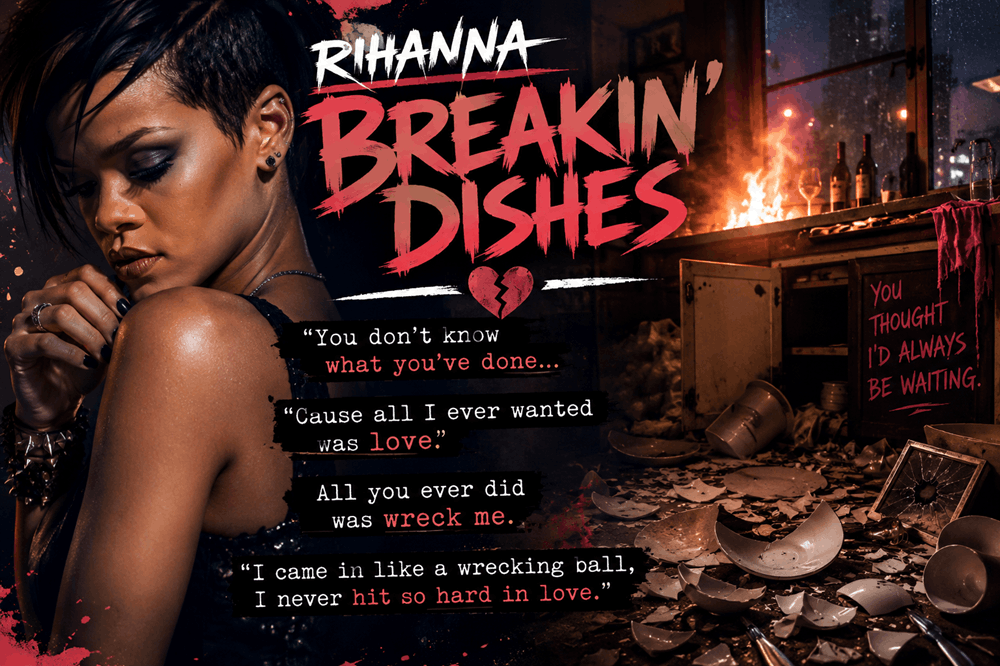
“Breakin’ Dishes” Lyrics Meaning: Rihanna’s Song About Suspicion, Anger and Reaching a Breaking Point
Rihanna’s “Breakin’ Dishes” is about a woman whose patience collapses after her partner repeatedly stays out late and fails to communicate with her.
She suspects he may be cheating, but she does not have proof. What she does know is that she feels ignored, disrespected and foolish for remaining calm while he behaves as though the relationship requires no accountability.
Her anger eventually becomes destructive. She imagines smashing household objects, ruining his clothes and confronting him when he returns.
The song’s central meaning is:
Unanswered suspicion can become more emotionally explosive than confirmed betrayal because the person is left alone to imagine what may be happening.
“Breakin’ Dishes” is intentionally exaggerated. It turns jealousy and relationship frustration into a theatrical revenge fantasy rather than presenting a realistic guide for handling conflict.
Listeners can hear the complete recording through Rihanna’s official audio release. It appears as the fourth track on her 2007 album Good Girl Gone Bad.
What is “Breakin’ Dishes” about?
“Breakin’ Dishes” is about reaching the end of your patience with an unreliable partner.
The narrator has noticed a pattern. Her partner repeatedly disappears, returns unusually late and fails to check in. She initially tries to remain calm, but every unexplained absence increases her suspicion.
She begins wondering whether he is:
- Seeing another woman
- Avoiding the relationship
- Taking her loyalty for granted
- Enjoying the freedom of acting single
- Assuming she will forgive him
- Deliberately testing how much she will tolerate
The song never fully confirms that he has cheated.
That uncertainty is important. The narrator is reacting not only to what he may have done but also to the disrespect of being left without an explanation.
His silence forces her to create her own story.
Why is the narrator so angry?
Her anger has probably developed over time.
One late night might be explained by work, friends or an unexpected problem. Repeated late nights without communication create a pattern that feels intentional.
The narrator appears angry because she has already tried being patient.
She feels that remaining calm has made her look foolish rather than mature. Her partner may have interpreted her restraint as permission to continue behaving in the same way.
Her anger therefore contains several emotions:
- Jealousy
- Humiliation
- Fear of being replaced
- Frustration
- Loneliness
- A desire to regain control
- Resentment over being ignored
The destructive behavior is the visible expression of feelings that have been building privately.
Is the man definitely cheating?
No.
The narrator strongly suspects infidelity, but she also admits that she does not know what is happening.
This makes the story psychologically interesting.
She is certain that his behavior is unacceptable, but she is uncertain about the exact reason for it.
The lack of proof creates competing possibilities:
He may be cheating
His late returns and lack of communication could indicate that he is hiding another relationship.
He may be avoiding conflict
He might be spending time away because the relationship is already tense and he does not want to confront it directly.
He may simply be inconsiderate
Even without cheating, repeatedly disappearing without checking in shows little respect for his partner.
The narrator may be imagining the worst
Her suspicion may be intensified by insecurity, earlier betrayal or poor communication between them.
The song does not resolve the mystery because the emotional damage has already occurred. Whether he is physically unfaithful or not, his behavior has made trust difficult.
What do the broken dishes symbolize?
The dishes represent both domestic life and the destruction of emotional restraint.
Dishes belong to the home. They are associated with meals, routines and the ordinary life a couple shares.
Smashing them symbolizes the collapse of that shared stability.
The narrator is no longer protecting the home because the relationship no longer feels safe within it.
The broken dishes can represent:
- Trust being destroyed
- A peaceful home becoming chaotic
- Repressed anger becoming visible
- The end of pretending everything is normal
- A desire to make her partner notice the consequences of his behavior
Breaking something also provides an immediate sense of power.
The narrator cannot control where her partner goes, but she can control what happens inside the home while he is absent.
That control is temporary and unhealthy, yet it explains why destruction becomes emotionally appealing in the moment.
Why does she damage his clothes?
His clothes represent his identity, freedom and ability to leave.
The narrator imagines damaging them because they belong directly to him. Unlike the shared dishes, the clothing is personal.
Ruining his possessions becomes a form of symbolic retaliation.
She may feel that he has damaged her confidence and emotional security, so she wants to damage something he values in return.
Clothing also helps people prepare to enter the outside world. By destroying it, she symbolically interferes with the life he has been enjoying away from her.
The fantasy says:
You cannot repeatedly disappear, return whenever you choose and expect the home to remain unchanged.
Why does she set things on fire?
Fire represents anger that can no longer be contained.
Earlier frustration could still be expressed through conversation. By the time the narrator imagines burning his belongings, her emotions have become much more dangerous.
Fire can symbolize:
- Revenge
- Emotional purification
- Loss of control
- The desire to erase reminders of him
- A relationship reaching an irreversible point
The image is also deliberately dramatic.
“Breakin’ Dishes” belongs to a long tradition of revenge songs in which emotional betrayal produces exaggerated acts of destruction. The fantasy creates a feeling of release for the performer and listener without suggesting that the behavior would be safe or constructive in reality.
Is “Breakin’ Dishes” a revenge song?
Yes, although the revenge is mostly imagined while the narrator waits.
She has not yet confronted her partner or received an explanation. Her mind fills the waiting period with increasingly aggressive possibilities.
The fantasy reverses the power imbalance.
At the beginning:
- He controls when he leaves.
- He controls when he returns.
- He controls how much information she receives.
- She is left waiting.
As her anger grows:
- She takes control of the house.
- She decides what will be destroyed.
- She prepares for confrontation.
- He becomes the person who should be afraid to return.
The revenge fantasy makes her feel powerful after repeated nights of helplessness.
Does the narrator want to end the relationship?
She sounds closer to confrontation than a calm breakup.
The narrator does not quietly pack her belongings or decide that the relationship is over. She wants her partner to return and witness the anger he has created.
This suggests that she still wants something from him.
She may want:
- An explanation
- A confession
- Proof that he still cares
- An apology
- Fear or regret
- A dramatic reaction
- Recognition that she cannot be ignored
Her destructive fantasy may therefore be partly about forcing communication.
She has been unable to make him respond through ordinary expectations, so she imagines creating a situation impossible for him to overlook.
Is the narrator trying to regain control?
Yes.
Much of her anger comes from feeling powerless.
She cannot see where her partner is, whom he is with or why he keeps returning late. Her emotional state depends on choices he makes outside her view.
Breaking objects allows her to convert uncertainty into action.
Instead of sitting still and wondering, she can:
- Move
- Make noise
- Change the environment
- Create consequences
- Express what she previously suppressed
The action does not solve the relationship problem, but it temporarily ends her passivity.
This is why revenge fantasies can feel satisfying even when they would cause additional harm in real life. They give a person an imagined version of control when reality feels humiliatingly uncertain.
Why does she keep insisting that he has underestimated her?
The narrator believes her partner has mistaken patience for weakness.
He may think she will remain available regardless of how he behaves. Her calmness has allowed him to assume that there will be no serious consequences.
She now wants to destroy that assumption.
The repeated challenge to his perception means:
- You do not understand how angry I am.
- You have misjudged what I will tolerate.
- You cannot continue treating me as predictable.
- I am no longer protecting you from the consequences.
- The person waiting at home has changed.
The narrator is redefining herself.
She no longer wants to be seen as the patient partner who accepts every excuse. She wants to become someone capable of resisting and confronting disrespect.
Is the song empowering?
The song can feel empowering because Rihanna performs anger without apologizing for it.
Female narrators in pop music are often expected to remain emotionally controlled, sympathetic and graceful after romantic disappointment. “Breakin’ Dishes” rejects that expectation.
The narrator is loud, jealous, unreasonable and furious.
Her anger is allowed to occupy the entire song.
That emotional freedom can feel satisfying to listeners who have experienced betrayal or disrespect.
However, empowerment should be separated from the literal behavior.
The healthy part of the message is refusing to remain silent or accept repeated mistreatment. Destroying property and threatening violence would create additional danger rather than genuine control.
The song is strongest as a fantasy about emotional release.
Is the narrator justified?
Her frustration is understandable.
A partner who repeatedly disappears and refuses to communicate is damaging the relationship, even if no physical cheating has occurred.
However, understandable anger does not make every reaction justified.
The narrator has valid reasons to demand:
- Honesty
- Communication
- Respect
- Clear boundaries
- An explanation
- A decision about the relationship’s future
She does not have a healthy reason to destroy property or physically attack someone.
The song deliberately pushes her response beyond reason because emotional exaggeration makes the recording more intense and memorable.
Listeners can recognize the feeling without endorsing the behavior.
Is the song about domestic violence?
The song contains threats, destruction and the possibility of a physical confrontation, so it uses imagery connected to domestic violence.
However, it is structured as an exaggerated pop revenge fantasy rather than a detailed portrayal of an abusive household.
The distinction does not make the behavior harmless in reality.
Throwing objects, destroying possessions and threatening a partner are serious warning signs when they occur outside a fictional song.
The track uses those actions symbolically to represent rage and emotional collapse.
Its entertainment value comes partly from allowing the narrator to express thoughts that listeners may understand but should not act upon.
Why does the narrator seem uncertain and confident at the same time?
She is confident about being mistreated but uncertain about the specific betrayal.
She knows:
- Her partner stays out too late.
- He does not communicate.
- She feels disrespected.
- The current pattern cannot continue.
She does not know:
- Where he is
- Who he is with
- Whether he is cheating
- What he will say when he returns
- Whether the relationship can survive
This combination creates emotional instability.
Certainty gives her anger direction.
Uncertainty makes that anger expand beyond the available evidence.
She begins treating the worst possible explanation as though it has already been confirmed because waiting for the truth has become intolerable.
Why is the song darkly funny?
The imagery is so exaggerated that it creates humor alongside anger.
The narrator moves quickly from waiting impatiently to imagining increasingly chaotic destruction. Some details are intentionally theatrical, turning the home into the setting of an outrageous revenge scene.
The humor works because listeners understand the emotional exaggeration.
A person may say they want to destroy everything after a betrayal without literally planning to do so. The language communicates the scale of the emotion rather than a practical intention.
Rihanna’s performance also contains confidence and playfulness.
She sounds aware that the situation has become extreme, but she commits fully to the fantasy.
Who wrote “Breakin’ Dishes”?
“Breakin’ Dishes” was written by Christopher “Tricky” Stewart and Terius Nash, better known as The-Dream.
Stewart produced the recording, while Kuk Harrell handled vocal production. Apple Music lists additional engineering credits including Phil Tan, Mike Tocci, Joshua Houghkirk and Chris Gehringer. (Apple Music’s song credits)
Stewart and The-Dream were also central to several major pop and R&B recordings from the late 2000s.
Their work often combines highly repetitive vocal hooks with dramatic relationship scenarios, allowing complicated emotions to become immediate and memorable.
Did Rihanna write the song?
Rihanna is not listed as one of its songwriters.
Her contribution comes through the performance.
The narrator requires a singer who can sound furious without becoming emotionally overwhelmed by the production. Rihanna delivers the words with a mixture of control, sarcasm and aggression.
That balance is important.
If the performance sounded completely uncontrolled, the song could become exhausting. If it sounded too calm, the destructive fantasy would lose its force.
Rihanna performs the anger as something both dangerous and entertaining.
Which album includes “Breakin’ Dishes”?
The song appears on Rihanna’s third studio album, Good Girl Gone Bad, released on June 5, 2007.
Rihanna’s official site lists it as the fourth track, following “Don’t Stop the Music” and preceding “Shut Up and Drive.” (Rihanna’s official album page)
Apple Music lists the recording at three minutes and 20 seconds. (Listen on Apple Music)
The track fits the album’s larger change in Rihanna’s image.
Her earlier work had already produced major hits, but Good Girl Gone Bad introduced a more rebellious, confrontational and experimental public persona.
The Recording Academy described the album as the project that transformed her from a rising pop performer into a major international trendsetter. Rihanna herself said she adopted a more rebellious attitude and wanted greater freedom in her image and sound.
How does the song fit the album’s title?
The phrase Good Girl Gone Bad describes a transformation.
In “Breakin’ Dishes,” the narrator begins as someone who has tried to remain composed. She has waited, tolerated uncertainty and apparently allowed the same behavior to continue.
Her decision to become destructive marks the “gone bad” moment.
However, the album title does not necessarily mean that Rihanna or each narrator becomes morally evil.
“Bad” can mean:
- Less obedient
- Less concerned with appearing polite
- More willing to express anger
- More sexually and emotionally assertive
- Unafraid of being judged
- Ready to reject an earlier image
“Breakin’ Dishes” turns that transformation into a relationship story.
The previously patient woman refuses to continue behaving according to the role her partner expects.
Was “Breakin’ Dishes” released as a single?
It was not one of the five principal singles originally released from Good Girl Gone Bad.
Those singles were “Umbrella,” “Shut Up and Drive,” “Hate That I Love You,” “Don’t Stop the Music” and “Rehab.”
Despite remaining primarily an album track, “Breakin’ Dishes” developed a strong fan following through streaming, live performances and online rediscovery.
Its aggressive hook and dramatic story made it especially suitable for short videos about anger, betrayal and exaggerated revenge.
Why did “Breakin’ Dishes” become popular again?
The song experienced a major revival in 2025 after gaining attention through short-form videos.
Creators used it in edits involving relationship drama, fictional villains, fashion transformations and scenes where a character finally loses patience.
The song’s structure works well for this format because listeners can understand the emotion almost immediately.
Its revival eventually carried it onto the main UK Official Singles Chart, where it reached No. 19 in 2025. It also climbed to No. 2 on the UK Official Hip Hop and R&B Singles Chart. (View its complete Official Charts history)
That success arrived approximately 18 years after the album’s original release.
Why does the song work so well in short videos?
The track contains an immediate emotional setup.
A creator does not need to explain a complicated story. The aggressive rhythm and destructive theme communicate that someone has reached a limit.
The song fits videos about:
- Discovering betrayal
- Losing patience
- A character becoming a villain
- Ending a toxic relationship
- Dramatic fashion or personality changes
- Fictional revenge scenes
- Humorous overreactions to small problems
The contrast between serious anger and exaggerated imagery also allows it to work in both dramatic and comedic edits.
Why does the production feel so tense?
The production creates the feeling of anger building inside a confined space.
The rhythm is steady, but the vocal repetitions and sharp instrumental sounds make the recording feel increasingly unstable.
Several qualities support the story:
Repetition creates obsession
The narrator continues returning to the same suspicion because she cannot obtain an answer.
Percussion suggests impact
The beat supports the imagery of objects being thrown and broken.
Electronic sounds create restlessness
The production feels alert and agitated rather than warm or romantic.
The hook turns anger into momentum
Instead of slowing down to reflect, the song keeps pushing forward.
The recording sounds like someone pacing through a house while becoming more furious with every minute.
Why is Rihanna’s vocal performance effective?
Rihanna does not perform the narrator as completely heartbroken.
She sounds irritated, sarcastic and increasingly amused by the scale of her own revenge fantasy.
Her delivery communicates that she is no longer begging for affection.
She wants confrontation.
The vocal performance gives the narrator several qualities at once:
- Anger
- Confidence
- Suspicion
- Humor
- Emotional instability
- A refusal to appear weak
This mixture prevents the song from becoming a conventional sad story about possible infidelity.
The narrator may be hurt, but she does not want her partner to see only vulnerability.
She converts the hurt into intimidation.
Is “Breakin’ Dishes” similar to other revenge songs?
Yes.
It belongs beside songs in which romantic betrayal produces property destruction, public embarrassment or fantasies of retaliation.
These songs often reverse traditional breakup roles.
Instead of crying quietly, the narrator becomes the person creating fear and consequences.
The appeal comes from emotional wish fulfillment.
Many listeners who would never damage another person’s possessions can still understand the fantasy of making betrayal impossible to ignore.
“Breakin’ Dishes” distinguishes itself through uncertainty. The narrator may be reacting to cheating that has not actually been confirmed.
That makes the song as much about suspicion and poor communication as revenge.
What would a healthy response look like in real life?
The song is designed for dramatic entertainment, not relationship advice.
In reality, a healthier response would involve:
- Waiting until both people are safe and calm
- Asking directly where the partner has been
- Explaining how the repeated behavior affects trust
- Establishing clear expectations about communication
- Leaving the conversation if it becomes threatening
- Deciding whether the relationship can realistically improve
- Seeking support if destructive anger feels difficult to control
The narrator’s emotions deserve attention.
Her imagined behavior would not create the honesty she needs.
Destruction might force a confrontation, but it would also make the situation more dangerous and shift attention away from the original disrespect.
Is the song ultimately about cheating?
Cheating is the immediate suspicion, but disrespect is the deeper subject.
The narrator might forgive one unexplained night.
What she cannot tolerate is the pattern of being treated as though her concern does not matter.
Her partner appears to assume that:
- He can come and go without explanation.
- She will continue waiting.
- Her patience has no limit.
- The relationship will remain available.
- There will be no consequences.
“Breakin’ Dishes” is the moment that assumption collapses.
Even if he has not cheated, the relationship has already been damaged by secrecy and neglect.
Final meaning
“Breakin’ Dishes” is about a woman whose anger explodes after her partner repeatedly stays out late and refuses to communicate.
She suspects betrayal but lacks proof. That uncertainty leaves her alone with jealousy, humiliation and increasingly destructive thoughts.
The dishes symbolize the home and relationship she no longer feels responsible for protecting. His clothes represent the private life he enjoys while leaving her behind. Fire represents anger reaching a point where the damage may become irreversible.
The song feels empowering because the narrator stops presenting herself as patient and powerless.
However, its literal behavior is intentionally extreme. Smashing possessions and threatening violence would not create a safe or healthy resolution.
Rihanna’s performance turns the situation into dark pop theater—a revenge fantasy where emotional frustration becomes noise, movement and destruction.
The narrator does not yet know whether her partner has cheated.
She knows something almost as important:
He has behaved as though she does not deserve an explanation.
“Breakin’ Dishes” captures the moment when waiting ends, restraint disappears and a person who felt ignored decides she will no longer be easy to overlook.