Irish Girl Names and Meanings: 75 Beautiful Names From Ireland
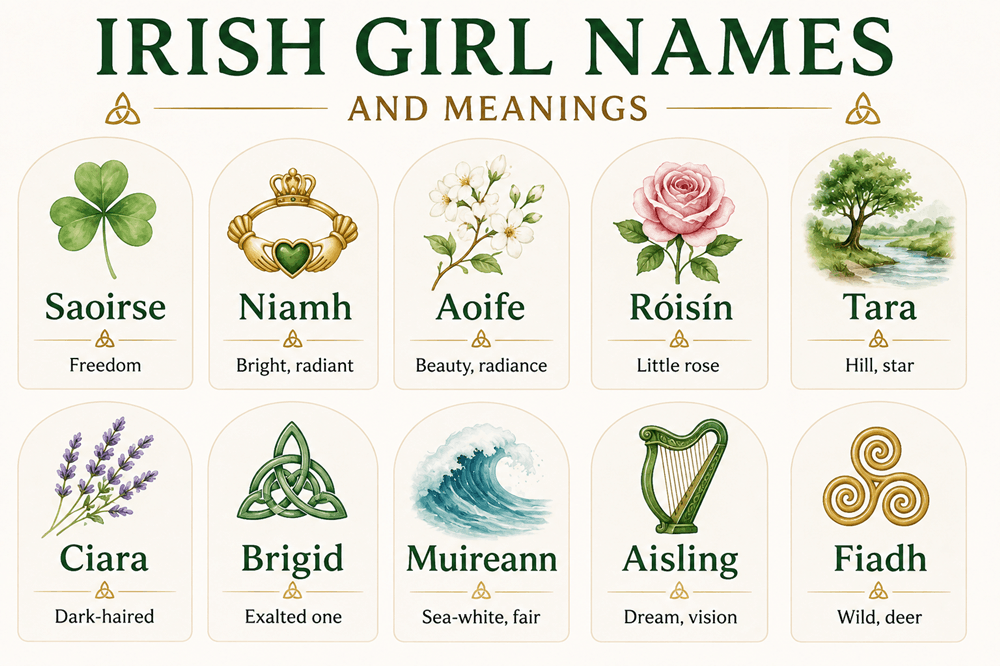
Irish girl names are known for their lyrical sounds, ancient roots, and connections to mythology, nature, saints, and Gaelic history. Names such as Saoirse can mean “freedom,” Niamh is traditionally associated with “brightness” or “radiance,” and Aoife is commonly connected with beauty.
Many traditional Irish names come from the Irish language, so their spellings may look unfamiliar if you have only seen English names. Pronunciation also does not always follow English spelling rules.
Here are 75 Irish girl names, their common meanings, and how many of them are pronounced.
1. Saoirse
Pronunciation: SEER-sha or SUR-sha
Meaning: Freedom or liberty
Saoirse comes directly from the Irish word for freedom.
Although the word itself has older roots, its use as a personal name became especially associated with modern Irish history and national identity.
It is now one of the most internationally recognizable Irish girl names.
2. Niamh
Pronunciation: NEEV
Meaning: Bright, radiant, or brilliant
Niamh is an important name in Irish mythology.
Niamh of the Golden Hair is associated with Tír na nÓg, the legendary land of eternal youth.
The name’s meaning makes it especially appealing for parents looking for something connected with light and beauty.
3. Aoife
Pronunciation: EE-fa
Meaning: Commonly associated with beauty or radiance
Aoife appears in several Irish legends and has long been one of the best-known traditional Irish female names.
Despite its complicated-looking spelling, the pronunciation is simple once you know it.
4. Siobhán
Pronunciation: shi-VAWN
Meaning: God is gracious
Siobhán is the Irish form of a name ultimately related to Joan or Johanna.
It became one of the most familiar Irish names outside Ireland during the twentieth century.
5. Caoimhe
Pronunciation: KEE-va or KWEE-va
Meaning: Gentle, beautiful, precious
Caoimhe comes from an Irish word associated with gentleness, beauty, or dearness.
The exact pronunciation varies somewhat by region.
6. Orla
Irish spelling: Órla or Órlaith
Pronunciation: OR-la
Meaning: Golden princess
The name combines elements connected with gold and a female ruler or princess.
Órlaith was used among medieval Irish royalty.
7. Maeve
Irish spelling: Méabh or Medb
Pronunciation: MAYV
Meaning: Commonly interpreted as intoxicating
Queen Medb of Connacht is one of the most famous women in Irish mythology.
She plays a central role in the epic Táin Bó Cúailnge.
Maeve is now popular well beyond Ireland.
8. Aisling
Pronunciation: ASH-ling
Meaning: Dream or vision
Aisling is the Irish word for a dream or vision.
It also refers to a type of Irish poetry in which Ireland appears symbolically as a woman.
The name combines beauty with strong literary and cultural associations.
9. Ciara
Pronunciation: KEE-ra
Meaning: Dark-haired or dark
Ciara is the feminine form of Ciarán.
The name comes from an Irish element associated with darkness, often understood as referring to dark hair or complexion.
10. Róisín
Pronunciation: ro-SHEEN
Meaning: Little rose
Róisín is a diminutive form of the Irish word for rose.
It has long been used both as a personal name and in Irish poetry and songs.
11. Brigid
Pronunciation: BRIJ-id
Meaning: Exalted one or high one
Brigid is one of the most important female names in Irish history.
It is associated both with the ancient goddess Brigid and with Saint Brigid of Kildare, one of Ireland’s patron saints.
12. Gráinne
Pronunciation: GRAWN-ya
Meaning: Traditionally associated with grain or seed
Gráinne appears throughout Irish legend.
One famous story tells of Gráinne and Diarmuid, whose forbidden romance became one of Ireland’s best-known legendary love stories.
13. Eimear
Pronunciation: EE-mer
Meaning: Swift or ready
Eimear, also written Emer, is another important mythological name.
Emer was the wife of the hero Cú Chulainn and was celebrated for intelligence, beauty, skill, and wisdom.
14. Clodagh
Pronunciation: KLO-da
Meaning: Named after the River Clodagh
Clodagh comes from the name of an Irish river.
Unlike many ancient Irish names, its use as a given name became fashionable comparatively recently.
15. Sadhbh
Pronunciation: SIVE, rhyming with “five”
Meaning: Sweet or good
Sadhbh appears in Irish mythology and legend.
Its spelling may be difficult for English speakers, but its one-syllable pronunciation makes it surprisingly simple once learned.
16. Fiadh
Pronunciation: FEE-a
Meaning: Wild, untamed, or deer
Fiadh is a modern favorite in Ireland.
Its connection with wilderness and wild animals gives it a strong nature-inspired feeling.
17. Éabha
Pronunciation: AY-va
Meaning: Life
Éabha is the Irish form of Eve.
It ultimately carries the traditional meaning associated with life or living.
18. Áine
Pronunciation: AWN-ya
Meaning: Radiance, brightness, or splendor
Áine is associated with an important figure in Irish mythology connected with summer, prosperity, love, and sovereignty.
The name remains strongly tied to light and beauty.
19. Deirdre
Pronunciation: DEER-dra
Meaning: Meaning uncertain
Deirdre is famous from the tragic Irish legend Deirdre of the Sorrows.
Because of that story, the name carries strong literary and mythological associations even though its exact original meaning is uncertain.
20. Mairéad
Pronunciation: ma-RAYD
Meaning: Pearl
Mairéad is an Irish form of Margaret.
Its traditional meaning ultimately comes from the same root associated with a pearl.
21. Maire
Irish spelling: Máire
Pronunciation: MOY-ra or MAW-ra
Meaning: Irish form of Mary
Máire is the traditional Irish-language form of Mary.
The deeper meaning of Mary itself is debated, so it is safer to understand Máire primarily through its linguistic connection to that name.
22. Sorcha
Pronunciation: SOR-ka or SUR-a
Meaning: Bright or radiant
Sorcha comes from an Irish word associated with brightness.
It should not be confused with Saoirse, even though the two names can look somewhat similar to unfamiliar readers.
23. Fionnuala
Pronunciation: fin-NOO-la
Meaning: White shoulder
Fionnuala appears prominently in the Irish legend The Children of Lir.
In the story, she is the eldest of the children transformed into swans.
24. Una
Irish spelling: Úna
Pronunciation: OO-na
Meaning: Possibly lamb
Úna is an old Irish feminine name with deep literary and historical roots.
It has the advantage of being traditional while also being simple for English speakers to pronounce.
25. Nessa
Pronunciation: NESS-a
Meaning: Meaning uncertain
Nessa appears in the Ulster Cycle of Irish mythology as the mother of King Conchobar.
The name has a modern, familiar sound despite its ancient background.
26. Tara
Pronunciation: TA-ra
Meaning: Associated with the Hill of Tara
Tara comes from one of the most important places in Irish history and mythology.
The Hill of Tara was traditionally associated with the High Kings of Ireland.
27. Shannon
Pronunciation: SHAN-un
Meaning: Associated with the River Shannon
Shannon comes from the name of Ireland’s longest river.
The river itself is connected with the mythological figure Sionann.
28. Erin
Pronunciation: EH-rin
Meaning: Ireland
Erin comes from an English poetic form of Éire, the Irish name for Ireland.
It became particularly popular as a given name outside Ireland.
29. Kerry
Pronunciation: KER-ee
Meaning: Associated with County Kerry
Kerry comes from the name of the Irish county.
Its deeper place-name origin is connected with the ancient Ciarraige people.
30. Enya
Pronunciation: EN-ya
Meaning: Modernized form of Eithne
Enya became internationally familiar through the Irish singer of the same name.
It represents an anglicized spelling of Eithne.
31. Eithne
Pronunciation: EN-ya or ET-na, depending on tradition
Meaning: Kernel or grain
Eithne is an ancient Irish name appearing in mythology and early Christian history.
Several Irish saints carried the name.
32. Bláthnaid
Pronunciation: BLAW-nid
Meaning: Little flower
Bláthnaid comes from an Irish word connected with flowers.
It is an attractive choice for someone looking specifically for an Irish nature name.
33. Bláth
Pronunciation: BLAW
Meaning: Flower or blossom
Bláth is directly associated with blossoms or flowers.
It is short, distinctly Irish, and strongly connected with nature.
34. Líadan
Pronunciation: LEE-a-dan
Meaning: Often interpreted as gray lady
Líadan appears in an old Irish love story involving the poet Cuirithir.
The name has a strongly historical and literary character.
35. Muireann
Pronunciation: MWIR-in
Meaning: Often interpreted as sea-white or fair sea
Muireann is an ancient Irish name with strong connections to traditional Gaelic naming.
Its associations with the sea make it particularly attractive as a coastal or nature-inspired name.
36. Muirgheal
Pronunciation: MWIR-yel
Meaning: Bright sea
The name combines Irish elements associated with the sea and brightness.
It is much less common than many other names on this list.
37. Neasa
Pronunciation: NYASS-a or NESS-a
Meaning: Traditionally connected with Nessa
Neasa is another spelling connected with the ancient Irish name Nessa.
It gives an old mythological name a distinctly Irish written form.
38. Bronagh
Irish spelling: Brónagh
Pronunciation: BRO-na
Meaning: Sorrowful
Brónagh comes from an Irish element associated with sorrow.
Saint Brónach is remembered in Irish religious tradition.
39. Dearbhla
Pronunciation: DER-vla
Meaning: Commonly interpreted as daughter of the poet
Dearbhla is also found in forms such as Dervla.
It has an unmistakably Irish sound while remaining relatively accessible in English.
40. Dervla
Pronunciation: DER-vla
Meaning: Variant of Dearbhla
Dervla is an anglicized spelling that preserves the traditional Irish pronunciation more transparently for English speakers.
41. Doireann
Pronunciation: DEER-en
Meaning: Meaning uncertain; traditionally Irish
Doireann appears in Irish mythology and folklore.
It remains much less common internationally than names such as Maeve or Saoirse.
42. Laoise
Pronunciation: LEE-sha
Meaning: Traditionally connected with the name Luíse or Louise
Laoise is a distinctively Irish name whose pronunciation often surprises people seeing it for the first time.
43. Sinéad
Pronunciation: shi-NAYD
Meaning: God is gracious
Sinéad is an Irish form related to Jane or Janet.
The name became internationally familiar through prominent Irish public figures and musicians.
44. Caitríona
Pronunciation: ka-TREE-na
Meaning: Irish form of Katherine
Caitríona is an Irish-language form of Katherine or Catherine.
The traditional meaning commonly associated with Katherine is “pure,” although the deeper etymology is debated.
45. Caitlín
Pronunciation: kotch-LEEN or kat-LEEN, depending on dialect
Meaning: Irish form of Katherine
Caitlín eventually gave English the spelling Kathleen.
It also influenced the modern English name Caitlin, whose pronunciation outside Ireland often differs from traditional Irish pronunciation.
46. Kathleen
Pronunciation: kath-LEEN
Meaning: Anglicized form related to Caitlín
Kathleen became one of the most recognizable Irish-associated female names in the English-speaking world.
47. Sheila
Irish form: Síle
Pronunciation: SHEE-la
Meaning: Irish form of Cecilia
Sheila developed from the Irish Síle.
It became so familiar internationally that many people no longer immediately recognize its Irish history.
48. Eileen
Irish forms: Eibhlín or Eilín
Pronunciation: eye-LEEN
Meaning: Traditionally connected with Helen or Evelyn, depending on origin
Eileen has several possible linguistic connections and has long been strongly associated with Ireland.
49. Eibhlín
Pronunciation: ev-LEEN
Meaning: Traditional Irish feminine name related to Eileen
Eibhlín demonstrates how dramatically Irish spelling can differ from English expectations.
50. Máirín
Pronunciation: maw-REEN
Meaning: Little Mary
Máirín is a diminutive form of Máire.
The ending gives the name an affectionate, smaller form similar to saying “little Mary.”
51. Nóinín
Pronunciation: NO-neen
Meaning: Daisy
Nóinín is the Irish word for daisy.
It makes an unusual nature-inspired choice with a very gentle meaning.
52. Síle
Pronunciation: SHEE-la
Meaning: Irish form of Cecilia
Síle is the original Irish form behind the familiar English-language name Sheila.
53. Treasa
Pronunciation: TRASS-a
Meaning: Strength
Treasa is commonly associated with strength.
It also functions as an Irish equivalent of Teresa in some naming traditions.
54. Meabh
Pronunciation: MAYV
Meaning: Variant spelling of Maeve
Méabh preserves a more traditional Irish spelling of the famous mythological name Maeve.
55. Ríona
Pronunciation: REE-na
Meaning: Queenly or queen
Ríona is associated with the Irish word for queen.
It has a modern sound while keeping clear Gaelic roots.
56. Ríoghnach
Pronunciation: REE-na
Meaning: Queenly
Ríoghnach is an older form connected with royalty or queenship.
It is much rarer than the simplified Ríona.
57. Síofra
Pronunciation: SHEE-fra
Meaning: Fairy or elf
Síofra comes from an Irish word associated with a fairy or supernatural being.
It is particularly appealing for anyone looking for an Irish name with a magical quality.
58. Síomha
Pronunciation: SHEE-va
Meaning: Good peace or peaceful
Síomha is a rare Irish name with associations of goodness and peace.
Its pronunciation is much simpler than its spelling may first suggest.
59. Caoilfhionn
Pronunciation: KEEL-in
Meaning: Slender and fair
This traditional Irish name combines elements associated with slenderness and fairness.
It is one of the more challenging names on the list for non-Irish readers.
60. Caoilinn
Pronunciation: KEE-lin
Meaning: Slender or fair
Caoilinn is a somewhat more accessible form related to traditional Gaelic naming elements.
61. Eilis
Irish spelling: Éilís
Pronunciation: AY-lish
Meaning: Irish form of Elizabeth
Éilís is a traditional Irish version of Elizabeth.
The familiar traditional meaning associated with Elizabeth is “God is my oath.”
62. Ailbhe
Pronunciation: AL-va
Meaning: Traditionally associated with white or bright
Ailbhe is an old Irish name that has historically been used for both men and women.
Today it is often encountered as a feminine name.
63. Alannah
Pronunciation: a-LAN-a
Meaning: Often associated with “child” or “darling”
Alannah is connected with the Irish expression a leanbh, an affectionate phrase meaning “O child” or “my child.”
Over time, it developed into a familiar given name.
64. Keelin
Pronunciation: KEE-lin
Meaning: Anglicized form of Caoilinn
Keelin makes the traditional pronunciation much more obvious to English-speaking readers.
65. Oonagh
Pronunciation: OO-na
Meaning: Variant of Úna
Oonagh is an anglicized spelling of the traditional Irish Úna.
It appears in Irish mythology and literary tradition.
66. Moya
Pronunciation: MOY-a
Meaning: Anglicized form associated with Máire
Moya is an Irish form connected with Mary.
Its spelling is easier for many English speakers than the traditional Máire.
67. Moira
Pronunciation: MOY-ra
Meaning: Anglicized form of Máire
Moira became particularly common in Scotland and Ireland.
It remains strongly associated with Celtic naming traditions.
68. Aideen
Irish spelling: Éadaoin or Étaín in related traditions
Pronunciation: ay-DEEN
Meaning: Often associated with jealousy or passion in mythological interpretation
Aideen is an anglicized form connected with old Irish names such as Étaín.
Étaín is one of the great heroines of Irish mythology.
69. Étaín
Pronunciation: AY-deen
Meaning: Meaning uncertain; ancient mythological name
Étaín is central to the tale The Wooing of Étaín.
The story involves love, transformation, jealousy, and rebirth.
70. Bebhinn
Irish spelling: Bébhinn
Pronunciation: BAY-vin
Meaning: Fair lady or melodious woman
Bébhinn appears in Irish mythology and medieval tradition.
Its name elements are associated with femininity and pleasantness.
71. Gobnait
Pronunciation: GUB-net
Meaning: Possibly connected with smithing
Saint Gobnait is an important Irish saint particularly associated with County Cork.
She is also traditionally connected with bees.
72. Lasairfhíona
Pronunciation: LAS-ar-EE-na
Meaning: Flame of wine
Lasairfhíona is a rare and striking Irish name.
Its literal meaning gives it one of the most unusual images among traditional Irish girl names.
73. Saorla
Pronunciation: SEER-la
Meaning: Noble or free princess, commonly interpreted
Saorla is a modern-feeling Irish name formed from elements associated with freedom or nobility and female rulership.
74. Fíona
Pronunciation: FEE-na
Meaning: Vine or wine-related, depending on interpretation
Fíona resembles the internationally familiar Fiona but has its own Irish-language associations.
75. Fiona
Pronunciation: fee-O-na
Meaning: Fair or white
Fiona feels thoroughly Celtic today, although its history as a given name is more literary and modern than many ancient Irish names.
It is commonly associated with the Gaelic element fionn, meaning fair, white, or bright.
What Are the Most Popular Traditional Irish Girl Names?
Some Irish names have become especially recognizable both within Ireland and internationally.
Popular or familiar choices include:
- Saoirse
- Niamh
- Aoife
- Maeve
- Caoimhe
- Ciara
- Orla
- Aisling
- Fiadh
- Róisín
These names retain a distinctly Irish identity while being familiar enough that many people outside Ireland recognize them.
What Are Some Irish Girl Names Meaning “Beautiful”?
Several Irish names are associated with beauty, brightness, or fairness.
Good examples include:
Aoife — commonly associated with beauty or radiance
Caoimhe — gentle, beautiful, precious
Niamh — bright or radiant
Sorcha — bright or radiant
Áine — radiance or splendor
Ailbhe — white or bright
Irish naming traditions frequently use brightness and fairness as symbols of beauty.
Which Irish Girl Names Mean “Princess” or “Queen”?
If you want an Irish name with a royal meaning, consider:
Órlaith — golden princess
Ríona — queen or queenly
Ríoghnach — queenly
Saorla — commonly interpreted as noble or free princess
Irish mythology is full of queens, noblewomen, and female rulers, so royal associations appear naturally in traditional names.
Which Irish Girl Names Are Connected With Nature?
Irish names have many connections to the natural world.
Examples include:
Fiadh — wild or deer
Róisín — little rose
Bláth — flower
Bláthnaid — little flower
Nóinín — daisy
Clodagh — named after a river
Shannon — associated with the River Shannon
Muireann — associated with the sea
This makes Irish names especially appealing to parents who like names inspired by flowers, animals, water, and landscapes.
Why Are Irish Names So Hard to Pronounce in English?
Irish uses different spelling and sound rules from English.
A combination of letters that looks strange to an English speaker may be completely predictable to an Irish speaker.
For example:
bh and mh can produce sounds similar to V or W.
ao can produce an EE-like sound in some names.
bh helps turn Sadhbh into something close to “Sive.”
That is why trying to pronounce an Irish name using English spelling rules often produces the wrong result.
The spelling is not random.
It belongs to another language.
Why Do Irish Names Have So Many Spellings?
Several reasons.
Traditional Irish names may have:
- An original Irish spelling
- An anglicized spelling
- Regional variations
- Older historical forms
- Modern simplified versions
For example:
Méabh → Maeve
Úna → Oonagh
Máire → Moira or Moya
Caitlín → Kathleen
The anglicized forms developed partly because English speakers struggled with Irish spelling and pronunciation.
Are Irish and Gaelic Names the Same Thing?
People often use “Irish” and “Gaelic” loosely, but the terminology can be more precise.
The Irish language is called Gaeilge in Irish.
It belongs to the Goidelic branch of Celtic languages alongside Scottish Gaelic and Manx.
So traditional Irish-language names can reasonably be described as Gaelic in a broad linguistic sense.
However, saying “Irish name” is usually clearer when you specifically mean names from Ireland.
What Are Some Easy Irish Girl Names to Pronounce?
If you want an Irish name that English speakers are unlikely to struggle with, consider:
- Maeve
- Tara
- Erin
- Kerry
- Orla
- Una
- Nessa
- Ciara
- Fiona
- Shannon
Names such as Saoirse, Caoimhe, Sadhbh, and Caoilfhionn are beautiful but may require regular pronunciation explanations outside Ireland.
What Are Some Rare Irish Girl Names?
Less common possibilities include:
- Líadan
- Síofra
- Síomha
- Lasairfhíona
- Bébhinn
- Muirgheal
- Caoilfhionn
- Ríoghnach
- Gobnait
- Saorla
These can be appealing if you want something with genuine Irish roots that is less likely to appear repeatedly in the same classroom.
The Bottom Line
Irish girl names combine beautiful sounds with centuries of language, mythology, religion, landscape, and history.
Some carry simple meanings:
Saoirse means freedom.
Aisling means dream or vision.
Róisín means little rose.
Nóinín means daisy.
Others are inseparable from legendary women such as Maeve, Niamh, Aoife, Gráinne, Étaín, and Deirdre.
The most important thing to remember is that Irish spelling follows Irish rules rather than English ones.
A name like Caoimhe may look difficult until you learn that it is pronounced roughly “KEE-va.”
Sadhbh looks mysterious until someone tells you it sounds like “Sive.”
Once those patterns become familiar, Irish names stop looking complicated and start revealing the language and history behind them.
That is part of what makes them so distinctive: the name is not only beautiful—it often carries a piece of Ireland with it.