Taíno Symbols and Meanings: 20 Ancient Caribbean Motifs and What They Represent
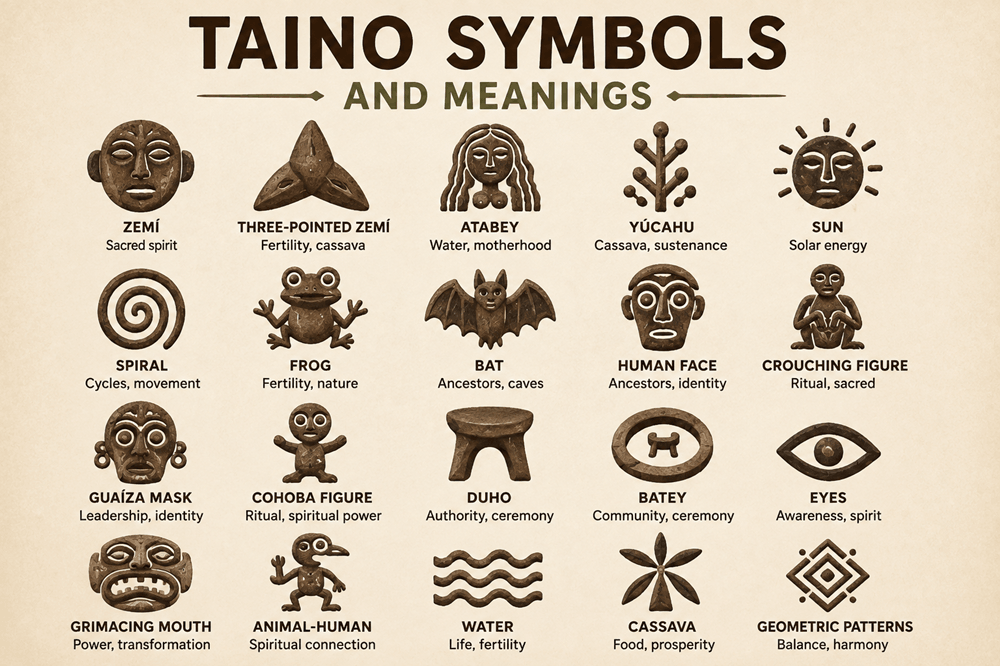
Taíno symbols are closely connected with ancestors, spirituality, nature, fertility, agriculture, leadership, ceremony, and the Caribbean landscape. Many survive today as petroglyphs carved into stone, while others appear on pottery, pendants, ceremonial stools, masks, and sacred objects.
One important thing to remember is that Taíno symbols were not a simple alphabet in which every image had one fixed translation. Some meanings are well supported by archaeology and historical accounts, while others remain uncertain. Understanding Taíno symbolism therefore means looking at the broader culture, mythology, religion, landscape, and ceremonial practices surrounding the images.
Taíno Symbols and Meanings at a Glance
| Symbol or Motif | Common Meaning or Association |
|---|---|
| Zemí | Deities, ancestors, sacred spiritual power |
| Three-pointed zemí | Cassava, fertility, agriculture, sacred power |
| Atabey | Fresh water, motherhood, fertility |
| Yúcahu | Cassava, agriculture, nourishment |
| Sun-like designs | Solar or celestial symbolism |
| Spirals | Meaning uncertain; possibly movement, cycles, or nature |
| Frog-like figures | Nature, fertility, spiritual imagery |
| Bat imagery | Caves, ancestors, the spirit world |
| Human faces | Ancestors, zemís, spirits, identity |
| Crouching figures | Ritual, transformation, sacred beings |
| Guaíza masks | Leadership, identity, sacred authority |
| Cohoba figures | Ritual communication with spiritual forces |
| Duho | Leadership and ceremonial authority |
| Batey imagery | Community, ceremony, games, political life |
| Large eyes | Supernatural awareness and sacred imagery |
| Grimacing mouths | Ritual power and altered spiritual states |
| Animal-human figures | Spiritual identity and interconnected beings |
| Water imagery | Life, fertility, sacred landscape |
| Cassava imagery | Food, prosperity, agricultural survival |
| Geometric designs | Decorative, ceremonial, or symbolic meaning |
1. Zemí — Sacred Spiritual Power
The most important concept for understanding Taíno symbolism is probably the zemí, sometimes written as cemí.
A zemí was not simply a statue or decorative symbol. It represented sacred spiritual power associated with deities, ancestors, forces of nature, and particular places.
Zemís could be represented in:
- Stone
- Wood
- Clay
- Shell
- Bone
- Other natural materials
Some zemí objects had human faces. Others looked like animals or combined human and animal features.
The object itself was important, but the deeper meaning was the sacred presence connected with it.
2. Three-Pointed Zemí — Cassava, Fertility, and Agriculture
One of the most recognizable Taíno sacred objects is the three-pointed stone.
These triangular forms often have a raised center and may include carved faces or animal features.
They are strongly associated with cassava, fertility, agriculture, and prosperity.
Cassava was one of the most important foods in Taíno life. It could be processed into bread and stored, making it essential for feeding communities.
The pointed shape has also been compared with mountains and the landscape of the Caribbean islands.
That creates a powerful connection between food, land, fertility, and spiritual life.
3. Atabey — Water, Motherhood, and Fertility
Atabey was an important female deity associated with fresh water, childbirth, fertility, and motherhood.
Fresh water was essential for drinking, farming, and community survival, so it naturally carried spiritual importance.
Modern images sometimes identify a specific carved face as the “Atabey symbol.”
That should be treated carefully.
It is more accurate to think of Atabey imagery as part of a wider tradition involving female spiritual power, fertility, water, and creation.
4. Yúcahu — Cassava and Sustenance
Yúcahu was closely associated with cassava and agricultural abundance.
His symbolism centers on:
- Food
- Farming
- Nourishment
- Prosperity
- Survival
For the Taíno, agriculture was not separate from spirituality.
The ability of the land to produce food was essential to the survival of families and entire communities.
Yúcahu therefore represents both sacred power and something deeply practical: nourishment.
5. The Taíno Sun Symbol
Sun-like Taíno designs are among the most popular symbols reproduced today.
They often appear as circular petroglyphs or faces surrounded by lines.
The sun naturally fits themes such as:
- Light
- Warmth
- Agriculture
- Time
- Seasons
- Life
However, not every circular Taíno carving can automatically be identified as a sun symbol.
Some modern interpretations are much more confident than the surviving historical evidence allows.
The safest approach is to recognize that celestial and solar imagery was important without assuming every similar petroglyph had exactly the same meaning.
6. Spiral Symbols
Spirals are common in ancient rock art across many cultures, including the Caribbean.
Modern Taíno-inspired charts sometimes say spirals represent:
- Eternity
- Life cycles
- The sun
- Water
- Spiritual journeys
Those interpretations can be meaningful, but the exact historical meaning of individual Taíno spirals is not always known.
A spiral may have represented movement, natural cycles, water, celestial forces, or something understood through stories that were never written down.
It is best viewed as an important geometric motif rather than a symbol with one guaranteed translation.
7. Frog and Coquí-Like Symbols
Frog-like figures appear in Indigenous Caribbean imagery and are especially popular today in Puerto Rican Taíno-inspired art.
The coquí, a small frog strongly associated with Puerto Rico, has become a major cultural symbol.
Frog imagery can suggest connections with:
- Rain
- Water
- Fertility
- Nature
- Transformation
Still, it is difficult to prove that every ancient frog-like petroglyph had one specific meaning.
Some may have represented particular spiritual beings, stories, or animals important to a community.
8. Bat Symbols
Bats appear in Taíno-related sacred objects and imagery.
The animal’s natural behavior makes its symbolism especially interesting.
Bats live in caves and emerge at night, placing them between different worlds:
Underground and sky.
Darkness and movement.
Hidden spaces and open air.
Because caves were spiritually important in Taíno culture, bats are often associated today with ancestors, death, caves, and the spirit world.
These interpretations are plausible, although the meaning of each specific image may vary.
9. Human Faces
Human or humanlike faces are among the most common features in surviving Taíno art.
They appear on:
- Petroglyphs
- Zemís
- Pendants
- Vessels
- Masks
- Ceremonial objects
These faces may represent ancestors, deities, zemís, supernatural beings, or important identities.
They should not always be interpreted as realistic portraits.
The exaggerated eyes, mouths, and expressions often suggest spiritual rather than ordinary human identity.
10. Large Eyes
Large or unusual eyes are common in Taíno sacred figures.
The eyes can make a carving look intense, alert, or supernatural.
In some ritual objects, exaggerated eyes may be connected with altered spiritual states or ceremonial experiences.
Symbolically, they can suggest awareness, spiritual perception, or supernatural presence.
But there is no universal rule saying every enlarged eye means exactly the same thing.
11. Grimacing Mouths and Bared Teeth
Some Taíno sacred figures have exaggerated mouths, visible teeth, and strained facial expressions.
To modern viewers, these faces can look frightening.
That does not necessarily mean they represented evil.
The expressions may relate to:
- Ritual intensity
- Fasting
- Transformation
- Spiritual power
- Altered states
Understanding these images requires resisting the temptation to judge them through modern horror imagery.
12. Crouching Figures
Crouching humanlike figures appear frequently in Taíno sacred art.
They are often shown with bent knees and compact bodies.
This posture may have had ritual or spiritual significance.
Some figures appear connected with zemís, ceremonial practices, and altered states of consciousness.
The crouching position may therefore represent sacred identity rather than an ordinary person simply sitting down.
13. Cohoba Figures
Cohoba ceremonies were an important part of Taíno religious life.
During these rituals, spiritual specialists used a psychoactive preparation as part of ceremonies intended to communicate with sacred beings or receive spiritual knowledge.
Some surviving Taíno objects were specifically connected with this practice.
Their designs often include:
- Thin bodies
- Large eyes
- Intense facial expressions
- Crouching positions
Cohoba-related imagery can therefore represent communication between the human and spiritual worlds.
14. Guaíza Masks
Guaízas were small face masks or face-shaped ornaments associated with ceremony and leadership.
They could express:
- Identity
- Political power
- Spiritual authority
- Leadership
- Ancestral relationships
These were not simply decorative masks.
They could communicate important information about the person wearing or possessing them.
15. Duho — Ceremonial Authority
A duho was a carved ceremonial stool or seat used by important members of Taíno society.
Many surviving duhos include human or animal-like imagery.
They are strongly associated with:
- Leadership
- Ceremony
- Authority
- Ritual gatherings
A duho was therefore much more than furniture.
Its design, ownership, and use could reinforce a leader’s political and spiritual position.
16. Batey Symbols
A batey was a ceremonial plaza and ball court used for community activities.
These spaces could host:
- Ball games
- Dances
- Music
- Ceremonies
- Storytelling
- Political gatherings
Petroglyphs carved around these spaces should be interpreted in relationship to community life.
A symbol beside a ceremonial court may have had a very different significance from the same shape carved elsewhere.
Location was part of meaning.
17. Animal-Human Figures
Some Taíno artworks combine human and animal characteristics.
These hybrid figures reflect a worldview in which humans, animals, ancestors, spiritual beings, and natural forces could be deeply connected.
Modern viewers sometimes describe these figures as monsters.
That can be misleading.
The blending of animal and human forms may have represented sacred transformation, spiritual identity, or relationships between different kinds of beings.
18. Water Imagery
Water had enormous importance in Taíno life.
Communities depended on:
- Rivers
- Rain
- Springs
- Coastal waters
- The sea
Water was necessary for drinking, agriculture, travel, and food.
It also held spiritual importance through figures such as Atabey and through sacred places such as caves, rivers, and pools.
Water-related imagery can therefore represent fertility, life, renewal, landscape, and sacred power.
19. Cassava Symbols
Cassava was one of the foundations of Taíno agriculture.
It could be processed into bread and stored, making it especially valuable.
That is why agricultural symbols often carry deeper meanings than simple food.
Cassava could represent:
- Survival
- Prosperity
- Fertility
- Community stability
- The generosity of the land
The three-pointed zemí is particularly important when discussing the relationship between spirituality and cassava cultivation.
20. Geometric Patterns
Taíno art includes many geometric patterns made from:
- Circles
- Lines
- Curves
- Spirals
- Repeated shapes
- Symmetrical forms
These patterns appear on pottery, rock art, and ceremonial objects.
Some may have been decorative.
Others likely carried spiritual, social, or cultural meaning.
Modern lists sometimes try to assign a precise definition to every geometric pattern, but the historical evidence does not always support that level of certainty.
Are Taíno Symbols a Written Language?
Taíno symbols were not a writing system in the same sense as an alphabet.
There is no evidence that every petroglyph represented a specific spoken word or sound.
Instead, visual symbols likely worked alongside:
- Oral stories
- Mythology
- Ceremony
- Music
- Dance
- Community memory
A carved face may have referred to an ancestor, deity, event, story, or sacred place that members of the community already understood.
The image alone was only part of the meaning.
Do We Know the Exact Meaning of Every Taíno Petroglyph?
No.
This is one of the most important facts to remember when researching Taíno symbolism.
Some meanings can be reconstructed with reasonable confidence because they are supported by archaeology, historical descriptions, repeated artistic patterns, and cultural traditions.
Others remain uncertain.
Many popular online charts present symbols as though they function like modern emojis:
One image equals one exact meaning.
Taíno visual culture was probably far more complicated.
The meaning of a carving could depend on:
- Its location
- The ceremony associated with it
- The object it appeared on
- The person using it
- The mythology known by the community
Why Were Caves Important in Taíno Symbolism?
Caves held special importance in Taíno mythology and spiritual life.
They were associated with origins, ancestors, sacred beings, water, and hidden spiritual spaces.
Many petroglyphs have been found inside caves or near cave entrances and pools.
This shows why context matters so much.
A symbol carved deep inside a sacred cave may have had a meaning connected with ritual or mythology that would never be obvious from its shape alone.
Why Are Taíno Symbols Popular in Tattoos?
Taíno-inspired tattoos are popular throughout the Caribbean diaspora, especially among people with connections to Puerto Rico and Hispaniola.
They may represent:
- Caribbean heritage
- Ancestry
- Cultural pride
- Respect for Indigenous history
- Connection with the land
- Spiritual identity
Popular tattoo motifs include:
- Sun-like faces
- Coquí figures
- Spirals
- Zemí faces
- Three-pointed forms
- Frog imagery
If you are choosing a Taíno-inspired tattoo, it is worth researching the particular design carefully.
Some symbols reproduced online are modern interpretations rather than confirmed ancient motifs.
Are Taíno Symbols Only From Puerto Rico?
No.
The Taíno and related Indigenous Caribbean peoples lived across a broad region that included parts of what are now:
- Puerto Rico
- Hispaniola
- Cuba
- Jamaica
- The Virgin Islands
- Other Caribbean islands
Puerto Rico contains several especially famous archaeological sites, which helps explain why Taíno symbols are so visible in Puerto Rican cultural identity today.
But the tradition belongs to a much wider Caribbean history.
What Is the Most Important Taíno Symbol?
If one concept had to be chosen, the zemí is probably more important than any single modern petroglyph symbol.
The zemí connects many central parts of Taíno culture:
- Ancestors
- Deities
- Nature
- Agriculture
- Leadership
- Healing
- Ceremony
- Community identity
Most importantly, the zemí was not merely an image.
It represented sacred presence and spiritual power.
The Bottom Line
Taíno symbols are best understood as part of a complex cultural and spiritual tradition rather than a simple collection of pictures with fixed dictionary definitions.
Zemís represented sacred power connected with ancestors, deities, nature, and community life.
Three-pointed stones were associated with cassava, fertility, agriculture, and possibly the Caribbean landscape itself.
Atabey represented fresh water, motherhood, and fertility, while Yúcahu was closely connected with cassava and nourishment.
Human faces, frogs, bats, spirals, geometric patterns, crouching figures, ceremonial masks, and animal-human forms all belonged to a visual culture shaped by mythology, ritual, landscape, and community memory.
The most important thing to remember is that not every Taíno symbol has an exact meaning that survives today.
Some interpretations are strongly supported.
Others are modern attempts to understand images created centuries ago inside an oral culture.
That uncertainty does not make Taíno symbolism less powerful.
It makes the surviving carvings and objects even more important because they preserve fragments of a worldview in which people, ancestors, animals, land, water, food, leadership, and spiritual forces were deeply connected.