Mood Necklace Color Meanings: What Each Color Is Supposed to Reveal
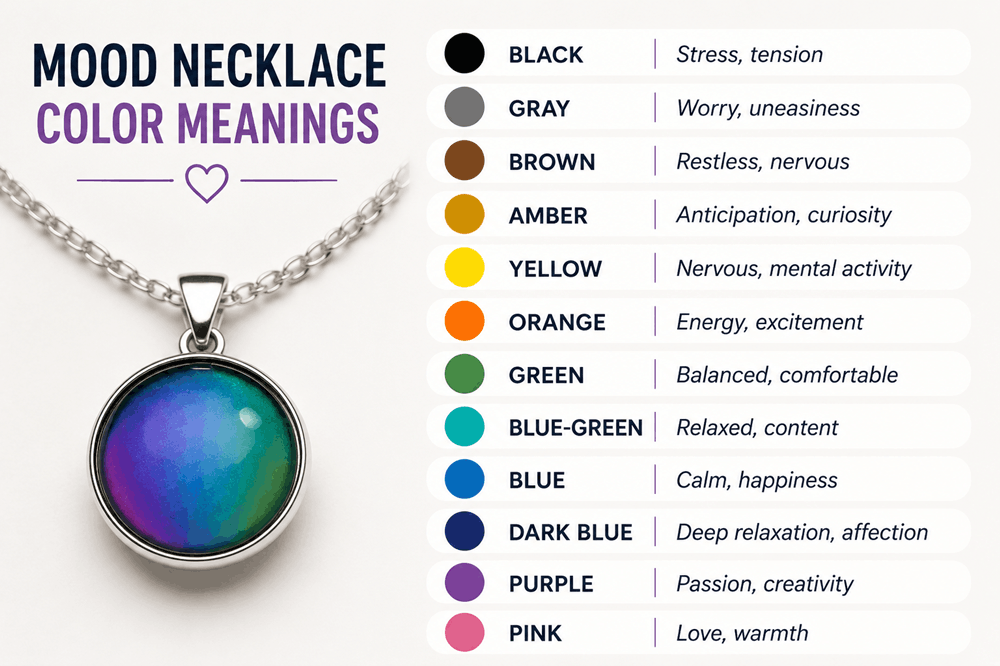
Mood necklace colors are traditionally said to reflect different emotions, but the jewelry is actually reacting to temperature changes, not directly reading your feelings. Blue and green are commonly linked with calmness and balance, purple with excitement or passion, yellow and orange with nervous or energetic feelings, and black with stress or a colder temperature.
Because body temperature can change with stress, relaxation, activity, weather, and circulation, mood jewelry can sometimes seem surprisingly accurate. Still, the color chart is mainly for fun rather than a scientific measurement of emotion.
Mood Necklace Colors and Meanings at a Glance
| Color | Common Meaning |
|---|---|
| Black | Stress, tension, anxiety, or cold temperature |
| Gray | Uneasiness, uncertainty, or worry |
| Brown | Restlessness, nervousness, or mixed feelings |
| Amber | Anticipation, unsettled feelings, or curiosity |
| Yellow | Mental activity, nervousness, or excitement |
| Orange | Energy, enthusiasm, stimulation, or impatience |
| Green | Balance, comfort, calmness, or neutrality |
| Blue-Green | Relaxation, contentment, and emotional ease |
| Blue | Calmness, happiness, trust, and relaxation |
| Dark Blue | Deep relaxation, affection, and confidence |
| Purple | Passion, excitement, creativity, or romance |
| Pink | Affection, love, warmth, or playful excitement |
What Does Black Mean on a Mood Necklace?
Black is usually associated with stress, anxiety, tension, or emotional discomfort.
However, black is also commonly what a mood necklace looks like when it is cold.
If the necklace has not been touching your skin, has been left in a cold room, or is exposed to cool outdoor temperatures, the color-changing material may simply darken.
So black does not automatically mean you are upset.
It may only mean the necklace itself is cold.
What Does Gray Mean on a Mood Necklace?
Gray is often interpreted as worry, uncertainty, emotional distance, or uneasiness.
It usually appears toward the cooler end of a mood necklace color chart.
Traditionally, gray suggests that you may not feel completely comfortable or relaxed.
In reality, your skin temperature could simply be slightly cooler than normal.
What Does Brown Mean?
Brown is commonly connected with restlessness, nervousness, uncertainty, or mixed emotions.
Someone might interpret a brown necklace as a sign that they feel distracted or unsettled.
Because brown usually appears at a cooler temperature, it can also be caused by cold weather or poor contact between the jewelry and your skin.
What Does Amber Mean?
Amber usually represents anticipation, curiosity, nervous energy, or emotional uncertainty.
It can fit moments when you feel both excited and slightly nervous.
For example, you might see amber before:
- A first date
- An interview
- A performance
- An important conversation
- A trip or event you have been waiting for
The traditional interpretation is that your emotional state is active but not fully relaxed.
What Does Yellow Mean on a Mood Necklace?
Yellow is commonly linked with mental activity, curiosity, nervousness, excitement, and anticipation.
It may be described as the color of a busy mind.
You could be concentrating, thinking quickly, or waiting for something important to happen.
Yellow does not necessarily mean something negative.
Nervous excitement before a good experience can produce the same general interpretation.
What Does Orange Mean?
Orange often represents energy, enthusiasm, stimulation, excitement, or impatience.
It is usually interpreted as a more active emotional state than green or blue.
You might see orange on traditional mood charts during moments of:
- Excitement
- Competition
- Social activity
- Anticipation
- High energy
If the feeling is uncomfortable rather than enjoyable, orange may also be interpreted as agitation.
What Does Green Mean on a Mood Necklace?
Green is one of the most common mood necklace colors and usually means balance, comfort, calmness, or a neutral emotional state.
Many mood jewelry charts treat green as the normal resting color.
It does not necessarily mean you are incredibly happy.
It simply suggests that things feel steady.
You may be comfortable, focused, and emotionally balanced.
What Does Blue-Green Mean?
Blue-green usually represents relaxation, contentment, comfort, and emotional ease.
It sits between ordinary green and deeper blue, so traditional charts often interpret it as someone becoming increasingly relaxed.
This might happen while:
- Relaxing at home
- Talking with someone you trust
- Listening to music
- Reading
- Doing something familiar and enjoyable
What Does Blue Mean on a Mood Necklace?
Blue is traditionally one of the most positive mood necklace colors.
It usually represents calmness, happiness, trust, relaxation, and emotional comfort.
A blue necklace is often interpreted as a sign that you feel peaceful and secure.
This interpretation is partly why blue became one of the most recognizable “happy” colors in mood jewelry.
What Does Dark Blue Mean?
Dark blue is commonly associated with deep relaxation, confidence, affection, happiness, and emotional warmth.
Some mood charts describe it as the color of someone who feels completely at ease.
Others associate it with love or strong positive emotion.
If a mood necklace becomes dark blue while you are spending time with someone you care about, it is easy to understand why people connect the shade with affection.
What Does Purple Mean on a Mood Necklace?
Purple usually represents passion, excitement, romance, creativity, inspiration, or strong emotion.
It tends to appear toward the warmer end of the mood jewelry spectrum.
Traditional charts therefore associate it with intense feelings.
Those feelings do not have to be romantic.
Purple could also represent being inspired, excited about an idea, or deeply engaged in an activity.
What Does Pink Mean?
Not every mood necklace produces a clear pink shade, but when it does, pink is usually associated with love, affection, warmth, playfulness, and romantic excitement.
Pink already has strong cultural associations with romance and tenderness, so its mood jewelry meaning follows naturally.
Modern mood jewelry may produce brighter pink or magenta shades than older versions.
How Does a Mood Necklace Actually Work?
Mood necklaces usually contain thermochromic liquid crystals or another temperature-sensitive material.
These materials change their structure slightly as the temperature changes.
That affects which wavelengths of light they reflect.
Your eyes see those changes as different colors.
The necklace may react to:
- Your skin temperature
- Room temperature
- Outdoor weather
- Exercise
- Blood circulation
- Stress
- Relaxation
- Holding hot or cold objects
So the necklace measures temperature, not emotion.
Can a Mood Necklace Really Tell Your Mood?
Not reliably.
There can be a loose connection between emotions and skin temperature because your nervous system can affect circulation.
Stress, for example, can sometimes make hands and skin cooler because blood vessels constrict.
Relaxation may increase warmth in certain areas.
But emotions are only one factor.
You could be extremely happy outside on a freezing day and still see a dark color.
You could also be stressed while sitting somewhere warm and get a blue or purple reading.
Mood necklaces are best treated as novelty jewelry rather than emotional detectors.
Why Does My Mood Necklace Keep Changing Colors?
Your body temperature changes constantly throughout the day.
Even small differences can shift the liquid crystals into another color range.
Your necklace might change after:
- Going outside
- Exercising
- Taking a hot shower
- Entering an air-conditioned room
- Drinking something hot
- Feeling nervous
- Warming up after being cold
Frequent changes usually mean the necklace is responding normally.
Why Is My Mood Necklace Always Black?
If a mood necklace stays black, possible explanations include:
- The necklace is too cold
- It is not making enough contact with your skin
- The temperature-sensitive material has been damaged
- The necklace is old
- Water or heat damaged the crystals
Try wearing it close to your skin for several minutes.
If it never changes even after warming, it may no longer be functioning correctly.
Why Is My Mood Necklace Always Blue?
If your necklace stays blue most of the time, your body temperature may simply remain within the range that produces blue.
The traditional interpretation would be that you are calm and relaxed.
But natural circulation and room temperature probably explain much of the consistency.
Different necklaces are also calibrated differently.
One necklace may appear blue at a temperature that produces green on another.
Do Mood Necklaces and Mood Rings Have the Same Meanings?
Usually, yes.
Mood necklaces, mood rings, mood bracelets, and similar jewelry generally use the same basic temperature-sensitive technology.
The traditional charts therefore tend to use similar meanings:
- Black = stress
- Yellow = nervous energy
- Green = balance
- Blue = relaxation
- Purple = strong positive emotion
However, the necklace may react slightly differently because it sits on a different part of the body.
A ring is constantly touching your finger.
A necklace may rest against clothing or move away from your skin.
That can make its colors less consistent.
Why Can a Mood Necklace Show Several Colors at Once?
Temperature may not be identical across the entire pendant.
One section may be warmer because it is touching your skin while another section remains cooler.
That can create:
- Color gradients
- Blue-green combinations
- Purple edges
- Yellow or amber patches
This is normal.
You can usually interpret the dominant color if you want to use a mood chart.
Do All Mood Necklaces Use the Same Color Chart?
No.
You may find one chart saying purple means passionate while another says it means happy.
One may describe yellow as nervous.
Another may call it imaginative.
The exact meanings are part of the novelty tradition rather than scientifically defined categories.
The broad pattern is generally similar:
Darker colors = cooler or more stressed.
Green = balanced.
Blue = relaxed.
Purple = warmer and emotionally energized.
Where Did Mood Jewelry Come From?
Mood jewelry became especially popular during the 1970s.
The idea was simple and irresistible:
Wear jewelry that changes colors and supposedly reveals how you feel.
The technology behind the color change was real.
The emotional interpretations were much more playful.
Mood rings became the most famous version, but the same idea eventually appeared in:
- Necklaces
- Bracelets
- Earrings
- Pendants
- Keychains
The combination of changing colors and personality-style meanings helped mood jewelry remain popular long after the original trend.
Can Water Damage a Mood Necklace?
Yes.
Many inexpensive mood necklaces can be damaged by water.
Moisture may seep into the pendant and interfere with the temperature-sensitive material.
To help your necklace last longer, remove it before:
- Swimming
- Showering
- Bathing
- Using strong cleaning products
- Exposing it to very hot water
Extreme heat can also permanently damage some mood jewelry.
What Is the Best Mood Necklace Color?
There is no objectively best color.
If you are following traditional meanings, blue and purple are often viewed as especially positive.
Blue represents relaxation and happiness.
Purple suggests passion, creativity, and excitement.
Green is also positive because it represents emotional balance.
But the real fun comes from watching the colors change rather than trying to keep the necklace on one “good” shade.
Should You Trust a Mood Necklace More Than How You Actually Feel?
No.
If your necklace is black but you feel completely calm, trust your own experience.
If it turns purple while you feel nervous, the necklace has not discovered a secret emotion you were unaware of.
It is simply responding to temperature.
The meaning chart is best treated as a playful interpretation.
The Bottom Line
Mood necklace colors traditionally represent different emotions, with black linked to stress, yellow to nervous energy, green to balance, blue to relaxation, and purple to excitement or passion.
But the necklace does not actually read your emotional state.
Its temperature-sensitive material changes color as your skin and surrounding environment become warmer or cooler.
Because emotions sometimes influence circulation and body temperature, the necklace may occasionally seem remarkably accurate.
Other times, the color simply reflects the weather or how warm your skin happens to be.
That is part of what makes mood necklaces fun.
The science creates the changing colors.
The mood chart gives those colors a story.