Japanese Last Names and Meanings: 75 Common Surnames and What They Mean
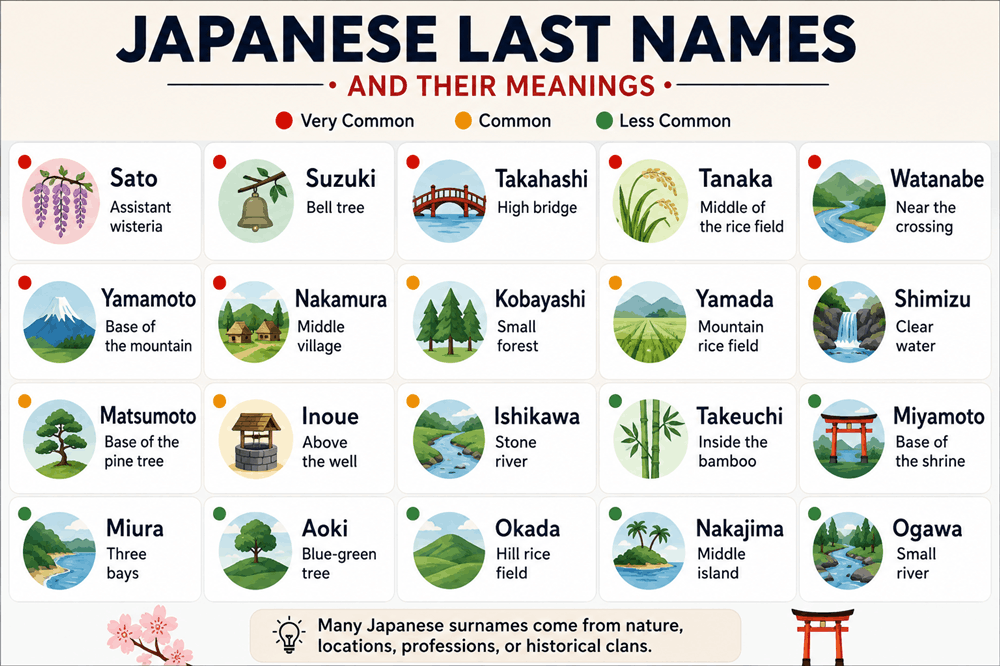
Japanese last names often come from nature, geography, occupations, and places where families once lived. Names such as Yamamoto can suggest “base of the mountain,” Tanaka can mean “middle of the rice field,” and Kobayashi can be read as “small forest.” Because Japanese surnames are written with kanji, however, their meanings can vary depending on the characters used and the history of a particular family.
Here are 75 Japanese last names, their common meanings, and what makes them distinctive.
1. Sato (佐藤)
Common meaning: “Assistant wisteria” or “helping Fujiwara.”
Sato is one of the most common surnames in Japan. The second character, 藤, means “wisteria” and is historically associated with the powerful Fujiwara clan.
2. Suzuki (鈴木)
Common meaning: “Bell tree.”
鈴 means “bell,” while 木 means “tree” or “wood.” Suzuki is especially common in eastern and central Japan.
3. Takahashi (高橋)
Common meaning: “High bridge” or “tall bridge.”
高 means “high,” and 橋 means “bridge.” The name likely developed from places near prominent bridges or elevated crossings.
4. Tanaka (田中)
Common meaning: “Middle of the rice field.”
田 means “rice field,” and 中 means “middle” or “inside.” It is a classic example of a Japanese surname connected with agricultural geography.
5. Watanabe (渡辺 / 渡邊)
Common meaning: “Crossing boundary” or “near the crossing.”
The name is historically associated with places near river crossings and other travel points.
6. Ito (伊藤)
Common meaning: Historically connected with the Fujiwara clan.
Like Sato, Ito contains 藤, the kanji for wisteria. Its origin is more historical than a straightforward literal phrase.
7. Yamamoto (山本)
Common meaning: “Base of the mountain.”
山 means “mountain,” while 本 can mean “origin” or “base.” A family with this surname may historically have lived near the foot of a mountain.
8. Nakamura (中村)
Common meaning: “Middle village.”
中 means “middle,” and 村 means “village.” The name likely identified families living in or originating from the central part of a settlement.
9. Kobayashi (小林)
Common meaning: “Small forest.”
小 means “small,” while 林 means “woods” or “grove.”
10. Kato (加藤)
Common meaning: Historically associated with a branch of the Fujiwara family.
The name contains the familiar 藤, or “wisteria,” found in several major Japanese surnames.
11. Yoshida (吉田)
Common meaning: “Lucky rice field” or “fortunate field.”
吉 means “good fortune” or “luck,” while 田 means “rice field.”
12. Yamada (山田)
Common meaning: “Mountain rice field.”
The combination of 山, “mountain,” and 田, “rice field,” reflects Japan’s strong tradition of surnames based on landscape.
13. Sasaki (佐々木)
Common meaning: The literal interpretation is complicated, but 木 means “tree.”
Sasaki is an old surname with historical clan connections, so its meaning cannot be reduced neatly to the modern meanings of its individual kanji.
14. Yamaguchi (山口)
Common meaning: “Mountain entrance.”
山 means “mountain,” while 口 can mean “mouth,” “opening,” or “entrance.”
15. Matsumoto (松本)
Common meaning: “Base of the pine tree.”
松 means “pine,” a tree traditionally associated with longevity and endurance in Japanese culture.
16. Inoue (井上)
Common meaning: “Above the well.”
井 means “well,” while 上 means “above” or “upper.”
17. Kimura (木村)
Common meaning: “Tree village.”
木 means “tree” or “wood,” and 村 means “village.”
18. Hayashi (林)
Common meaning: “Woods” or “grove.”
The single character 林 depicts two trees together and commonly means a small forest or grove.
19. Shimizu (清水)
Common meaning: “Clear water” or “pure water.”
清 means “clear” or “pure,” while 水 means “water.” It is one of the more poetic-sounding Japanese surnames.
20. Saito (斎藤 / 齋藤)
Common meaning: Traditionally connected with a Fujiwara family branch.
Saito has several common kanji spellings, which is a useful reminder that the same spoken surname can be written in different ways.
21. Yamazaki (山崎)
Common meaning: “Mountain cape” or “mountain promontory.”
山 means “mountain,” while 崎 refers to a cape, point, or projecting landform.
22. Mori (森)
Common meaning: “Forest.”
森 consists of three tree characters and represents a dense forest.
23. Abe (阿部 / 安部)
Common meaning: Varies depending on the kanji.
Abe is an old surname with several written forms, so there is no single literal meaning shared by every Abe family.
24. Ikeda (池田)
Common meaning: “Pond rice field.”
池 means “pond,” while 田 means “rice field.”
25. Hashimoto (橋本)
Common meaning: “Base of the bridge.”
橋 means “bridge,” and 本 means “base” or “origin.”
26. Ishikawa (石川)
Common meaning: “Stone river.”
石 means “stone,” while 川 means “river.”
27. Yamashita (山下)
Common meaning: “Below the mountain.”
山 means “mountain,” and 下 means “below” or “under.”
28. Nakajima (中島)
Common meaning: “Middle island.”
中 means “middle,” while 島 means “island.”
29. Ishii (石井)
Common meaning: “Stone well.”
石 means “stone,” and 井 means “well.”
30. Maeda (前田)
Common meaning: “Front rice field.”
前 means “front” or “before,” and 田 means “rice field.”
31. Fujita (藤田)
Common meaning: “Wisteria field.”
藤 means “wisteria,” and 田 means “rice field.”
32. Ogawa (小川)
Common meaning: “Small river” or “stream.”
小 means “small,” while 川 means “river.”
33. Goto (後藤)
Common meaning: Historically linked with a Fujiwara branch.
The 藤 character again connects the surname with the historical Fujiwara naming tradition.
34. Okada (岡田)
Common meaning: “Hill rice field.”
岡 means “hill” or “ridge,” and 田 means “rice field.”
35. Hasegawa (長谷川)
Common meaning: Often interpreted as “long valley river.”
長 means “long,” 谷 means “valley,” and 川 means “river.”
36. Murakami (村上)
Common meaning: “Upper village” or “above the village.”
村 means “village,” and 上 means “above” or “upper.”
37. Kondo (近藤)
Common meaning: Historically associated with another Fujiwara lineage.
近 means “near,” while 藤 means “wisteria.”
38. Ishida (石田)
Common meaning: “Stone rice field.”
石 means “stone,” and 田 means “rice field.”
39. Sakamoto (坂本)
Common meaning: “Base of the slope.”
坂 means “slope” or “hill,” while 本 means “base” or “origin.”
40. Endo (遠藤)
Common meaning: Historically associated with the Fujiwara clan.
遠 means “far” or “distant,” while 藤 means “wisteria.”
41. Aoki (青木)
Common meaning: “Blue-green tree.”
青 can describe blue or green shades, while 木 means “tree.”
42. Fujii (藤井)
Common meaning: “Wisteria well.”
藤 means “wisteria,” and 井 means “well.”
43. Nishimura (西村)
Common meaning: “Western village.”
西 means “west,” and 村 means “village.”
44. Fukuda (福田)
Common meaning: “Blessed rice field” or “fortunate field.”
福 means “fortune,” “blessing,” or “good luck.”
45. Ota (太田 / 大田)
Common meaning: Often “large rice field,” depending on the kanji.
The surname can be written in multiple forms, and that changes the literal interpretation.
46. Miura (三浦)
Common meaning: “Three bays” or “three inlets.”
三 means “three,” while 浦 means “bay,” “coast,” or “inlet.”
47. Fujiwara (藤原)
Common meaning: “Wisteria plain.”
藤 means “wisteria,” and 原 means “plain” or “field.”
Fujiwara is also one of the most historically important surnames in Japan.
48. Okamoto (岡本)
Common meaning: “Base of the hill.”
岡 means “hill,” while 本 means “base” or “origin.”
49. Matsuda (松田)
Common meaning: “Pine rice field.”
松 means “pine,” and 田 means “rice field.”
50. Nakagawa (中川)
Common meaning: “Middle river.”
中 means “middle,” and 川 means “river.”
51. Nakano (中野)
Common meaning: “Middle field” or “central plain.”
野 can mean “field” or “plain.”
52. Harada (原田)
Common meaning: “Plain rice field.”
原 means “plain,” and 田 means “rice field.”
53. Ono (小野)
Common meaning: “Small field.”
小 means “small,” and 野 means “field” or “plain.”
54. Tamura (田村)
Common meaning: “Rice-field village.”
田 means “rice field,” and 村 means “village.”
55. Takeuchi (竹内)
Common meaning: “Inside the bamboo.”
竹 means “bamboo,” while 内 means “inside.”
56. Kaneko (金子)
Common meaning: “Golden child” or “child of gold,” literally.
金 means “gold” or “metal,” and 子 means “child.” As with many surnames, the historical origin may be more important than the literal modern reading.
57. Ueda (上田)
Common meaning: “Upper rice field.”
上 means “upper” or “above,” and 田 means “rice field.”
58. Morita (森田)
Common meaning: “Forest rice field.”
森 means “forest,” while 田 means “rice field.”
59. Hara (原)
Common meaning: “Plain” or “field.”
This simple one-character surname reflects open land or plains.
60. Shibata (柴田)
Common meaning: “Brushwood rice field.”
柴 refers to brushwood or small woody plants, while 田 means “rice field.”
61. Sakai (酒井)
Common meaning: “Sake well.”
酒 means alcoholic drink or sake, and 井 means “well.”
62. Kudo (工藤)
Common meaning: Historically linked with the Fujiwara clan.
工 can mean “craft” or “work,” while 藤 means “wisteria.”
63. Yokoyama (横山)
Common meaning: “Sideways mountain” or “mountain to the side.”
横 means “side” or “horizontal,” and 山 means “mountain.”
64. Miyazaki (宮崎)
Common meaning: “Shrine cape” or “palace promontory.”
宮 can mean “shrine” or “palace,” while 崎 refers to a cape or projecting landform.
65. Miyamoto (宮本)
Common meaning: “Base of the shrine.”
宮 means “shrine” or “palace,” and 本 means “base” or “origin.”
66. Uchida (内田)
Common meaning: “Inner rice field.”
内 means “inside” or “inner,” while 田 means “rice field.”
67. Takagi (高木)
Common meaning: “Tall tree.”
高 means “high” or “tall,” and 木 means “tree.”
68. Ando (安藤)
Common meaning: Historically associated with a Fujiwara family branch.
安 can mean “peace” or “safety,” and 藤 means “wisteria.”
69. Maruyama (丸山)
Common meaning: “Round mountain.”
丸 means “round,” and 山 means “mountain.”
70. Imai (今井)
Common meaning: “Present well” or “new well,” depending on historical interpretation.
今 means “now” or “present,” while 井 means “well.”
71. Kawaguchi (川口)
Common meaning: “River mouth.”
川 means “river,” while 口 means “mouth” or “entrance.”
72. Matsui (松井)
Common meaning: “Pine well.”
松 means “pine,” while 井 means “well.”
73. Kinoshita (木下)
Common meaning: “Under the tree.”
木 means “tree,” and 下 means “under” or “below.”
74. Sugiyama (杉山)
Common meaning: “Cedar mountain.”
杉 means “Japanese cedar,” and 山 means “mountain.”
75. Kawamura (川村)
Common meaning: “River village.”
川 means “river,” and 村 means “village.”
Why Do So Many Japanese Last Names Mention Mountains, Rivers, and Fields?
Japanese surnames are strongly connected with geography.
For much of history, where a family lived was one of the easiest ways to identify it.
A household might live beside a river, at the bottom of a mountain, near a bridge, in the western part of a village, or beside rice fields.
Over generations, those descriptions could become family names.
That is why certain kanji appear repeatedly in surnames.
Some of the most common include:
- 山 (yama): mountain
- 川 / 河 (kawa): river
- 田 (ta/da): rice field
- 木 (ki/gi): tree
- 林 (hayashi): grove or woods
- 村 (mura): village
- 島 (shima/jima): island
- 井 (i): well
- 橋 (hashi/bashi): bridge
- 原 (hara/bara): plain or field
Once you recognize these pieces, unfamiliar Japanese surnames become much easier to interpret.
Why Does the Same Kanji Sound Different in Different Last Names?
Japanese kanji can have multiple pronunciations.
For example, 田 means “rice field,” but it can appear as ta or da depending on the name.
That is why you see:
Tanaka
Yamada
Fujita
Okada
They all contain the same 田 character.
Likewise, 川 is often read as kawa, but it becomes gawa in some compound surnames.
This sound change is normal in Japanese and is one reason you cannot always determine a surname’s pronunciation simply by translating each kanji separately.
Do Japanese Last Names Always Have One Meaning?
No.
This is one of the most important things to remember when looking up Japanese surname meanings.
The same spoken surname can sometimes be written using different kanji.
Those different characters can create different literal meanings.
Even when two families use the same kanji, their historical origins may be unrelated.
For that reason, saying that a surname “means” something usually refers to the literal meaning of its written characters rather than a complete explanation of the family’s ancestry.
Why Do So Many Japanese Surnames End in -to or -do?
Several famous surnames—including Sato, Ito, Kato, Saito, Kondo, Endo, and Kudo—contain the kanji 藤.
藤 means “wisteria,” but its presence often has a historical explanation.
It became strongly associated with branches or descendants connected in some way with the powerful Fujiwara clan.
That is why translating every one of these names literally can be misleading.
The “wisteria” character frequently functions as a historical family marker rather than a poetic description of where someone lived.
How Are Japanese Names Written?
In traditional Japanese order, the family name comes first and the given name comes second.
For example:
Yamada Haruki
Yamada is the family name.
Haruki is the given name.
In English-language contexts, Japanese names have often been reversed to match Western name order:
Haruki Yamada
However, Japanese family-name-first order has become increasingly common in international writing as well.
Are Japanese Last Names Gendered?
No.
Japanese surnames are generally not male or female.
A surname such as Sato, Suzuki, Yamamoto, or Kobayashi can belong to a person of any gender.
Given names are much more likely to contain patterns or kanji associated with masculine or feminine naming traditions.
What Are Some Beautiful Japanese Last Names?
Beauty is subjective, but several surnames have particularly attractive literal meanings.
Examples include:
- Shimizu (清水): Clear water
- Fujita (藤田): Wisteria field
- Aoki (青木): Blue-green tree
- Matsumoto (松本): Base of the pine
- Sugiyama (杉山): Cedar mountain
- Ogawa (小川): Small river
- Mori (森): Forest
- Yoshida (吉田): Lucky field
Many Japanese surnames sound poetic in translation because they contain natural imagery that English surnames do not always preserve so clearly.
What Are Some Japanese Last Names Connected With Nature?
Nature appears constantly in Japanese family names.
Examples include:
- Mori: Forest
- Hayashi: Grove
- Aoki: Blue-green tree
- Ogawa: Small river
- Ishikawa: Stone river
- Yamaguchi: Mountain entrance
- Maruyama: Round mountain
- Sugiyama: Cedar mountain
- Matsuda: Pine field
- Miura: Three bays
This strong connection with landscape is one of the most recognizable features of Japanese surnames.
Can You Choose a Japanese Last Name for a Fictional Character?
Yes, but choosing one only because the English translation sounds cool can sometimes create an unnatural result.
If you are naming a Japanese character, consider:
- How common the surname should be
- The character’s region
- The historical period
- The kanji spelling
- Whether the pronunciation feels natural
A very common surname such as Sato or Suzuki may work well for an ordinary modern character.
A less common surname can make a character more distinctive, but it should still be plausible.
It is also worth remembering that real Japanese people generally do not experience their surnames as constant poetic descriptions.
A person named Yamamoto does not walk around thinking of themselves as “the person from the base of the mountain.”
It is simply their family name.
The Bottom Line
Japanese last names often preserve traces of geography, family history, and the natural environment.
Mountains, rivers, fields, forests, wells, villages, islands, bridges, and trees appear again and again.
That is why names such as Yamamoto, Tanaka, Kobayashi, Ishikawa, and Shimizu can feel almost like miniature landscape descriptions when translated literally.
But kanji meanings should not be treated as perfect family histories.
A surname can have multiple spellings, multiple readings, and origins that are much more complicated than the dictionary definitions of its characters.
The best way to understand a Japanese surname is therefore to see its literal kanji meaning as the beginning of the story—not necessarily the entire story.