Lily of the Valley Meaning: Love, Purity, Luck, Renewal, and Symbolism Explained
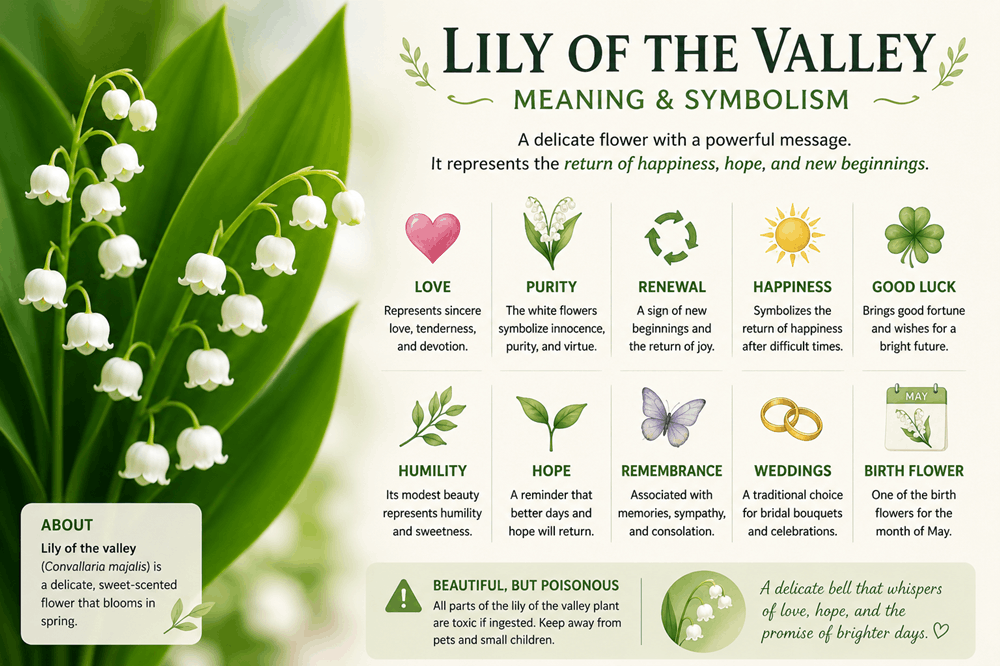
Lily of the valley most commonly symbolizes purity, happiness, renewal, humility, and the return of joy. Its tiny white bell-shaped flowers make it look delicate and innocent, while its habit of returning each spring has connected it with new beginnings and hope. In love and weddings, lily of the valley can also represent sincere affection and lasting happiness.
The flower has accumulated several meanings across cultures, religion, literature, and modern flower symbolism. Some are joyful, while others are surprisingly connected with grief and remembrance.
What Does Lily of the Valley Symbolize?
The most common meanings associated with lily of the valley include:
- Purity
- Humility
- Renewal
- Happiness
- Hope
- Love
- Good luck
- New beginnings
- Remembrance
- The return of happiness
The phrase “return of happiness” is especially closely associated with the flower.
That meaning fits its natural growth cycle.
Lily of the valley disappears during colder months and then reappears in spring, often spreading across shaded ground with surprisingly persistent growth.
Something that seemed to have vanished returns.
That makes the flower an easy symbol for hope after a difficult period.
Why Does Lily of the Valley Mean the Return of Happiness?
Flowers frequently gain symbolic meanings from the way they grow.
Lily of the valley is a spring flower.
Its appearance comes after winter, when gardens and forests begin becoming green again.
For that reason, the flower can represent the idea that sadness, hardship, or emotional darkness does not necessarily last forever.
Happiness can disappear for a time and still return.
This meaning makes lily of the valley particularly appropriate when someone is beginning again after a difficult experience.
It can represent recovery after heartbreak, a new relationship after disappointment, renewed hope after uncertainty, or simply the arrival of a happier stage of life.
What Does Lily of the Valley Mean in Love?
In romantic symbolism, lily of the valley represents sincere love, tenderness, devotion, and happiness returning through love.
It is not usually associated with intense passion in the same way as a red rose.
Its romantic meaning is quieter.
The flower suggests affection that feels gentle, honest, and deeply valued.
That makes it especially suitable for relationships built around trust and emotional intimacy rather than dramatic desire.
Giving someone lily of the valley can therefore communicate something close to:
You bring happiness into my life.
Or:
I hope our happiness continues.
The delicate appearance of the flower reinforces that message.
Why Is Lily of the Valley Used in Weddings?
Lily of the valley has long been popular in bridal bouquets and wedding arrangements.
Its symbolism makes the connection easy to understand.
A wedding represents a new beginning.
Lily of the valley represents happiness, purity, love, and renewal.
The two naturally fit together.
The flower’s small white blooms also work visually with traditional bridal imagery. They are elegant without appearing overwhelmingly dramatic.
A bouquet containing lily of the valley can therefore represent the hope that married life will bring continuing happiness and a fresh chapter for the couple.
Does Lily of the Valley Symbolize Purity?
Yes.
Purity is one of its strongest traditional associations.
The symbolism comes partly from its white color.
White flowers have long been connected with innocence, sincerity, peace, and spiritual purity.
Lily of the valley intensifies that impression because its blossoms are so small and delicate.
Instead of demanding attention through size or bright color, the flowers hang quietly beneath green leaves.
That visual modesty also explains another important meaning: humility.
Why Does Lily of the Valley Represent Humility?
Lily of the valley grows close to the ground.
Its little bell-shaped flowers often hang downward rather than facing proudly upward.
That posture has encouraged people to associate the flower with modesty and humility.
It does not tower over a garden like a sunflower or demand attention like a large rose.
It remains small.
Yet its fragrance can be surprisingly noticeable.
Symbolically, that creates a beautiful contrast.
Something does not have to be loud or visually dominant to have a strong presence.
Lily of the valley can therefore symbolize quiet strength as much as humility.
What Is the Spiritual Meaning of Lily of the Valley?
Spiritually, lily of the valley is commonly associated with purity, renewal, hope, humility, and consolation after sorrow.
Its ability to return each spring naturally fits spiritual ideas involving rebirth and restoration.
The flower can represent the belief that life continues after difficult periods and that suffering may eventually give way to peace.
Because of its white color, it can also suggest spiritual cleanliness or innocence.
This combination of sadness and hope is important.
Lily of the valley does not symbolize happiness simply because everything has always been easy.
Its deeper symbolism often involves happiness returning after sadness.
What Does Lily of the Valley Mean in Christianity?
Lily of the valley has accumulated several Christian associations over time.
One tradition connects the flowers with the Virgin Mary and describes them symbolically as tears.
This is sometimes why the plant has been associated with names such as Mary’s tears.
In that interpretation, the flower combines grief with purity and devotion.
Christian symbolism has also connected lily imagery more broadly with humility, innocence, and spiritual renewal.
It is important to distinguish later flower symbolism from the exact identity of plants mentioned in ancient biblical texts. Common plant names and translations have changed over centuries, so not every historical use of the word “lily” necessarily refers to the modern plant now called lily of the valley.
Does Lily of the Valley Mean Good Luck?
Yes, particularly in some European traditions.
The flower is often associated with good fortune and wishes for future happiness.
France has one of the strongest modern traditions involving lily of the valley.
The flowers are traditionally given around the beginning of May as a gesture wishing someone happiness and good luck.
That makes the flower different from symbols that communicate only romance.
You can associate lily of the valley with a partner, friend, family member, or anyone you simply want to wish well.
What Does Lily of the Valley Mean in France?
In France, lily of the valley is strongly associated with May 1 and good fortune.
Small bunches of the flowers are traditionally given to friends, relatives, and loved ones as wishes for happiness.
This tradition reinforces one of the flower’s central meanings: the return of joy.
Spring is fully underway.
Flowers are blooming.
Winter has ended.
Giving lily of the valley becomes a simple way of saying that you hope good things are ahead.
What Does Lily of the Valley Mean in a Bouquet?
The meaning depends partly on the occasion and the other flowers surrounding it.
In a romantic bouquet, it can symbolize tender love and happiness.
In a wedding bouquet, it suggests purity, new beginnings, and hopes for a joyful marriage.
In a sympathy arrangement, its meaning can shift toward remembrance, peace, and the hope that happiness will eventually return after grief.
That flexibility is one reason flower symbolism should not be interpreted too rigidly.
The same flower can communicate different emotions depending on when and why it is given.
Can Lily of the Valley Symbolize Grief?
Yes.
This may seem contradictory for a flower associated with happiness, but the two meanings actually fit together.
Lily of the valley can represent tears, mourning, remembrance, and consolation.
At the same time, it represents happiness returning.
That makes it especially meaningful in situations involving loss.
The symbolism does not pretend that grief never happened.
Instead, it suggests that sorrow and hope can exist together.
You can remember someone who is gone while still believing that joy will eventually return to life.
What Does a Lily of the Valley Tattoo Mean?
A lily of the valley tattoo can carry several meanings depending on the person wearing it.
Common interpretations include:
- Starting over
- Finding happiness again
- Purity
- Quiet strength
- Personal growth
- Remembering someone who died
- Recovery after a difficult period
- Love and devotion
- A connection with spring or May
The “return of happiness” symbolism makes it especially meaningful as a tattoo after a major life change.
Someone might choose it after leaving a difficult relationship, recovering from a painful period, beginning a new life chapter, or finding hope after loss.
The flower can say something optimistic without denying the difficult experience that came first.
Is Lily of the Valley a Birth Flower?
Lily of the valley is commonly recognized as one of the birth flowers associated with May.
That makes it a popular symbol for people born during the month.
The meaning fits May especially well.
May represents late spring in the Northern Hemisphere, when flowers are abundant and warmer weather has returned.
A May birth-flower tattoo or gift can therefore combine personal identity with ideas of renewal, sweetness, humility, and happiness.
What Does Lily of the Valley Mean in Dreams?
Dream symbolism is subjective, so there is no universal interpretation.
However, someone using traditional flower symbolism might interpret lily of the valley in a dream as representing renewed hope, innocence, emotional healing, or something positive returning after an absence.
Context changes everything.
A healthy blooming patch might feel hopeful.
Wilted flowers might suggest disappointment or a fear of losing happiness.
Receiving the flowers from someone could be interpreted as affection or reconciliation.
Finding them unexpectedly might symbolize a new beginning.
Dream meanings are best treated as personal reflection rather than prediction.
Why Does Lily of the Valley Look So Delicate?
The plant produces tiny white flowers shaped like miniature bells.
They hang from slender stems beneath larger green leaves.
That structure contributes heavily to the flower’s symbolism.
It looks fragile.
Yet the plant itself can spread persistently once established.
This creates another useful symbolic contrast:
Delicate appearance does not necessarily mean weakness.
Someone may appear gentle, quiet, or reserved while possessing remarkable resilience underneath.
For that reason, lily of the valley can be a meaningful symbol for quiet endurance.
Is Lily of the Valley Actually a Lily?
Despite its common name, lily of the valley is not a true lily belonging to the same botanical group as familiar garden lilies.
Common plant names frequently develop from appearance rather than strict scientific relationships.
The little white flowers may have encouraged the lily comparison, while “of the valley” evokes the shaded woodland environments where the plant naturally feels at home.
For symbolism, however, the botanical technicality matters less than the name people have used for generations.
Is Lily of the Valley Poisonous?
Yes. Lily of the valley is a poisonous plant and should not be eaten.
Its attractive flowers and berries can look harmless, but the plant contains compounds that can affect the heart and cause serious illness if ingested.
This is particularly important in homes with young children or pets.
The plant’s toxicity creates a striking contrast with its symbolism.
Visually, lily of the valley represents innocence, purity, and sweetness.
Physically, it needs to be treated with caution.
That does not change its traditional symbolic meaning, but it is worth remembering if you grow the plant rather than simply use the image in artwork, jewelry, tattoos, or floral designs.
What Does Lily of the Valley Represent in Literature and Art?
In literature and visual art, lily of the valley can be used to suggest innocence, spring, memory, lost happiness, restored happiness, femininity, tenderness, or quiet beauty.
Its meaning depends heavily on context.
A writer placing the flower beside a grieving character may emphasize remembrance.
A bride carrying it may suggest purity and hope.
A character discovering it after a difficult winter may suggest renewal.
Good symbolism rarely works like a simple dictionary.
The flower brings its traditional associations into the story, but the story decides which association matters most.
What Does It Mean When Someone Gives You Lily of the Valley?
Usually, it is a positive gesture.
Depending on your relationship, the gift could communicate:
- “I hope you are happy.”
- “You bring happiness into my life.”
- “I wish you good luck.”
- “I hope better days are coming.”
- “I value your gentle nature.”
- “I remember you.”
For someone recovering from a difficult experience, the flower’s “return of happiness” meaning can be particularly thoughtful.
For a romantic partner, it can express quiet devotion.
For a May birthday, it can simply recognize the person’s birth month.
What Is the Most Important Lily of the Valley Meaning?
If you remember only one meaning, remember the return of happiness.
That phrase connects many of the flower’s other associations.
Renewal means something begins again.
Spring means warmth returns after winter.
Hope means believing circumstances can improve.
Good luck expresses a wish that better things are ahead.
Even its association with grief can ultimately point toward consolation and emotional healing.
The flower’s symbolism is therefore not simply about being happy.
It is about happiness finding its way back.
The Bottom Line
Lily of the valley symbolizes purity, humility, love, good luck, renewal, hope, and especially the return of happiness.
Its white bell-shaped flowers give it an innocent, delicate appearance, while its springtime return connects it with fresh beginnings and emotional renewal.
That is why the flower can appear in so many different situations.
At a wedding, it represents love and a joyful new chapter.
As a May birth flower, it represents spring and personal identity.
In a memorial context, it can symbolize remembrance and hope after grief.
As a tattoo, it can represent someone who passed through a difficult period and found happiness again.
Its message is gentle rather than dramatic.
Winter does not last forever.
Something beautiful can return.