Ring Around the Rosie Meaning: Is the Nursery Rhyme Really About the Plague?
“Ring Around the Rosie” is often said to be a nursery rhyme about the Black Death or another outbreak of plague, but that explanation is probably a later myth rather than the rhyme’s original meaning. The familiar interpretation connects the “rosie” to a plague rash, “posies” to flowers carried against disease, and “we all fall down” to death. The problem is that historians have not found convincing evidence linking the rhyme to medieval plague outbreaks.
The rhyme is better understood as a traditional children’s singing game whose words changed over time. Its mysterious lyrics made it easy for later generations to attach a much darker story to it.
What Does “Ring Around the Rosie” Mean?
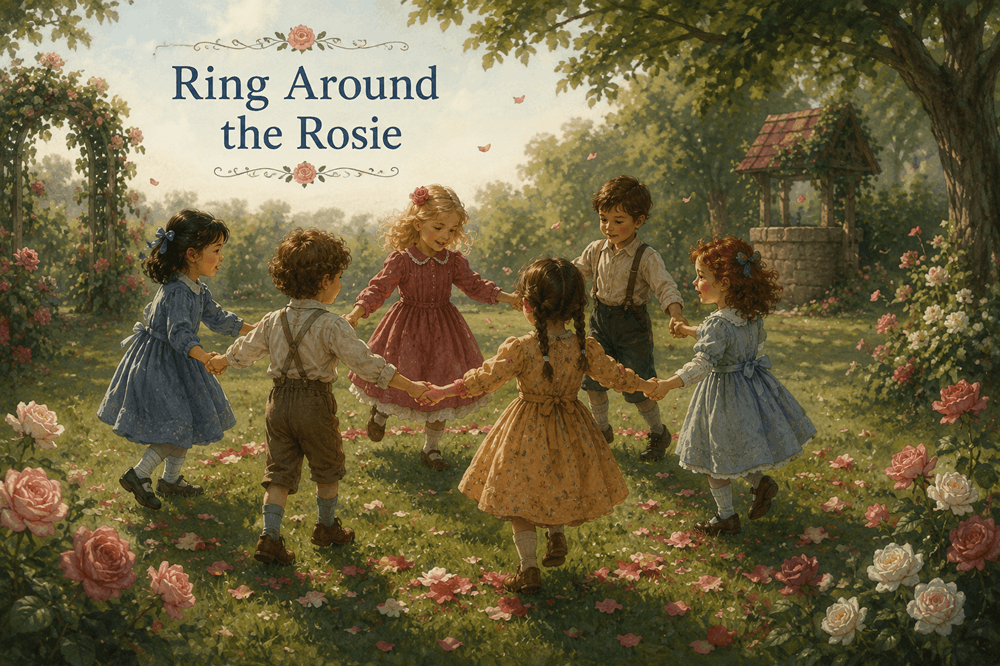
At its simplest, “Ring Around the Rosie” is a circle game.
Children hold hands, form a ring, move around together while singing, and then fall or crouch at the end.
The familiar American version goes:
“Ring around the rosie,
A pocket full of posies,
Ashes, ashes,
We all fall down.”
The words sound strangely ominous when read without the game.
There is a circle.
There are flowers.
There are ashes.
Then everyone falls.
That combination practically invites people to search for a hidden meaning.
The most famous explanation says the rhyme describes plague.
It is a compelling story.
It is just not especially well supported.
Is “Ring Around the Rosie” About the Black Death?
Probably not.
The Black Death devastated Europe during the 14th century, and later plague outbreaks continued for centuries. According to the popular interpretation, every part of the rhyme supposedly corresponds to symptoms or practices associated with the disease.
The explanation usually goes like this:
- “Ring around the rosie” represents a red circular rash.
- “Pocket full of posies” refers to flowers carried to protect against bad smells or disease.
- “Ashes, ashes” represents cremated bodies.
- “We all fall down” represents death.
It sounds remarkably neat.
Almost too neat.
The main problem is that known written versions of the rhyme appear much later than the medieval Black Death.
If children had really been singing a recognizable plague rhyme since the 1300s, historians would expect to find some trace of it earlier.
Instead, the documented rhyme belongs much more clearly to the 19th-century world of children’s games and folklore collecting.
Why Do People Think It Is About the Plague?
Because the theory makes the strange words feel meaningful.
Without the plague story, “Ring Around the Rosie” seems almost nonsensical.
Why a rosie?
Why posies?
Why ashes?
Why does everyone suddenly fall down?
The plague interpretation supplies an answer for every line.
That makes it extremely memorable.
It also turns an innocent childhood game into something unexpectedly dark, which is exactly the kind of historical fact people enjoy repeating.
“You know that nursery rhyme you sang as a child? It was actually about mass death.”
That is a much more interesting story than, “Children used to sing different versions of a circle game.”
Interesting stories, however, are not automatically true.
What Does “Ring Around the Rosie” Refer To?
There is no single confirmed explanation.
The word “ring” fits the game itself because children form a circle.
“Rosie” or “roses” may simply belong to the flower imagery common in traditional songs and children’s rhymes.
Older folk songs frequently mention roses, flowers, garlands, gardens, and gathering plants without those images representing disease.
The phrase may also have changed as children repeated the rhyme from one generation to another.
Traditional playground songs are especially unstable.
Children do not usually consult an official lyric sheet before playing.
They hear something, repeat what they think they heard, and pass that version along.
Over decades, words can shift dramatically.
What Does “A Pocket Full of Posies” Mean?
A posy is a small bunch of flowers.
The plague theory says people placed sweet-smelling flowers in their pockets because they believed pleasant scents could protect them from disease.
That idea is not completely invented.
Before modern germ theory, people sometimes associated disease with foul air and used herbs, flowers, perfumes, and other scents around sickness.
But that does not prove the rhyme refers to plague.
Flowers are also extremely common in folk songs, dancing games, courtship songs, and children’s traditions.
A pocket of flowers could simply be a pleasant image associated with play.
The presence of posies is therefore compatible with the plague theory without being evidence for it.
What Does “Ashes, Ashes” Mean?
This is one of the biggest problems with the supposed plague explanation.
Many people assume “ashes” refers to bodies being burned during an epidemic.
But different versions of the rhyme use different words.
One famous British version says something closer to:
“A-tishoo! A-tishoo! We all fall down.”
That sounds like sneezing, which has also been pulled into the plague interpretation.
Other historical forms contain still different phrases.
This variation matters because there may never have been one original sacred set of lyrics that needs to be decoded line by line.
The words changed with place and time.
“Ashes, ashes” may simply be one later American variation chosen partly for rhythm.
Does “We All Fall Down” Mean Everyone Dies?
Within the game, “we all fall down” describes exactly what the children do.
They fall, crouch, kneel, or drop to the ground.
That does not require a metaphorical explanation.
Traditional children’s songs frequently tell participants what action to perform.
Think of games in which children clap, turn around, jump, freeze, or sit down when the lyrics instruct them.
“We all fall down” works perfectly as a game instruction.
It only becomes obviously connected with death after the plague interpretation is added.
When Was “Ring Around the Rosie” Written?
No known individual songwriter can be credited with writing the rhyme.
It developed through oral tradition.
Versions began being documented in the 19th century, long after the Black Death of the 1300s and also well after London’s Great Plague of 1665.
That time gap is one of the strongest reasons scholars are skeptical about claims that the rhyme directly records a particular plague epidemic.
Oral traditions can survive without being written down, of course.
But several hundred years of undocumented transmission is a large claim, especially when the later versions vary considerably.
Could It Be About the Great Plague of London?
Some versions of the theory connect “Ring Around the Rosie” not with the medieval Black Death but with the Great Plague of London in 1665.
This reduces the chronological gap somewhat, but it does not solve the basic problem.
There is still no strong evidence showing that London children created this rhyme as a description of the epidemic.
The explanation appears to have become popular much later than the rhyme itself.
That is usually a warning sign when evaluating folklore.
If a supposed historical meaning suddenly becomes widely known centuries after the event, it may tell us more about modern storytelling than about the original song.
Did Plague Victims Really Have a Ring-Shaped Rash?
Plague can cause serious skin changes, including bleeding beneath the skin and darkened tissue, but the tidy idea of every victim developing a recognizable “ring around the rosie” does not match a universal defining symptom.
Bubonic plague is especially associated with swollen lymph nodes called buboes, fever, weakness, and severe illness.
Trying to translate the phrase “ring around the rosie” directly into one specific plague symptom therefore requires more interpretation than the popular story usually admits.
Why Do Nursery Rhymes Have So Many Dark Meaning Theories?
Nursery rhymes are ideal targets for hidden-history theories.
They are short.
Their language is old-fashioned.
The stories are often strange.
And many do not have known authors who can explain what they originally meant.
That creates empty space.
People fill that space with historical events.
A king becomes the secret subject.
A queen becomes another character.
A rhyme becomes coded political criticism.
A children’s game becomes a memory of an epidemic.
Some nursery rhymes genuinely do contain political, historical, or adult themes.
But each claim needs evidence.
The fact that an interpretation fits the words is not enough by itself.
Are There Different Versions of “Ring Around the Rosie”?
Yes, many.
That is one of the most interesting things about the rhyme.
The wording differs between countries and even between communities within the same country.
Some versions use “roses” rather than “rosie.”
Some have “ashes.”
Some use a sneezing sound.
Additional verses may tell children to stand back up, curtsy, jump, or perform other actions.
These differences make sense if the rhyme developed as a living playground game rather than a fixed literary poem.
Children adapted it.
That process may still be happening today.
Why Is the British Version Different?
British versions are often associated with a line sounding like “a-tishoo,” an imitation of sneezing.
That naturally seems to strengthen the disease theory.
But the argument can become circular.
People assume the rhyme is about plague.
Then they interpret sneezing as evidence of plague.
Yet if the rhyme was simply a children’s game, sneezing could have entered because it was funny, rhythmic, and easy for children to perform.
The existence of multiple variants makes it difficult to treat any one line as the key that unlocks a secret original meaning.
Is “Ring Around the Rosie” Creepy?
It certainly can feel creepy once you hear the plague story.
A group of children holding hands, singing about flowers and ashes, and then collapsing together creates a powerful image when interpreted as mass death.
That contrast between childhood innocence and historical tragedy is probably one reason the theory refuses to disappear.
Even after someone learns that the plague connection is doubtful, it can be difficult to hear the rhyme innocently again.
The story has become attached to the song.
What Is the Most Likely Real Meaning?
The safest answer is that “Ring Around the Rosie” was primarily a children’s circle game.
The lyrics accompanied physical actions, and the song changed through oral tradition.
It may contain older folk imagery involving flowers and rings, but there is no universally accepted historical event that explains every word.
That uncertainty may feel less exciting than the plague explanation.
It is also more consistent with how traditional children’s rhymes actually develop.
Why Is the Plague Story Still So Popular?
Because it is almost perfectly designed to survive.
It takes a familiar childhood rhyme and reveals a supposedly shocking secret beneath it.
Every line appears to have a dark explanation.
The story is short enough to repeat in a classroom, documentary, social-media post, or conversation.
And it sounds historically plausible because plague really did shape European life for centuries.
Once the explanation became popular, people began repeating it as fact.
Eventually, the interpretation became almost as famous as the rhyme itself.
The Bottom Line
The popular idea that “Ring Around the Rosie” is about the Black Death is almost certainly more legend than established history.
The familiar theory says the ring represents a plague rash, posies were carried against disease, ashes represent death or burned bodies, and everyone falling down means everyone died.
It is a memorable interpretation.
But there is no strong historical evidence showing that medieval plague victims or children created the rhyme for that purpose.
The known rhyme appears much later and exists in many different versions, which is exactly what you would expect from a traditional children’s singing game.
So what does “Ring Around the Rosie” really mean?
Probably much less than the scary story suggests.
Children form a ring, sing about flowers, and fall down together at the end.
The darkest part of the rhyme may not be its original meaning at all.
It may be the meaning later generations decided to give it.