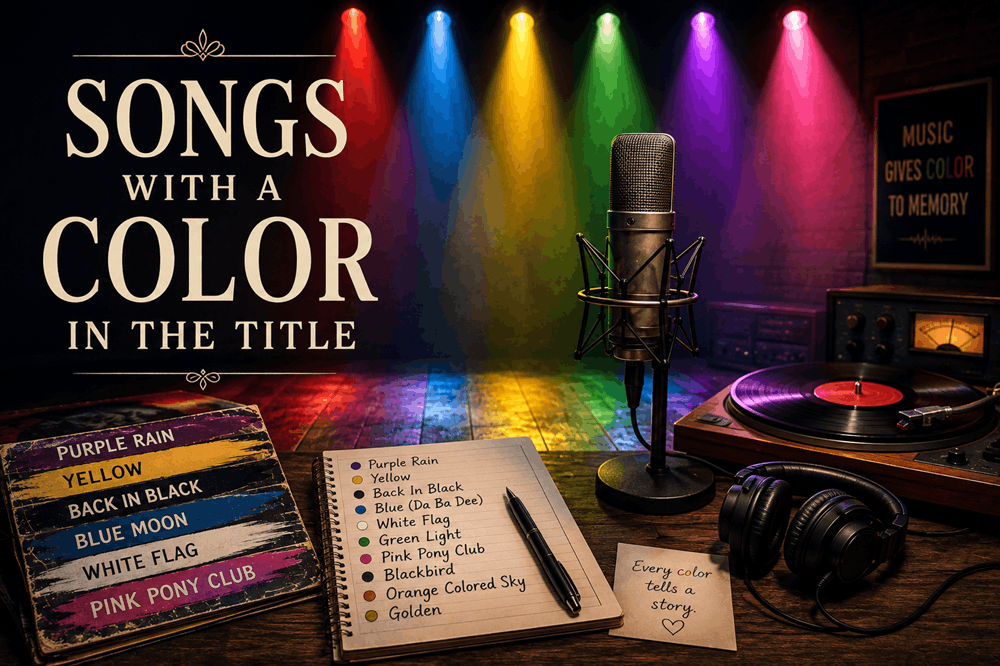
16 Songs With a Color in the Title
Songs with a color in the title often use that color to communicate much more than appearance.
Blue can suggest sadness, distance or nighttime. Red may represent passion, danger or emotional intensity. Black can imply grief, mystery or rebellion, while white may stand for surrender, innocence or emptiness.
Some titles use color literally. Others turn it into a mood, a memory or an entire imaginary world.
These 16 songs move across rock, pop, folk, country, soul and electronic music, showing how differently songwriters can use a single color word.
1. “Purple Rain” — Prince
“Purple Rain” is one of the most famous color-titled songs in popular music.
The phrase does not describe ordinary weather. Purple rain becomes an emotional and almost spiritual image connected with love, forgiveness, endings and the hope of remaining close to someone during a period of change.
The color matters because purple combines qualities commonly associated with red and blue: passion and sadness, warmth and distance. That mixture matches a song in which romantic devotion is surrounded by uncertainty.
Prince allows the recording to expand gradually from a quiet ballad into an enormous guitar-led conclusion. The title also became inseparable from the album and film of the same name, helping make “Purple Rain” the defining centerpiece of that era of his career.
2. “Yellow” — Coldplay
“Yellow” uses a bright color to describe devotion.
Chris Martin never gives “yellow” one strict definition. It can suggest stars, sunlight, warmth or the strange glow that surrounds someone when affection changes the way the world appears.
That openness is part of the song’s appeal. Listeners can connect the color with their own memories rather than decoding one fixed symbol.
The arrangement begins modestly but grows through ringing electric guitars and a vocal that sounds both hopeful and vulnerable. The person being addressed seems extraordinary, but the narrator still worries about whether his feelings will be returned.
Released as one of Coldplay’s earliest breakthrough singles, “Yellow” reached No. 4 on the UK chart and became one of the band’s most enduring recordings.
3. “Blue (Da Ba Dee)” — Eiffel 65
“Blue (Da Ba Dee)” turns one color into an entire world.
The character in the song lives in a blue house, drives a blue car and sees blue everywhere around him. The exaggerated repetition makes the color playful and cartoonish, while the electronic production gives the track a futuristic late-1990s atmosphere.
At the same time, “blue” traditionally means sadness. The cheerful dance beat and melancholy interpretation exist together, allowing the song to sound silly, lonely or both.
Its simple central idea made it immediately recognizable across languages and cultures. “Blue (Da Ba Dee)” reached No. 1 in the United Kingdom and became Eiffel 65’s signature international hit.
4. “Back in Black” — AC/DC
“Back in Black” uses black as a symbol of mourning, strength and return.
AC/DC recorded the song after the death of former lead singer Bon Scott. The title recognizes loss without turning the track into a quiet memorial. Instead, the band returns with one of rock music’s most confident guitar riffs.
Black clothing is often associated with grief, but it can also suggest toughness and refusal to disappear. The song carries both meanings.
Brian Johnson’s vocal announces that the group is moving forward, while Angus Young’s riff makes the comeback feel immediate rather than cautious.
“Back in Black” is the title track of AC/DC’s 1980 album, which the band’s official site continues to present as a central release in its catalog.
5. “White Flag” — Dido
“White Flag” reverses the traditional meaning of surrender.
A white flag normally signals that someone is ready to stop fighting. Dido’s narrator insists that no such flag will appear above her door because her feelings remain alive, even though the relationship has ended.
She understands that reconciliation may never happen. She also refuses to pretend that emotional attachment can be turned off simply because moving on would be more convenient.
That distinction gives the song dignity. The narrator is not necessarily asking the other person to return. She is admitting that love may continue without reward.
“White Flag” reached No. 2 on the UK Singles Chart and became one of Dido’s most successful recordings.
6. “Blackbird” — The Beatles
“Blackbird” contains a color inside the name of a bird.
Paul McCartney’s acoustic performance sounds simple, but the bird becomes a symbol of someone learning to rise after being restricted or wounded.
Darkness is not presented only as something frightening. It is also the environment through which the bird must learn to see and move.
The recording depends on guitar, voice and rhythmic sounds resembling footsteps or tapping. That restraint keeps attention on the encouragement at the center of the song.
The Beatles’ official archive identifies “Blackbird” as a McCartney composition credited to Lennon–McCartney and released on the band’s 1968 self-titled double album, commonly called the White Album.
7. “Red” — Taylor Swift
“Red” uses colors to map the emotional stages of a relationship.
Red represents the relationship at its most intense. It is fast, vivid, exciting and impossible to ignore. Other colors suggest emotional distance, emptiness or the quieter aftermath of losing someone.
The central idea is that passionate love does not always become stable love.
Something can feel completely alive and still be unsustainable.
The pop-country production mirrors that contrast. Guitars connect the song with Swift’s earlier sound, while electronic vocal effects and polished pop rhythms point toward the musical direction she would pursue more fully later.
“Red” works because the color is immediately understandable. The relationship was not calm enough to be pale or predictable. It was red.
8. “Green Light” — Lorde
“Green Light” turns a traffic signal into permission to move forward.
The narrator has experienced a breakup but remains caught between what she knows and what she feels. Intellectually, she understands that the relationship is over. Emotionally, she is still waiting for some final signal that will allow her to leave it behind.
Green commonly represents movement, permission and renewal.
The song complicates that meaning because the narrator cannot control when the light arrives. She dances, remembers and tries to force herself toward freedom, but grief continues interrupting the celebration.
The production captures that struggle. Its verses are unsettled and conversational, while the chorus becomes a large piano-driven release.
“Green Light” is not the sound of someone who has completely moved on. It is the sound of someone who desperately wants to.
9. “Pink Pony Club” — Chappell Roan
“Pink Pony Club” uses pink to create a theatrical world of freedom and self-invention.
The club represents a place where the narrator can perform, dress and live more openly than she could in the environment she left behind.
Pink is bright, playful and deliberately visible. It rejects the pressure to remain quiet or blend into a life chosen by someone else.
The song contains both excitement and sadness. The narrator knows that her transformation may disappoint her family, especially her mother. Yet returning to her earlier identity would require abandoning a version of herself that finally feels real.
“Pink Pony Club” therefore becomes more than a venue. It is an imagined home built from music, performance and the freedom to be seen.
10. “Brown Eyed Girl” — Van Morrison
“Brown Eyed Girl” connects eye color with youthful memory.
The narrator recalls spending time outdoors, laughing, dancing and sharing a relationship that now belongs to the past. The brown-eyed girl becomes inseparable from the season and landscape surrounding those memories.
The title feels personal because it uses one physical feature rather than a general romantic description. The listener can imagine one specific person whose identity is preserved through the color of her eyes.
The upbeat rhythm keeps the song from becoming openly mournful, but nostalgia remains beneath its surface.
The narrator is not living the experience anymore. He is returning to it through music, trying to bring back a time when life seemed simpler and the future had not yet separated the two people.
11. “Orange Colored Sky” — Nat King Cole
“Orange Colored Sky” uses a brightly colored sky to describe love arriving without warning.
The narrator is calmly moving through life when a sudden romantic encounter changes everything. The performance fills that moment with comic sound effects, energetic brass and exaggerated surprise.
Orange is ideal for the song because it feels warmer and more unusual than an ordinary blue sky.
It suggests a world temporarily transformed by shock and excitement.
Nat King Cole’s smooth delivery keeps the increasingly dramatic language under control. He sounds amused by how completely one meeting has disrupted him.
The result is a love song with the energy of a cartoon lightning strike: elegant, humorous and immediately memorable.
12. “99 Red Balloons” — Nena
“99 Red Balloons” turns an innocent red object into a symbol of political panic.
A group of balloons drifts into the sky and is mistaken for a potential threat. Military systems react, tensions increase and a harmless event develops into catastrophe.
Red can represent celebration, but it is also associated with alarms, danger and war. The song allows the balloons to move between those meanings.
The bright new-wave production makes the story sound energetic enough for a party, creating a disturbing contrast with the destruction described in the narrative.
That contrast is the song’s warning. A society dominated by fear can transform something harmless into evidence of an enemy.
The German-language original, “99 Luftballons,” and the English recording both became internationally recognized Cold War-era songs.
13. “Silver Springs” — Fleetwood Mac
“Silver Springs” sounds like a place name, but it began with the image of a destination Stevie Nicks noticed on a road sign.
The phrase inspired an imagined location that felt romantic, beautiful and slightly unreachable.
Within the song, that beauty contrasts with the end of a relationship. The narrator does not quietly disappear after being rejected. She believes her presence will remain in the other person’s memory.
Silver carries several possible associations: moonlight, reflection, age and something precious but colder than gold.
The recording gradually intensifies until remembrance begins to sound almost like a promise or warning. The relationship may have ended, but the narrator refuses to let its emotional history be erased.
14. “Golden” — Harry Styles
“Golden” uses gold to represent brightness, attraction and emotional exposure.
The person being addressed appears radiant, while the narrator worries that he may not be able to offer the security the relationship requires.
That uncertainty separates the song from a simple celebration.
Golden light is beautiful, but it is also revealing. It removes shadows and makes vulnerability difficult to hide.
The fast-moving production gives the song an open-road feeling. Guitars, layered vocals and a steady rhythm create warmth, while the lyrics retain anxiety about loneliness and rejection.
“Golden” captures the moment when love feels full of possibility but has not yet become safe.
15. “Black Hole Sun” — Soundgarden
“Black Hole Sun” combines blackness with the brightest object in the sky.
A black-hole sun is an impossible and threatening image. Instead of providing light and stability, the sun seems capable of swallowing or washing away the surrounding world.
Chris Cornell’s lyrics use surreal scenes rather than one clear narrative. Faces, weather and social behavior become distorted, creating the sensation of a familiar place turning deeply wrong.
The music supports that unease through heavy guitars and a chorus that is melodic enough to sound almost comforting.
That contradiction made the song unusually effective. It is dark without abandoning beauty and catchy without becoming emotionally reassuring.
The title remains one of rock music’s most memorable uses of color because it transforms black from an absence of light into a force powerful enough to consume it.
16. “Blue Moon” — The Marcels
“Blue Moon” begins with loneliness and ends with unexpected love.
A blue moon is rare, and the color blue reinforces the narrator’s isolation at the start of the song. He is alone, without a dream or a person to call his own.
Then someone appears, changing the meaning of the moon above him.
What began as a symbol of sadness becomes a witness to emotional transformation.
The Marcels’ famous doo-wop version adds playful bass vocals and energetic harmonies to a standard that had previously been performed in slower, more romantic arrangements.
The result is both nostalgic and joyful: a song in which blue does not remain sad forever.
More songs with colors in their titles
The possibilities extend far beyond these 16 songs.
Other strong examples include:
- “Paint It, Black” — The Rolling Stones
- “Black or White” — Michael Jackson
- “White Rabbit” — Jefferson Airplane
- “Blue Velvet” — Bobby Vinton
- “Behind Blue Eyes” — The Who
- “Little Red Corvette” — Prince
- “Lady in Red” — Chris de Burgh
- “Red Red Wine” — UB40
- “Pink Houses” — John Mellencamp
- “Pink Cadillac” — Bruce Springsteen
- “Green River” — Creedence Clearwater Revival
- “Green, Green Grass of Home” — Tom Jones
- “Gold Dust Woman” — Fleetwood Mac
- “Fields of Gold” — Sting
- “Silver Thunderbird” — Marc Cohn
- “A Whiter Shade of Pale” — Procol Harum
Some titles describe clothing, eyes, cars or landscapes. Others use color entirely as emotional symbolism.
Color songs for different playlists
Romantic color songs
Choose:
- “Yellow”
- “Purple Rain”
- “Brown Eyed Girl”
- “Orange Colored Sky”
- “Golden”
These songs use color to describe attraction, devotion or memories of love.
Sad or reflective color songs
Choose:
- “White Flag”
- “Blue Moon”
- “Silver Springs”
- “Blackbird”
- “Red”
These recordings connect color with separation, recovery or feelings that remain after a relationship changes.
Energetic color songs
Choose:
- “Blue (Da Ba Dee)”
- “Green Light”
- “Pink Pony Club”
- “99 Red Balloons”
- “Back in Black”
Their titles are memorable, and their arrangements can support party, workout or road-trip playlists.
Darker color songs
Choose:
- “Black Hole Sun”
- “Paint It, Black”
- “Black or White”
- “White Rabbit”
- “Back in Black”
Black and white titles frequently create sharp contrasts involving grief, identity, conflict or surreal imagery.
Why colors work so well in song titles
Colors communicate before the song begins.
A listener sees “red” and may expect passion or danger. “Blue” suggests sadness before the first note plays. Gold may signal value and warmth, while black can make a title feel heavier or more mysterious.
Songwriters can then confirm or challenge those expectations.
“Blue Moon” begins in sadness but moves toward love.
“White Flag” rejects surrender rather than accepting it.
“Pink Pony Club” transforms a playful color into a statement of identity, while “99 Red Balloons” turns a celebratory image into a political warning.
Colors are also easy to remember. They create an immediate visual image that helps a title remain distinct even when the lyrics describe complicated emotions.
Final thoughts
Songs with colors in their titles show how one simple word can create an entire emotional atmosphere.
Prince uses purple to combine romance, sorrow and spiritual uncertainty.
Coldplay turns yellow into warmth and devotion. Taylor Swift uses red for a relationship too intense to remain stable, while Dido’s white flag represents a surrender she refuses to make.
Other songs construct complete worlds from color.
Eiffel 65 imagines everything becoming blue. Chappell Roan finds freedom inside a pink club, and Soundgarden transforms the sun into something dark enough to consume the sky.
The color may describe an object, person or place.
What listeners remember is the feeling attached to it.