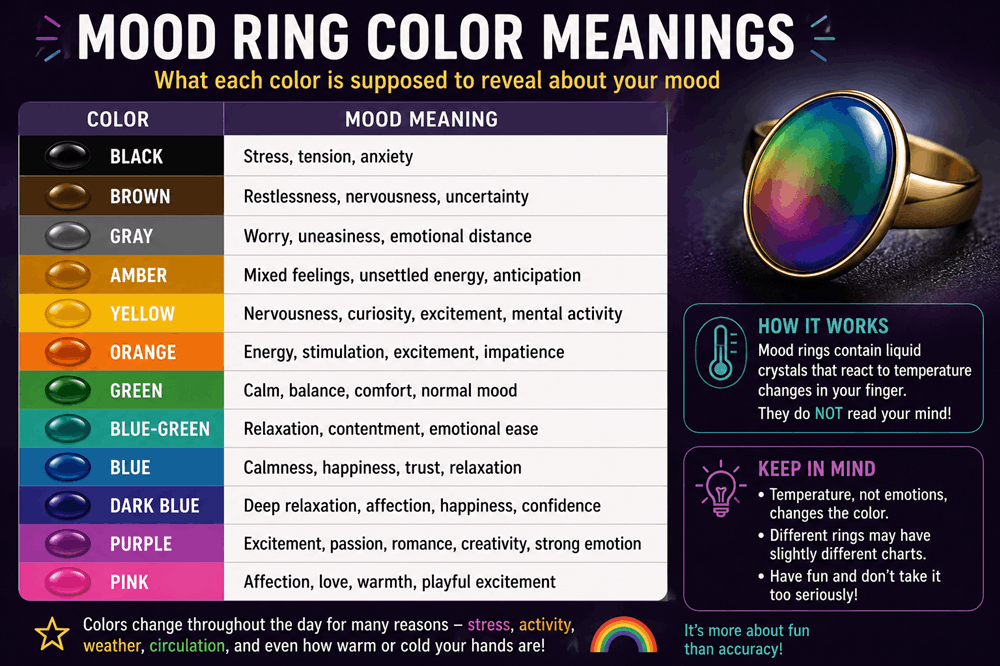
Mood Ring Color Meanings: What Each Color Is Supposed to Reveal
Mood ring colors are supposed to reflect changes in your emotional state, but the ring is actually reacting to temperature, not reading your feelings directly. The liquid crystals inside the ring change color as the temperature of your finger changes. Because stress, relaxation, activity, and circulation can affect skin temperature, people began associating different colors with different moods.
In the traditional mood ring chart, blue and green usually suggest calm or balanced feelings, purple can represent excitement or romance, yellow and orange are often linked with nervous energy, and black is commonly interpreted as stress or tension.
Mood Ring Colors and Meanings at a Glance
| Color | Common Mood Meaning |
|---|---|
| Black | Stress, tension, anxiety, or cold temperature |
| Brown | Restlessness, uncertainty, or nervousness |
| Gray | Worry, uneasiness, or emotional distance |
| Amber | Mixed feelings, unsettled energy, or anticipation |
| Yellow | Nervousness, curiosity, excitement, or mental activity |
| Orange | Energy, stimulation, excitement, or impatience |
| Green | Calm, balance, comfort, or normal mood |
| Blue-Green | Relaxation, contentment, or emotional ease |
| Blue | Calmness, happiness, trust, or relaxation |
| Dark Blue | Deep relaxation, affection, happiness, or confidence |
| Purple | Excitement, passion, romance, creativity, or strong emotion |
| Pink | Affection, love, warmth, or playful excitement |
These meanings are traditional interpretations rather than scientific measurements. Two mood rings may even use slightly different color charts.
What Does Black Mean on a Mood Ring?
Black is usually interpreted as stress, tension, anxiety, or emotional discomfort.
However, black can also appear for a much simpler reason: the ring is cold.
Mood rings often turn very dark when your hands are cold, when you are outside in low temperatures, or when the ring is not being worn at all.
This is important because black has developed a dramatic reputation in mood ring charts.
People sometimes assume that a black ring means something is terribly wrong emotionally.
Usually, it simply means the liquid crystals are responding to a lower temperature.
What Does Brown Mean on a Mood Ring?
Brown is commonly associated with restlessness, nervousness, uncertainty, or mixed feelings.
It tends to appear in the cooler range of the mood ring spectrum.
Someone might interpret brown as a sign that they are uncomfortable, distracted, or trying to decide what they feel.
But again, physical temperature matters.
If you have naturally cool hands, brown may appear even when you feel perfectly calm.
What Does Gray Mean on a Mood Ring?
Gray is often linked with worry, uneasiness, tension, or emotional distance.
It is usually treated as a transitional color between very dark shades and warmer colors such as amber or yellow.
If your ring frequently turns gray, the traditional interpretation would suggest that your mood is somewhat unsettled.
In reality, the color may simply mean your finger temperature is slightly cooler than the range that produces green or blue.
What Does Amber Mean on a Mood Ring?
Amber can represent anticipation, mixed emotions, uncertainty, or nervous energy.
This color is interesting because it sits between the cooler dark tones and brighter yellows.
Traditional mood charts sometimes describe amber as the color of someone who is not completely relaxed but is not deeply stressed either.
You might see it before a first date, an interview, a performance, or any situation where excitement and nervousness happen at the same time.
What Does Yellow Mean on a Mood Ring?
Yellow is usually associated with mental activity, curiosity, nervousness, excitement, or anticipation.
It can represent a mind that feels busy.
You may be thinking quickly, waiting for something important, or feeling stimulated by what is happening around you.
Because yellow sits in a middle temperature range, it is often interpreted as a transition between nervousness and more energetic excitement.
What Does Orange Mean on a Mood Ring?
Orange is typically linked with energy, excitement, enthusiasm, stimulation, or impatience.
It suggests a more activated emotional state than green or blue.
Someone wearing a mood ring might see orange while feeling energized before a competition, party, concert, date, or important event.
It can also be interpreted as mild agitation if the excitement is uncomfortable rather than enjoyable.
What Does Green Mean on a Mood Ring?
Green is one of the most common mood ring colors and usually represents balance, comfort, calmness, or a neutral emotional state.
Many mood ring charts treat green as the normal resting color.
If your ring stays green for long periods, the traditional interpretation is that you feel comfortable and emotionally steady.
That does not necessarily mean you are extremely happy or relaxed.
Green is more like the middle ground.
You are okay.
Nothing feels especially wrong or overwhelmingly exciting.
What Does Blue-Green Mean on a Mood Ring?
Blue-green usually represents relaxation, contentment, comfort, and a pleasant emotional state.
It sits between ordinary green and deeper blue, so it is often interpreted as someone moving from neutral toward calm and happy.
This color might appear while you are relaxing at home, talking comfortably with someone you trust, or doing something familiar and enjoyable.
What Does Blue Mean on a Mood Ring?
Blue is traditionally one of the most positive mood ring colors.
It is commonly associated with calmness, happiness, relaxation, trust, and emotional comfort.
A blue mood ring is often interpreted as a sign that you feel peaceful and secure.
This fits the temperature mechanism reasonably well because relaxed hands may have good circulation and warmer skin, allowing the crystals to shift toward blue.
That connection helped make blue one of the signature “good mood” colors.
What Does Dark Blue Mean on a Mood Ring?
Dark or deep blue is usually interpreted as strong happiness, deep relaxation, affection, confidence, or emotional warmth.
Some charts describe it as the color of being completely at ease.
Others connect it with love and contentment.
If someone notices their ring becoming dark blue while spending time with a partner or close friend, it is easy to see why the color became associated with affection.
What Does Purple Mean on a Mood Ring?
Purple is commonly linked with passion, romance, excitement, creativity, strong emotion, or inspiration.
It is one of the warmest colors in many mood ring systems.
Because purple often appears when the ring reaches a relatively warm temperature, marketers historically connected it with intense positive feelings.
This could mean romantic attraction, excitement, confidence, or simply feeling deeply engaged with what you are doing.
What Does Pink Mean on a Mood Ring?
Pink is not present on every mood ring chart, but when it appears it usually represents love, affection, warmth, playfulness, or romantic excitement.
Pink naturally carries romantic symbolism even outside mood jewelry, so its mood ring meaning follows the same pattern.
Some modern rings use crystals that produce pinkish or magenta shades more clearly than older models.
Why Does a Mood Ring Change Color?
A mood ring changes color because of thermochromic liquid crystals.
These crystals respond to temperature.
When the temperature changes, their molecular structure changes slightly, affecting which wavelengths of light they reflect.
Your eye sees that reflected light as a different color.
Your finger temperature changes throughout the day because of things such as:
- Room temperature
- Outdoor weather
- Blood circulation
- Exercise
- Stress
- Relaxation
- Illness
- Holding hot or cold objects
The ring reacts to these physical temperature changes.
It does not directly detect emotions.
Can Mood Rings Actually Tell Your Mood?
Not reliably.
Mood rings do not contain sensors that detect happiness, sadness, anxiety, love, or anger.
They measure temperature indirectly through color-changing crystals.
There can be a loose relationship between emotion and skin temperature because emotions sometimes affect circulation.
Stress, for example, can cause blood vessels in the hands to constrict, making fingers cooler.
Relaxation may allow better circulation and warmer fingers.
But many other things affect your temperature too.
You might be extremely happy while standing outside in winter and still have a black mood ring.
You could also have a blue ring simply because your hands are warm.
That is why mood rings are better understood as novelty jewelry than emotional measuring devices.
Why Is My Mood Ring Always Blue?
If your mood ring stays blue most of the time, your finger may simply stay within the temperature range that produces blue.
The traditional meaning would be that you are calm, relaxed, or happy.
But your natural circulation, room temperature, and the ring’s specific crystal mixture can all affect its resting color.
Different manufacturers calibrate their rings differently, so one person’s normal blue might be another person’s normal green.
Why Is My Mood Ring Always Black?
A mood ring that stays black can have several explanations.
Your hands might be cold.
The room may be cold.
The ring might not fit closely enough against your skin.
Or the liquid crystal material may have been damaged.
Older or damaged mood rings sometimes stop changing color altogether.
If the ring remains black even after warming it gently with your hand, it may no longer be functioning correctly.
What Does It Mean If a Mood Ring Keeps Changing Colors?
Usually, it means your finger temperature is moving between different ranges.
Your hands can warm and cool surprisingly quickly.
Walking outside, washing your hands, exercising, drinking something hot, becoming nervous, or sitting in an air-conditioned room can all affect the color.
The traditional fun interpretation is that your mood is changing rapidly.
That can be entertaining, but temperature is still the real mechanism.
Do All Mood Rings Use the Same Color Meanings?
No.
This is why you may find slightly different mood ring charts online or printed on product packaging.
One chart may say purple means romance.
Another may call it excitement.
One may describe yellow as nervous.
Another may describe it as imaginative or curious.
The overall pattern is usually similar:
Darker colors are associated with stress or coldness.
Green represents balance.
Blue represents relaxation.
Purple represents stronger emotional warmth or excitement.
But the exact words are largely part of the novelty and marketing tradition surrounding mood jewelry.
Where Did Mood Rings Come From?
Mood rings became a major fashion trend during the 1970s.
They fit perfectly into an era fascinated by self-discovery, psychology, spirituality, changing social attitudes, and colorful fashion.
The idea was irresistible:
Put on a ring, watch it change colors, and supposedly discover what you are feeling.
Even though the rings were really reacting to temperature, attaching emotional meanings to each shade made them much more interesting.
They became both jewelry and conversation pieces.
Why Are Mood Rings Popular Again?
Mood rings have repeatedly returned because they combine nostalgia with something interactive.
Unlike an ordinary ring, a mood ring appears to respond to you.
The colors shift while you wear it, which makes the jewelry feel personal even when you know the science behind it.
They also fit naturally with modern interest in retro fashion, Y2K accessories, colorful jewelry, astrology, crystals, and other playful forms of self-expression.
Are Mood Rings Safe?
Most modern mood rings are ordinary novelty jewelry and are safe to wear as intended.
The main concerns are similar to other inexpensive jewelry.
Some metals can irritate sensitive skin, particularly if the wearer reacts to nickel or certain alloys.
The liquid crystal material is normally sealed inside the ring, so it should not be exposed during normal use.
If a ring cracks or breaks, it is better to stop wearing it rather than continue using damaged jewelry.
Can Water Ruin a Mood Ring?
Yes, especially with inexpensive designs.
Water can seep beneath the protective surface and damage the liquid crystals or backing.
To help a mood ring last longer, remove it before:
- Showering
- Swimming
- Washing dishes
- Using cleaning chemicals
- Soaking your hands for long periods
Heat can also damage some mood rings, so avoid exposing them to very hot water.
How Do You Read a Mood Ring?
Wear the ring for a few minutes and allow it to adjust to your skin temperature.
Then compare the main color with the chart that came with the ring.
Do not worry if several shades appear at once.
The crystals can produce gradients, especially while the ring is warming or cooling.
And remember that the chart is meant for entertainment.
If your ring says you are stressed but you feel completely relaxed, trust yourself rather than the jewelry.
What Is the Best Mood Ring Color?
There is no objectively best color, but blue and purple are usually given the most positive meanings.
Blue suggests calmness, contentment, and happiness.
Purple often represents passion, love, excitement, or creativity.
Green is also positive because it represents balance and comfort.
But you do not need to chase a specific shade.
The fun of a mood ring comes from watching it change.
The Bottom Line
Mood ring colors traditionally represent different emotional states, with black linked to stress, green to balance, blue to relaxation, and purple to excitement or love.
But mood rings do not literally detect emotions.
They contain temperature-sensitive liquid crystals that change color as your finger becomes warmer or cooler.
Because emotions can sometimes affect circulation and skin temperature, the colors may occasionally seem surprisingly accurate.
Other times, the ring is simply telling you that your hands are cold.
That does not make mood rings any less fun.
The science explains how the colors change.
The meaning chart gives you a story to attach to them.
And that combination is exactly why people have kept wearing mood rings for generations.