What Is Yacht Rock Music? The Smooth Sound, Artists, and Songs Explained
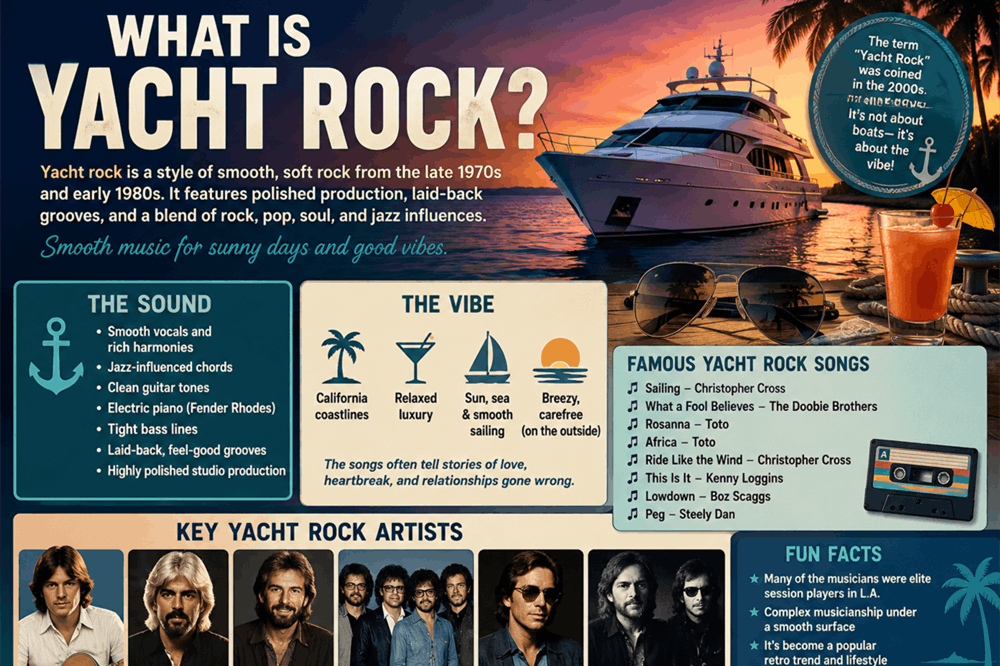
Yacht rock is a style of polished, smooth pop and rock associated mainly with the late 1970s and early 1980s. It typically features soft vocals, sophisticated studio production, jazz-influenced chords, electric piano, clean guitar, tight bass lines, and relaxed grooves. Artists commonly associated with yacht rock include Christopher Cross, Michael McDonald, Toto, Kenny Loggins, Boz Scaggs, and Steely Dan.
The name can make it sound like music written specifically for boats, but that is not really what yacht rock means. The term was created decades after most of the music was recorded. It describes a particular sound and production style that happens to evoke sunny coastlines, expensive studios, soft breezes, and an unusually comfortable version of late-1970s California.
What Does Yacht Rock Mean?
Yacht rock refers to a loosely defined group of smooth, highly produced songs that flourished around the end of the 1970s and beginning of the 1980s.
The music tends to sit somewhere between soft rock, pop, R&B, jazz, and soul.
It is usually melodic rather than aggressive.
The arrangements may sound relaxed, but the musicianship underneath them is often extremely precise.
A yacht rock song might contain:
- Electric piano
- Clean electric guitar
- Smooth backing vocals
- Detailed bass lines
- Jazz-influenced chord changes
- Saxophone
- Light percussion
- Polished studio production
- R&B or soul influences
The result is music that feels easy to listen to without necessarily being simple to play.
Why Is It Called Yacht Rock?
The musicians themselves generally did not call their music yacht rock when they were making it.
The label came later.
The term became popular through a comedy web series called Yacht Rock, which humorously imagined the lives and rivalries of musicians associated with the smooth Southern California sound.
The name worked because the music seemed to match a very specific imagined lifestyle.
Picture a white yacht moving slowly along the California coast.
The sun is setting.
Someone is wearing an open-collar shirt.
The drinks are cold.
A perfectly recorded Fender Rhodes keyboard is playing somewhere in the background.
That exaggerated image captures the mood people now associate with yacht rock.
The irony is that many of the songs themselves are not carefree at all.
They often deal with heartbreak, betrayal, loneliness, romantic confusion, and relationships falling apart.
The music sounds smooth.
The emotions underneath it frequently are not.
What Does Yacht Rock Sound Like?
The easiest way to recognize yacht rock is through its production.
Everything tends to sound controlled.
The drums are clean rather than explosive. Guitars usually shimmer instead of distort. Keyboards create soft harmonic layers. Vocals are polished, often supported by carefully arranged harmonies.
Even when the rhythm is funky, it rarely feels chaotic.
There is usually room between the instruments.
This makes yacht rock ideal for background listening, but the better examples reward closer attention. A song that initially sounds simple may contain sophisticated chord changes, unusual rhythmic details, or extremely precise studio performances.
What Years Are Considered the Yacht Rock Era?
Yacht rock is most strongly associated with music released from roughly the mid-1970s through the mid-1980s, with the late 1970s and early 1980s representing the core period.
This was an era when major recording studios had become extremely sophisticated.
Artists had access to excellent session musicians, expensive analog equipment, detailed multitrack recording, and producers willing to spend enormous amounts of time perfecting performances.
The result was a particular kind of studio perfection.
Rather than sounding raw or spontaneous, many yacht rock recordings feel carefully engineered down to the smallest detail.
Who Are the Main Yacht Rock Artists?
There is no official membership list, but several artists repeatedly appear whenever yacht rock is discussed.
Christopher Cross
Christopher Cross may be the artist most closely associated with the term.
His music combines soft vocals, sophisticated arrangements, polished guitar, and the kind of coastal imagery that perfectly fits the yacht rock stereotype.
“Sailing” is practically the genre’s unofficial theme song.
Its gentle rhythm, floating melody, and ocean imagery make it almost impossible to separate from the yacht rock concept.
Michael McDonald
Michael McDonald is another central figure.
His distinctive voice appears throughout the period, both through his work with The Doobie Brothers and through collaborations and background vocals on other recordings.
McDonald brings more soul and R&B influence to the sound.
His presence is one reason yacht rock is not simply another name for soft rock.
Kenny Loggins
Kenny Loggins moved easily between soft rock, pop, soundtrack music, and the polished West Coast sound associated with yacht rock.
His collaborations with Michael McDonald strengthened that connection.
Some Loggins songs are more clearly yacht rock than others, but he remains one of the artists most often included in the conversation.
Toto
Toto is important because the band included elite studio musicians who helped define the polished sound of the era.
Their recordings could move between rock, pop, jazz, funk, and R&B without sounding uncomfortable in any of them.
“Rosanna” is particularly useful for understanding yacht rock because it combines complicated musicianship with an extremely smooth surface.
Boz Scaggs
Boz Scaggs helped establish some of the musical language that yacht rock would later become known for.
His 1970s work blended blue-eyed soul, pop, jazz, and smooth studio production.
Albums such as Silk Degrees also involved musicians who would become closely connected with Toto.
Steely Dan
Steely Dan occupies a slightly unusual position.
The band’s music is often more cynical, harmonically complex, and intellectually strange than the relaxed yacht rock stereotype suggests.
But the immaculate production, jazz influence, studio musicianship, and smooth surfaces make Steely Dan essential to the broader conversation.
They may not represent the genre’s easiest side, but they helped create the musical environment from which it emerged.
What Are Some Famous Yacht Rock Songs?
If you want to understand yacht rock quickly, listening is more useful than reading definitions.
These songs provide a strong starting point:
- “Sailing” — Christopher Cross
- “Ride Like the Wind” — Christopher Cross
- “What a Fool Believes” — The Doobie Brothers
- “Rosanna” — Toto
- “Africa” — Toto
- “This Is It” — Kenny Loggins
- “Heart to Heart” — Kenny Loggins
- “Lowdown” — Boz Scaggs
- “Peg” — Steely Dan
- “Deacon Blues” — Steely Dan
- “I Keep Forgettin’” — Michael McDonald
- “Reminiscing” — Little River Band
- “Baby Come Back” — Player
Not everyone agrees that every one of these songs belongs equally inside the yacht rock category.
That disagreement is part of the fun.
Yacht rock is not an official industry genre with strict rules. It is a retrospective label built around a recognizable musical center.
Is “Africa” by Toto Yacht Rock?
“Africa” is frequently included on yacht rock playlists, although it does not fit every traditional definition perfectly.
The song is polished, melodic, rhythmically sophisticated, and performed by musicians deeply connected with the yacht rock world.
At the same time, its atmosphere is more dramatic and geographically expansive than the California-coastal feeling associated with the genre.
This is a good example of why yacht rock discussions can become surprisingly serious.
Some listeners use the term broadly for almost any smooth 1970s or 1980s soft rock.
Others apply much stricter musical criteria.
Is “Sailing” the Ultimate Yacht Rock Song?
Probably.
Christopher Cross’ “Sailing” combines nearly everything people associate with yacht rock.
It has a smooth arrangement, gentle vocals, immaculate production, sophisticated musicianship, and an actual nautical theme.
The song sounds effortless, which is part of the illusion.
A tremendous amount of craft is hidden beneath that calm surface.
If someone had never heard yacht rock and wanted one song to understand the idea, “Sailing” would be difficult to beat.
What Is the Difference Between Yacht Rock and Soft Rock?
Soft rock is a much broader category.
It includes mellow rock and pop music from many artists, decades, and production styles.
Yacht rock is more specific.
A soft rock song might simply be gentle and melodic.
A yacht rock song usually has additional characteristics:
- High-level studio musicianship
- Jazz or R&B influence
- Sophisticated chord progressions
- Extremely polished production
- A late-1970s or early-1980s West Coast studio feel
That means most yacht rock could reasonably be described as soft rock, but not all soft rock is yacht rock.
A simple acoustic ballad from the same period may be soft rock without having anything particularly yacht-like about it.
Is Yacht Rock the Same as Adult Contemporary?
No.
Adult contemporary is primarily a radio format and broad musical category built around accessible, generally melodic popular music.
It covers far more than yacht rock.
An adult contemporary station might play power ballads, singer-songwriters, mainstream pop, soft rock, and romantic music from several decades.
Yacht rock describes a much more specific cluster of sounds and musicians.
Why Does Yacht Rock Have So Much Jazz Influence?
Many musicians involved in these records had far more technical training than the smooth surface suggests.
They were comfortable using chord changes and harmonies drawn from jazz, soul, and R&B.
That is why certain yacht rock songs feel subtly richer than ordinary three-chord pop.
The listener may not consciously identify a sophisticated chord substitution.
They simply hear a song that feels unusually smooth and harmonically satisfying.
This is one of yacht rock’s defining contradictions.
The music feels easy.
The musicianship often is not.
Why Were Session Musicians So Important to Yacht Rock?
Elite session players were central to the sound.
During the 1970s and early 1980s, Los Angeles had a large network of professional studio musicians who could move between projects quickly and perform complex material with extraordinary precision.
The same musicians could appear across multiple albums by different artists.
This created a kind of shared musical language.
The drums might have a familiar tightness. The keyboard voicings might resemble another record. A backing vocalist might appear on several seemingly unrelated albums.
That overlap helps explain why yacht rock can feel like a coherent genre even though the artists involved never formed an official movement.
Does Yacht Rock Have to Be About Boats?
No.
Most yacht rock songs are not actually about yachts.
The nautical association is largely humorous and atmospheric.
“Sailing” obviously fits the image perfectly, but a song about romantic betrayal can be just as yacht rock if the production, harmony, rhythm, and musicianship match the style.
The boat is a metaphor for the mood.
It represents smoothness, comfort, sunshine, leisure, and polished late-1970s luxury.
Why Are So Many Yacht Rock Songs About Bad Relationships?
This is one of the genre’s most entertaining contradictions.
The music often sounds incredibly comfortable while the lyrics describe emotional disaster.
Someone has left.
Someone is cheating.
Someone refuses to understand that a relationship is over.
Someone is realizing that love was not what they thought it was.
Yet the bass is perfect, the harmonies are beautiful, and the electric piano sounds expensive.
“What a Fool Believes” is an excellent example.
The groove is buoyant and sophisticated, but the emotional situation involves a man misunderstanding a relationship that never meant what he imagined it did.
That contrast is one reason yacht rock remains interesting beyond its retro aesthetic.
Why Did Yacht Rock Become Popular Again?
Nostalgia plays a role.
Music associated with the late 1970s and early 1980s carries a particular visual world: analog studios, vintage keyboards, pastel colors, convertibles, coastal highways, and elaborate record production.
But nostalgia alone does not explain the revival.
The music is also genuinely easy to enjoy.
It works at parties without demanding attention.
It works during road trips.
It works in restaurants, at the beach, while cooking, or while sitting outside in summer.
At the same time, musicians and serious listeners can appreciate the technical skill underneath it.
Yacht rock therefore works on two levels.
You can analyze the chords.
Or you can simply enjoy the breeze.
Is Yacht Rock Supposed to Be Funny?
The name definitely contains humor.
Part of the modern appeal comes from exaggerating the image surrounding the music.
Yacht parties, captain’s hats, pastel clothing, cocktails, mustaches, and marina imagery have all become part of the aesthetic.
But the music itself was generally not created as a joke.
The musicians were serious professionals making carefully produced pop, rock, soul, and jazz-influenced records.
The modern label can be playful without making the original music meaningless.
Is Hall & Oates Yacht Rock?
Hall & Oates are sometimes included on yacht rock playlists, but their catalog is too broad to fit completely inside the genre.
The duo moved through soul, rock, pop, new wave, and R&B across different periods.
Some songs overlap with the smooth yacht rock aesthetic more closely than others.
This is true for many artists associated with the category.
Yacht rock usually describes particular songs or periods rather than everything an artist ever recorded.
Is Fleetwood Mac Yacht Rock?
Fleetwood Mac is usually better described as rock, pop rock, or soft rock.
Certain recordings may sit comfortably beside yacht rock on a playlist because of their polish and California atmosphere, but the band’s core sound developed from different musical traditions.
This distinction matters because simply being smooth and recorded in California does not automatically make something yacht rock.
Is Steely Dan Really Yacht Rock?
Steely Dan is one of the most debated examples.
They share many of yacht rock’s defining traits: elite studio musicians, sophisticated harmony, jazz influence, immaculate production, and a cool late-1970s sound.
But their lyrics are often too dark, ironic, cynical, and strange to fit the carefree yacht stereotype comfortably.
That tension actually makes them important.
Steely Dan demonstrates that yacht rock is ultimately more about musical construction than literal sunshine and boats.
How Can You Tell If a Song Is Yacht Rock?
Ask several questions.
Does it sound extremely polished?
Does it use clean guitars, electric piano, layered vocals, or jazz-influenced harmony?
Does the rhythm feel smooth rather than aggressive?
Does it have noticeable soul or R&B influence?
Was it recorded around the late 1970s or early 1980s?
Does it sound like musicians spent a very long time making something difficult feel effortless?
If several of those answers are yes, you may be in yacht rock territory.
How to Build a Yacht Rock Playlist
Start with the core artists rather than adding every soft 1980s hit you remember.
A strong opening group might include:
- Christopher Cross
- The Doobie Brothers
- Michael McDonald
- Toto
- Kenny Loggins
- Boz Scaggs
- Steely Dan
- Player
- Little River Band
Then listen for songs that share the same production language.
The playlist should feel smooth but not sleepy.
Good yacht rock still grooves.
There should be bass movement, rhythmic precision, sophisticated harmony, and enough polish that every instrument seems to know exactly where it belongs.
The Bottom Line
Yacht rock is a style of exceptionally smooth, polished pop and rock associated mainly with the late 1970s and early 1980s.
It blends soft rock with elements of jazz, soul, R&B, and high-end studio craftsmanship.
Christopher Cross, Michael McDonald, Toto, Kenny Loggins, Boz Scaggs, and Steely Dan are among the artists most closely connected with the sound.
The name was invented later and is partly humorous. The musicians were not gathering in recording studios and announcing that they were making yacht rock.
What connects the music is the sound: clean guitars, electric piano, tight rhythm sections, sophisticated harmony, smooth vocals, and production so polished that difficult musicianship can seem effortless.
And despite the name, no yacht is required.
If the song sounds like heartbreak happening on a perfectly sunny afternoon beside the Pacific Ocean, you are probably getting close.