“Free” Lyrics Meaning: Rumi and Jinu’s KPop Demon Hunters Song About Shame, Trust and the Life They Cannot Have
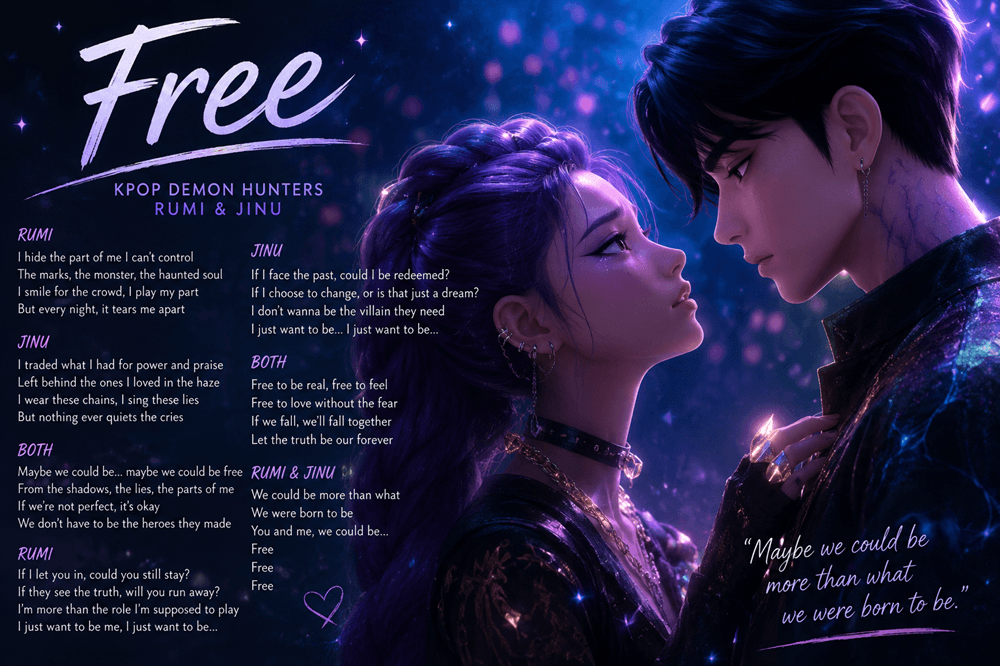
“Free” from KPop Demon Hunters is about two people who have spent their lives hiding painful parts of themselves and briefly imagining what might happen if they stopped.
Rumi hides her demonic heritage because she fears that her friends, fans and fellow hunters would reject her. Jinu serves the demon ruler Gwi-Ma while carrying centuries of guilt over the family he abandoned in exchange for wealth and status.
Although they begin as enemies, each recognizes the shame controlling the other.
The song’s central meaning is:
Freedom begins when someone sees the part of you that you hate most—and gives you a reason to believe it does not make you unworthy of love or redemption.
“Free” is the closest thing KPop Demon Hunters has to a traditional romantic duet, but it is not simply about two characters falling in love. It is about the possibility of becoming different people when they are together.
Rumi and Jinu imagine a life without secrets, inherited roles or the voices telling them they can never change.
The tragedy is that imagining freedom is easier than choosing it.
What is “Free” about?
“Free” follows Rumi and Jinu as they lower the emotional defenses separating them.
At this point in the film, they are supposed to be enemies.
Rumi is the leader of HUNTR/X, a K-pop trio whose music helps protect humanity from demons. Jinu leads the Saja Boys, a demonic boy band created to steal HUNTR/X’s fans and weaken the magical Honmoon barrier.
Their roles appear completely opposed:
- Rumi protects human souls.
- Jinu serves the demons trying to consume them.
- Rumi believes demons must be destroyed.
- Jinu believes escape from Gwi-Ma may be impossible.
- Rumi hides that she is part demon.
- Jinu hides that he was once human.
Their connection begins when each discovers that the other does not fit neatly into the identity they perform publicly.
Rumi is not purely human.
Jinu is not purely monstrous.
“Free” allows them to imagine that those contradictions do not have to be corrected or hidden.
Netflix describes the duet as Rumi and Jinu sharing desires they have never revealed to anyone else and imagining what they might become together, despite the enormous barriers between them.
What does “free” mean in the song?
Freedom has several meanings for Rumi and Jinu.
Freedom from shame
Both characters believe their hidden pasts make them unacceptable.
Rumi has spent her life trying to remove the demonic patterns on her body. Jinu has spent centuries avoiding the guilt attached to his human life.
They do not merely keep secrets from others.
They also try to hide those truths from themselves.
Freedom from control
Rumi is controlled by expectations surrounding perfection, duty and the belief that a demon hunter can never contain demonic blood.
Jinu is controlled more directly by Gwi-Ma, who uses his guilt and misery to keep him obedient.
Both understand what it means to live according to a role someone else has assigned.
Freedom to be seen
Neither character feels fully known.
Rumi’s fans see a flawless idol.
Mira and Zoey see a dependable leader.
Celine sees the child she must protect from a dangerous inheritance.
Jinu’s fans see a charming pop star, while Gwi-Ma sees a useful servant.
During “Free,” each character encounters someone who begins seeing beyond those surfaces.
Freedom to choose differently
The song asks whether identity is determined by origin or by action.
Rumi was born part demon but chooses to protect people.
Jinu became a demon through a selfish choice, yet he may still be capable of making a sacrificial one.
Freedom means believing the past can influence a person without permanently owning them.
Why do Rumi and Jinu understand each other?
They recognize the same emotional wound in different forms.
Rumi believes that revealing her demonic side would destroy everything she loves. She therefore treats concealment as protection.
Jinu believes that facing his human past would expose a guilt too painful to survive. He treats avoidance as freedom, even though it keeps him under Gwi-Ma’s control.
Both characters:
- Live behind carefully maintained performances
- Fear being truly known
- Carry identities they consider shameful
- Believe their secrets could separate them from others
- Use achievement to avoid confronting pain
- Feel trapped between two worlds
- Want connection while distrusting it
This similarity allows intimacy to develop quickly.
They do not need to explain why secrecy becomes exhausting.
Each has already lived that experience.
Rumi is Jinu’s enemy, but she may be the first person capable of understanding why he wants another life.
Jinu is a demon, but he may be the first person who sees Rumi’s demonic heritage without immediately treating it as proof that she is evil.
Is “Free” a love song?
Yes, although its romance is built around emotional recognition rather than a conventional declaration.
Rumi and Jinu do not spend the song imagining dates, marriage or an ordinary future. They imagine the relief of being honest with someone who understands.
That makes the connection intimate.
Their attraction grows from several experiences:
- Being seen without the public persona
- Sharing secrets
- Recognizing similar loneliness
- Feeling less divided in each other’s presence
- Imagining that change may be possible
- Receiving compassion from an unexpected person
The romantic feeling comes from possibility.
They are not yet free, but being together allows them to picture freedom.
Executive music producer Ian Eisendrath described the song as a musical image of the life Rumi and Jinu wish they could have, created by two people sharing things they may never have told anyone else.
Why is their relationship forbidden?
Their relationship threatens almost every structure surrounding them.
Rumi has been trained to believe demons are humanity’s enemies.
Jinu belongs to the group trying to defeat her and steal the souls of her fans.
If Rumi trusts him, she risks:
- Betraying her responsibilities as a hunter
- Endangering Mira and Zoey
- Weakening the Honmoon
- Being manipulated by Gwi-Ma
- Revealing her own secret
- Questioning everything Celine taught her
If Jinu trusts Rumi, he risks:
- Defying Gwi-Ma
- Losing the protection of his demon identity
- Facing his human guilt
- Abandoning the Saja Boys’ mission
- Accepting that redemption requires sacrifice
- Believing in a future he may never receive
Their bond is not dangerous merely because they belong to opposing groups.
It is dangerous because understanding one another could dismantle the identities on which both sides depend.
What is Rumi hiding?
Rumi is half demon.
Her mother was a demon hunter, while her father was a demon. After her mother died shortly after childbirth, Celine adopted and trained her.
Rumi grows up believing that her demonic inheritance is a flaw that must be removed.
She hides the markings on her skin and hopes that sealing the Golden Honmoon will make them disappear. Her mission to protect the world is therefore connected with a private desire to cure herself.
Netflix’s character history describes Rumi as someone who has spent most of her life attempting to remove a part of herself she considers shameful. Her journey eventually requires her to stop treating that inheritance as a verdict on her character.
“Free” takes place before she fully reaches that acceptance.
She wants to believe she can live honestly, but she is still frightened of what honesty could cost.
Why is Rumi losing her voice?
Rumi’s damaged voice symbolizes the consequences of suppressing her identity.
Her voice is central to every part of her life.
It allows her to:
- Lead HUNTR/X
- Connect with fans
- Strengthen the Honmoon
- Fight demons
- Express herself through music
- Maintain the image of a perfect idol
As her shame becomes harder to contain, the thing giving her purpose begins to fail.
This creates a painful contradiction.
Rumi believes hiding her demonic identity protects her career and friendships. In reality, the secrecy is damaging the voice on which those things depend.
Her body is revealing what she refuses to say openly.
Jinu understands that shame can become a form of imprisonment because Gwi-Ma controls demons through the same emotion.
That is why his recognition matters so much.
He does not merely see that Rumi has markings.
He understands what it means to fear that an unwanted identity has become permanent.
What is Jinu hiding?
Jinu was once human.
More than four centuries earlier, he came from poverty and wanted enough success to escape hunger. He accepted Gwi-Ma’s offer of fame and wealth, eventually living comfortably in a palace.
But his advancement came at a terrible cost.
He left behind his mother and younger sister.
Rather than return for them, he continued enjoying the life he had gained. His guilt over that choice becomes the emotional chain Gwi-Ma uses to control him.
Netflix describes Jinu as a former human who sold his soul for fame and fortune and later became the immortal demon leading the Saja Boys. His arrogance conceals profound shame over abandoning his family.
During “Free,” he allows Rumi closer to the truth than he allows anyone else.
However, he does not yet reveal everything.
That incomplete honesty becomes crucial later.
Why doesn’t Jinu tell Rumi the whole truth?
Jinu wants the comfort of being understood without fully confronting the act he finds unforgivable.
He shares enough vulnerability to create closeness, but he continues controlling the story.
This shows that he has begun changing but is not yet free.
Complete honesty would require him to admit:
- He did not merely lose his family.
- His ambition influenced the separation.
- He benefited while they suffered.
- He repeatedly chose not to return.
- Gwi-Ma’s power depends partly on guilt Jinu refuses to face.
Jinu fears that Rumi’s compassion would disappear if she knew everything.
That fear resembles Rumi’s belief that Mira and Zoey would reject her if they saw her markings.
Both characters want to be accepted.
Neither initially trusts acceptance enough to provide the complete truth.
Why is honesty central to the song?
“Free” suggests that healing requires facing what has been hidden.
Rumi and Jinu cannot change by pretending their shame does not exist.
They must recognize:
- What happened
- What they fear
- What they regret
- Which beliefs were imposed on them
- Which choices remain their responsibility
- What kind of person they want to become next
Honesty is frightening because it removes control over how another person will respond.
A secret allows someone to preserve a relationship, but only with the version of themselves they have chosen to reveal.
Being known requires risking rejection.
The duet captures the moment before that risk is complete.
Rumi and Jinu move toward honesty and experience enough relief to imagine another life.
The film later shows that partial honesty cannot support freedom indefinitely.
Why does it feel easier when they are together?
Each character temporarily escapes the pressure to perform.
Rumi does not have to be HUNTR/X’s perfect leader.
Jinu does not have to be the Saja Boys’ charming, manipulative frontman.
Their conversations allow them to become two frightened individuals rather than symbols in a supernatural conflict.
This emotional ease can be mistaken for proof that the relationship will solve everything.
It cannot.
Rumi cannot heal Jinu’s guilt for him.
Jinu cannot make Rumi accept herself simply by accepting her.
What they can do is reveal that another emotional experience is possible.
For a few moments:
- Rumi is not treated as contaminated.
- Jinu is not treated as irredeemable.
- Neither person has to pretend certainty.
- Their pasts do not completely determine the present.
- Connection becomes stronger than inherited hatred.
The song does not portray love as a cure.
It portrays love as evidence that healing might be worth attempting.
Does Rumi want to save Jinu?
Yes, but her idea of saving him is more complex than simply defeating Gwi-Ma.
Rumi recognizes that Jinu’s obedience is connected with shame. She believes that if he faces the truth and chooses differently, he may be able to reclaim his soul.
Her offer also reflects what she wants someone to believe about her.
If Jinu can be more than a demon, then Rumi can be more than her demonic blood.
Helping him becomes a way of testing her emerging belief that origin does not equal destiny.
However, Rumi risks overlooking the difference between compassion and trust.
Jinu may deserve the opportunity to change.
That does not mean he has already become dependable.
The song exists during a hopeful moment when potential feels almost as convincing as action.
Is Jinu genuinely trying to change?
Part of him is.
His feelings for Rumi appear to awaken emotions he has suppressed for centuries. He begins questioning Gwi-Ma’s control and imagining a future in which he no longer serves the demon ruler.
But Jinu remains afraid.
When change demands immediate sacrifice, his shame and survival instincts regain control. He betrays Rumi before eventually making a final redemptive choice.
This does not make the connection in “Free” false.
It shows that wanting to change and being ready to change are different things.
Jinu’s journey includes:
- Recognizing his imprisonment
- Imagining freedom
- Becoming frightened by its cost
- Returning temporarily to obedience
- Facing the full truth
- Choosing sacrifice
“Free” belongs to the second stage.
He can picture another life, but he has not yet developed the courage required to enter it.
Why is the song tragic?
The duet presents a future the audience gradually realizes may never exist.
Rumi and Jinu imagine:
- Living without secrets
- Escaping inherited roles
- Being accepted completely
- Choosing each other over the conflict
- Entering a life not controlled by shame
The emotional possibility is genuine.
The practical possibility is fragile.
They have met too late, after centuries of manipulation and years of secrecy have shaped their instincts. Their connection opens a door, but neither knows how to walk through it without causing harm.
Jinu ultimately helps free Rumi by sacrificing himself.
He does not receive the future they imagined.
The song therefore becomes more painful after the film ends.
What initially sounds like a promise becomes a glimpse of the life that could have existed under different circumstances.
Does Jinu redeem himself?
Yes, although redemption does not erase his earlier choices.
Near the end, Jinu finally reveals that he abandoned his family after accepting Gwi-Ma’s offer. He stops describing himself only as a victim of demonic control and accepts responsibility for the human decision that began his fall.
He then defies Gwi-Ma and gives his soul to Rumi, allowing her to fight back and protect humanity.
Netflix describes his final act as a moment of tragic grace: a fallen character choosing light even though he cannot preserve his own future.
His sacrifice fulfills the emotional promise of “Free.”
He becomes free not by escaping consequences but by choosing something other than shame and self-preservation.
Does Rumi become free?
Rumi’s freedom comes from accepting rather than erasing herself.
For most of the film, she believes peace will arrive when the demonic part of her disappears.
By the conclusion, she understands that her heritage does not control her moral identity.
She can be:
- A demon hunter
- Part demon
- A K-pop idol
- A friend
- A leader
- Imperfect
- Worthy of love
These identities do not have to cancel one another.
Her final freedom is not a life without conflict.
It is a life without the belief that one hidden truth makes everything else false.
Netflix’s account of Rumi’s arc emphasizes that she turns the secret she once considered a curse into a source of strength.
Jinu helps her begin that process because he sees the markings and still sees Rumi.
Why is “Free” quieter than the other soundtrack songs?
Much of the KPop Demon Hunters soundtrack is designed around public performance.
Songs such as “How It’s Done,” “Golden,” “Soda Pop,” “Takedown” and “Your Idol” operate as concerts, music videos, battles or demonstrations of group identity.
“Free” is different.
It creates a private emotional space.
The arrangement emphasizes:
- Softer vocals
- Piano
- Atmospheric production
- Gradually expanding strings
- Harmonies that bring the two voices together
- A restrained build rather than an explosive dance break
The quieter sound reflects what the characters are doing.
They are no longer performing for fans.
They are attempting to communicate honestly.
The duet still feels polished enough to exist as a standalone pop ballad, but its production allows vulnerability to remain the focus.
Why do their voices begin separately?
Rumi and Jinu initially express their struggles from different emotional positions.
Their separate sections reinforce the boundaries between them.
Each character has:
- A different history
- A different form of shame
- A different relationship with demons
- A different reason to distrust connection
As the song develops, their voices move closer together.
The harmonies suggest that they are beginning to imagine one shared emotional truth.
This musical convergence matters because neither character completely knows whether the other can be trusted.
Singing together allows them to experience unity before their choices have fully created it.
The voices meet before their lives can.
Who sings “Free”?
EJAE performs Rumi’s singing voice, while Andrew Choi performs Jinu’s.
Arden Cho provides Rumi’s spoken voice in the English-language version, and Ahn Hyo-seop voices Jinu. Netflix’s official character guides identify the distinction between the characters’ speaking and singing performers.
EJAE’s delivery gives Rumi both strength and vulnerability. She sounds like someone accustomed to performing perfectly who is finally allowing uncertainty into her voice.
Andrew Choi gives Jinu a smoother but guarded presence. His performance suggests a character who wants closeness while remaining frightened of what complete honesty would expose.
Their contrasting textures support the story.
Rumi reaches toward freedom.
Jinu sounds as though he is still deciding whether he deserves it.
Who wrote and produced “Free”?
“Free” was written by Jenna Andrews, Stephen Kirk and Mark Sonnenblick.
Andrews, Kirk and executive music producer Ian Eisendrath produced the recording. EJAE and Eisendrath handled vocal arrangement, while Rob Mathes arranged the strings.
Apple Music’s official credits also list Stephen Kirk on keyboards, guitar, bass, drum programming and strings, with Andrews and Kirk contributing background vocals. The soundtrack recording was released on June 20, 2025, and runs slightly over three minutes.
Andrews and Kirk had previously collaborated on major pop projects, including BTS’s “Butter,” which helped prepare them for the challenge of creating songs that could function both inside a story and as convincing contemporary pop music.
How was “Free” written?
“Free” was the first song Andrews and Kirk completed for the film.
Andrews said the writing process happened quickly. The filmmakers provided an explanation of the scene and allowed the writers to develop their interpretation before the animation and final script were complete.
The filmmakers responded positively to the first version, unlike the finale “What It Sounds Like,” which required many more revisions as the story evolved.
This early creation helped shape the film rather than merely accompanying a finished scene.
The songwriters and filmmakers developed the music and script alongside one another. That process explains why “Free” reveals character so efficiently.
It does not pause the story.
It helps define what Rumi and Jinu want before either is capable of saying it through ordinary dialogue.
Why does the song work outside the film?
Listeners do not need to be half-demon hunters or immortal idols to understand its emotional conflict.
“Free” can describe anyone who:
- Hides part of themselves from a partner
- Believes their past makes them unlovable
- Feels controlled by family expectations
- Wants to leave an unhealthy situation
- Has difficulty trusting acceptance
- Meets someone who makes honesty feel possible
- Fears that vulnerability will lead to rejection
The supernatural story enlarges these emotions without replacing them.
Gwi-Ma’s control is magical, but shame controls real people too.
Rumi’s markings are fictional, but many people hide visible or invisible differences because they fear social judgment.
Jinu’s centuries of guilt are fantastical, but unresolved regret can shape an entire adult life.
The duet succeeds because its fantasy vocabulary expresses recognizable emotional experiences.
How successful was “Free”?
“Free” became one of the soundtrack’s most sustained streaming tracks, even though it did not receive the same chart attention as the global hit “Golden.”
In the United Kingdom, it reached No. 24 on the Official Streaming Chart and remained there for 19 chart weeks. It also peaked at No. 15 on the Official Video Streaming Chart, where it accumulated 20 chart weeks.
Netflix also selected it as one of the first five songs featured in the official KPop Demon Hunters lyric-video collection, alongside “How It’s Done,” “Golden,” “Soda Pop” and “Takedown.”
The wider soundtrack became a major global success. Netflix reported that it was the first soundtrack to place four songs simultaneously in the Billboard Hot 100 Top 10 and later surpassed 10 billion global streams.
Why did audiences connect with Rumi and Jinu?
Their relationship combines several familiar storytelling patterns:
- Enemies who begin understanding each other
- Two characters with mirrored secrets
- A romance divided by opposing duties
- A damaged person offered redemption
- A heroine learning that her feared difference is also a strength
- A connection that becomes meaningful because it cannot easily survive
But “Free” gives the relationship more than romantic tension.
Rumi and Jinu matter to each other because they alter how each character sees the self.
Rumi helps Jinu imagine that his soul is not permanently lost.
Jinu helps Rumi imagine that being part demon does not make her a monster.
Even after their relationship ends tragically, those changes remain.
Is their connection healthy?
It is emotionally meaningful, but it is not yet stable.
They offer one another recognition, compassion and hope.
They also hide information and make decisions that endanger other people.
Rumi wants to believe Jinu is ready for redemption because his redemption would support what she wants to believe about herself.
Jinu wants Rumi’s acceptance without immediately accepting full responsibility for his past.
Their bond contains genuine care alongside:
- Incomplete honesty
- Conflicting loyalties
- Unequal knowledge
- Manipulation from Gwi-Ma
- Enormous external pressure
- The risk of treating love as rescue
The song does not prove that a relationship between them would have solved their problems.
It proves that their connection helped them imagine becoming more honest people.
Why is “Free” important to the film?
“Free” connects the film’s romance with its larger theme of self-acceptance.
Without the song, Rumi and Jinu’s bond could appear to be based mainly on attraction or convenient cooperation.
The duet shows that they are drawn together because they share the same hidden fear:
If people knew the truth, they would leave.
That fear shapes almost every major conflict in the film.
Rumi hides from Mira and Zoey.
Jinu hides from Rumi.
Celine hides painful truths from Rumi.
Gwi-Ma gains power by convincing demons that their shame defines them.
“Free” offers the alternative.
Truth may create pain, but secrecy guarantees continued imprisonment.
What is the deeper meaning of “Free”?
The deeper meaning concerns the difference between escaping consequences and escaping shame.
Jinu initially wants freedom from the pain of remembering his family.
Rumi initially wants freedom from her demon identity.
Both imagine that peace requires removing the past.
The film eventually offers another definition.
Freedom does not mean pretending the past never happened.
It means facing it without allowing it to control every future decision.
Rumi cannot change how she was born.
Jinu cannot undo abandoning his family.
They can still decide what those truths mean next.
Rumi transforms inherited darkness into protective power.
Jinu transforms guilt into a final act of sacrifice.
Neither becomes innocent.
Both become capable of choosing.
Final meaning
“Free” from KPop Demon Hunters is about Rumi and Jinu briefly imagining a life beyond the shame, secrecy and roles controlling them.
Rumi hides her demonic heritage because she believes it makes her unworthy of belonging among her fellow hunters.
Jinu hides the human choices that led him into Gwi-Ma’s control because he believes his guilt makes redemption impossible.
When they meet, each sees the contradiction inside the other.
Rumi is part demon but repeatedly chooses compassion.
Jinu is a demon who still possesses traces of humanity.
Their duet becomes an emotional refuge where neither character has to perform the identity expected by their side of the conflict.
That refuge is real, but it is incomplete.
Rumi has not yet accepted herself fully.
Jinu has not yet told the entire truth.
They can sing about freedom before they are ready to pay its cost.
Jinu ultimately reaches freedom through sacrifice, giving his soul to Rumi after finally confronting what he did. Rumi reaches freedom by rejecting the belief that her demonic side must be erased before she can be loved.
The future they imagine together never arrives.
Yet the song still changes both characters.
“Free” ultimately suggests that another person cannot rescue you from your past. They can, however, see the part you believed made you unlovable—and help you imagine that facing it may lead somewhere other than rejection.