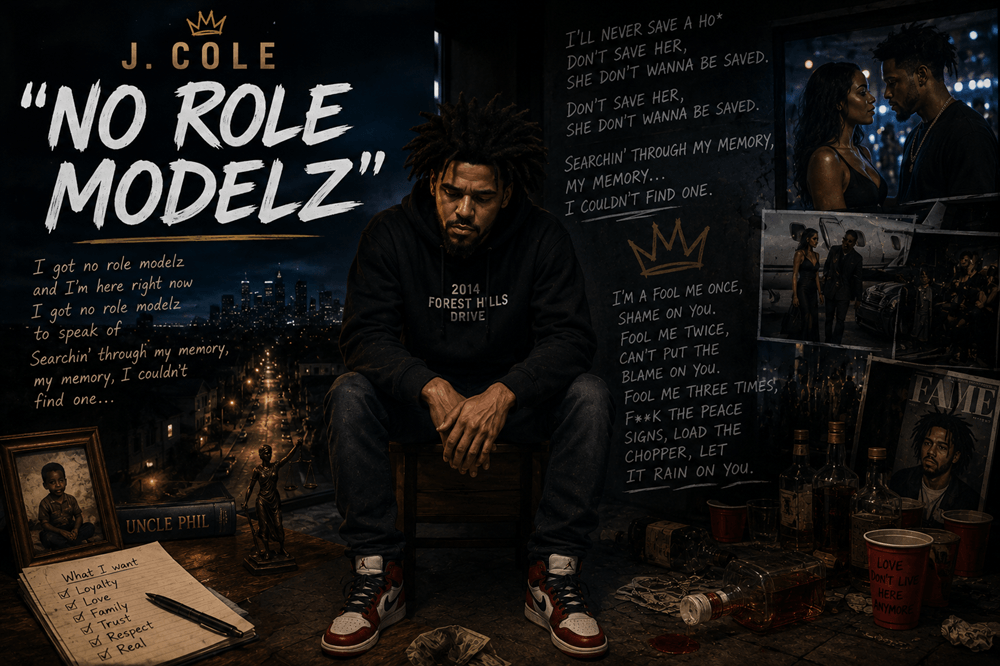
“No Role Modelz” Lyrics Meaning: J. Cole’s Song About Fame, False Love and Growing Up Without Guidance
J. Cole’s “No Role Modelz” is about a successful man discovering that fame has not solved the emotional problems he carried into adulthood.
He wants a loyal, meaningful relationship, but many of the people around him appear attracted to celebrity, money and access rather than the person behind the public image. At the same time, Cole gradually admits that he participates in the same shallow culture he criticizes.
The song’s central meaning is:
Without trustworthy examples of love, responsibility and adulthood, people may repeat unhealthy behavior while blaming others for the emptiness they helped create.
The title refers to more than famous people worth admiring. Cole is searching for models of how to become a dependable man, choose a healthy partner and remain grounded after success.
He finds very few.
That absence helps explain his distrust, but it does not excuse everything he says or does. The song is most revealing when Cole recognizes that fame has also changed his own behavior.
Listeners can hear the complete recording through J. Cole’s official “No Role Modelz” audio. The track appears on his 2014 album 2014 Forest Hills Drive.
What is “No Role Modelz” about?
“No Role Modelz” follows Cole as he compares the kind of love he wants with the relationships fame has made available to him.
He describes a world filled with:
- People attracted to celebrity status
- Relationships based on access or appearance
- Casual encounters that leave him unsatisfied
- Public images that seem more appealing than private reality
- A shortage of dependable fathers and mentors
- His own growing inability to treat intimacy seriously
Cole initially sounds confident that he can identify who is genuine and who is using him.
As the song continues, that confidence becomes less convincing.
He admits that fame changed the way he speaks about women and the kinds of encounters he accepts. He criticizes superficial behavior while repeatedly choosing situations built around the same values.
The song therefore works as both an accusation and a confession.
What does “no role models” mean?
The title describes the absence of people who can demonstrate how to live well.
Cole is not only searching for celebrities to admire. He needs examples of:
- Responsible fatherhood
- Stable romantic love
- Loyalty after financial success
- Respectful relationships
- Personal discipline
- Integrity inside a fame-driven industry
A role model offers more than inspiration.
They provide a practical example of what to do when money, attraction, anger or temptation make decisions complicated.
Without that guidance, Cole appears to learn through mistakes.
He becomes financially successful before becoming completely certain about the kind of man he wants to be.
That imbalance creates much of the song’s conflict.
Why does the song begin with Uncle Phil?
The opening tribute refers to Philip Banks, commonly known as Uncle Phil, from The Fresh Prince of Bel-Air.
James Avery played Philip as the strict but caring head of the Banks household. The character was a lawyer and judge who became an important father figure for Will Smith’s fictional teenage character. Avery died on December 31, 2013, less than a year before 2014 Forest Hills Drive was released.
Cole’s reference shows how a fictional television parent can become meaningful when dependable examples are missing in real life.
Uncle Phil represented:
- Authority without abandonment
- Financial success without emotional absence
- Discipline combined with affection
- A Black father shown as intelligent and responsible
- Someone willing to correct a young man without rejecting him
Cole does not claim that a television character can replace an actual parent.
He shows why viewers may attach themselves to characters who demonstrate qualities they have not experienced closely enough elsewhere.
Why does Cole call Uncle Phil a father figure?
Uncle Phil repeatedly gives Will boundaries, advice and emotional support.
He does not approve of every choice Will makes, but he continues treating him as family.
That consistency matters.
Cole’s narrator appears surrounded by temporary relationships. People may enjoy his fame, money or company, but he remains uncertain about who would stay when those benefits disappear.
Uncle Phil represents the opposite of temporary attention.
He is dependable even when the young person under his care behaves badly.
By invoking him before discussing romance, Cole suggests that relationship problems begin before dating.
The way someone experiences—or fails to experience—parental guidance may influence:
- What they expect from love
- How they respond to rejection
- Whether they trust commitment
- How they treat partners
- What kind of parent they hope to become
The song’s romantic frustration is connected to a deeper fear of repeating abandonment.
Is the song really about women?
Women occupy much of the narrative, but the deeper subject is Cole’s own disappointment with fame and himself.
He complains about women he believes are interested in celebrity status. Yet he also chooses partners based on appearance, participates in casual encounters and uses degrading language.
This contradiction is intentional enough to matter.
At one point, Cole looks back at the person he was before becoming a celebrity and recognizes that fame affected the way he talks and thinks.
That self-awareness changes the song.
He can no longer present himself only as an innocent man surrounded by dishonest people.
He has entered the same culture he claims to dislike.
Is Cole criticizing himself?
Yes, although the self-criticism is incomplete.
Cole acknowledges that fame has made him more dismissive and objectifying. He remembers an earlier version of himself who seemed less consumed by status and celebrity behavior.
This admission suggests that the people around him are not the only ones who changed.
Success gave him:
- More romantic options
- Less pressure to remain accountable
- Greater access to temporary relationships
- The ability to leave instead of resolving conflict
- An audience willing to excuse his behavior
Cole understands that these privileges have not made him wiser.
They may have made it easier to avoid growth.
However, he continues directing much of his anger outward. He recognizes his participation without fully abandoning the double standard that allows him to judge women more harshly for similar behavior.
That tension is one reason the song remains debated.
Why does he distrust women in Los Angeles?
Los Angeles represents the entertainment industry rather than every woman living in the city.
In Cole’s description, relationships near Hollywood are shaped by:
- Fame
- Public image
- Reality television
- Career ambition
- Access to influential people
- Money
- The desire to be noticed
He worries that women may be responding to J. Cole the celebrity rather than Jermaine Cole the person.
That fear is understandable.
Fame makes motives difficult to evaluate because attention that appears romantic may actually be strategic.
The problem is that Cole begins treating suspicion as proof.
He assumes he can divide women into respectable partners and fame-seeking opportunists, even while admitting that men around them often cannot—or do not want to—recognize the difference.
The song captures genuine celebrity distrust but expresses it through broad judgments.
What does the repeated warning about “saving” someone mean?
The refrain advises against trying to rescue a person who does not want to change.
In the song’s immediate context, Cole applies that warning to women he views as committed to fame, attention and transactional relationships.
The idea can be understood more broadly:
- Love cannot force another person to change.
- Financial support does not create emotional loyalty.
- Attraction should not be mistaken for compatibility.
- A rescuer may be motivated by ego rather than compassion.
- People must participate in their own growth.
The refrain also protects Cole from vulnerability.
If he declares that someone cannot be saved, he no longer has to ask whether he misunderstood her, treated her unfairly or expected love without offering emotional safety.
The warning may contain wisdom.
It can also become an excuse to avoid accountability.
Where does the refrain come from?
The central refrain draws from Project Pat’s earlier song “Don’t Save Her.”
The official credits for “No Role Modelz” include writers connected with that earlier composition, including Paul Beauregard and Jordan Houston, better known through Three 6 Mafia as DJ Paul and Juicy J. Apple Music and the official YouTube release list the full group of credited songwriters.
Using the earlier refrain connects Cole’s song with a longer hip-hop conversation about mistrust, transactional relationships and the idea that romantic rescue is impossible.
Cole does not simply repeat that message.
He places it beside a confession that he lacks healthy examples of love.
The result is more psychologically complicated:
He tells himself not to rescue anyone while quietly wishing someone could offer him a more dependable kind of love.
What kind of love does Cole want?
Cole imagines love that feels ordinary, private and secure.
He wants a relationship in which:
- Both partners trust each other
- Parenthood is not surrounded by uncertainty
- Personal items can remain at each other’s homes
- Attraction continues without constant suspicion
- Fame is not the relationship’s foundation
- The couple behaves like a real family rather than a public arrangement
These desires are deliberately domestic.
After describing celebrity encounters and glamorous appearances, Cole’s ideal relationship is built around small signs of permanence.
He does not ultimately want more excitement.
He wants somewhere he can stop performing.
Why does he reference Aunt Viv?
Aunt Vivian from The Fresh Prince of Bel-Air represents an intelligent, confident and respected Black woman within a stable family structure.
Placed beside Uncle Phil, she helps complete the parental image Cole believes is missing elsewhere.
The two characters offered television viewers a model of:
- Marriage
- Education
- Professional achievement
- Family discipline
- Black prosperity
- Adults remaining present for their children
Cole’s attraction to that image reveals that he is not rejecting commitment.
He is frustrated because commitment feels more convincing in fictional or idealized examples than in the relationships available to him.
The television family becomes a standard against which real life appears disappointing.
What do Will Smith and Jada Pinkett Smith represent in the song?
Cole uses the couple as a symbol of visible, lasting Black love.
The important point is the public image available to listeners when the song was released in 2014, not a claim that outsiders understood every detail of the couple’s private relationship.
Celebrities often become symbols that exceed what the public actually knows about them.
Cole does the same thing he criticizes elsewhere in the song:
He uses a public image to construct a fantasy.
That reveals how difficult the search for role models can be.
Even when a famous couple appears stable, the audience sees only selected parts of the relationship.
The model may inspire people while remaining incomplete.
Why does the song mention Martin Luther King Jr.?
Cole imagines Martin Luther King Jr. recognizing or belonging within the values of Dreamville.
The reference connects Cole’s success with a larger tradition of leadership and social responsibility.
King represents:
- Purpose beyond personal wealth
- Public service
- Moral courage
- Leadership grounded in community
- A vision larger than entertainment
Cole’s reference is ambitious.
He wants his music and Dreamville identity to represent more than commercial success.
Yet the rest of the song deliberately complicates that ambition.
A man invoking King immediately moves into crude descriptions of relationships and fame.
The contrast shows the distance between Cole’s ideals and daily behavior.
He wants to inherit the language of principled leadership while admitting he is still struggling with basic emotional maturity.
What is the meaning of the George W. Bush sample?
The song includes part of a widely remembered 2002 speech in which President George W. Bush stumbled while trying to repeat the “fool me once” proverb.
Bush delivered the remarks at East Literature Magnet School in Nashville on September 17, 2002. The White House archive preserves the transcript, including the verbal mistake that later became a frequently replayed cultural clip.
Cole uses the sample to introduce a section about repeated deception.
The message is that being fooled once may be another person’s fault, but continuing to accept the same behavior eventually requires self-examination.
This principle applies to several relationships in the song:
- Women who may be using Cole
- Cole repeatedly choosing the same kind of encounter
- Audiences believing celebrity images
- People expecting fame to create happiness
- Cole promising himself that he has learned without changing his behavior
The Bush clip adds humor, but it also turns the song toward responsibility.
At some point, disappointment becomes a pattern.
Why does Cole become more threatening after the Bush sample?
The song shifts from disappointment toward aggression.
Cole takes a familiar proverb about learning from mistakes and exaggerates it into a warning about what happens after repeated betrayal.
This escalation reveals how quickly vulnerability can become anger.
Instead of saying, “I need better boundaries,” the narrator imagines responding with force.
That reaction may make him sound powerful, but it also shows emotional immaturity.
A role model might teach him how to:
- Recognize patterns earlier
- Leave unhealthy situations
- Communicate limits
- Accept embarrassment
- Respond without turning hurt into revenge
Without that guidance, he converts humiliation into aggression.
The threatening language is therefore not evidence that he has solved the problem.
It shows how trapped he remains inside it.
Why does Cole mention older celebrity women?
Cole imagines relationships with women who were already famous when he was younger.
These references express several connected ideas.
Missed timing
He regrets being too young to pursue people he admired.
Nostalgia
The women represent an earlier cultural period that appears more elegant or authentic in memory.
Idealization
Because he did not actually have those relationships, they remain untouched by ordinary disappointment.
Dissatisfaction with the present
Imagined partners from the past seem preferable to the people available after fame.
This is another fantasy of role models.
Cole creates ideal women from distance while judging real women through close contact.
The imagined relationships remain perfect because they never had the opportunity to become complicated.
Does the song idealize the past?
Yes.
Cole looks backward toward:
- Uncle Phil and Aunt Viv
- Earlier celebrity crushes
- His pre-fame personality
- A period when music seemed less commercially dependent
- Relationships he imagines as more genuine
The past becomes a place where values appear clearer.
However, nostalgia is selective.
Cole remembers what earlier images represented to him, not necessarily how complete or realistic those images were.
This matters because the song repeatedly criticizes people for being out of touch with reality.
Cole is not immune to that problem.
His preferred world is partly built from television, celebrity fantasy and memory.
Is “No Role Modelz” misogynistic?
Parts of the song have reasonably been criticized as misogynistic.
Cole repeatedly reduces women to insulting categories, judges their sexual behavior and presents himself as more morally aware despite participating in similar encounters.
Pitchfork’s review of 2014 Forest Hills Drive argued that the song turns regressive ideas about women into a supposed moral struggle, highlighting the contradiction between Cole’s reputation for thoughtfulness and the track’s crude judgments.
The criticism does not require dismissing the entire song.
Its self-awareness, celebrity anxiety and reflections on fatherhood remain meaningful.
But interpretation should not erase the double standard.
Cole’s narrator:
- Criticizes women for seeking fame while benefiting from fame himself
- Condemns casual relationships while participating in them
- Wants respectful love while using disrespectful language
- Complains about being judged for money while judging others by appearance
- Recognizes his decline without fully changing his behavior
The contradictions are part of the text, not distractions from it.
Is Cole being intentionally hypocritical?
The song contains enough self-criticism to suggest that at least some hypocrisy is deliberate.
Cole looks backward and notices that celebrity life changed him.
He understands that he cannot clearly distinguish between genuine and transactional relationships partly because he also approaches intimacy transactionally.
However, recognizing hypocrisy is not the same as resolving it.
The narrator remains caught between two identities:
The reflective Cole
He wants family, loyalty, maturity and meaningful cultural leadership.
The celebrity Cole
He enjoys access, casual encounters, status and the freedom to leave without commitment.
“No Role Modelz” works because neither identity defeats the other.
The song documents a conflict, not a completed transformation.
What does the song say about fame?
Fame expands opportunity while weakening trust.
Before success, Cole may have worried that women would reject him.
After success, he worries they will accept him for the wrong reason.
This is not a simple improvement.
Fame provides:
- Money
- Attention
- Romantic access
- Social status
- Career freedom
It also creates:
- Suspicion
- Isolation
- Transactional relationships
- Pressure to perform a persona
- Doubt about who would remain without celebrity
Cole discovers that being desired is not the same as being known.
The more people recognize his public identity, the harder it becomes to determine who is interested in the private person underneath it.
Why does the song remain relatable outside celebrity culture?
Most listeners do not experience J. Cole’s level of fame.
They may still recognize the deeper problem.
Modern relationships are often shaped by public presentation. People evaluate each other through:
- Social media
- Appearance
- Occupation
- Status
- Lifestyle
- Popularity
- Curated images
This can create the same basic question Cole asks:
Does this person care about me, or what being connected to me represents?
The song also reflects the experience of growing up without clear emotional guidance.
A person may reach adulthood knowing how to succeed academically or professionally while remaining uncertain about:
- Choosing a partner
- Resolving conflict
- Becoming a parent
- Expressing vulnerability
- Breaking family patterns
External achievement can arrive before internal maturity.
Who produced “No Role Modelz”?
Darius “Phonix Beats” Barnes produced the track, with additional production from J. Cole.
Kaye Fox contributed background vocals. Juro “Mez” Davis handled recording and mixing, Brian Gardner mastered the track and Cole served as an executive producer alongside Dreamville, Mark Pitts and Roc Nation. The album recording runs approximately four minutes and 52 seconds.
The production is restrained enough to keep the focus on Cole’s voice.
Its repeated vocal elements and steady rhythm allow the song to move between reflection, humor, frustration and aggression without needing major instrumental changes.
That simplicity helped make the refrain immediately recognizable.
Which album includes “No Role Modelz”?
“No Role Modelz” appears on J. Cole’s third studio album, 2014 Forest Hills Drive, released on December 9, 2014.
The album title refers to Cole’s childhood address in Fayetteville, North Carolina. It debuted at No. 1 on the Billboard 200, moving 375,000 equivalent album units in its first week according to Dreamville’s report of the chart result.
The album repeatedly looks backward at Cole’s development.
Its songs explore:
- Childhood
- Adolescence
- Ambition
- Fame
- Sexual insecurity
- Family
- The difference between success and fulfillment
“No Role Modelz” fits that larger structure because it asks what happens after the dream of fame becomes real.
Cole has achieved what his younger self wanted.
He remains unsure whether the achievement made him better.
How does the song fit 2014 Forest Hills Drive?
The album moves between memories of Cole’s upbringing and reflections on celebrity life.
Several songs show him comparing:
- Poverty with wealth
- Insecurity with public confidence
- Childhood ambition with adult consequences
- Genuine relationships with industry attention
- The desire to succeed with the desire to belong
“No Role Modelz” sits near the center of those tensions.
Cole sounds proud that he fulfilled predictions he made in Fayetteville.
He also sounds disappointed by the life waiting for him after fulfillment.
Success removed certain obstacles.
It did not teach him how to love, trust or become the father he imagines being.
Was 2014 Forest Hills Drive critically successful?
The album received a nomination for Best Rap Album at the 2016 Grammy Awards. Cole also received a Best Rap Performance nomination for “Apparently” from the same project.
Its reputation grew partly because Cole carried the project without prominently billed guest rappers, making the album feel closely connected to one voice and one personal history.
The absence of major featured verses strengthened Cole’s image as a self-contained storyteller.
However, reviews were divided on whether every moral argument was as thoughtful as the album intended. “No Role Modelz,” in particular, became an example of how Cole’s introspection could coexist with broad and sometimes demeaning judgments.
How successful was “No Role Modelz”?
The track became one of the most enduring songs in Cole’s catalog despite not initially behaving like a conventional chart-focused pop single.
Official Charts ranked it as Cole’s biggest UK song by chart sales in a 2021 career list, even though it had not entered the main UK Singles Chart. At that time, the organization credited it with 855,000 UK chart sales and more than 92 million UK streams.
The Recording Academy identified it in 2022 as Cole’s most-played Spotify song at that point, reporting more than 1.2 billion streams.
Its long-term popularity reflects the difference between an immediate chart peak and sustained cultural recognition.
The song continued growing through streaming, live performances, social media and listeners discovering 2014 Forest Hills Drive years after its release.
Why has the song lasted?
“No Role Modelz” combines a simple refrain with several unresolved questions:
- Can fame and genuine love coexist?
- How does someone learn fatherhood without experiencing it consistently?
- Can a person criticize superficial relationships while participating in them?
- Are public figures useful role models if their private lives remain unknown?
- Does self-awareness matter without behavioral change?
The song is catchy enough to work without close analysis.
Its contradictions give listeners reasons to return.
Cole sounds confident, insecure, judgmental, lonely and self-aware within the same recording.
That mixture feels more human than a perfectly consistent moral lesson.
What is the deeper meaning of “No Role Modelz”?
The deeper meaning concerns inherited emotional absence.
Cole has achieved enough money and recognition to construct almost any public identity he wants.
What he cannot easily construct is an internal model for:
- Trust
- Commitment
- Respect
- Fatherhood
- Partnership
- Emotional responsibility
Those qualities are usually learned through relationships, observation and repetition.
Without dependable examples, Cole borrows models from television, celebrity couples, historical leaders and his own imagination.
Each source is incomplete.
Uncle Phil is fictional.
Celebrity relationships are partly public performances.
Historical leaders cannot provide personal guidance.
Fantasy partners never have to survive real conflict.
Cole is left trying to build adulthood from fragments.
Final meaning
J. Cole’s “No Role Modelz” is about a man who becomes successful before learning how to trust love or define mature manhood.
He begins by honoring Uncle Phil, a fictional father whose consistency and authority offered the kind of example Cole felt was missing.
From there, the song moves into celebrity relationships, suspicion and disappointment.
Cole believes many women around him are attracted to fame rather than genuine connection. Yet he also admits that fame changed him. He became more dismissive, more objectifying and more willing to participate in the shallow encounters he condemns.
That contradiction is the song’s real center.
Cole wants dependable love while repeatedly choosing temporary intimacy.
He wants to become a better father while acknowledging that he lacks a clear model.
He wants the moral purpose associated with leaders such as Martin Luther King Jr. while behaving in ways that fall far below that ideal.
The repeated warning against rescuing someone can sound like wisdom, but it also protects him from examining his own role in the cycle.
“No Role Modelz” does not provide a clean lesson about good men and bad women.
It presents a narrator caught between maturity and celebrity temptation, using humor and blame to cover a deeper fear:
He has reached the life he once dreamed about, but nobody taught him how to live inside it.