
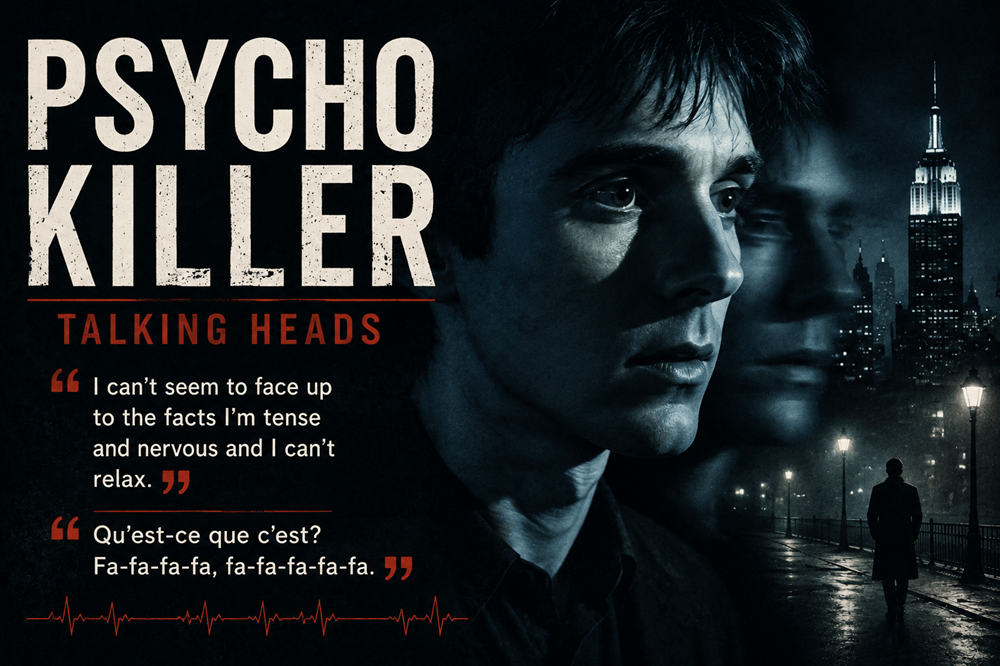
“Psycho Killer” Lyrics Meaning: Talking Heads’ Song About Anxiety, Isolation and a Disturbed Mind
Talking Heads’ “Psycho Killer” is an imagined interior monologue spoken by a deeply unstable person who cannot control his anxiety, anger or disconnected thoughts.
The narrator is tense, sleepless and easily irritated. Conversations frustrate him, other people seem unbearable and his mind repeatedly jumps between panic, resentment and fantasies of importance.
The song’s central meaning is:
“Psycho Killer” explores how fear, social alienation and wounded ego can become distorted inside a mind that no longer interprets other people normally.
Despite its title, the lyrics do not describe a detailed murder. David Byrne deliberately avoids a conventional crime story. Instead, he places listeners inside the character’s confused thought process and lets the rhythm suggest the danger that the words rarely state directly.
The complete recording is available through Talking Heads’ official “Psycho Killer” video, released in 2025 and starring Saoirse Ronan.
What is “Psycho Killer” about?
“Psycho Killer” is about a narrator whose thoughts are becoming increasingly disorganized and threatening.
He describes physical and emotional symptoms of extreme tension:
- He cannot relax.
- He cannot sleep.
- He feels overstimulated.
- Ordinary conversations make him angry.
- He believes other people speak without saying anything.
- He struggles to restrain his reactions.
- He imagines himself moving toward some form of glory.
The song never explains exactly what happened to him.
Listeners are not told:
- Who he has harmed
- Whether he has committed a crime
- Why he became unstable
- Whether anyone is pursuing him
- Whether he is describing real events or fantasies
That uncertainty makes the narrator more disturbing.
A conventional villain would have a recognizable plan. This character appears governed by impulses, fragments and emotional pressure he cannot explain.
Byrne later described the idea as an experiment in entering the mind of a disturbed figure without concentrating on graphic violence. He wanted the character’s confused inner voice to create the threat.
Is the narrator actually a killer?
The title identifies him as a “psycho killer,” but the lyrics themselves leave his actions deliberately unclear.
He sounds capable of violence. His nervousness, anger and inability to tolerate other people create the impression that something dangerous could happen.
However, the song is more interested in psychological instability than criminal evidence.
The narrator could be:
- A murderer speaking after a crime
- Someone imagining violence
- A paranoid person losing control
- A fictional horror character
- A socially alienated man exaggerating his own danger
- An unreliable narrator who wants to appear more powerful than he is
The ambiguity prevents the song from becoming a simple confession.
Listeners are placed close enough to recognize the narrator’s instability but not close enough to know what he has done.
This distance is essential. The song lets the audience experience the character’s tension without offering a complete biography that might explain or excuse him.
Why is the narrator so tense?
The narrator appears unable to process ordinary social life.
Small interactions feel unbearable. A conversation that another person might find harmless becomes evidence that people are empty, repetitive or irritating.
His tension may come from several connected problems:
- Social discomfort
- Insomnia
- Paranoia
- Emotional isolation
- Repressed anger
- Sensory overload
- A need to control other people
- A belief that nobody understands him
The song does not diagnose the character.
Instead, it shows what his experience feels like from inside.
His body and mind both appear overheated. He cannot sleep, settle down or complete a calm exchange. Every thought seems to increase the pressure of the thought before it.
This is why the song’s danger feels immediate even without a detailed act of violence.
The narrator does not sound like someone remembering a resolved event.
He sounds like someone approaching a breaking point.
What does “Psycho Killer” mean?
The title sounds like a label applied from the outside.
It reduces the narrator to a frightening category rather than explaining him as a person.
That fits the song because listeners never learn his name, age, background or relationships. He exists only as a voice displaying symptoms of instability.
The term “psycho” is informal and should not be treated as a medical diagnosis. Within the song, it represents a popular horror image: someone emotionally detached, unpredictable and potentially violent.
The title may also reflect how the narrator imagines himself.
He appears to enjoy the idea of becoming important or feared. His grandiose thoughts suggest that violence and recognition may be connected in his mind.
A person who feels ignored can fantasize about an act that forces everyone to notice him.
The song therefore presents the “killer” identity as both a threat and a performance.
What does “Qu’est-ce que c’est?” mean?
The French phrase means roughly “What is it?” or “What is that?”
Placed after the title, it makes the chorus sound like a startled reaction:
A psycho killer—what is this?
The question does not provide an answer. It interrupts the label and adds another fragment to the narrator’s disconnected mental rhythm.
The French also creates emotional distance.
A familiar English phrase would sound direct. Switching languages makes the chorus feel stranger, more theatrical and slightly difficult to process.
That effect suits a character whose mind never remains in one stable place.
Tina Weymouth contributed the French section after Byrne said he wanted part of the song written in another language. Weymouth grew up speaking French with her mother and developed the passage from the perspective of a disturbed, Norman Bates-like character.
What does the French bridge mean?
The French passage refers to something the narrator did during a particular night, something a woman said and his belief that he is moving toward a glorious destiny.
Rather than clarifying the story, it makes the character sound more unstable.
The bridge suggests three possibilities.
Something important happened between him and a woman
The narrator may be remembering a confrontation, rejection or violent event.
He believes the event fulfilled a private ambition
What others would view as horrifying may appear meaningful or triumphant to him.
He is turning shame into glory
Instead of recognizing wrongdoing, he imagines himself becoming important.
This is a familiar feature of unreliable narrators. They reshape events to protect their identity.
If the character feels powerless, he may transform failure into destiny. If he feels rejected, he may reinterpret the rejection as the beginning of a larger story in which he becomes famous.
The song never confirms whether his “glory” is real.
The exaggerated language makes it more likely that it exists only inside his distorted self-image.
Why does the narrator hate conversation?
The narrator complains that another person begins speaking but cannot complete a meaningful thought.
He believes people talk excessively while communicating very little.
At first, this criticism can sound almost reasonable. Many listeners have felt trapped in a repetitive or empty conversation.
The danger lies in the intensity of his reaction.
Instead of becoming mildly bored or frustrated, the narrator treats poor communication as evidence that other people deserve his contempt.
He also appears contradictory.
He criticizes others for speaking too much, but his own thoughts are fragmented and repetitive. He demands clarity from everyone else while failing to communicate clearly himself.
This reveals his lack of self-awareness.
He believes the problem is always outside him:
- Other people are foolish.
- Other people are repetitive.
- Other people are impolite.
- Other people create his anger.
If he never recognizes his own role, every social interaction can become another justification for hostility.
Why does politeness matter to him?
Near the end, the narrator expresses hatred toward people who are not polite.
That complaint is almost comically ordinary compared with the title.
A supposed killer is not describing grand moral evil. He is furious about manners.
The line reveals how trivial frustrations can become enormous inside his mind.
Politeness may represent:
- Respect
- Predictability
- Social control
- Proof that others recognize his importance
- Rules he expects everyone else to follow
When people violate those rules, he experiences the behavior as a personal attack.
The irony is that his own thoughts are far more threatening than the minor rudeness he condemns.
He demands civilized behavior from others while appearing unable to regulate himself.
This mixture of menace and absurdity is central to Talking Heads’ style. The narrator is frightening, but his complaints also expose him as vain, petty and socially confused.
Is “Psycho Killer” about the Son of Sam?
No.
The song became associated with serial killer David Berkowitz, known as the Son of Sam, because Talking Heads released it during the same year Berkowitz was arrested after terrorizing New York.
However, the song had been written several years earlier.
Chris Frantz recalled that the group developed it while he, Byrne and Weymouth were still connected to the Rhode Island School of Design in the early 1970s. Its origin therefore predates the Son of Sam crimes that made headlines in 1976 and 1977.
The timing may have influenced how listeners received the song.
New York audiences hearing the phrase “psycho killer” in 1977 would naturally connect it with current fear and media coverage.
That association helped give the recording an atmosphere of real-world danger, even though Berkowitz was not the inspiration.
What inspired the song?
According to Byrne and Frantz, the original concept combined two very different songwriting influences.
Alice Cooper provided the theatrical subject: horror, danger and a disturbing character.
Randy Newman provided the narrative approach: entering a flawed character’s mind and allowing that person to reveal himself through an interior monologue.
Byrne wanted to explore how a horror figure might think rather than describe violent acts from the outside.
This combination explains why “Psycho Killer” sounds unusual.
It has the title of a shock-rock song but the emotional detail of a character study.
The narrator is not introduced through blood, weapons or a crime scene. He is introduced through nervousness, sleeplessness and irritation.
The horror begins with recognizable feelings and then pushes them toward something more extreme.
Who wrote “Psycho Killer”?
“Psycho Killer” is credited to David Byrne, Chris Frantz and Tina Weymouth.
It was one of the earliest songs they developed together, before Talking Heads had become the classic four-member lineup with Jerry Harrison.
Frantz recalled that Byrne arrived at the painting studio he shared with Weymouth carrying an acoustic guitar and an early version of the song. Frantz helped add another section, while Weymouth created the French passage.
The collaboration was important because it demonstrated how the three musicians’ different strengths could work together:
- Byrne created the central character and vocal perspective.
- Weymouth contributed the French bridge and later the defining bass performance.
- Frantz helped expand the words and supplied the rigid rhythmic foundation.
The song developed before Talking Heads formally released their first album, but it remained central to their live performances as the band grew through New York’s CBGB scene.
Which album includes “Psycho Killer”?
The song appears on the band’s debut album, Talking Heads: 77, released on September 16, 1977.
The album introduced the classic lineup of Byrne, Weymouth, Frantz and Jerry Harrison. A 2024 expanded edition included acoustic, alternate and live versions of “Psycho Killer,” along with a previously unreleased recording from the band’s October 10, 1977, CBGB performance.
The album’s sound did not fit neatly into the aggressive punk stereotype associated with CBGB.
Talking Heads used:
- Tight rhythms
- Nervous vocals
- Funk-influenced bass
- Clean guitar
- Art-school ideas
- Characters uncomfortable inside ordinary life
“Psycho Killer” became an effective introduction because it combines all of those qualities.
The subject is extreme, but the arrangement is disciplined and economical.
Why is Tina Weymouth’s bassline so important?
The bassline gives the song its physical identity.
It is repetitive, controlled and immediately recognizable. Rather than illustrating chaos, it creates a strict pattern beneath Byrne’s unstable narration.
That contrast makes the character feel more trapped.
His thoughts may jump unpredictably, but the bass keeps returning to the same place. It resembles a compulsion he cannot escape.
The bassline also prevents the song from becoming a slow horror performance.
It gives “Psycho Killer” movement and danceability, allowing listeners to respond physically even while the narrator becomes more disturbing.
This became a defining Talking Heads technique: anxious or alienated words placed over rhythms that invite movement.
The body can enjoy the song while the mind remains uneasy about what it is hearing.
Why does the music sound controlled when the narrator is unstable?
The arrangement mirrors someone attempting to hold himself together.
The guitar, bass and drums remain precise. There is little unnecessary decoration, and each part seems carefully contained.
The narrator’s voice is where the instability appears.
He sounds:
- Tense
- Abrupt
- Detached
- Overstimulated
- Occasionally mocking
- Close to losing control
The difference between the band and the voice creates suspense.
If the music were equally chaotic, the song might feel like an explosion already happening.
Because the instruments remain disciplined, listeners feel the explosion could happen later.
The structure holds the character inside a narrow frame.
His performance keeps pressing against it.
Why does “Psycho Killer” open Stop Making Sense?
Jonathan Demme’s 1984 concert film Stop Making Sense begins with Byrne walking onto an empty stage carrying an acoustic guitar and a portable cassette player.
He tells the audience he has a tape to play, starts the rhythm and performs “Psycho Killer” alone.
Other musicians and stage equipment are then added gradually across the following songs. A24’s restored edition confirms that the film was recorded over three nights at Hollywood’s Pantages Theater in December 1983.
The opening works because “Psycho Killer” already sounds like one person trapped with his own thoughts.
The empty stage intensifies that isolation.
Byrne’s body becomes part of the performance. His sharp movements and anxious delivery make the narrator’s nervous energy visible without requiring costumes, crime imagery or a literal storyline.
As the concert grows into a communal performance, the opening isolation also gains another meaning.
One alienated figure gradually becomes part of a larger musical group.
What does the 2025 music video mean?
For nearly five decades, “Psycho Killer” did not have a conventional official music video.
Talking Heads finally released one in June 2025, starring Saoirse Ronan and directed by Mike Mills.
The video avoids portraying Ronan as a literal murderer.
Instead, it follows an office worker moving through a wide range of emotional states. Her clothes, gestures and physical behavior repeatedly change, suggesting that multiple identities and pressures exist inside one apparently ordinary person.
That approach fits the song’s deeper meaning better than a graphic crime story would.
The threat in “Psycho Killer” does not come primarily from seeing violence.
It comes from recognizing that an unstable inner world may be hidden beneath an everyday appearance.
The video turns the song into a broader study of emotional performance, routine and the identities people carry privately.
Why has the song lasted?
“Psycho Killer” remains effective because it never completely explains itself.
Listeners receive enough information to recognize danger but not enough to solve the character.
The song also combines elements that rarely fit together so naturally:
- A disturbing title
- A danceable bassline
- Social awkwardness
- Dark humor
- French language
- Minimal instrumentation
- An unforgettable chorus
- A narrator who is both frightening and ridiculous
Its influence has extended far beyond its original chart performance. The song became one of Talking Heads’ signature recordings, opened Stop Making Sense and continued returning through covers, samples, reissues and the 2025 official video.
It also entered the UK chart in 2025, reaching No. 81 after renewed attention surrounding the band’s anniversary period and new video.
Final meaning
Talking Heads’ “Psycho Killer” is an imagined journey through the mind of an unstable narrator whose anxiety, isolation and anger have begun distorting his relationship with reality.
He cannot sleep or relax.
He treats ordinary conversations as intolerable.
He demands politeness while showing little ability to control his own thoughts. He imagines himself moving toward glory, suggesting that fear, resentment and a desire for recognition have become dangerously connected.
The song does not provide a detailed crime.
That absence is the point.
David Byrne wanted to explore the character from the inside, where violence first exists as tension, fantasy and disordered thinking rather than a visible act.
The French passage deepens the uncertainty. It hints at a past event involving a woman and shows the narrator transforming something dark into a grand personal destiny.
The controlled bass, guitar and drums make his instability more unsettling. The band holds a strict rhythm while his mind pushes against it.
“Psycho Killer” lasts because it never turns its narrator into a simple horror villain.
He is frightening, but he is also nervous, vain, socially frustrated and absurdly concerned with manners.
Those ordinary traits make the song more uncomfortable.
The killer does not arrive as a supernatural monster.
He arrives as a human voice insisting that everyone else is the problem.