“HOT TO GO!” Lyrics Meaning: Chappell Roan’s Song About Desire, Confidence and Making the First Move
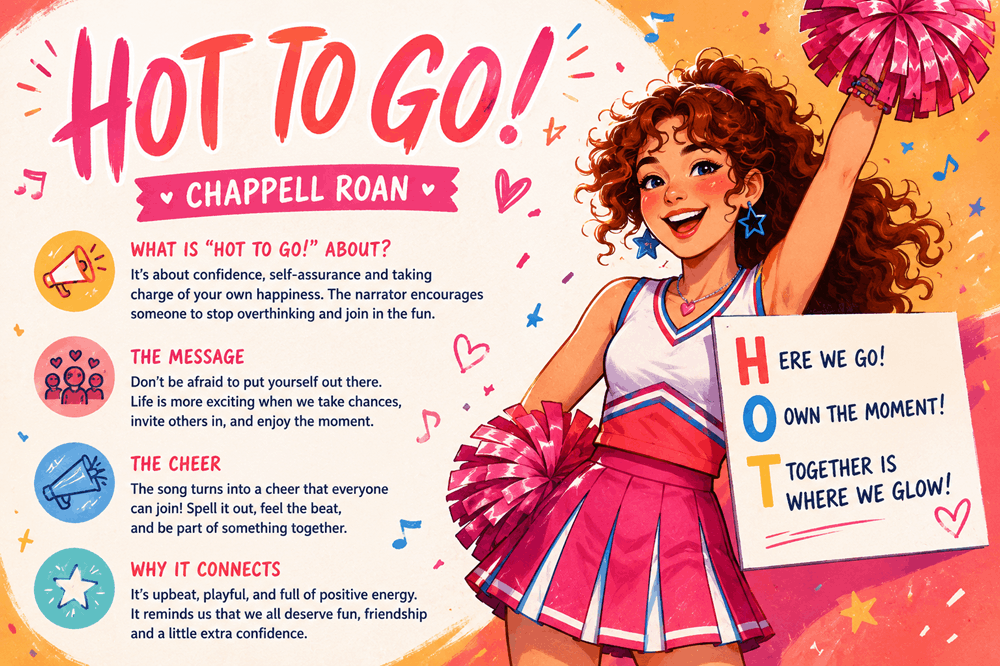
Chappell Roan’s “HOT TO GO!” is about openly telling someone that you are attracted to them and inviting them to stop watching from a distance.
The narrator does not rely on subtle hints. She presents herself as confident, desirable and available, then turns her flirtation into a cheer that an entire audience can perform with her.
The song’s central meaning is:
Wanting someone does not have to be private or embarrassing. Attraction can be expressed loudly, playfully and without apology.
Beneath the confidence, however, is a trace of vulnerability. The narrator is tired of being alone and frustrated that the person staring at her has not acted.
That combination gives “HOT TO GO!” its emotional energy. It sounds like fearless flirtation, but the performance also protects someone who genuinely cares whether her invitation is accepted.
Listeners can hear the complete recording through Chappell Roan’s official “HOT TO GO!” music video or on Apple Music.
What is “HOT TO GO!” about?
“HOT TO GO!” is about making the first move.
The narrator notices that someone appears attracted to her but remains hesitant. Instead of waiting quietly, she challenges that person to approach, dance with her and turn mutual interest into something real.
Her method is deliberately theatrical.
She does not make a private confession. She creates a beat, a spelling routine and a crowd-sized cheer around the invitation.
Private desire becomes public performance.
The narrator’s attitude combines two feelings:
- She believes she is attractive and worth approaching.
- She is becoming impatient because attention has not yet turned into action.
That tension matters. She may sound fearless, but the repeated invitation reveals that the outcome is important to her.
She is not flirting only to entertain herself. She wants to be chosen.
What does “hot to go” mean?
“Hot to go” is a playful adaptation of language associated with takeout food.
Something prepared “to go” is ready to be collected immediately. Roan turns that familiar phrase into a romantic and sexual invitation.
The narrator presents herself as ready, interested and tired of waiting.
Food-related imagery appears throughout the song, connecting attraction with heat, hunger, ordering and supper. The metaphors are intentionally exaggerated rather than subtle.
The humor keeps the desire from feeling overly serious.
The narrator is essentially saying:
I am interested. You appear interested. Why are we still standing apart?
That directness is central to the song. She refuses to behave as though wanting someone must be hidden behind complicated signals.
The title also gives her control over how she is perceived. She is not passively waiting to be judged attractive. She announces her own desirability and tells the other person what to do next.
Confidence, loneliness and making the first move
The narrator appears highly confident, but her confidence is not completely effortless.
She prefers to be seen as “hot” rather than simply pretty. “Pretty” can suggest someone being admired from a safe distance. “Hot” implies physical chemistry, urgency and an effect on another person.
She does not want to remain an attractive figure across the room. She wants the attention to produce movement.
At the same time, the song reveals that she has been waking up alone and is frustrated by the absence of physical closeness.
That detail changes the emotional meaning.
The narrator wants more than compliments. She wants connection, excitement and proof that the attraction she senses is real.
Her boldness may therefore be partly self-encouragement.
A quiet invitation could make rejection feel painfully personal. Turning that invitation into a cheer makes the moment playful. The narrator can hide some of her vulnerability behind choreography, humor and a large pop hook.
The confidence is still genuine. She is willing to say what she wants.
But the song recognizes that confidence and loneliness can exist together. A person can openly celebrate desire while still caring deeply about whether someone responds.
Why is “HOT TO GO!” considered a queer anthem?
“HOT TO GO!” belongs to Chappell Roan’s larger world of openly queer pop, theatrical performance and spaces where desire is celebrated instead of hidden.
Roan’s music frequently places queer attraction inside familiar pop-song structures without treating it as something that requires explanation or tragedy.
In “HOT TO GO!,” desire is:
- Joyful
- Physical
- Public
- Humorous
- Unashamed
The narrator does not apologize for wanting someone. She does not reduce the attraction to longing from a distance or frame it as an impossible secret.
She invites participation.
That quality has made the song especially powerful in queer spaces, where being able to express attraction openly can carry additional emotional meaning.
The audience is also essential to the performance. Fans do not simply watch Roan announce her confidence. They form the letters with her and repeat the invitation as a group.
Individual desire becomes collective celebration.
Roan’s concerts have reinforced this atmosphere through theatrical dress themes, local drag performers and a strong emphasis on audience participation. Her Chappell Roan persona functions as an exaggerated, flamboyant contrast to her quieter private identity, allowing her to perform confidence on a much larger scale.
Why does the song use a cheerleader routine?
Roan created “HOT TO GO!” partly from a childhood desire to be a cheerleader.
She wanted a song with simple movements that audiences could learn immediately. The spelling routine gave her a recognizable physical hook while matching the narrator’s loud and encouraging personality.
The cheerleader concept fits the song in several ways.
It projects confidence
A cheerleader must appear energetic and certain, even when the performance requires effort. The narrator similarly turns uncertainty into visible enthusiasm.
It makes the invitation communal
Instead of one person nervously approaching another, an entire audience supports the message.
It uses repetition effectively
Spelling the title makes the chorus easy to remember after one performance.
It turns flirtation into encouragement
The narrator behaves almost like a coach, telling the other person to stop hesitating and act.
It makes embarrassment part of the fun
Forming letters with your arms can look slightly ridiculous. The song succeeds because it asks people to stop worrying about appearing sophisticated.
Roan told Pitchfork that she wanted a playful song that would let her move around onstage and involve the audience. She also discussed the cheerleader inspiration and childhood fantasy in an interview with Vanity Fair.
Is the dance inspired by “Y.M.C.A.”?
Yes.
The dance uses arm positions to form the letters in the title, making the influence of the Village People’s “Y.M.C.A.” easy to recognize.
Roan admired the way “Y.M.C.A.” gave nearly everyone in a room a role. People did not need dance training or detailed knowledge of the song. They only needed to recognize the letters and join at the correct moment.
“HOT TO GO!” uses the same principle.
A listener can participate even without knowing every verse. The routine turns the recording into an event that can be recreated at concerts, clubs, sporting events and parties.
The dance also reflects the song’s meaning.
The narrator is asking one hesitant person to stop observing and participate. Roan asks the audience to do exactly the same thing.
At live performances, the energy changes when thousands of people form the letters together. The song no longer belongs only to the performer. The audience completes it.
That participatory quality helped “HOT TO GO!” grow gradually rather than depend on one brief viral moment.
What does the “HOT TO GO!” music video mean?
The official video brings Roan’s theatrical pop persona back to Springfield, Missouri.
Rather than filming only in a glamorous nightclub or anonymous studio, the video places her around recognizable Midwestern locations while she wears bright costumes and performs the dance.
The contrast is central to its meaning:
- Small-town surroundings and enormous pop-star confidence
- Familiar family life and exaggerated queer performance
- Everyday Midwestern locations and theatrical fantasy
- The person Roan grew up as and the persona she created
The video suggests that she does not need to erase her origins to become Chappell Roan.
She brings the performance home.
Her grandparents also appear and participate in the dance. Their presence gives the video warmth and prevents it from becoming a simple rejection of her hometown or family background.
Different generations and environments can occupy the same frame.
The dance is presented as something anyone can attempt, not something reserved for professional performers or young queer audiences.
Directed by Jackie! Zhou, the video premiered with the single on August 11, 2023. Roan discussed her grandparents’ participation and her connection to her Missouri background with Vanity Fair.
Who wrote and produced “HOT TO GO!”?
“HOT TO GO!” was written by Chappell Roan, whose legal name is Kayleigh Rose Amstutz, and Daniel Nigro.
Nigro also produced the recording and contributed guitar, programming and background vocals. Additional musicians include Sam Stewart on guitar and Sterling Laws on drums.
The production is built around clarity and movement.
Its beat leaves room for the title to be spelled distinctly, while the chorus is simple enough for a crowd to follow. The arrangement does not ask listeners to remain still and admire musical complexity.
It asks them to respond.
“HOT TO GO!” appears on Roan’s debut album, The Rise and Fall of a Midwest Princess, between “Super Graphic Ultra Modern Girl” and “My Kink Is Karma.” The album’s official track listing is available through Island Records.
Within the album, the song represents one of Roan’s most direct expressions of confidence.
Other tracks explore unavailable partners, unequal desire, homesickness and the difficulty of building a new identity. “HOT TO GO!” temporarily pushes those complications aside.
The narrator knows what she wants and says it clearly.
Why did “HOT TO GO!” become so popular?
The single was released in August 2023, but its largest commercial growth arrived during Roan’s broader breakthrough in 2024.
Its success was gradual because the song became stronger each time another audience learned the dance.
Several qualities helped it spread.
The meaning is immediate
The flirtation is understandable within seconds.
The choreography is accessible
The movements are distinctive but simple enough for non-dancers.
The chorus rewards group participation
People can join even if they do not know the verses.
The song has a specific personality
The cheerleading, queer perspective, comic food imagery and Midwestern video prevent it from feeling like a generic dance track.
It works especially well live
Some viral songs become smaller outside short videos. “HOT TO GO!” becomes more powerful when a real crowd performs it.
The song eventually reached No. 4 on the UK Singles Chart. Its complete British chart history is available through the Official Charts archive.
Roan’s larger rise also led to her winning Best New Artist at the 2025 Grammy Awards. The Recording Academy’s overview of her breakthrough is available through its official Chappell Roan profile.
Is “HOT TO GO!” only a novelty dance song?
The cheer and spelling routine give it novelty appeal, but the central device is closely connected to the narrator’s personality.
The choreography is not randomly attached to the recording.
It communicates:
- Her refusal to be subtle
- Her need for the other person to respond
- Her willingness to appear silly
- Her belief that attraction should be enjoyable
- Her ability to transform insecurity into performance
That connection gives the song more durability than a dance built around an unrelated gimmick.
The routine also fits Roan’s larger artistic identity. Her performances combine camp, comedy, drag influences, emotional directness and exaggerated costumes.
“HOT TO GO!” feels less like a temporary trend than a concentrated expression of the Chappell Roan persona.
The song’s silliness is part of its emotional argument.
People often avoid expressing desire because they are afraid of looking foolish. Roan removes some of that fear by making foolishness unavoidable and communal.
Once everyone is forming letters with their arms, appearing cool becomes less important than joining the moment.
Final meaning
“HOT TO GO!” is about openly inviting someone to act on mutual attraction.
The narrator is tired of being watched from across the room. She wants the other person to approach her, dance, ask for her number and stop pretending not to understand the signals.
The title uses takeout language to present her as ready and available. Food and temperature imagery turn sexual desire into a playful order waiting to be collected.
Yet the narrator’s confidence contains vulnerability.
She has been alone, wants physical closeness and genuinely cares whether the other person responds. The cheer allows her to express that need without becoming quiet or ashamed.
Roan created the song to fulfill a cheerleader fantasy and give audiences a routine they could perform together. The letter-shaped dance transforms one person’s invitation into a shared event.
That is why “HOT TO GO!” works so well beyond the recording.
It does not ask the audience to admire confidence from a distance.
It asks everyone to practice it.
The song’s message is direct: desire becomes less frightening when you stop treating it like a secret, make the first move and invite the whole room to cheer you on.