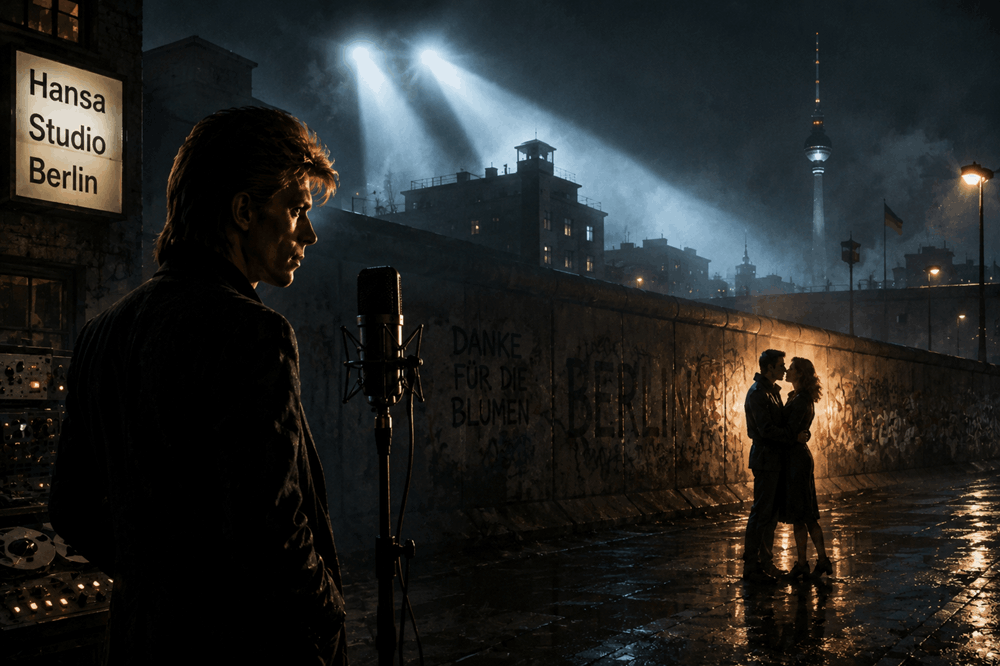
David Bowie’s “Heroes” Meaning: Love by the Berlin Wall
David Bowie’s “Heroes” is often treated as a straightforward anthem about courage and victory. Its soaring music certainly feels triumphant, but the story beneath it is far less certain.
The lovers at the song’s center cannot permanently change the world around them. They cannot remove the Berlin Wall, guarantee that their relationship will survive or escape their own weaknesses. Their victory is smaller: they claim one moment in which those forces do not decide who they are.
That is why “Heroes” does not promise lasting triumph. It imagines what it means to become heroic briefly—to live freely even when freedom may last only one day.
Listen to “Heroes” and access the full lyrics
We do not reproduce the complete copyrighted lyrics here, but you can follow them through authorized sources:
- Watch David Bowie’s official “Heroes” music video
- Listen to “Heroes” on Apple Music, where signed-in users can select View Full Lyrics
- Explore the complete “Heroes” album on Bowie’s official website
The official video is hosted on Bowie’s verified YouTube channel, while Apple Music provides the recording credits and access to the complete lyrics.
“Heroes” at a glance
- Artist: David Bowie
- Single released: September 23, 1977
- Album released: October 14, 1977
- Album: “Heroes”
- Lyrics: David Bowie
- Music: David Bowie and Brian Eno
- Producers: David Bowie and Tony Visconti
- Recorded primarily at: Hansa by the Wall in West Berlin
- Additional recording: Mountain Studios in Montreux
- Notable musicians: Robert Fripp, Brian Eno, Carlos Alomar, George Murray and Dennis Davis
The single was released in the United Kingdom on September 23, 1977, with “V-2 Schneider” as its B-side. The album followed on October 14. Bowie’s official anniversary release also credits both Hansa by the Wall and Mountain Studios as recording locations.
What is David Bowie’s “Heroes” about?
“Heroes” is about two imperfect people attempting to create a private space for love beside a structure built to divide people.
The couple cannot permanently defeat the political and personal forces surrounding them. They may not remain together, and the narrator does not pretend that either person is flawless. Yet for one brief period, their relationship allows them to imagine a different identity.
Their heroism is not public or conventional. They do not overthrow a government, bring down the Wall or rescue anyone. They simply refuse, for a moment, to let fear and separation dictate everything they are allowed to feel.
The song therefore presents heroism as something temporary and accessible. A person does not have to become permanently fearless or morally perfect. Sometimes courage consists of acting freely while knowing the victory may not last.
Why “just for one day” matters
The repeated phrase “just for one day” changes the entire meaning of the song.
Without that limitation, “Heroes” could be heard as a familiar declaration that love conquers every obstacle. Bowie offers no such guarantee. The lovers may create one meaningful moment, but the world outside their relationship will eventually return.
The Wall remains standing. Their personal problems do not disappear. Tomorrow is still uncertain.
Yet the song does not conclude that temporary freedom is worthless. One day can become a memory that lasts much longer. A brief act of courage can reveal that the surrounding circumstances never possessed complete control.
This is the song’s central tension: the victory is limited, but it is still real.
The music makes the moment sound permanent even while the words insist that it is not. That contradiction is one reason “Heroes” can feel both exhilarating and deeply sad.
Why the title appears in quotation marks
The official title is not simply Heroes. It is “Heroes”, with the word placed inside quotation marks.
Those marks introduce uncertainty and irony. The characters are not heroes in the usual sense of the word. No public ceremony will recognize them, and their actions may change nothing beyond their private experience.
They are “heroes” because they temporarily imagine themselves that way.
The punctuation prevents the song from becoming uncomplicated triumphalism. It suggests that Bowie understands how fragile, improvised and possibly illusory their heroic identity is. The lovers can claim the word, but only with qualifications attached.
That interpretation fits the song’s repeated time limit. Their heroism is not false, but neither is it permanent or conventional.
Love beside the Berlin Wall
Bowie recorded much of the album at Hansa Studios in West Berlin while the city remained physically and politically divided.
The Berlin Wall was not merely an abstract image. It separated communities and families, restricted movement and represented the power of governments to determine where people could live and whom they could reach.
Placing two lovers beside it creates an immediate contrast. Their affection is intimate and human, while the structure behind them represents an enormous political system with no concern for individual desire.
The lovers cannot dismantle the Wall. What they can do is behave briefly as though it has failed to control their inner lives.
That historical setting also allows the Wall to carry broader meanings. It can represent social judgment, emotional distance or any system that tells people their relationship is impossible. Those wider meanings are interpretations, but they grow naturally from the confirmed Berlin context.
Who inspired the lovers in “Heroes”?
The best-known account involves Bowie’s producer Tony Visconti and German singer Antonia Maass.
Bowie later said he saw Visconti and Maass embracing near the Wall while the album was being made. Visconti was married at the time, so Bowie initially avoided identifying the couple publicly. He later acknowledged that their relationship helped inspire the scene.
Maass also contributed background vocals to the recording.
A 2024 BBC Radio 4 documentary introduced another possible influence. Artist Clare Shenstone, who had been involved with Bowie, recalled spending a day with him in divided Berlin. She described discussing dolphins, crossing into East Berlin and kissing Bowie near the Wall—experiences she believed appeared in the finished song.
The documentary’s creator considered her account convincing while acknowledging that it could not be established as the song’s single definitive origin.
The two stories do not necessarily contradict each other. Songwriters often combine observation, memory and imagination. Visconti and Maass may have supplied the central visual scene, while Bowie’s own experiences contributed other images and emotions.
Why the lovers are deliberately imperfect
The narrator does not turn the couple into ideal romantic figures.
He acknowledges cruelty, drinking and the possibility that their promises may not be true. Their connection does not erase their faults or guarantee a healthy future together.
That imperfection is essential to the song.
If the lovers were presented as pure, fearless and morally exceptional, their heroism would feel distant from ordinary life. Instead, Bowie gives us people who are compromised and uncertain.
They become heroic not because they have overcome every personal weakness, but because they create one moment that is larger than those weaknesses.
The song also avoids suggesting that love automatically repairs destructive behavior. Their flaws remain. What changes is how they see themselves while they are together.
The king and queen imagery
The narrator imagines the couple as a “king and queen,” even though they possess no real authority.
The fantasy reverses the balance of power around them. The Wall represents states, borders and institutions capable of controlling human movement. The lovers cannot compete with that authority in practical terms.
Within their private relationship, however, they declare themselves sovereign.
They decide what the moment means without waiting for approval from the world outside it. Calling themselves royalty does not change their material circumstances, but it allows them to imagine that the Wall’s power has become temporarily irrelevant.
The exaggeration is intentional. They know they are not rulers. The fantasy matters because they choose to inhabit it anyway.
What do the dolphins represent?
The wish to “swim like dolphins” introduces an image of movement without human borders.
Dolphins pass through open water without recognizing walls, checkpoints or political divisions. They represent a form of freedom that the lovers do not possess.
The image can therefore suggest escape from artificial boundaries and the desire to move together without fear. It expands the song beyond one relationship and one city, turning the lovers’ situation into a wider human wish for unrestricted movement.
Shenstone’s account offers a possible personal origin for the image, but the metaphor works even without that background. The dolphins’ natural freedom contrasts sharply with the concrete barrier dominating the lovers’ world.
How the recording becomes an anthem
The emotional meaning of “Heroes” comes as much from the recording as from its words.
The song begins with relative restraint. Bowie’s early vocal feels close and controlled, as though the narrator is testing an idea he does not yet fully believe.
The arrangement gradually accumulates force. Brian Eno’s synthesizer adds movement and atmospheric instability, while Robert Fripp’s lead guitar produces long, sustained notes that seem to hover above the rhythm section.
Fripp created those tones through controlled feedback. Different positions in the studio caused particular notes to sustain, allowing him to construct a guitar part that feels both melodic and strangely weightless.
The gradual growth is crucial. The song does not suddenly turn into an anthem. It becomes one as the narrator pushes himself to believe more strongly in what he is saying.
Tony Visconti’s three-microphone technique
Producer Tony Visconti used an unusual setup to record Bowie’s lead vocal inside Hansa’s large Meistersaal.
One microphone was positioned close to Bowie. Two additional microphones were placed farther away and controlled with noise gates. As Bowie sang more loudly, the gates opened and allowed more of the room’s natural reverberation into the recording.
The result is tied directly to the intensity of his performance. When Bowie sings quietly, the voice feels close and contained. As he pushes harder, the physical space around him becomes increasingly audible.
Eventide later modeled its Tverb processor on Visconti’s three-microphone Hansa setup.
The technique supports the song’s meaning perfectly:
- The opening resembles a private confession.
- Bowie gradually has to raise his voice.
- The room expands around him.
- A fragile personal fantasy grows into something that sounds historically enormous.
The production does not remove the uncertainty from the words. It makes the decision to believe in them feel heroic.
Is “Heroes” an optimistic song?
“Heroes” is hopeful, but it is not comfortably optimistic.
The music encourages listeners to feel that something has been won. Bowie’s performance grows so powerful that it is easy to overlook how often the lyrics qualify that victory.
The couple may be deceiving themselves. Their relationship may not last. The political barrier remains untouched.
The hope comes from refusing to make permanence the only measure of value.
A moment does not become meaningless simply because it ends. A relationship, protest or act of courage can matter even when it does not permanently transform the world.
“Heroes” does not promise that defiance always succeeds. It argues that the act of defying something can still change the people involved.
“Heroes” in The Perks of Being a Wallflower
“Heroes” reached another generation through the 2012 film The Perks of Being a Wallflower.
The original Bowie recording appears on the official soundtrack and accompanies the film’s defining tunnel sequence.
In Stephen Chbosky’s novel, Fleetwood Mac’s “Landslide” occupies a related place. For the film, however, Chbosky wanted music with greater cinematic energy. Music supervisor Alexandra Patsavas suggested “Heroes,” and Chbosky believed it fit the scene perfectly.
The pairing works because the film uses the song for another temporary experience of freedom.
Its teenage characters cannot permanently escape fear, trauma or uncertainty. During the tunnel drive, however, they feel briefly unlimited. Like Bowie’s lovers beside the Wall, they create a moment that does not solve their lives but changes how those lives feel.
“Heroes” is not the film’s official theme song, but it became one of its most recognizable musical statements.
Bowie’s 1987 performance near the Wall
The song’s relationship with Berlin gained another layer when Bowie performed near the Wall on June 6, 1987.
The concert took place in West Berlin near the Reichstag. The stage was positioned close enough to the border for people in East Berlin to hear the performance. Bowie later recalled hearing thousands of them cheering and singing from the other side and described the experience as one of the most emotional performances of his career.
The concert did not single-handedly cause the Wall to fall two years later. Its significance was more symbolic.
A song about people claiming temporary freedom beside the Wall was now being heard simultaneously by audiences physically separated by that same structure.
The moment demonstrated how far “Heroes” had traveled beyond its original love story. Its private act of defiance had become something listeners on both sides of a political border could share.
Final meaning
“Heroes” does not promise that courage will permanently change the world.
Its lovers remain flawed, the Wall remains standing and tomorrow is uncertain. Their victory is that, for one day, they refuse to let those limits determine everything they are allowed to feel.
Bowie’s expanding vocal, Fripp’s sustained guitar and Visconti’s room-filling production make that temporary freedom sound eternal.