What Is an EP in Music? Meaning, Length, and How It Differs
An EP in music is a release that is longer than a single but shorter than a traditional full-length album. EP stands for extended play, and most modern EPs contain roughly three to six songs and usually run for less than 30 minutes.
That sounds simple, but the boundary between an EP and an album has become increasingly flexible in the streaming era. Some artists use EPs to introduce themselves, experiment with a new sound, bridge the gap between albums, or release a small group of songs that belong together without turning them into a full album.
What Does EP Mean in Music?
EP means extended play.
The term originally came from physical records. An EP could hold more music than a standard single but less than a full-length LP, or long-playing record.
That basic distinction still explains the term today.
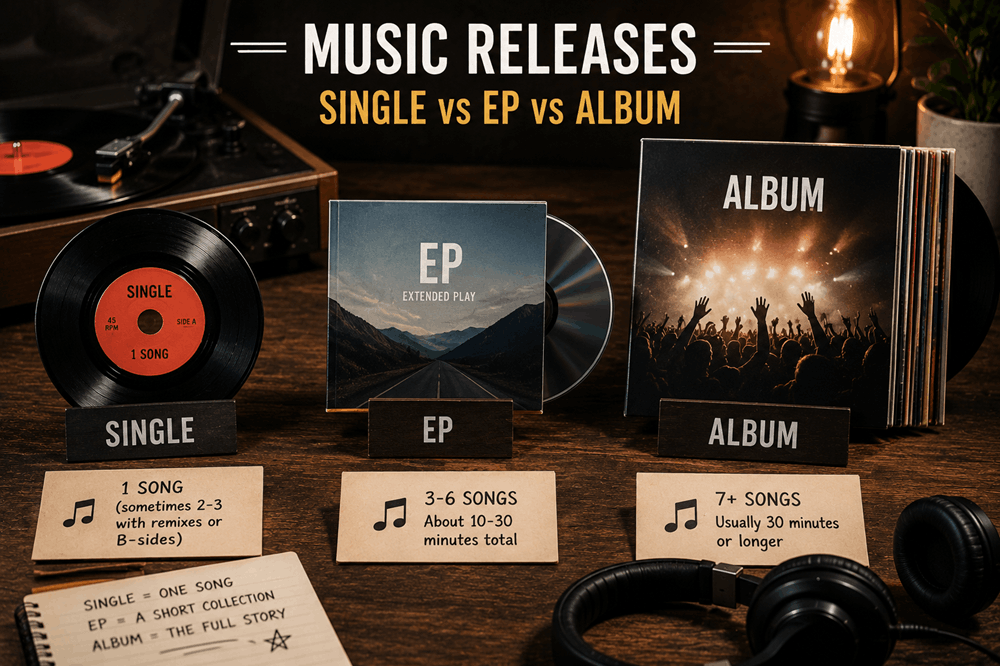
You can think of the common release formats like this:
- Single: Usually one main song, sometimes with additional versions or B-sides
- EP: A small collection of several songs
- Album: A larger, full-length collection of songs
Digital music has made those categories less dependent on the physical limitations of vinyl, CDs, or cassettes, but musicians and streaming services still use them to describe different kinds of releases.
How Many Songs Are Usually on an EP?
Most EPs contain around three to six songs.
Four or five tracks is particularly common.
However, there is no universal rule saying that every five-song release must be an EP.
Length matters too.
For example, a four-song release containing several long progressive-rock tracks could run for 40 minutes and feel more like an album. Meanwhile, an eight-song punk release could last only 18 minutes.
That is why track count alone does not always determine whether something is an EP.
How Long Is an EP?
A typical EP lasts somewhere between 10 and 30 minutes.
Many fall near the 15-to-25-minute range.
Again, this is more of a convention than a strict artistic rule.
Different distributors, charts, record labels, and streaming platforms can use slightly different definitions when categorizing releases.
For listeners, the easiest way to understand an EP is simply that it provides more music than a single without requiring the length or scale normally associated with an album.
What Is the Difference Between an EP and an Album?
The main difference is usually length and number of songs.
An EP is generally shorter and contains fewer tracks. An album usually represents a larger body of work.
A typical comparison might look like this:
| Release Type | Typical Songs | Typical Length |
|---|---|---|
| Single | 1–3 | A few minutes |
| EP | 3–6 | About 10–30 minutes |
| Album | Usually 7+ | Often 30 minutes or longer |
But the creative difference can be just as important.
An album is often treated as a major statement in an artist’s career. It may have a concept, extended promotional campaign, tour, physical editions, and a longer development process.
An EP can be more immediate.
An artist might have four songs that belong together and simply decide those four songs are enough.
What Is the Difference Between an EP and a Single?
A single centers on one song.
Even when a single release includes multiple tracks, there is usually one main track being promoted.
An EP is intended to function more like a collection.
If an artist releases five new songs together and gives the project its own title and artwork, listeners would usually consider that an EP rather than a single.
The difference becomes slightly confusing because digital singles sometimes contain remixes, acoustic versions, instrumentals, and extra songs.
The artist’s intended release format therefore matters as well as the number of tracks.
Why Do Artists Release EPs?
EPs are useful because they give musicians room to release a meaningful group of songs without committing to an entire album.
There are several common reasons artists choose the format.
To Introduce a New Artist
An EP can act as a musical introduction.
A new artist may not yet have enough strong material—or enough audience demand—for a full album. Four or five songs can still demonstrate personality, songwriting ability, production style, and artistic direction.
For listeners, it is also easier to try a 20-minute EP from an unfamiliar musician than commit to an hour-long album.
To Experiment With a Different Sound
An established musician may want to explore something that does not fit comfortably on a normal studio album.
An EP can become a controlled experiment.
The artist might try electronic production, acoustic arrangements, collaborations, covers, or songs written around a specific concept without suggesting that the new direction represents a permanent reinvention.
To Release Music Between Albums
Full albums can take years to write, record, and promote.
An EP allows musicians to remain active between those larger projects.
Instead of leaving fans with no new material, an artist can release several songs while continuing work on the next album.
To Group Songs Around One Idea
Sometimes an idea is too large for a single but too small for an album.
That is almost the ideal situation for an EP.
Four songs about one relationship, one season, one fictional story, or one musical experiment can form a complete project without needing extra tracks simply to reach album length.
Why Are EPs So Common for New Artists?
Making an album requires time and money.
There are recording costs, mixing, mastering, artwork, promotion, music videos, and potentially physical manufacturing.
For an independent artist, investing heavily in 12 songs before knowing whether an audience exists can be risky.
An EP lowers that barrier.
A musician can concentrate resources on a smaller number of strong songs.
If the project attracts listeners, those fans may then be much more interested when the artist eventually releases a full album.
In that sense, an EP can function almost like an extended introduction.
Can an EP Have Seven or Eight Songs?
Yes, although it starts becoming less clear.
A seven-song project might be called an EP if the tracks are particularly short. Another seven-song project might be marketed as a full album.
There is no music police deciding what every artist must call a release.
Industry classifications can matter for charting and distribution, but from an artistic perspective, musicians have substantial freedom in how they present their work.
This is why you occasionally encounter surprisingly short albums and unusually long EPs.
Can an EP Have Only Two Songs?
It can, although a two-song release is more commonly classified as a single.
Historically, singles often contained an A-side and B-side, meaning two different songs could appear on one physical release.
Modern digital releases preserve some of that flexibility.
Calling something an EP generally makes more sense once the project begins feeling like a small collection rather than one primary song with an additional track.
Is an EP Considered an Album?
Not usually.
People sometimes use “album” casually to describe any project containing multiple tracks, but the music industry typically distinguishes EPs from full-length albums.
That distinction matters when discussing an artist’s discography.
If a musician has released two albums and three EPs, most fans would not say the musician has released five studio albums.
The EPs are separate projects.
Do EPs Have Singles?
Yes.
An artist can release one song first as a single and later include it on an EP.
That strategy is extremely common.
For example, an artist might release a lead single in March, another song in April, and then release a five-track EP containing both songs plus three new ones in May.
The earlier singles then become part of the larger EP project.
Can a Song Be on Both an EP and an Album?
Yes.
A musician might release a song on an EP and later include it on a full-length album.
Sometimes the album uses exactly the same recording. Other times the song is remixed, remastered, re-recorded, or changed slightly.
This is particularly common with developing artists whose early EP songs become popular enough to deserve a place on their debut album.
What Is an LP?
LP stands for long play or long-playing record.
The term originally referred to vinyl records capable of holding considerably more music than singles or EPs.
Today, LP is commonly used as another way of referring to a full-length album.
So if someone says an artist is “working on their next LP,” they generally mean the artist is preparing another album.
This creates the traditional progression:
Single → EP → LP
That does not mean every artist follows that path, but the three terms represent the basic hierarchy of traditional music-release formats.
Where Did EPs Come From?
The term makes more sense when you remember that music releases were once limited by physical technology.
A vinyl record could only hold a certain amount of audio depending on its size, speed, and manufacturing format.
Singles were designed for shorter releases, often centered around one song.
LPs allowed substantially more music and became the standard format for albums.
EPs occupied the space in between.
They provided an “extended” amount of playing time compared with a standard single without becoming full-length LPs.
Streaming removed those physical limitations, but the terminology survived.
Why Do EPs Still Exist in the Streaming Era?
There is technically nothing stopping an artist from uploading two songs, 20 songs, or 200 songs digitally.
So why keep calling anything an EP?
Because release formats communicate expectations.
Calling something an EP tells the listener that this is a compact project rather than a major full-length record.
It also gives artists a useful creative boundary.
Unlimited space does not necessarily create better art.
Sometimes deciding that a project needs only five songs forces a musician to choose the strongest material and keep the idea focused.
Are EPs Less Important Than Albums?
Not necessarily.
Albums have historically received more attention because they are usually treated as major career statements.
But an EP can still become an essential part of an artist’s catalog.
Some musicians first attracted significant attention through EPs. Others have used them to release music that fans eventually considered among their best work.
A project’s importance is determined by the music, not simply by how many songs it contains.
How Should You Listen to an EP?
One advantage of an EP is that it is short enough to hear from beginning to end without much commitment.
That makes listening in sequence worthwhile.
Instead of immediately shuffling the songs, play the project in its intended order at least once.
Because EPs contain fewer tracks, sequencing can be especially deliberate. The first song may establish the idea, middle tracks may develop it, and the last song may provide the emotional conclusion.
Twenty minutes can still tell a complete story.
The Bottom Line
An EP in music is a release that sits between a single and a full-length album. EP stands for extended play, and a typical modern EP contains around three to six tracks and lasts roughly 10 to 30 minutes.
There are exceptions because no single rule perfectly defines every release.
What matters most is the purpose.
A single highlights a song. An album usually represents a larger body of work. An EP gives an artist enough space to create a small, meaningful collection without stretching the idea into a full-length record.
That flexibility is exactly why the format has lasted.
Technology no longer forces musicians to make EPs, but artists keep making them because sometimes five songs are exactly enough.