What Does LP Mean in Music? Albums, Vinyl Records, and EPs Explained
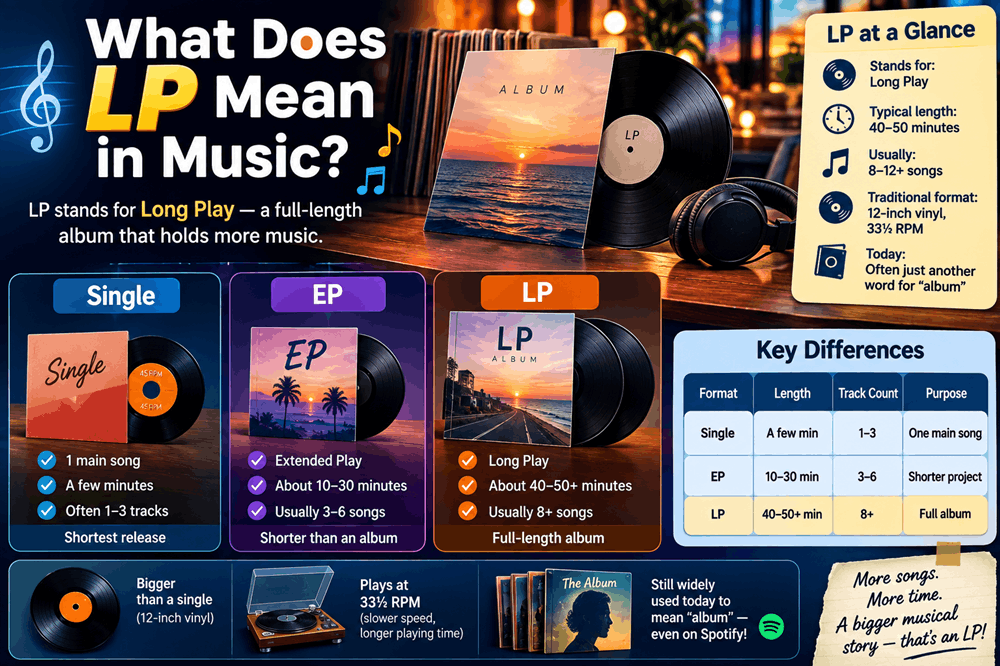
LP in music means long play or long-playing record. The term originally referred to a 12-inch vinyl record designed to hold much more music than a single, usually playing at 33⅓ revolutions per minute. Today, musicians and fans often use “LP” as another way of saying full-length album, even when the album is released digitally rather than on vinyl.
So if an artist says, “I’m working on my next LP,” they usually mean they are making their next full-length album—not necessarily that they are pressing it only on vinyl.
What Does LP Stand for in Music?
LP stands for long play.
The term developed during the vinyl-record era to distinguish longer records from shorter formats such as singles and EPs.
A traditional LP could hold multiple songs on each side, allowing musicians to release a much larger collection of music than was possible on a standard single.
That made the LP ideal for albums.
Over time, “LP” became so closely connected with full-length albums that the two terms are often used almost interchangeably.
Is an LP the Same as an Album?
Usually, yes in modern conversation.
An LP traditionally refers to a particular physical record format, while an album refers to a collection of music.
Technically, those are not exactly the same thing.
An album can be released as:
- A vinyl LP
- A CD
- A cassette
- A digital download
- A streaming release
But because LPs became the dominant physical format for full-length albums, people began using “LP” to mean the album itself.
Today, you might hear someone say that an artist has released “three LPs” even if those albums were primarily consumed through Spotify, Apple Music, or another digital platform.
In that context, they simply mean three full-length albums.
How Long Is an LP?
A traditional vinyl LP usually holds around 40 to 50 minutes of music, divided between two sides.
There is no absolute rule.
Some LPs are shorter than 40 minutes, while others push beyond 50 minutes.
Vinyl has physical limitations, however.
The more music engineers try to fit onto one side of a record, the more compromises may be necessary in terms of groove spacing, volume, and sound quality.
That is one reason many longer albums are released as double LPs instead of squeezing everything onto a single record.
How Many Songs Are Usually on an LP?
A typical LP might contain around 8 to 12 songs, although there is no fixed requirement.
Song length matters considerably.
A progressive rock album containing several ten-minute songs could have only five or six tracks and still clearly qualify as a full-length LP.
A punk album might contain 15 very short songs and run for less time.
Modern albums have become even more flexible because digital releases are not limited by vinyl capacity.
An artist can release seven songs, 12 songs, 20 songs, or more and still market the project as an album.
What Is the Difference Between an LP and an EP?
The biggest difference is usually the size of the project.
An LP generally represents a full-length album.
An EP, which stands for extended play, is shorter.
A simple comparison looks like this:
| Format | Meaning | Typical Length | Typical Track Count |
|---|---|---|---|
| Single | One main song | A few minutes | Usually 1–3 tracks |
| EP | Extended play | About 10–30 minutes | Usually 3–6 tracks |
| LP | Long play | Often 30–50+ minutes | Usually 7 or more tracks |
These numbers are guidelines rather than laws.
A six-song project containing very long songs might be marketed as an album, while another artist may call a seven-song release an EP.
The artist, label, distributor, and streaming service can all influence how a release is classified.
What Is the Difference Between an LP and a Single?
A single is built around one primary song.
Historically, a vinyl single commonly used a smaller record playing at 45 rpm, with one song on the A-side and another track on the B-side.
An LP was designed to hold an entire album.
Instead of promoting one song, it gave artists enough space to create a larger body of work.
That change became extremely important as musicians began thinking of albums as complete artistic statements rather than collections of unrelated singles.
Why Are LP Records Usually 12 Inches?
The classic LP is generally a 12-inch vinyl record.
The larger surface provides more space for grooves, allowing considerably more audio to be stored than on many smaller records.
Most traditional LPs play at 33⅓ rpm.
That means the record rotates more slowly than the common 45 rpm single.
The combination of a larger disc and slower playback speed gives an LP enough capacity to contain several songs on each side.
This basic format became one of the defining technologies of recorded music during the second half of the twentieth century.
What Does 33⅓ RPM Mean?
RPM means revolutions per minute.
A 33⅓ rpm LP rotates approximately 33⅓ times every minute while it plays.
The turntable needs to be set to the correct speed.
If you play a 33⅓ rpm record at 45 rpm, the music will sound much faster and higher in pitch than intended.
If you play a 45 rpm record at 33⅓ rpm, everything will sound slow and unnaturally deep.
Many modern turntables include controls for switching between the two speeds.
Why Was the LP Important to Music?
The LP changed much more than the amount of music consumers could buy on one record.
It changed how artists thought about making music.
When recorded music revolved heavily around singles, the individual song was the main product.
The LP gave musicians enough time to create extended experiences.
Albums could develop themes.
Songs could be arranged in a deliberate sequence.
One track could lead directly into another.
Artists could include slower, stranger, or more experimental music that might never work as a radio single.
This eventually helped establish the idea of the album as an art form of its own.
What Is a Double LP?
A double LP contains two vinyl records instead of one.
That usually means four playable sides:
- Side A
- Side B
- Side C
- Side D
Double LPs are useful for albums that cannot comfortably fit onto one record.
They can also improve sound quality by giving the grooves more physical space.
Some modern albums that could technically fit onto one disc are still released as double LPs for this reason.
Live albums, greatest-hits collections, expanded editions, and especially long studio albums frequently use the format.
Can an LP Have Only Six Songs?
Yes.
The number of songs does not determine everything.
If those six songs are long enough to create a full-length project, the release can still be considered an LP or album.
This is common in genres where compositions frequently stretch beyond ordinary pop-song lengths.
A 42-minute record containing six tracks is much closer to a traditional album than a 15-minute release containing six two-minute tracks.
Runtime and artistic intent are often more useful than track count alone.
Can an LP Have 20 Songs?
Yes, especially in the digital era.
Streaming removed the physical time limitations of vinyl.
An artist can now release a 20-track album without worrying about whether all those songs physically fit onto two sides of one record.
If that same album receives a vinyl release, however, it may need to be spread across two or more discs.
This is one reason the definition of LP has changed.
The phrase originally described physical technology.
Today it often describes the artistic category of a full-length album.
Does LP Always Mean Vinyl?
No.
This is where the term can be confusing.
If someone says, “I bought the LP,” they probably mean the vinyl record.
If a musician says, “My next LP is coming this year,” they probably mean their next full-length album, regardless of format.
Context tells you which meaning is intended.
Record collectors tend to use LP more literally.
Musicians, journalists, and music fans sometimes use it more broadly.
What Does LP Mean on Spotify?
Spotify does not need the physical LP format because there is no spinning record involved.
However, people may still describe a full-length Spotify album as an LP.
The term is cultural rather than technical in this situation.
If an artist announces a new LP and then releases it on Spotify, they are using LP to mean a full-length project.
The music does not have to exist on vinyl for that usage to make sense.
Why Do Artists Still Say LP?
Partly because the term has become part of music vocabulary.
“Album” and “LP” communicate a sense of scale that “project” does not always provide.
If an artist says they are working on an LP, listeners usually understand that they mean something more substantial than a single or short EP.
The term also connects modern music with the history of recorded albums.
Even artists whose listeners primarily stream their music are working within a format shaped by decades of vinyl culture.
Is an LP Better Than an EP?
Not necessarily.
An LP gives an artist more space, but more songs do not automatically create better music.
An EP can be tightly focused because it contains only a handful of tracks.
An LP can develop ideas more deeply but can also become repetitive if the artist stretches a concept too far.
The better format depends on the music.
Some ideas need 45 minutes.
Others need 18.
Why Do Vinyl LPs Sometimes Sound Different?
Vinyl playback involves a physical groove, stylus, cartridge, turntable, amplifier, and speakers.
That entire chain influences the listening experience.
A vinyl release may also use a different master from the digital edition.
Because vinyl has physical limitations, engineers sometimes adjust bass, volume, stereo information, and overall dynamics specifically for the format.
This does not mean vinyl automatically sounds better than digital music.
It means vinyl can sound different.
The quality of the mastering, pressing, turntable, speakers, and original recording all matter.
What Is an LP Record Made Of?
Modern LPs are usually made from polyvinyl chloride, which is why people commonly call them vinyl records.
The audio information exists as tiny physical variations in the spiral groove running across the record.
When the stylus follows that groove, its movement is converted into an electrical signal and eventually reproduced through speakers as music.
It is a remarkably physical process compared with streaming.
The song you hear is literally being traced from a groove.
Why Did Vinyl LPs Come Back?
Streaming made music more convenient than ever, but that convenience also removed much of the physical experience surrounding an album.
An LP brings some of that ritual back.
You choose a record.
Remove it from the sleeve.
Place it on the turntable.
Lower the stylus.
Listen through one side.
Then physically turn the record over.
The large format also gives album artwork, photography, liner notes, and packaging much more presence than a small image on a phone screen.
For collectors, the object becomes part of the experience.
Should You Call Every Vinyl Record an LP?
No.
Not every vinyl record is an LP.
Vinyl describes the physical material and general record format.
LP refers specifically to the long-playing format.
A seven-inch 45 rpm single is a vinyl record, but it is not normally an LP.
An EP can also be pressed on vinyl without becoming an LP.
So:
All traditional LPs are vinyl records, but not all vinyl records are LPs.
What Does LP Mean in an Artist’s Discography?
When discussing an artist’s discography, LP usually means a full-length album.
For example, someone might say:
“The band released two EPs before its first LP.”
That means the band released two shorter projects before releasing its first full-length album.
This terminology is useful because an artist may have dozens of releases when singles, live projects, compilations, EPs, and albums are counted together.
Separating LPs from everything else makes the discography easier to understand.
LP vs. EP: Which One Should a New Artist Release?
A new artist does not automatically need an LP.
Recording a full album can require considerable money, time, songwriting, production, mixing, artwork, and promotion.
If an artist has four excellent songs, releasing a strong EP may be smarter than adding six weaker songs simply to reach album length.
An LP makes more sense when there is enough material to justify a larger project.
That might mean a concept that needs more room, a developed fan base waiting for an album, or enough strong songs to create a satisfying beginning-to-end experience.
The Bottom Line
LP in music means long play or long-playing record.
Originally, the term described the 12-inch, 33⅓ rpm vinyl format that allowed several songs to fit on each side of a record.
Because LPs became the standard format for full-length albums, the term eventually became another way of saying “album.”
Today, an artist can announce a new LP even if most fans will hear it through streaming rather than vinyl.
The basic distinction is simple:
A single centers on one song.
An EP is a shorter collection.
An LP is generally the full-length statement.
The technology has changed dramatically since the vinyl album became popular, but the term survived because the idea behind it still matters: an LP gives an artist enough space to create something larger than a song.