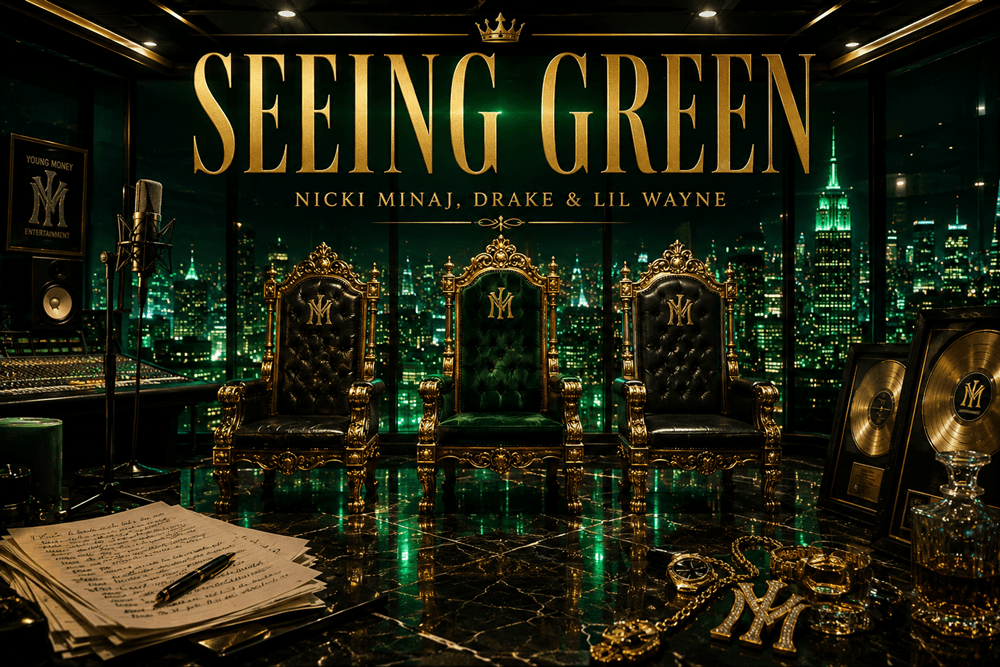
“Seeing Green” Lyrics Meaning: Nicki Minaj, Lil Wayne and Drake Turn Success Into a Young Money Victory Lap
“Seeing Green” by Nicki Minaj, Lil Wayne and Drake is about wealth, dominance and the satisfaction of outlasting everyone who doubted them.
The word green primarily represents money. All three rappers describe careers that have produced enormous financial rewards, influence and freedom. But green also suggests envy: while they see money, their competitors may be turning green as they watch the Young Money stars continue winning.
The song’s central message is simple:
Their success is no longer a prediction they need listeners to believe. It has become visible evidence that their confidence was justified.
“Seeing Green” is also more than three separate displays of wealth. It reunites the most famous members of Young Money and allows them to measure how far they have traveled since their early collaborations.
Lil Wayne appears as the mentor whose label created the platform. Nicki Minaj presents herself as a queen whose position survived years of competition. Drake closes the track as an artist who has turned commercial achievement into almost permanent momentum.
They are not introducing themselves.
They are comparing empires.
What is “Seeing Green” about?
“Seeing Green” is structured as an extended rap showcase rather than a conventional song built around a large sung chorus.
Lil Wayne opens, Nicki Minaj follows and Drake delivers the final verse. Each artist receives enough space to establish a distinct version of success.
Wayne emphasizes verbal invention, danger and the confidence of someone who helped create the family being celebrated.
Minaj focuses on status, imitation, wealth and the idea that her true competition is larger than any single rival.
Drake describes extraordinary commercial numbers, business ownership and the belief that pressure only makes him more competitive.
Together, the verses revolve around several themes:
- Financial abundance
- Artistic longevity
- Loyalty to Young Money
- Competitors copying their style
- The difference between image and proven success
- The freedom created by wealth
- The desire to remain dominant after reaching the top
The official lyric video presents the track as a direct lyrical exhibition, allowing the wordplay and changing voices to provide nearly all of its movement.
What does “seeing green” mean?
The title works through several connected meanings.
Green means money
This is the clearest interpretation.
Each rapper describes a life surrounded by expensive cars, property, jewelry and business success. They do not merely hope to become wealthy. Their verses treat wealth as an established environment.
They are constantly “seeing green” because money appears everywhere they look.
Green means envy
The title can also describe how their success affects other people.
Competitors watch them accumulate achievements, remain culturally visible and survive attempts to replace them. The more success the trio displays, the more jealousy they expect to produce.
This creates a useful contrast:
The artists see green as money.
Their rivals see green through envy.
Green represents a narrowed field of vision
When someone becomes intensely focused, everything outside the goal can begin to disappear.
The three rappers present themselves as people who have converted ambition into habit. They continue recording, competing and expanding even after achieving more than most artists ever will.
They see green because success has become the lens through which they interpret the world.
The song is a cipher disguised as a luxury record
“Seeing Green” does not depend on a traditional chorus because the verses are the main event.
The structure resembles a cipher or posse cut: several elite rappers receive the same musical space and attempt to leave the most memorable performance.
This makes competition part of the collaboration.
Wayne, Minaj and Drake belong to the same musical family, but none of them approaches the track casually. Each verse sounds aware that listeners will compare it with the other two.
Apple Music describes the song as Minaj sparring with her YMCMB family and demonstrating that she can both compete with major rappers and encourage them to perform at their highest level. (Apple Music)
That competitive energy prevents the reunion from becoming sentimental.
They are celebrating shared history by challenging one another again.
Why the Young Money reunion matters
Lil Wayne founded Young Money, and Nicki Minaj and Drake became the label’s two largest breakout stars.
Their careers eventually grew far beyond the original crew, but their shared history remains central to how audiences understand them. Wayne was not merely another collaborator. He was the established rapper who recognized both artists before they became global headliners.
“Seeing Green” therefore contains a quiet generational story.
Wayne begins as the architect.
Minaj and Drake follow as artists whose success helped turn the Young Money name into an era of mainstream rap.
The song arrived when Minaj brought her 2009 mixtape Beam Me Up Scotty to streaming services for the first time. The updated release included “Seeing Green” as one of its new tracks, connecting her mixtape beginnings with the status she, Wayne and Drake possessed more than a decade later. (Pitchfork)
Placing the reunion at the beginning of the reissue creates a before-and-after effect.
The old mixtape shows Minaj fighting to become impossible to ignore.
“Seeing Green” shows what happened after she succeeded.
Lil Wayne opens as the unpredictable founder
Lil Wayne’s verse is filled with compressed jokes, violent imagery and phrases that change meaning almost as soon as they appear.
He moves between relationships, loyalty, danger and pandemic-era references without pausing to explain every transition. That speed makes his verse feel unstable in a productive way. The listener must remain alert because an ordinary phrase may suddenly become a threat or punchline.
Wayne’s position on the song is distinctive.
He does not need to argue that he influenced Nicki Minaj and Drake. Their presence beside him demonstrates it. Few mentors can appear on a track with two former protégés who became comparable commercial giants.
His verse therefore carries the confidence of someone admiring the scale of what began around him.
The other two artists may have built independent empires.
They are still speaking a musical language Wayne helped teach them.
Wayne turns danger into verbal entertainment
Wayne’s violent references are not organized into a literal narrative.
They function as demonstrations of control.
He treats threatening ideas as raw material for jokes, internal rhymes and unexpected turns. The danger matters less as a documented event than as part of the Tunechi persona: quick-thinking, difficult to predict and always capable of turning a familiar phrase into something stranger.
This is important because “Seeing Green” celebrates wealth without making Wayne sound domesticated by success.
Money has not removed the unruly energy that made him influential.
He may be wealthy enough to live far from the conditions associated with his early music, but he still presents himself as the most unpredictable person in the room.
His success did not replace the persona.
It gave the persona more space.
Nicki Minaj enters as the center of the reunion
Although all three rappers receive long verses, “Seeing Green” belongs to Minaj’s project.
Her position in the middle is appropriate because she connects Wayne’s mentorship with Drake’s competitive closing performance.
She also has the most to prove within the song’s release context.
Beam Me Up Scotty originally documented her rise. By 2021, Minaj had spent years being compared with newer women rappers, discussed through industry conflicts and repeatedly asked whether her position had changed.
Her verse responds by refusing to treat any individual woman as an equal threat.
Instead, she suggests that the opposition she has faced comes from corporate structures and larger industry machinery.
That move expands her argument.
She is not simply claiming she defeated another rapper.
She is claiming she remained powerful despite systems capable of promoting, limiting or replacing artists.
Why does Minaj mention people copying her work?
Minaj compares imitators to students submitting work that originated with someone else.
The image reduces imitation from flattery to evidence of hierarchy.
A copied assignment may look complete, but the person turning it in did not create the original thinking. In the same way, another artist may reproduce Minaj’s vocal changes, visual exaggeration, pop-rap balance or confrontational confidence without possessing the creative authority that made those elements influential.
This concern has followed Minaj throughout her career.
Her style became commercially important enough that its features could be absorbed into mainstream expectations for women in rap. Once an innovation becomes common, audiences may forget how unusual it initially appeared.
Minaj’s verse insists on authorship.
She is not only competing in the present.
She is protecting the record of who helped shape the present.
Private airports represent success without public access
Minaj’s references to private travel do more than signal wealth.
Privacy is a form of power for someone whose career depends on public attention.
Fame makes a person highly visible. Airports, hotels and public appearances can turn ordinary movement into spectacle. Wealth allows Minaj to reverse that relationship: she can remain famous while controlling when she is available to be seen.
This is a more advanced form of status than simply purchasing an expensive object.
She is buying distance.
The person who once needed every opportunity for exposure can now choose secrecy.
That movement from hunger for attention to control over attention mirrors her career development.
Motherhood enters the song without weakening the persona
Minaj briefly brings her child into the world of luxury she describes.
The detail expands the purpose of her wealth.
Earlier rap boasts often frame money through personal consumption: clothing, jewelry, cars and the ability to defeat rivals. Here, property also becomes space in which her child can grow and play.
The queen persona has not disappeared.
It now exists beside motherhood.
That combination is important because public expectations often treat women’s identities as mutually exclusive. A woman can be presented as a dominant rapper or a mother, glamorous or domestic, confrontational or nurturing.
Minaj refuses that separation.
The same verse can contain family, wealth, humor and threats without requiring one identity to cancel another.
“Seeing green” becomes one of Minaj’s strongest wordplay moments
Near the end of her verse, Minaj turns the title into a spelling and sound joke.
She separates the sound of seeing from the letter C, creating a line that connects language, money and perception.
The technique is characteristic of her writing. A simple phrase becomes more memorable when she makes listeners notice how it is constructed.
The joke also reinforces the song’s larger claim.
Minaj’s wealth may be impressive, but verbal control remains the true evidence of her status as a rapper.
Anyone can mention money.
She must mention it in a way that sounds recognizably hers.
The king, the greatest and the queen
Minaj places the three artists into a symbolic royal structure.
Wayne represents the established leader and mentor.
Drake represents an artist whose commercial achievements allow him to claim all-time status.
Minaj identifies herself as the queen positioned beside them rather than beneath them.
This is an important detail because collaborations can easily treat a woman rapper as a guest inside male authority.
“Seeing Green” does not.
Minaj is the host, the central artist and the person who brought the reunion together. Her verse does not ask Wayne or Drake to confirm her position.
Their participation helps demonstrate it.
The three titles are competitive, but they also form a family portrait.
Drake’s interlude turns the song into a public announcement
Before his verse, Drake speaks rather than immediately rapping.
The moment resembles a host introducing the final stage of an event. He celebrates the scale of the Young Money combination and jokes that other rappers cannot survive sharing a track with Minaj.
This interlude changes the energy.
Wayne and Minaj have already delivered their performances. Drake acknowledges that standard and then steps forward as though accepting a challenge.
His tone is relaxed because he wants dominance to sound normal.
The message is not that he hopes to compete.
It is that competition becomes serious only when he decides to participate.
Drake measures power through numbers
Drake’s verse repeatedly returns to quantities, records and accumulated achievements.
Plaques, cars, playing time and commercial movement all become ways of making status measurable.
This distinguishes his approach from Wayne’s unpredictable imagery and Minaj’s emphasis on authorship.
Drake presents himself as an institution.
His success is documented through statistics large enough to seem almost absurd. He does not need to rely only on self-description because chart performance and business activity provide external evidence.
Yet numbers also create pressure.
Once an artist becomes associated with constant commercial achievement, every release is judged against earlier success. Remaining dominant requires continued movement.
Drake’s verse embraces that burden.
He treats the expectation to perform as another arena in which he expects to win.
The sports language presents rap as endurance
Drake repeatedly draws from basketball and physical injury.
These references portray rap not as one brilliant moment but as a long season requiring durability.
A player may be talented, but greatness also depends on remaining available, performing through pain and producing results when opponents know what to expect.
Drake applies that logic to his career.
By 2021, he was no longer the emerging artist introduced through early Young Money collaborations. He had spent more than a decade near the center of popular rap.
His challenge was not entering the game.
It was continuing to dominate after everyone had studied how he played.
The injury imagery suggests that even reduced mobility would not stop his production.
He expects to keep scoring.
Starting a league represents the next level of wealth
Drake’s verse moves beyond participating in established systems.
He imagines creating systems of his own.
This is the difference between being a successful player and owning the environment in which players compete. Money becomes meaningful because it allows him to build opportunities, gather powerful people and reduce dependence on institutions controlled by someone else.
That idea connects all three verses.
Wayne created a label that helped launch major careers.
Minaj argues that she survived corporate forces and now moves with unusual independence.
Drake describes business ownership and the ability to organize success around himself.
They are no longer satisfied with being invited into powerful rooms.
They want control over the room.
The song celebrates family without pretending there is no competition
Young Money is presented as a family, but “Seeing Green” does not sound gentle or nostalgic.
Each artist wants the strongest verse.
That tension is part of the group’s bond.
Their relationship was built inside rap, where respect often comes from demonstrating skill rather than avoiding competition. Trying to outperform one another does not necessarily weaken their loyalty. It may be one of the ways they express it.
The song consequently creates an unusual form of affection.
Wayne’s legacy is strengthened when Minaj and Drake rap brilliantly.
Their success proves the quality of the family he assembled.
Minaj’s central position is strengthened because two major artists treat her return as an event.
Drake’s closing verse is strengthened by the standard established before he begins.
Everyone benefits.
No one wants to sound comfortable.
The soulful production makes wealth feel reflective
The production is smoother and more spacious than the aggressive language might suggest.
A warm vocal texture floats behind the drums, giving the track the atmosphere of looking back over a long career rather than fighting through an immediate crisis.
This softness allows the performances to feel luxurious.
The rappers do not need an overwhelming beat to create authority. The instrumental leaves open space, trusting their voices, pauses and changes in cadence to hold attention.
The contrast also supports the reunion.
The production contains enough nostalgia to connect the song with an earlier Young Money era, but it does not sound like an attempt to recreate a specific old hit.
They are revisiting the chemistry.
They are not pretending time stopped.
Why was the song added to Beam Me Up Scotty?
Minaj’s original Beam Me Up Scotty arrived in 2009, before her debut album turned her into a global star.
When the mixtape reached streaming platforms in 2021, new tracks were placed at the beginning, allowing listeners to hear present-day Minaj before moving backward into the material that helped establish her.
Apple Music describes the sequence as beginning with her current position and then tracing the ascent that made it appear inevitable.
“Seeing Green” is therefore an ideal opening.
The old mixtape asked listeners to recognize Minaj’s potential.
The new song shows Wayne and Drake recognizing her longevity.
The release became a major commercial event despite most of its material being more than a decade old. The reissue reached No. 2 on the Billboard 200, while “Seeing Green” debuted at No. 12 on the Billboard Hot 100.
The chart performance supported the song’s argument.
Minaj did not simply claim that her older work still mattered.
Listeners returned to prove it.
Confirmed background versus interpretation
It is confirmed that “Seeing Green” features Nicki Minaj, Lil Wayne and Drake and was released as new material with the 2021 streaming edition of Beam Me Up Scotty. The official audio was released through Republic Records, while Pitchfork reported the song’s arrival alongside the mixtape’s first official streaming release.
It is also documented that Minaj announced the song as a Young Money reunion and that Drake publicly praised her presence and lyrical ability during the release period.
The ideas that green represents both the trio’s money and their rivals’ envy, that the three verses form a family portrait and that private travel symbolizes control over visibility are interpretations based on the song’s language and structure.
The track does not hide one complicated narrative.
It builds meaning through accumulation.
Every punchline, purchase and career claim adds another piece of evidence that the three artists have reached a level of success their younger selves could only imagine.
Final meaning
“Seeing Green” is about three artists looking at the results of their ambition and recognizing that they have become larger than the dreams that first brought them together.
Lil Wayne opens as the founder whose influence is visible in the careers beside him.
Nicki Minaj stands at the center, defending her authorship, longevity and position against imitators and industry forces.
Drake closes by turning achievement into numbers, businesses and a level of momentum that appears almost impossible to interrupt.
Their wealth is important, but money is not the song’s deepest subject.
The deeper subject is proof.
They were once young artists making enormous claims about where their talent would take them. Years later, they can point toward careers, audiences and influence that support those claims.
They see green because success now surrounds them.
Their competitors see green because that success has endured.
And Young Money, once a promise attached to a group of ambitious rappers, appears in “Seeing Green” as something history has already confirmed.