Is Apple Music Better Than Spotify? A Clear Comparison for 2026
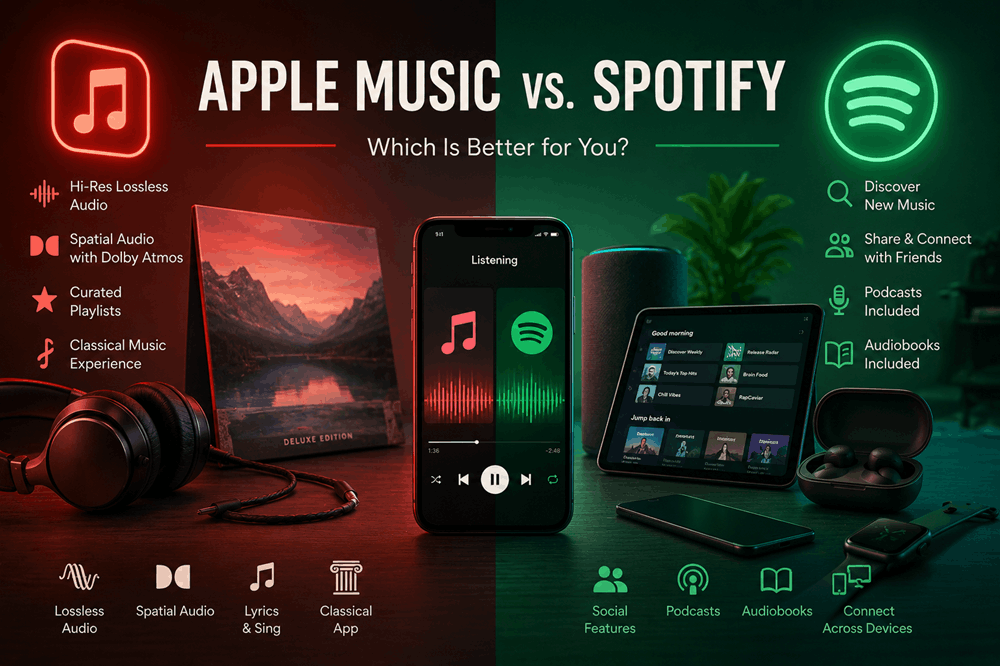
Apple Music is better than Spotify for listeners who prioritize higher-resolution audio, Spatial Audio, classical music and strong integration with Apple devices.
Spotify is better for listeners who prioritize music discovery, social features, device switching, podcasts, audiobooks and a free listening option.
For most people, Spotify remains the more flexible all-purpose platform. For listeners who mainly care about albums and sound quality, Apple Music offers better value—especially because its individual and family plans currently cost less in the United States.
The simplest verdict is:
Choose Apple Music for sound quality and a music-first experience. Choose Spotify for discovery, sharing and convenience across many devices.
Apple Music vs. Spotify at a glance
| Feature | Apple Music | Spotify |
|---|---|---|
| Individual price | $11.99 per month | $12.99 per month |
| Student price | $6.99 per month | $6.99 per month |
| Family price | $19.99 per month | $21.99 per month |
| Duo plan | No | $18.99 per month |
| Free plan | No full free tier | Yes, with ads and restrictions |
| Lossless audio | Up to 24-bit/192 kHz | Up to 24-bit/44.1 kHz |
| Spatial Audio | Yes, with Dolby Atmos | Not a comparable catalog-wide feature |
| Music discovery | Good | Excellent |
| Podcasts | Separate Apple Podcasts app | Built into Spotify |
| Audiobooks | Separate Apple Books app | Included listening hours with selected plans |
| Classical music | Dedicated Apple Music Classical app | Standard Spotify search and browsing |
| Device switching | Good within Apple ecosystem | Excellent through Spotify Connect |
| Social listening | Collaborative playlists and SharePlay | Jam, Blend and collaborative playlists |
Prices and features can change, but the current U.S. pages list Apple Music at $11.99 for an individual plan and $19.99 for a family plan. Spotify lists $12.99 for Individual, $18.99 for Duo and $21.99 for Family. Both student plans cost $6.99. (Apple Music plans) (Spotify Premium plans)
Which service is cheaper?
Apple Music currently provides the better price for individual subscribers and families.
An Apple Music individual subscription costs one dollar less per month than Spotify Premium Individual. Its family plan costs two dollars less and can be shared with up to five additional people, giving six users separate libraries and recommendations.
Spotify’s main pricing advantage is its Duo plan. Two people living at the same address can receive separate Premium accounts without paying for a full family subscription.
Spotify also offers a free, ad-supported version. Apple Music requires a paid plan after any introductory trial ends. Spotify Free retains access to saved music and playlists, but listeners hear advertisements and may face shuffle-based playback restrictions. (Spotify Free)
Best value by household
- One person: Apple Music is cheaper.
- Two people: Spotify Duo is usually the most practical option.
- Three to six people: Apple Music Family is currently cheaper.
- Someone unwilling to pay: Spotify wins because it has a free tier.
- College students: Both cost the same, but the extras differ.
Spotify Student currently includes Hulu for eligible U.S. students. Apple Music Student includes access to Apple TV at no additional cost. These bundled services may matter more than the music-app differences for some subscribers.
Which has better sound quality?
Apple Music still has the technical advantage.
Apple offers its catalog in the Apple Lossless Audio Codec, with standard lossless quality reaching 24-bit/48 kHz and Hi-Res Lossless reaching 24-bit/192 kHz. It also includes a substantial collection mixed in Spatial Audio with Dolby Atmos. (Apple’s lossless audio guide)
Spotify now offers lossless music to Premium users, which significantly narrows what was once one of the largest differences between the services. Spotify’s current Premium page lists lossless playback up to 24-bit/44.1 kHz, while its support documentation notes that availability depends on compatible devices, content and connection quality. (Spotify’s lossless audio guide)
Apple Music therefore wins on maximum resolution:
- Apple Music: up to 24-bit/192 kHz
- Spotify: up to 24-bit/44.1 kHz
However, those numbers do not tell the complete story.
Most listeners use wireless earbuds, car speakers, smart speakers or ordinary phone audio. The difference between well-encoded compressed audio and lossless playback may be subtle or impossible to notice in those conditions.
To receive the full benefit of Hi-Res Lossless, Apple users may need wired headphones, compatible speakers and an external digital-to-analog converter. Spotify likewise warns that Bluetooth, network stability and device compatibility can affect lossless playback.
Winner for sound quality: Apple Music
Its higher maximum resolution and Dolby Atmos catalog make it the stronger choice for serious listening systems, although Spotify’s addition of lossless audio means the difference is less important for everyday listeners than it used to be.
Which is better at recommending music?
Spotify remains better at music discovery.
Its recommendation system is built into nearly every part of the service. Discover Weekly provides a personalized collection of unfamiliar tracks, while Release Radar focuses on recent music connected with artists a listener follows or regularly plays.
Spotify also offers:
- Daylist
- DJ
- Blend
- Smart Shuffle
- AI Playlist or prompted-playlist tools in supported markets
- New Music Friday
- Fresh Finds
- Personalized genre and mood mixes
Spotify’s July 2026 discovery update continued expanding Release Radar and other weekly playlists, reinforcing how central personalized discovery remains to the platform. (Spotify’s discovery-playlist update)
Apple Music has improved significantly. It offers personalized artist and album recommendations, curated stations, new-music mixes and tools for creating playlists from songs or moods. Apple’s human editors also produce strong genre pages, essential-album selections and artist-focused playlists.
The difference is in emphasis.
Apple Music often feels designed to help listeners explore albums, artists and editorially selected music. Spotify is more aggressive about continuously placing new songs in front of the listener.
Spotify’s recommendations can occasionally become repetitive. Listening to music for sleep, work or children may also influence future suggestions more strongly than expected. Even with those weaknesses, Spotify usually learns a listener’s habits faster and provides more ways to discover music without actively searching.
Winner for music discovery: Spotify
Which has the better music library?
For most listeners, the difference is negligible.
Apple Music advertises more than 100 million songs. Spotify describes its service as containing millions of songs without emphasizing one fixed catalog number on its current Premium page. Both platforms carry nearly every major mainstream release, along with extensive independent, international and archival catalogs.
Occasional differences occur because of:
- Regional licensing
- Artist or label decisions
- Alternate album editions
- Remasters and deluxe releases
- Unofficial uploads
- Local music files
- Spoken-word or specialist recordings
The better library is therefore not necessarily the one with the larger advertised number. It is the one that has the artists, editions and recordings a particular listener wants.
People considering a switch should search for their ten most important albums, including any rare live albums, regional releases or older compilations.
Winner for general music selection: Tie
Apple Music is much better for classical music
Apple Music includes Apple Music Classical at no extra charge for Individual, Student and Family subscribers.
The separate app is built around the complicated way classical music is organized. Listeners can search by composer, conductor, orchestra, soloist, work or movement rather than relying only on standard artist-and-album fields.
It also provides composer biographies, work descriptions, curated recommendations and access to what Apple calls the world’s largest classical catalog. (Apple Music Classical)
Spotify contains a large amount of classical music, but its conventional search and metadata can make it harder to distinguish hundreds of recordings of the same composition.
Someone searching for Beethoven’s Fifth Symphony may want a particular orchestra, conductor, recording year or edition. Apple Music Classical is designed to handle those distinctions more clearly.
Winner for classical music: Apple Music
Spotify is better for podcasts and audiobooks
Spotify places music, podcasts and audiobooks inside one application.
Its Premium Individual plan includes 15 hours of audiobook listening per month from an eligible subscriber catalog. On Duo and Family plans, the included hours are generally assigned to the plan manager rather than every member. Spotify currently advertises more than 700,000 titles in its subscriber audiobook catalog.
Spotify is also one of the largest podcast platforms, offering audio and video programs alongside music.
This creates convenience for people who regularly move between:
- Albums
- Podcasts
- Audiobooks
- Video podcasts
- Music videos
- Workout content
Apple distributes these formats through separate services. Apple Music handles music, Apple Podcasts handles podcasts and Apple Books sells audiobooks.
Some people prefer Apple’s separation because their music library is not crowded with podcast episodes and audiobook recommendations. Others want all entertainment in one place.
Winner for podcasts and audiobooks: Spotify
Which works better across devices?
Spotify has the advantage, especially in mixed-device households.
Spotify says its service is compatible with more than 2,000 devices. Spotify Connect allows a phone, tablet or computer to control playback on another compatible device and makes it easy to move music between speakers, televisions, consoles and computers. (Spotify Connect)
A listener can begin a song on a phone, transfer it to a smart speaker and later continue on a computer without manually reconnecting in the same way required by ordinary Bluetooth.
Apple Music works on more devices than its name may suggest. It is available on Android, Windows, Sonos, Alexa, Google Nest, PlayStation, Xbox, Roku and numerous smart televisions.
It is strongest, however, inside Apple’s ecosystem:
- iPhone
- iPad
- Mac
- Apple Watch
- HomePod
- Apple TV
- CarPlay
- Siri
People whose household contains iPhones, Android phones, game consoles, smart speakers from different companies and several television brands may find Spotify easier to manage.
People who use an iPhone, Apple Watch, HomePod and Apple TV may prefer Apple Music’s system-level integration.
Winner for broad device compatibility: Spotify
Winner within an all-Apple household: Apple Music
Which has better social features?
Spotify offers the more developed social experience.
Blend compares the listening tastes of friends and creates a shared playlist. Jam allows people to contribute to a live listening queue, including from different locations in supported situations. Collaborative playlists and public profiles also make it easy to share music.
Spotify’s large user base matters here. A social feature is more useful when most friends already have accounts.
Apple Music supports collaborative playlists, emoji reactions and SharePlay listening. CarPlay passengers can also contribute music without passing one phone around.
These features are useful, but Spotify still feels more naturally organized around observing, comparing and sharing listening habits.
Spotify Wrapped also remains one of the internet’s largest annual music-sharing events. Apple Music Replay provides similar personal statistics, but it does not usually generate the same level of public participation.
Winner for social listening: Spotify
Which app has the better interface?
This depends heavily on listening style.
Apple Music generally places greater emphasis on albums, artwork, artists and personal-library organization. Listeners who still think of their collection as a digital record shelf may prefer it.
Spotify emphasizes playlists, recommendations and mixed content. Its home screen may include music, podcasts, audiobooks, video and personalized suggestions in one continuous feed.
That makes Spotify feel active and personalized, but also busier.
Apple Music can feel cleaner for music-only listeners, although managing the library and queue is not always as intuitive as it should be. Spotify’s queue, device menu and recommendation tools are generally easier to understand, but its increasing amount of nonmusic content can distract users who only want songs.
Winner for a music-focused interface: Apple Music
Winner for fast navigation and mixed media: Spotify
Apple Music has better karaoke and lyric tools
Apple Music Sing provides real-time lyrics and lets listeners reduce the lead vocal on compatible songs. It can display separate lines for duet partners and, on supported devices, turn an iPhone into a microphone connected to Apple TV.
Apple Music also offers lyric translation and pronunciation for supported songs, helping listeners understand and sing music in other languages. (Apple Music Sing)
Spotify displays synchronized lyrics and has continued improving its lyric features, but it does not provide a direct equivalent to Apple Music Sing’s adjustable vocal levels across a comparable catalog.
Winner for lyrics and karaoke: Apple Music
Does Apple Music work well on Android and Windows?
Yes, but Apple users receive the most seamless version.
Apple Music has dedicated Android and Windows apps and supports lossless playback on both platforms. Android users can access the same music catalog, playlists and most major listening features.
However, Spotify was built as a platform-independent service. Its experience is generally more consistent when a person switches frequently between Android, Windows, iPhone, Mac, smart televisions and speakers from different manufacturers.
Android users can enjoy Apple Music without owning another Apple device. They should choose it because they prefer its music experience, not because the service is limited to iPhones.
Is Spotify still better now that both offer lossless audio?
Spotify’s lossless launch removes one of Apple Music’s easiest advantages.
Before Spotify added lossless playback, Apple Music was the obvious choice for subscribers who wanted uncompressed audio without paying for a separate premium tier. Spotify Premium now provides lossless music at no separate charge, bringing the two services much closer.
Apple Music still offers:
- Higher maximum resolution
- Dolby Atmos and Spatial Audio
- Apple Digital Masters
- A stronger classical-music experience
- A lower U.S. individual price
Spotify still offers:
- Better recommendations
- A free tier
- Duo subscriptions
- Podcasts and audiobooks
- Wider device integration
- Stronger social features
The decision is no longer simply “Apple has good audio and Spotify does not.”
It is now about the complete experience surrounding the music.
Who should choose Apple Music?
Apple Music is the better choice for someone who:
- Primarily listens to music rather than podcasts
- Regularly listens to complete albums
- Uses an iPhone, Apple Watch, HomePod or Apple TV
- Wants Hi-Res Lossless or Dolby Atmos
- Listens to a substantial amount of classical music
- Wants karaoke-style vocal controls
- Prefers editorial curation to constant algorithmic recommendations
- Needs a cheaper family plan
It is particularly attractive for listeners building a high-quality home audio setup.
Who should choose Spotify?
Spotify is the better choice for someone who:
- Constantly wants to discover new artists
- Shares music with friends
- Uses many device brands
- Listens to podcasts and audiobooks
- Wants a free option
- Needs a two-person Duo plan
- Values Spotify Connect
- Enjoys Wrapped, Blend, Jam and social playlists
- Prefers playlists over carefully organizing an album library
Spotify is also the safer recommendation for someone who does not yet know exactly what matters. Its free plan allows listeners to build a library and test its recommendations before paying.
Final verdict: Is Apple Music better than Spotify?
Apple Music is better in several important areas, but it is not universally better.
It offers higher maximum audio quality, Spatial Audio, a dedicated classical app and lower current U.S. prices for individual and family subscriptions. It also keeps the experience centered more closely on music.
Spotify provides the stronger overall platform.
Its discovery system is more developed, its social tools are more engaging and Spotify Connect remains one of the easiest ways to control music across different devices. Podcasts, audiobooks and a free tier also make it useful to a wider range of listeners.
The best overall choices are:
Best for sound quality: Apple Music
Best for discovering new music: Spotify
Best for Apple-device owners: Apple Music
Best for mixed-device households: Spotify
Best for classical music: Apple Music
Best for podcasts and audiobooks: Spotify
Best free service: Spotify
Best family-plan value: Apple Music
Best for two people: Spotify Duo
Best overall for most users: Spotify
Best for serious music listeners: Apple Music
Neither service is objectively superior for everyone.
Apple Music is built for listeners who want music to remain the main event.
Spotify is built for listeners who want the service to understand, organize and accompany almost every kind of listening they do.