“My Ordinary Life” Lyrics Meaning: The Living Tombstone’s Song About Fame, Ego and Losing Yourself
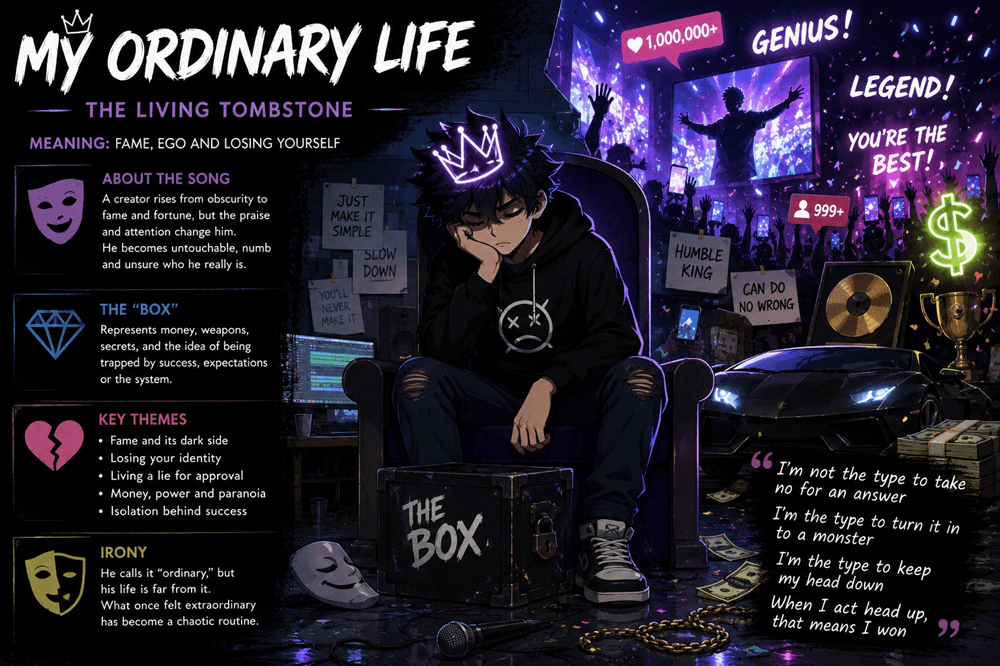
The Living Tombstone’s “My Ordinary Life” is about a successful creator who gradually loses touch with reality while trying to maintain a confident public image.
The narrator boasts about money, talent and admiration, but his confidence becomes increasingly unstable. Fans treat him as flawless, critics become meaningless and ordinary human limits no longer seem to apply to him.
Underneath that superiority is someone who feels emotionally numb, dependent on attention and uncertain whether a real person still exists behind the performance.
The song’s central meaning is:
Fame can make someone feel powerful while quietly separating them from reality, genuine relationships and their own identity.
The title is deliberately ironic. The narrator’s life is not ordinary at all. It is filled with wealth, praise, pressure and emotional chaos. Yet these extremes have become so familiar that he now treats them as his everyday condition.
Listeners can hear the complete recording through The Living Tombstone’s official “My Ordinary Life” video or stream it through the group’s official Bandcamp page.
What is “My Ordinary Life” about?
“My Ordinary Life” follows the psychological transformation of a creator who becomes increasingly successful and increasingly detached.
At first, the narrator sounds ambitious.
Other people tell him to simplify his ideas, slow down or behave more carefully. He refuses. His creativity produces music, money and public attention, apparently proving his doubters wrong.
Success then changes the relationship between the narrator and everyone around him.
People begin praising everything he does. They describe him as gifted, humble and almost superhuman. Even when he exaggerates or lies, they accept the image because they prefer the entertaining version of him.
The narrator enjoys this treatment, but he also recognizes its emptiness.
He begins questioning:
- Whether anyone knows the real person
- Whether his admirers are sincere
- Whether success has made him emotionally unreachable
- Whether he can still feel ordinary fear or pain
- Whether creativity has been replaced by performance
- Whether he controls the persona or the persona controls him
The song begins like a victory speech and gradually reveals itself as a crisis.
Why is the title “My Ordinary Life” ironic?
Nothing described in the song resembles an ordinary life.
The narrator portrays himself as wealthy, admired and elevated above other people. His daily experience includes public attention, expensive possessions, nonstop creative output and the expectation that he remain exceptional.
Calling this life “ordinary” can mean several things.
Chaos has become routine
Success no longer feels exciting because the narrator has adapted to it. What once seemed extraordinary is now simply another day.
He is minimizing his distress
Describing the situation as ordinary allows him to pretend that emotional numbness, sleeplessness and loss of identity are normal.
The public sees glamour while he sees repetition
Fans may imagine fame as constant excitement. The person living inside it may experience deadlines, pressure and the endless obligation to produce more content.
The narrator is performing false modesty
He may call his life ordinary while clearly enjoying the idea that it is more impressive than everyone else’s.
The title therefore contains both sarcasm and sadness.
The narrator has achieved an unusual level of attention, but that attention no longer gives him a stable sense of meaning.
Why does the song repeatedly focus on what “they” tell him?
The unidentified “they” can represent fans, critics, industry figures, friends or the wider online audience.
These voices constantly tell the narrator who he is:
- Talented
- Special
- Humble
- Successful
- Better than others
- Incapable of making mistakes
Their praise seems positive, but it prevents honest self-reflection.
When everyone treats a creator as exceptional, criticism becomes easy to dismiss. Mistakes are forgiven, exaggerated claims are repeated and the public image grows further away from the private person.
The narrator appears to understand that some of the praise is false.
He notices that people accept his dishonesty and continue rewarding him. Instead of correcting them, he participates in the deception because their admiration supports his lifestyle.
The relationship becomes mutually dependent.
The audience wants an entertaining genius.
The narrator wants to be treated like one.
Both sides help maintain the illusion.
Is the narrator arrogant or insecure?
He is both.
His arrogance is visible in the way he compares himself with others. He treats financial success as proof of superiority and responds to criticism by pointing toward his money, popularity and output.
However, that confidence depends heavily on outside attention.
He admits that he would feel lost without the people praising him. This suggests that his superiority is not based on stable self-belief.
It is based on continuous validation.
The narrator needs to believe he is above everyone, yet he also needs those same people to keep looking upward at him.
This creates a fragile form of confidence.
If the audience disappeared, the elevated identity might disappear with it.
The arrogance therefore works like armor. It protects someone who is afraid that, without success and admiration, there may be nothing valuable underneath.
What does the Midas reference mean?
Midas is a figure from Greek mythology best known for receiving the ability to turn everything he touched into gold.
At first, the power appears to be a perfect gift. It creates unlimited wealth. Midas then discovers that the ability is also a curse because ordinary human life becomes impossible when everything he touches is transformed.
In “My Ordinary Life,” Midas represents the dangerous side of creative success.
The narrator wants his work to become valuable. He wants every song, idea and performance to produce recognition and money.
Yet transforming everything into gold creates distance.
Art becomes a product.
Relationships become part of a public image.
Personal experiences become stories for an audience.
The narrator gains commercial value while losing the ability to touch life normally.
This connects directly with his fear of becoming “untouchable.” The word can describe someone so successful that critics cannot harm them, but it can also describe someone nobody can reach emotionally.
The Midas fantasy promises unlimited achievement.
The Midas curse is that achievement begins replacing life itself.
Why does the narrator compare himself to a god?
The comparison shows how praise has distorted his self-image.
People treat the narrator as though he exists above ordinary human judgment. They overlook mistakes, believe his stories and continue rewarding him regardless of how honestly he behaves.
He begins adopting their view.
Feeling godlike can represent:
- Creative power
- Fame
- Control over an audience
- Financial freedom
- The belief that normal consequences no longer apply
- Separation from ordinary people
Yet the comparison is not completely triumphant.
The narrator admits that he is lost inside the image.
Being placed above everyone means he can no longer stand beside them. Admiration creates distance, and distance produces isolation.
The song turns godhood into another kind of imprisonment.
The narrator is worshipped, but not necessarily known.
What does it mean to become untouchable but unable to touch?
This is the emotional center of the song.
Becoming untouchable sounds desirable. It suggests that criticism, failure and ordinary problems can no longer reach the narrator.
However, emotional protection works in both directions.
If nothing can touch him, he may also lose the ability to touch anyone else.
He becomes:
- Protected but isolated
- Admired but not understood
- Visible but emotionally hidden
- Surrounded by people but unable to form genuine connections
- Successful but increasingly unreal
The song suggests that vulnerability is necessary for human closeness.
Pain, uncertainty and criticism are uncomfortable, but removing them completely would also remove the experiences that connect one person to another.
The narrator wants the benefits of emotional invulnerability without recognizing that intimacy requires risk.
By the time he understands the cost, the public persona may already be stronger than the person behind it.
Why does the narrator hide behind luxury?
Money, clothing and celebration appear throughout the song as ways to avoid emotional discomfort.
Expensive objects help support the image of success. They provide visible evidence that the narrator has won.
They can also distract from questions he does not want to answer.
Instead of examining whether he is happy, he can focus on:
- How much he earns
- What he wears
- What people say about him
- How quickly he produces new music
- Whether critics appear jealous
- Whether the audience remains impressed
Luxury becomes a form of emotional camouflage.
The narrator can display everything except vulnerability.
This explains why celebration in the song feels strangely empty. Champagne and admiration appear at moments when he is questioning his identity, as though every uncomfortable thought must immediately be covered with another symbol of success.
What do the references to pain and numbness mean?
The narrator repeatedly presents pain as something he can laugh at, avoid or chemically suppress.
That attitude makes him appear strong, but it also suggests that he has stopped processing difficult emotions normally.
Numbness may represent:
- Burnout
- Depression
- Substance use
- Emotional avoidance
- Dissociation
- The pressure to remain entertaining
- Fear of appearing weak
The narrator does not say that the pain has disappeared.
He says, in effect, that he refuses to engage with it.
That distinction matters.
Avoided pain often returns in other forms: sleeplessness, anxiety, loss of creativity or a feeling that life is happening from a distance.
By the end of the song, the narrator sounds less like someone who conquered fear than someone who has become too detached to feel it clearly.
What does the fear disappearing mean?
The repeated idea of feeling fear for the final time can be interpreted in several ways.
He believes he is becoming fearless
Success has made him powerful enough that ordinary threats no longer matter.
He is becoming emotionally numb
Fear is disappearing because all strong emotions are disappearing.
He is approaching self-destruction
The wording can sound like someone taking a final reckless step without caring about the consequences.
He is surrendering his identity
Once the public persona completely replaces the private person, there may be nobody left to feel fear.
The ambiguity makes the ending unsettling.
Losing fear normally sounds liberating. Fear can prevent risk, creativity and change.
But fear is also evidence that a person still cares what happens.
The narrator’s final calm may not represent peace.
It may represent complete emotional separation from himself.
Is the narrator reliable?
Not entirely.
He openly acknowledges that people accept stories that may not be true. He understands how to shape his image and appears willing to manipulate the audience when doing so strengthens his status.
This means listeners should question his boasts.
He may not be as wealthy, fearless or emotionally controlled as he claims. The exaggerated confidence could be part of the persona he has created.
However, his unreliability does not make the song emotionally false.
The cracks in his performance reveal the deeper truth.
He tries to sound invincible but repeatedly returns to:
- Fear
- Pain
- Sleeplessness
- Isolation
- Loss of creativity
- Uncertainty about his real identity
The narrator may lie about being powerful.
He appears more honest when he accidentally reveals how frightened that power has made him.
Why does the song begin in Japanese?
The opening uses a short Japanese call associated with beginning a game of rock-paper-scissors.
The Living Tombstone’s official upload says the song was musically inspired by Nichijou, a Japanese animated comedy produced by Kyoto Animation, and by composer Yūji Nomi’s music for the series.
The reference creates an immediate contrast.
Nichijou is known for turning ordinary daily situations into exaggerated, chaotic comedy. That idea closely matches the song’s title.
The narrator calls his life ordinary even as everything becomes increasingly excessive and unstable.
The playful Japanese opening also makes the darker psychological direction less predictable. The track begins like a colorful game before moving into anxiety, artificial confidence and emotional collapse.
That shift reflects the narrator himself.
The surface is energetic and amusing.
The interior is much less comfortable.
Why does the production sound cheerful and disturbing at the same time?
The music is fast, bright and highly animated.
Its electronic rhythm, vocal shifts and cartoon-like energy create the impression of constant movement. The song feels entertaining enough to distract listeners from how dark the narrator’s thoughts become.
This contrast supports the meaning.
The narrator’s public life is similarly attractive on the surface:
- Successful
- Energetic
- Colorful
- Funny
- Confident
Underneath it are fear, dependence and exhaustion.
The production never gives him much room to rest. Even quieter moments quickly return to the driving beat, mirroring the pressure to keep producing and performing.
The song sounds like someone using momentum to avoid stopping long enough to confront himself.
Who wrote and performed “My Ordinary Life”?
“My Ordinary Life” was created by the core members and collaborators of The Living Tombstone.
Yoav Landau composed and produced the music, while Sam Haft wrote the words and performed the lead vocal. Orko recorded guitar, Fruutella handled vocal editing and tuning, and Ara Adkins mixed and mastered the recording. The official video was directed, animated and produced by Pedro Calvo, with character and visual design work from Calvo and Zee Giesbrecht.
The single was originally released on November 23, 2017.
Why was the song important to The Living Tombstone?
“My Ordinary Life” represented an important creative turning point.
The Living Tombstone had become especially well known for songs connected to games and online fandoms, including Five Nights at Freddy’s, Overwatch and other internet-culture properties.
Landau and Haft explained that “My Ordinary Life” was the first time they deliberately released an original song that was not built around a specific game. They wanted to discover whether listeners cared about their own thoughts and artistic identity rather than only the familiar characters or franchises surrounding earlier releases.
The response gave them confidence that audiences were interested in The Living Tombstone itself.
Haft described the song’s underlying concern as a question familiar to online creators: do people care about the person making constant content, or is that person only a temporary distraction in someone else’s weekly routine?
That context strengthens the fame interpretation.
The song is not merely inventing a fictional celebrity. It reflects genuine uncertainty about building an identity in front of an internet audience.
Why did “My Ordinary Life” become so popular online?
The track is designed around contrasts that work especially well in internet culture.
It combines:
- An instantly recognizable opening
- Fast electronic production
- A dramatic animated video
- Memorable vocal shifts
- Dark ideas hidden beneath an energetic surface
- Lines that can be separated into short edits
- A narrator who sounds powerful and unstable at once
The official upload became one of The Living Tombstone’s most widely viewed original releases, demonstrating that the group could attract a large audience without tying the song to one specific game.
Its emotional themes also fit the experience of online creators and audiences.
Social media encourages people to build simplified public identities. Success may depend on repeating the version of oneself that receives the strongest reaction, even when that version no longer feels authentic.
The narrator’s transformation into a brand therefore feels larger than one musician’s story.
Why do listeners relate to the song?
Most listeners are not famous musicians surrounded by millions of admirers.
Many still understand the pressure to perform an identity.
A person may present themselves as:
- Confident at school
- Successful at work
- Happy on social media
- Calm inside a family
- Funny around friends
- Productive while privately exhausted
The more people respond positively to that performance, the harder it can become to admit that it is incomplete.
“My Ordinary Life” asks what happens when the mask works too well.
The narrator receives everything the persona was created to obtain. People admire him, forgive him and reward him.
Yet the success of the mask makes removing it more dangerous.
He fears that people love the image rather than the person.
He also fears that he may no longer know the difference.
Final meaning
“My Ordinary Life” is about a successful creator who becomes trapped inside the confident personality that made him popular.
He initially treats money and attention as proof that critics were wrong. As admiration increases, people stop challenging him and begin accepting almost everything he says.
That freedom gradually becomes isolation.
The narrator feels godlike because he has been placed above ordinary people, but being above them prevents genuine closeness. He becomes untouchable in both senses: difficult to harm and impossible to reach.
The Midas imagery captures the danger.
Everything he creates becomes valuable, yet that value turns experiences, relationships and even identity into commercial material.
The title is ironic because this extraordinary instability has become normal to him.
Fame, praise, sleeplessness, numbness and fear now belong to the same routine.
The song ends without proving that the narrator has found peace. He may have overcome fear, or he may simply have lost the ability to feel it.
That uncertainty gives “My Ordinary Life” its lasting power.
Beneath the bright production and exaggerated confidence is a question many people recognize:
If everyone loves the version of you that you perform, how do you know whether the real you is still there?